

Today’s episode is brought to you by Parafin - the leading provider of ready-to-launch financial products that help your merchants grow. Check out what Parafin can do to drive revenue, retention, and TAM at your business!
Alright, let’s dive in…

Contrary Research’s deep dive notes 42% of 2024 enterprise AI projects failed. The uneven adoption of AI has created a paradox. Despite billions invested and rapid advances in generative models, 42% of enterprise AI initiatives were discontinued in 2024.
Thyme Care raises $97 Million Series B. Focusing on oncology care navigation using AI. Business model is risk-sharing contracts with payers, targeting cancer care (the #1 specialty by cost). Investors include Andreessen Horowitz, CVS Health, JP Morgan Chase Health, Humana
Inspiron raises $100 Million Series B. Focusing on AI-driven senior living facilities optimization with services like Care planning, emergency response, workforce optimization
Are we in an AI data center infra spending bubble? There’s a shortfall of roughly $780B in AI revenue that needs to be filled for each year of CapEx at the current state. To reiterate, this effectively amounts to a trillion dollars in net-new recurring revenue, as the shortfall is only expected to grow in 2026.

Mike Kopko
Founder & CEO @ Pearl Health
Background: Former Bridgewater Associate, 7.5 years at Oscar Health (took public), now revolutionizing value-based care for seniors.
We explored with Mike what’s actually working in healthcare AI. Kopko, who previously spent 7.5 years building Oscar Health and taking it public, now leads a company that’s cracked the code on value-based care for seniors.
Pearl Health at a glance:
Serves 250,000+ seniors through 6,000+ physicians
Manages $2.5B in healthcare costs (growing to $3.5B)
Focus: Avoiding hospitalizations and improving outcomes
Revenue model: Software fees + shared savings (25% of avoided costs)

The Pearl Health Playbook: How to Build Healthcare AI That Actually Works
If you want to understand how to build a successful healthcare AI company, Mike Kopko’s journey offers a masterclass. After spending 7.5 years building Oscar Health from startup to public company, Kopko had a front-row seat to healthcare’s complexity. Now, as CEO of Pearl Health, he’s built a company that manages $2.5 billion in healthcare costs for 250,000+ seniors – and actually saves money while improving outcomes.
But here’s what makes Pearl different: they’re not trying to replace doctors or revolutionize healthcare overnight. Instead, they’ve found a way to make the existing system work better by focusing on one critical metric – avoiding unnecessary hospitalizations.
The Math That Makes Healthcare AI Profitable
Here’s where Pearl Health gets brilliant. Instead of charging traditional SaaS fees and hoping for the best, they’ve built a model where everyone wins when patients stay healthy:
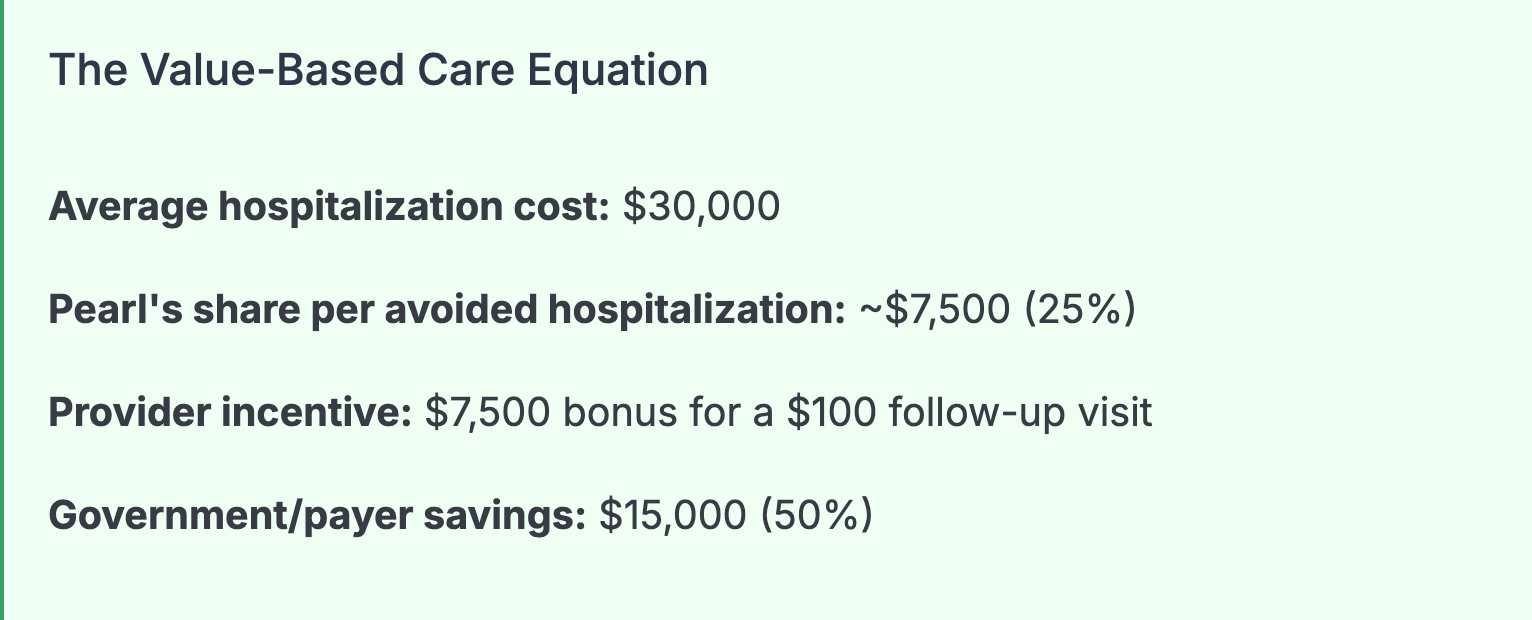
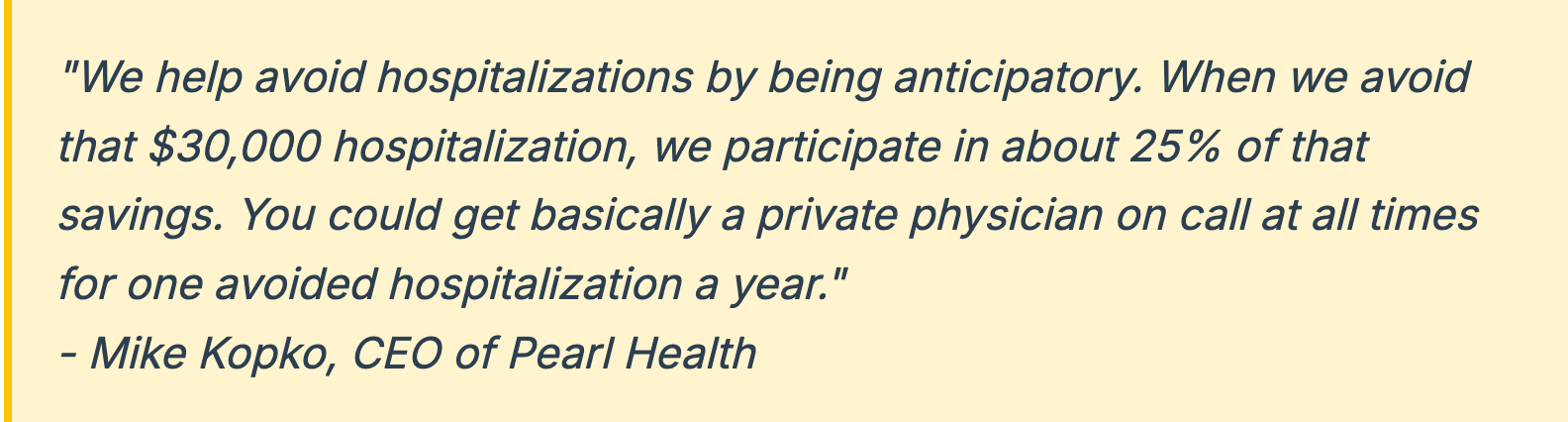
This isn’t just clever accounting – it’s a fundamental shift in how healthcare AI creates value. Instead of promising efficiency gains that may or may not materialize, Pearl puts their money where their mouth is. If they don’t deliver measurable outcomes, they don’t get paid.
“The first thing is making sure you understand what your clients need,” Kopko explains. “And it does start with financial viability. Once you win clients, you’ve got to do well by them. It’s not that you won – it’s did you deliver?”
The Secret Sauce: What Pearl Got Right That Others Miss
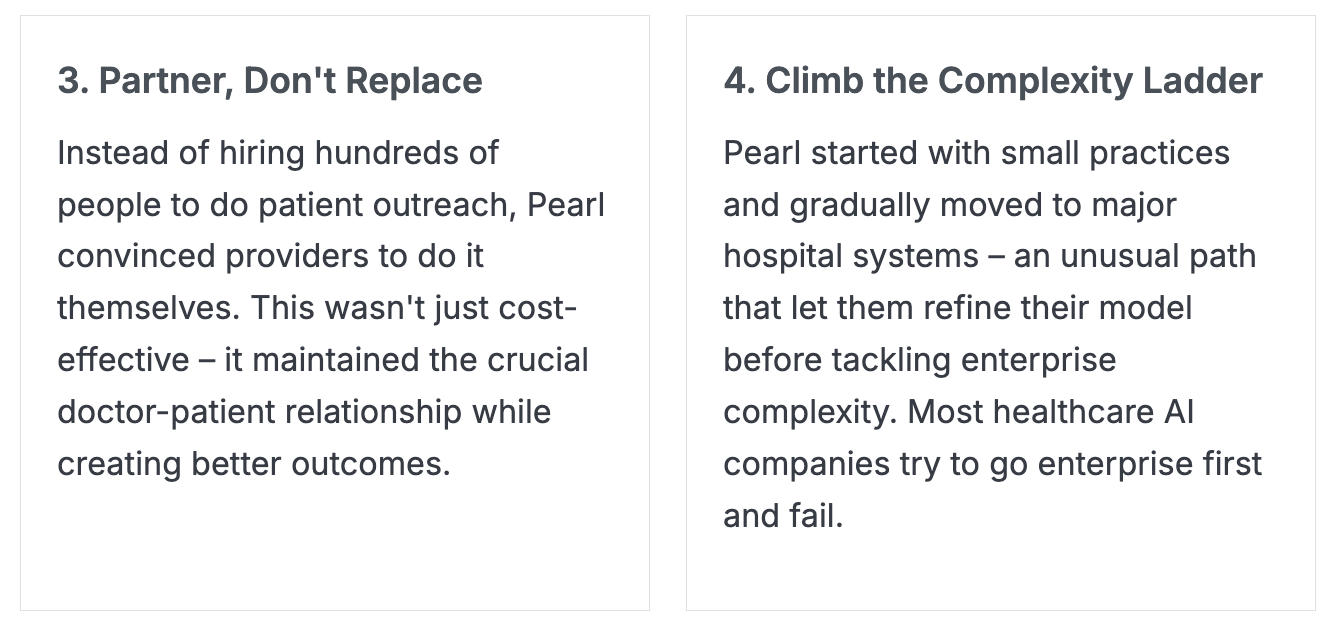
After analyzing dozens of healthcare AI companies, certain patterns emerge among the winners. Pearl Health’s success offers four critical lessons for anyone building in this space:

Where AI Will Actually Transform Healthcare (Hint: It’s Not Replacing Doctors)
While the media focuses on AI replacing physicians, the real transformation is happening in the background operations that most patients never see. Kopko predicts massive changes in areas that are currently manual, repetitive, and expensive:
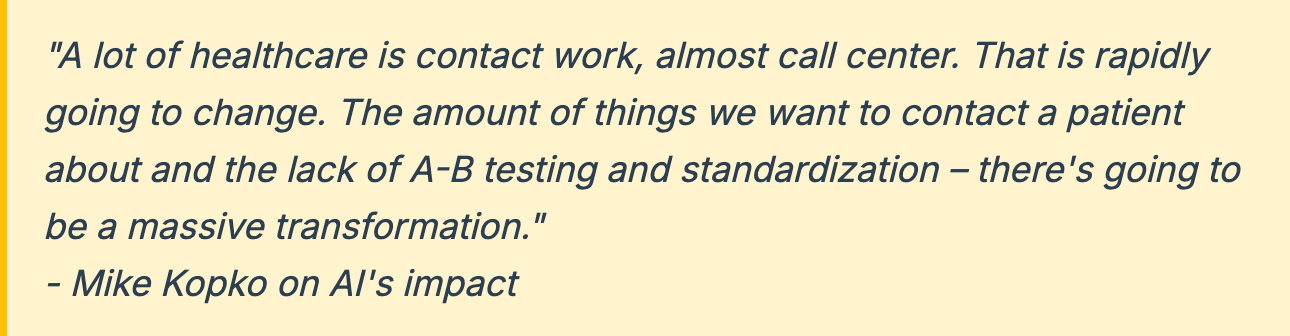
The practical applications are already emerging:
Patient Communication Revolution: Instead of playing phone tag with patients, AI can handle scheduling, follow-up reminders, and basic health check-ins through voice and text. This isn’t about replacing human interaction – it’s about making sure the human interaction happens when it matters most.
Intelligent Care Coordination: Think of AI as the ultimate care coordinator, tracking when patients need follow-ups, flagging potential issues before they become emergencies, and ensuring nothing falls through the cracks.
Logistics Optimization: From drug delivery to telehealth scheduling, AI can eliminate much of the friction that makes healthcare frustrating for patients and expensive for providers.
The key insight? AI works best when it handles the logistics so humans can focus on the medicine.
The Healthcare AI Companies That Will Survive and Thrive
After diving deep into Pearl Health’s approach and analyzing the broader market trends, a clear pattern emerges. The healthcare AI companies that will succeed in the coming years won’t be the ones with the flashiest demos or the biggest funding rounds. They’ll be the ones that master four key principles:
1. Financial Accountability: Put skin in the game through risk-sharing models. If your AI doesn’t deliver measurable outcomes, you don’t get paid.
2. Provider Partnership: Work with healthcare professionals, don’t try to replace them. The most successful healthcare AI enhances human decision-making rather than circumventing it.
3. Outcome Focus: Measure what matters to patients and payers – health outcomes and cost savings – not just operational efficiency.
4. Workflow Integration: Build systems that complement existing workflows rather than forcing wholesale adoption of new processes.

As AI becomes increasingly commoditized and enterprise buyers become more sophisticated, the winners will be those who can navigate healthcare’s unique complexities while delivering concrete, measurable value. Companies like Pearl Health, Time Care, and Inspiron are showing the way forward – not by promising to revolutionize healthcare overnight, but by methodically solving specific, expensive problems within defined healthcare verticals.
The future of healthcare AI isn’t about replacement – it’s about augmentation, accountability, and results.
Want to dig deeper? Check out the podcast or watch the Youtube episode and subscribe for a weekly drop. Mike, Nic and I covered a ton more ground in our full conversation
Have a product or service that would be great for our audience of vertical SaaS founders/operators/investors? Reply to this email or shoot us a note at ls@lukesophinos.com


