


Today’s episode is brought to you by Parafin - the leading provider of ready-to-launch financial products that help your merchants grow. Check out what Parafin can do to drive revenue, retention, and TAM at your business!

Nate Baker, Founder & CEO @ Qualia, Founder @ Fractal
Nate Baker isn’t your typical tech founder. Before building one of the most successful vertical SaaS companies of the past decade, he cut his teeth at 8VC—watching deals, learning patterns, and developing an intuition for what makes markets work. When he left to start Qualia in 2015, he picked one of the least glamorous industries imaginable: title insurance.
Title agents are the invisible infrastructure of every real estate transaction in America. They verify ownership, manage escrow, handle the closing paperwork. It’s complex, regulated differently in every state, and was running on software that looked like it belonged in a museum. Nate saw opportunity where others saw obscurity.
But Nate didn’t stop there. Five years ago, he co-founded Fractal with Mike Furlong—a venture studio built on the thesis that vertical SaaS company creation could be systematized. The idea: if you know the playbook, why not run it repeatedly? Fractal now has 150 portfolio companies, each attacking a different underserved vertical.
This dual perspective—operator of a scaled vertical SaaS company AND investor in 150 early-stage ones—gives Nate unusual insight into what’s changing. He’s seen the old playbook work. He’s betting on what the new one looks like. And he’s not being subtle about the stakes.

How AI is Changing the Vertical SaaS Playbook
For a decade, the vertical SaaS playbook was clear: do the hard work, become the system of record, then expand. Nate Baker built Qualia on exactly this thesis—600 employees and 11 years later, it’s the backbone of title agents across America. But when he says “every business that isn’t seriously reevaluating their product offerings right now is going to be done in 24 months,” you should listen.
This conversation cuts through the noise. We’re not talking about vague “AI transformation” rhetoric. We’re talking about specific tactical decisions: Should you build the system of record first or chase quick wins? How do you know if your market is big enough? What actually predicts startup success after 150 portfolio companies?
The TAM Question That Never Goes Away
Before starting Qualia, Nate worked at 8VC. He watched firms pass on Carta because “cap table software sounds tiny.” That same skepticism followed him through every fundraising round at Qualia—investors constantly asking how big title agent software could really get.
This is the perennial challenge of vertical SaaS. You’re not building for a horizontal market where everyone needs your product. You’re building for title agents, or dental practices, or scrapyards. The TAM objection is the first thing investors reach for.
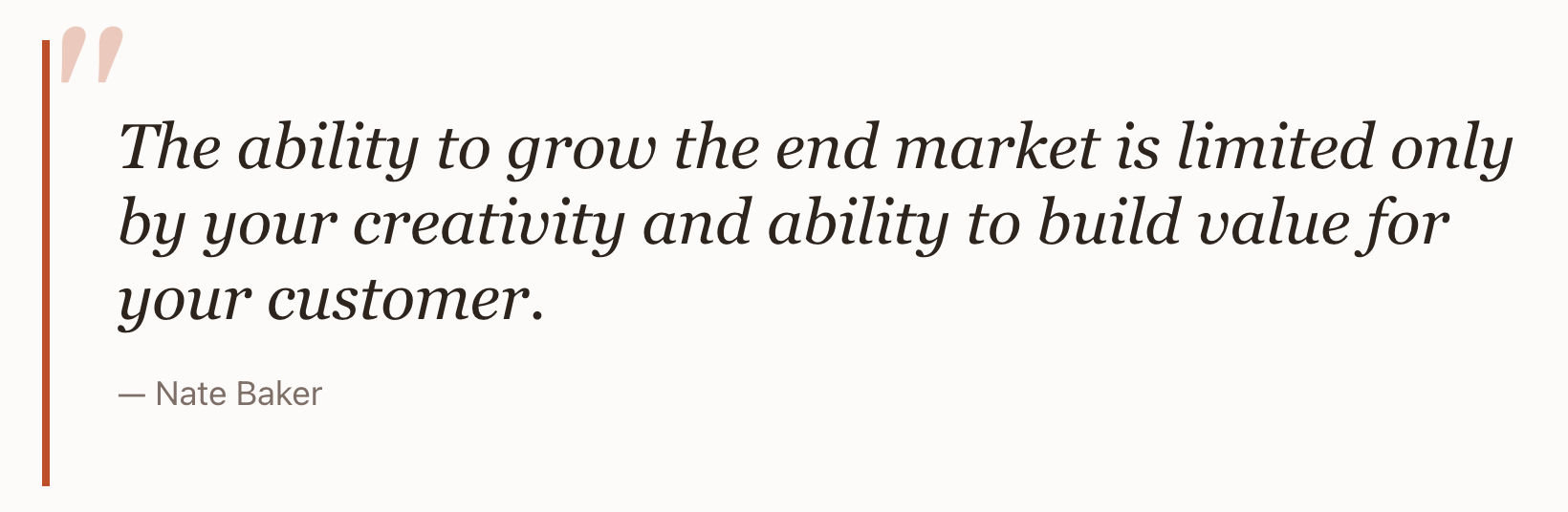
The insight that changed everything: in vertical markets, TAM isn’t fixed. It expands with each new layer of value you create. Companies that seem to have a $5K ACV ceiling routinely break through to $50K+ by solving adjacent problems.
Consider Qualia’s trajectory. They started as title production software—helping title agents manage the closing process. But the real estate transaction involves dozens of participants: lenders, real estate agents, buyers, sellers, notaries. Each represents an opportunity to add value. Each expands the addressable market.
ACV Expansion
What starts as $5K/year can become $50K+ as you solve more problems for the same customer. The ceiling is usually self-imposed, not market-imposed.
Adjacent Opportunities
Every industry has a web of connected players. Your initial customer is just the entry point— the entire ecosystem is your real market.
The Great Inversion: Point Solution First
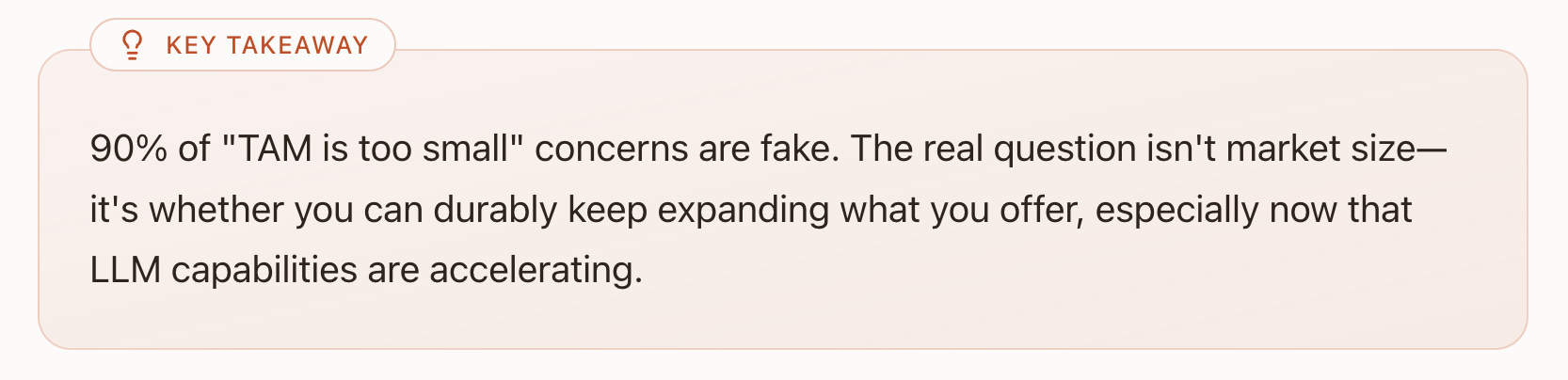
Here’s where it gets interesting. Nate built Qualia as a system of record from day one. It took years, required navigating state-by-state regulatory complexity, and demanded patience that most startups don’t have. But if he were starting today?
The traditional playbook went like this: build the boring infrastructure first. Become the system of record. Once you have the data and the workflows locked in, you can layer on features forever. The hard part is the foundation—everything else follows.
This made sense in a world where building software was slow and expensive. If it takes three years to build a proper ERP, you want that investment to compound. You want to be the one everyone else integrates with, not the point solution that gets displaced when the real system of record decides to add your feature.
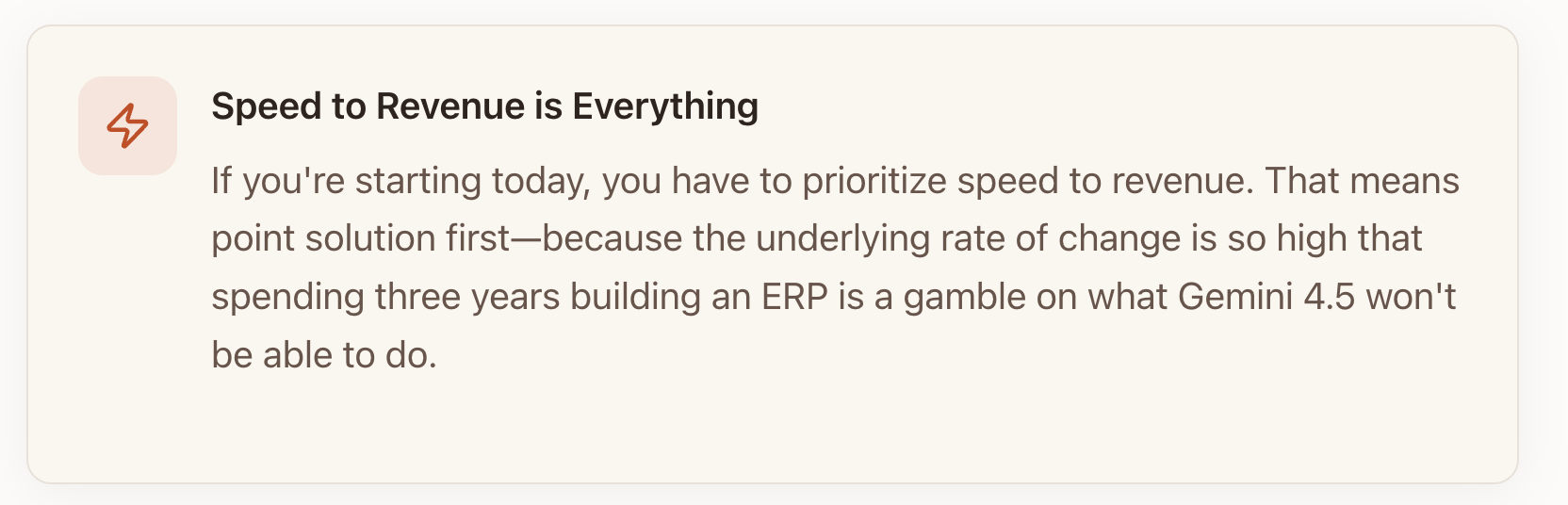
This isn’t just theoretical. The calculus has fundamentally shifted. What took years to build can now be assembled in weeks. Legacy incumbents who promised AI features “in 18 months” are already behind—in six months, whatever exists today will feel legacy.
The new playbook: Start with a point solution that solves one specific, painful problem. Get to revenue fast. Prove there’s a market. Then—and only then—work backwards to build the 20% of an ERP that actually matters for your use case. Not the whole thing. Just enough structured data to make your AI features work reliably.
Why Structured Workflows Still Matter
Here’s the counterintuitive part. Even though speed matters more than ever, you can’t just slap an LLM on unstructured chaos and expect it to work. The constraint on AI deployment isn’t the AI—it’s the underlying data and workflow quality.
The primary constraint on rolling out LLMs across your business is actually clean, structured workflows that are interpretable. If you don't have that, that's where point solutions fall down.
This is why system-of-record companies like Qualia have an advantage—but only if they move fast. They already have the structured workflows. They already have the clean data. The AI layer can actually work because there’s something solid underneath.
Point solutions that try to go AI-first without any underlying structure will struggle. They’ll face the same hallucination and reliability problems that plague consumer AI applications. The magic only happens when AI meets structured process.
The Incumbent’s Dilemma
Being the system of record used to be an unassailable moat. You had the data, the workflows, the customer relationships. Point solutions came and went, but you endured. That dynamic is shifting.
The problem for incumbents is twofold. First, the speed of change means their traditional product roadmaps are obsolete before they ship. Second, their organizational structure—built for incremental improvement—can’t match the velocity of a small team with modern tools.
Legacy Advantage
If you’re already the system of record, you have 12-18 months of advantage. But only if you’re building aggressively—not planning 18-month roadmaps.
Startup Advantage
If you’re starting fresh, prioritize speed. Get to revenue. Prove the market. Build the “20% of the ERP” that matters backwards from your point solution.
The existential threat is real: Nate admits that if Qualia weren’t on offense—building new AI-native features aggressively—they might not have customers in 24 months. And Qualia is well-positioned. Imagine what happens to the actual legacy players running on-premise software.
This is the true incumbent’s dilemma. Your moat—the thing that made you successful—can become your prison. All that technical debt, all those integration commitments, all those enterprise contracts with feature-freeze clauses. They made you dominant. Now they might make you irrelevant.
Inside the Fractal Machine
Six years ago, Nate co-founded Fractal with Mike Furlong. Their thesis: vertical SaaS company formation could be systematized. Starting a company involves solving three problems—the idea, the capital, and the co-founder. Fractal solves all three at once.
Most studios or incubators focus on one piece. Accelerators give you capital and mentorship but expect you to arrive with an idea. Idea labs generate concepts but don’t always have the founders to execute. Fractal’s insight was that these three problems are interdependent—solve them together or don’t bother.
The Fractal Formula
1.Research Engine
Find “sneaky big” markets—cornerstone industries that seem small but are pillars of the economy. Scrapyard software. Addiction treatment. Airplane parts. These are markets where software is either non-existent or embarrassingly bad, but the industries themselves are massive and essential.
2.Recruiting Machine
Match founders with ideas—people who want to build but need the right market. Finance-oriented CEOs who can sell but care about the engineering craft. The ideal Fractal founder has operator experience, can close enterprise deals, and has enough technical fluency to make good product decisions.
3.Operational Playbook
Best practices in sales, product, and go-to-market—compressing the time from “I want to start a company” to “product with paying customers” by a year. This isn’t just advice. It’s templates, processes, shared services, and a network of operators who’ve seen the same problems across 150 companies.
The result: Fractal companies get to market faster, with better ideas, and more support than typical startups. The trade-off is equity and control—but for founders who value de-risking over maximizing upside, it’s a compelling proposition.
Finding “Sneaky Big” Markets
One of Fractal’s superpowers is market selection. They’ve developed a systematic approach to finding industries that look small from the outside but are actually massive—and massively underserved.
The Sneaky Big Framework
Look for industries that are:
(1) essential to the economy,
(2) running on decades-old software or paper,
(3) resistant to horizontal solutions because of domain complexity, and
(4) large enough that even a small slice represents a real business.
Examples abound. Scrapyards handle billions of dollars in materials but run on software from the 1990s. Addiction treatment centers manage life-or-death patient care on spreadsheets. Airplane parts distributors—a market most VCs have never considered—represent a massive opportunity for someone willing to learn the domain.
The common thread: these are industries where generalist solutions don’t work. The regulatory requirements, the workflow complexity, the industry-specific terminology—they all create barriers that keep horizontal players out. That’s exactly where vertical SaaS thrives.
150 Companies, 3 Key Learnings
With 150 portfolio companies and multi-year performance data, Fractal has developed surprisingly high-signal indicators for success. Some of these findings are counterintuitive—and humbling.
1. Co-location Matters—But Not How You’d Think
If founders are in the same city but don’t work together five days a week in the office, that’s very bad. Fully remote actually doesn’t hurt as much. It’s the “could be together but aren’t” pattern that predicts trouble. The interpretation: if you can be together and choose not to, something is already wrong with the relationship.
2. Speed to MVP is Everything
Eight weeks in, Fractal can already tell if a company is lagging. Time to first revenue is a massive indicator. Speed correlates with success more than almost any other factor. The companies that ship fast tend to keep shipping fast. The ones that struggle early rarely catch up.
3. Founder Intuition is Often Wrong
Nate’s personal predictions about which companies will succeed have not correlated with actual outcomes. Companies he thought would fail are now crushing it. The lesson: trust the process, not the gut. The data knows more than the pattern-matching heuristics we’ve developed.
This last point is particularly striking. Nate has been doing this for over a decade. He’s seen hundreds of companies. And yet his intuitive predictions don’t correlate with outcomes. That’s a powerful argument for systematic approaches over gut feelings—and a reminder that early-stage investing is genuinely hard.
The Founder Archetype That Works
After 150 companies, Fractal has developed a clear picture of who succeeds in vertical SaaS. It’s not the stereotypical Silicon Valley founder.
The Ideal Vertical SaaS Founder
What Works
• Finance or operations background
• Comfortable with enterprise sales
• Cares about craft and quality
• Willing to deeply learn a domain
• Patient enough for long sales cycles
What Doesn’t
• “Move fast and break things” mentality
• Disdain for “boring” industries
• Expectation of viral growth
• Impatience with complexity
• Pure technical background with no sales instinct
The pattern is clear: vertical SaaS rewards operators who can sell, not hackers who can code. Technical skills matter, but they can be hired. The ability to close enterprise deals, navigate complex buyer organizations, and maintain relationships over multi-year contracts—that has to come from the founder.
AI Changes the Talent Equation
Here’s where it gets interesting for current founders. The AI revolution isn’t just changing what products you build—it’s changing who can build them.
This is transformative for vertical SaaS specifically. The hardest part of these businesses was always finding someone who understood both the domain AND could build software. Now the domain expert can build. The former insurance adjuster can create insurance software. The ex-logistics operator can build freight tools.
The implication: the next wave of vertical SaaS winners might look very different. Less Stanford CS grads learning about scrapyards. More scrapyard operators learning to prompt AI. The domain expertise becomes the scarce resource; the technical execution becomes table stakes.
The Wedge in the AI Era
When asked for his favorite wedge product in the AI era, Nate’s answer is telling: Claude Code. Not because it’s a traditional wedge, but because it represents the model everyone should pursue—a tool that starts by helping and expands by becoming essential.
The “wedge” concept is core to vertical SaaS strategy. You don’t try to replace everything at once. You find one specific pain point, solve it brilliantly, and use that foothold to expand. In the AI era, this means finding workflows where AI can deliver 10x improvement—then building out from there.
It’s going to be crazy what they’re able to do over there in the next six months.
What makes Claude Code a good wedge? It starts with a specific use case—helping developers write code. But once it’s in your workflow, it understands your codebase, your patterns, your preferences. That understanding becomes valuable. You don’t want to switch. And Anthropic can expand from there into adjacent developer workflows.
The same pattern applies to any vertical. Find the AI wedge—the workflow where AI can be genuinely transformative. Nail that. Then expand to adjacent workflows using the context and relationships you’ve built.
The 24-Month Warning
Throughout the conversation, one theme keeps recurring: urgency. Nate isn’t talking about gradual evolution. He’s talking about existential threat on a compressed timeline.
The Survival Imperative
“Every business that isn’t seriously reevaluating their product offerings right now is going to be done in 24 months.” This isn’t hyperbole—it’s a realistic assessment of how fast AI capabilities are advancing.
Consider what this means practically. If you’re an incumbent, you can’t plan an 18-month roadmap to “add AI.” By the time you ship, the baseline will have moved. You need to be shipping AI features now, learning from them now, iterating now.
If you’re a startup, you can’t spend three years building infrastructure before adding intelligence. The infrastructure itself might be obsolete. You need to move fast, get to revenue, and build just enough structure to make AI work reliably.
In Closing…
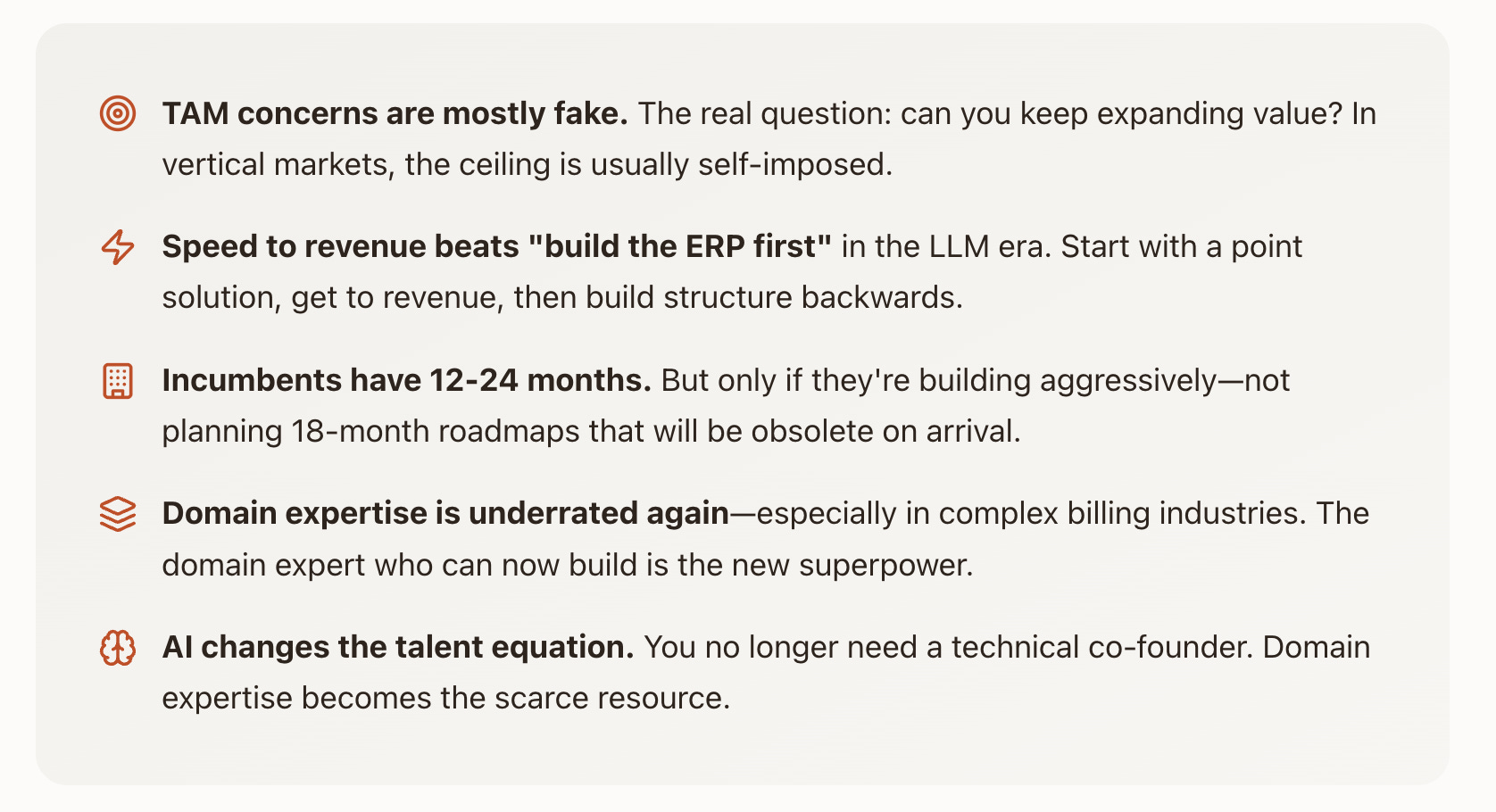
The window is closing. Whether you're an incumbent defending position or a startup seeking opportunity, the next 24 months will separate those who adapted from those who planned to adapt. The playbook has changed. The question is whether you're willing to change with it.
Have a product or service that would be great for our audience of vertical SaaS founders/operators/investors? Reply to this email or shoot us a note at ls@lukesophinos.com


