


Today’s episode is brought to you by Parafin - the leading provider of ready-to-launch financial products that help your merchants grow. Check out what Parafin can do to drive revenue, retention, and TAM at your business!
Darren Fike Is Building the Operating System for America’s Liquor Stores
How the Santé founder went from working the register in Tribeca to replacing every legacy POS in an $80 billion industry — and why AI agents are his secret weapon for rip-and-replace.

From Register to Founder
Most founders do market research from their laptops. Darren Fike got a job at a liquor store in Tribeca — nights and weekends, while holding a full-time role. He worked the day before Thanksgiving (the busiest day of the year) and Christmas Eve. He wanted the hardest, most complex jobs the owner could give him.
It wasn’t just about validating an idea. It was about de-risking. Having worked at several venture-backed companies, Darren knew how long the founder journey is. He didn’t want to make the wrong bet on a space that didn’t actually need what he thought it needed. By the time he left the liquor store, he could operate with “a real degree of precision” — speaking about problems he’d personally experienced, then validating them with store owners across the country.
The first painful job? Entering wholesale invoices into Square. Three hours of manual data entry — every single day. Liquor stores deal with 25-50+ distributor relationships (compared to 5-6 for a convenience store), receiving deliveries five days a week, each with a paper invoice that needs to go into the system. A three-tier distribution system — where producers can’t sell directly to retailers — fragments who you buy from, creating dozens of daily invoices.
“I went back to first principles: what is something that’s not going to be done this way in two to five years? And it felt very obvious.”
— Darren Fike
That pain became Santé’s first product: an AI-powered invoice receiving tool that automated the entire process. It took paper documents, ran them through AI, and presented the data with human-in-the-loop automation — “here’s what you’re receiving, send it to your inventory, edit as needed.”
They got to about 20 customers around New York using the receiving tool. But running a point solution in this industry proved incredibly difficult to scale — it was even hard to add value because the tool lived outside the store’s core system. Then, unprompted, six or seven customers said the same thing: “Build a point-of-sale system. We’ll do it with you.”
The team was initially intimidated by the platform play — feature depth, switching costs, the sheer amount to build. But the combination of pain from the point solution and a clear vote of confidence from customers made the decision inevitable. Three months into the company, they started building the POS.

The Hidden Giant on Main Street
Wine and liquor stores are one of those businesses you walk past every day without thinking twice. But behind the counter lies an $80 billion market — and the vast majority of it, around 90%, is independently owned and operated. Prohibition-era state regulations make it nearly impossible for corporate chains to dominate, creating a massive fragmented market ripe for verticalized software.
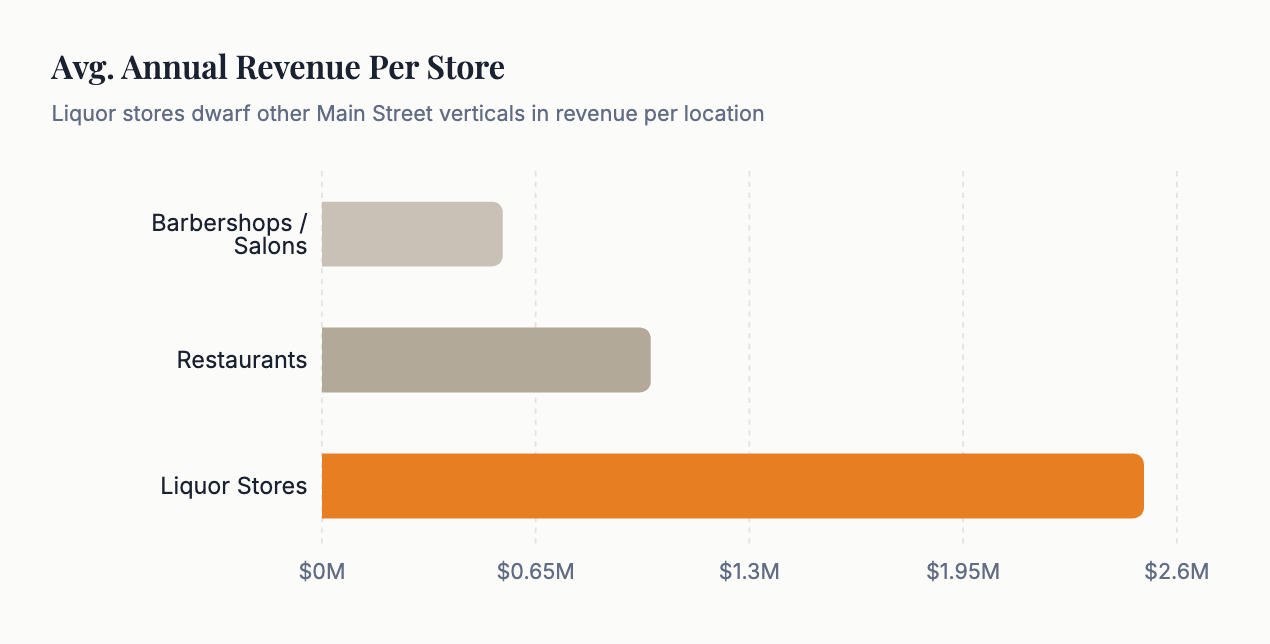
What makes liquor stores uniquely interesting? They’re orders of magnitude bigger than other Main Street verticals. The average liquor store does $2.5 million in annual sales — more than double an independent restaurant and 4-5x a barbershop or salon. And because Santé has been in the payment processing game since day one, that volume of credit card transactions per location is central to how the business scales.
Today, Santé enables consumer payments. Tomorrow, it’s B2B payments — because if a store is running $2.5 million in credit card transactions a year, they’re also spending a ton upstream buying wholesale goods from distributors. The payments layer becomes the economic engine underneath the entire platform.
Beyond the POS, Santé delivers a full suite of modern commerce tools: an e-commerce platform, a marketing engine that uses AI agents to send email and SMS campaigns on the store’s behalf, integrations with DoorDash and Uber Eats, loyalty programs, gift cards, employee management, and distributor management. It’s a complete operating system — purpose-built for an industry that’s been stuck with cash-register software for decades.
Why Can’t Square or Toast Just Do This?
Alcohol is the only controlled substance not federally regulated. Unlike CBD, THC, or even ketamine making its way into med spas, alcohol regulation happens entirely at the state level. Prohibition-era laws require each state to mandate its own rules around how alcohol is acquired at the wholesale level and sold to consumers. That means tax rules, delivery fees, and compliance requirements vary not just state to state, but sometimes county to county.
There’s a second, subtler moat: you have to be in the trenches with these customers to understand the nuances. Santé learned this the hard way — they launched in Massachusetts without knowing they needed automatic bottle deposits on anything carbonated. That kind of discovery only comes from boots on the ground, and it’s a pretty big lift to expect a product team at a big horizontal company to deliver on.
Darren uses what he calls the “Gmail comparison.” Gmail serves tens of millions of users. Could they build what Superhuman offers? Probably. But would it be worth the complexity — the support tickets from barbershop owners being prompted to set up carbonated-beverage bottle deposit rules?
The Complexity Stack
Three-tier distribution system (producers → distributors → retailers)
State-by-state tax rules: carbonation taxes, category taxes, county-specific delivery fees
25-50+ distributor relationships per store (vs. 5-6 for convenience stores)
17-hour operating days (California stores sell until 2-3 AM)
Bottle deposits, age verification, CBD/THC compliance
99.9%+ uptime requirement — stores are on the platform 17 hours straight
Paper invoice processing from daily wholesale deliveries
Finding Product-Market Fit
Darren describes a painful but instructive phase where every signed deal came with a list of feature requests. The team was essentially a “dev shop for SMBs” — building custom features per customer, without a repeatable identity. Every customer was basically a design partner, and the product didn’t have something to stand on beyond being “a JavaScript version of your legacy software that looks nicer.”
The shift came when they developed strong opinions about what was a true blocker to operations vs. “the way things have always been done.” They stopped taking orders and started leading the industry forward. Their framework: if a gap blocks operations — if it “clouds the waters” for the value being delivered elsewhere — you probably should build it. If it’s just how things are done and not a hard requirement, focus on the broader vision and bring customers into that vision.
The turning point arrived through a series of marquee wins: onboarding the highest-grossing liquor store chain in New York, one of the highest-grossing independent locations in California, and a PE-backed group in Massachusetts. Through these cycles, Santé reached feature parity across all competitors. The “fog lifted” — they could call any state, any store, any size, and there was nothing needed to go live.
“We closed 30 deals last month and none of them had any feature requests. It was almost like a fog was lifted over the business.”
— Darren Fike
The Santé Journey
Early 2023
Boots on the Ground
Darren works at a liquor store in Tribeca while holding a full-time job, experiencing the pain firsthand.
Feb – May 2023
Point Solution MVP
Builds an automated invoice receiving tool — the first product, solving the 3-hour daily data entry problem.
Summer 2023
YC Batch & POS Pivot
Gets into Y Combinator’s Summer ‘23 batch. Customers ask Santé to build the full POS — so they go all-in on the platform.
May 2024
First Sales Push
Founder-led sales ramp to ~10 onboards/month. Discovers missing tax regulations (like MA bottle deposits) that need fixing.
Q3 2024 – Now
The “Fog Lifts”
Feature parity achieved. 30 deals/month with zero feature requests. Sales team scales to 6 AEs and 3 BDRs.
2025
Scaling Machine
Signed the highest grossing liquor store chain in New York, major locations in California and Massachusetts. Each rep closing 10-15 deals/month.
Building the Sales Machine
With PMF confirmed, Darren scaled outbound with a specific playbook. No door-to-door — just cold calling from their in-person office in New York. Each rep targets at least 20 conversations per day (real dialogue, not voicemails), which should yield 3-5 booked meetings. It’s not difficult to get liquor store owners on the phone — the challenge was historically getting them to show up for the demo.
Their solution? They don’t consider it a meeting without the person’s personal phone number. They text immediately after booking with the calendar link, send a morning-of reminder with the dial-in link, and optimize for the easiest path — clicking the link on their phone. “You’ve got to meet them where they are,” as Luke put it.
The hiring strategy is equally deliberate: hungry, early-career reps with 1-3 years of experience, ideally president’s club at another software company. They’re familiar with the phones and velocity, but haven’t been in an environment where they can close at this clip. The combination of post-PMF product, greenfield market, and high-velocity pipeline is “a salesperson’s dream.”

The AI Playbook for Rip & Replace
The biggest objection in any system-of-record sale is switching cost — and Darren names the root cause bluntly: complacency. Stores aren’t leaving their current system because it’s good; they’re staying because switching feels painful. The data is the most important thing — years of inventory, sales history, loyalty points, customer records — and the fear of losing it keeps people locked in.
Santé’s answer? AI agents that crawl legacy systems, extract years of data, reformat it to Santé’s schema, and spin up a fully populated account — live on a demo call. They’ve built agents for six to eight different legacy systems, covering the five industry-specific incumbents and a handful of generic ones.
How It Works — Live on a Demo Call
01: Sales rep asks the prospect: ‘Can I send you a file? Drop it into your system’s server and I’ll show you how this works.’
02: A bot enters the legacy system, extracts all historical data — inventory, sales history, loyalty points, gift cards, customer records. Could be 10-15 years of history.
03: Data is automatically reformatted to Santé’s schema and uploaded into a fresh account.
04: The prospect sees their complete Santé account — with everything from their current system — right there on the demo. The switching fear evaporates in real time.
“AI has unlocked the opportunity not just to charge more and offer more value, but to onboard at an incredibly high clip with a really small post-sales team.”
— Darren Fike
The impact goes beyond sales demos. Santé is onboarding at an “incredibly high clip” with what is actually a really small post-sales team, because agents handle the repetitive migration work. The human team focuses on relationship building and making sure the customer understands how to use the product. It’s a playbook Luke called “so money” — using AI not just for customer-facing features, but for internal tooling that makes the rip-and-replace motion frictionless.
Darren’s View: Generational Timing
Five legacy vertical POS players — occupying about 26% of the market — have all been acquired by private equity firms in the last 24-36 months. A couple have even been sunset, requiring their customers to fold into a generic platform. That means over a quarter of the market is actively shopping for a replacement.
And because the industry is “fragmented at the front door, connected at home,” word travels fast. If you sell to liquor stores in Nashville, they all know each other. Same in New York, Boston, LA. One won deal recently led to 20 introductions from a single customer — before they’d even gone live. The competitors are writing blogs about Santé, sending their engineers to study how they build product.
Darren’s perspective on timing is worth internalizing: it’s something you can’t really found a startup searching for. You might build two or three other successful companies in your career that don’t have it. When you do have it, hold on tight.
“Timing is the fleeting thing. If you have it, hold on to it — because you may start two or three other successful companies that don’t have it.”
— Darren Fike
The 10-Year Vision
Darren’s target: 50-60% market share in liquor stores, making Santé as synonymous with the industry as Slice is with pizza shops or Squire is with barbershops. At those numbers, factoring in fintech and AI revenue streams, he’s eyeing a $12-13 billion company.
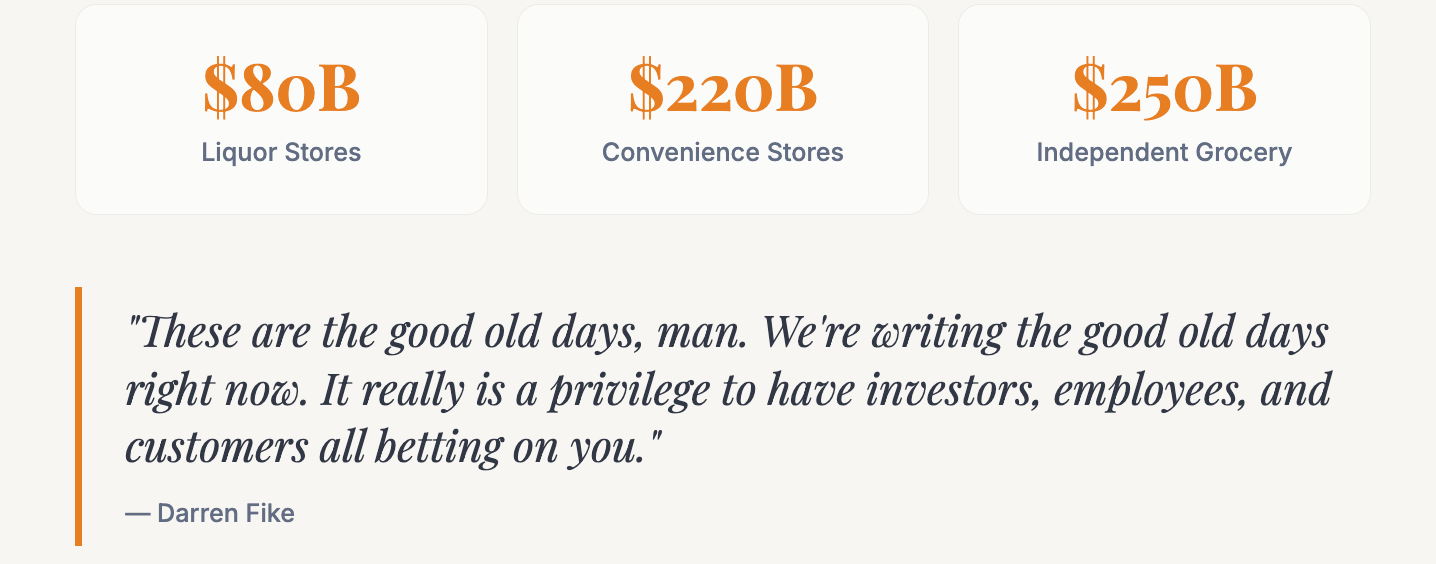
Beyond liquor, Santé has its sights on adjacent verticals: convenience stores (a $220 billion market — without gas pumps) and independent grocery ($250 billion). Both operate with remarkably similar dynamics: high-velocity sales, thousands of SKUs in stock, age verification, delivery, shipping, and fragmented independent ownership. There are nuances to accommodate, especially in grocery, but the core platform translates.
The Underrated Role: Customer Experience
When asked about the most underrated role at a SaaS company, Darren didn’t hesitate: post-sales. At Santé, they don’t even call it “customer success” — they call it customer experience. Everyone on the team has a CS degree. They can write code, write tickets, and supplement what a PM could potentially do.
His advice for young people in tech: if you don’t want to sell and you’re not sure you want to commit to writing code, take a post-sales role at a startup. You’ll work closely with sales (reps need deals to go live so they can get paid), closely with engineering (delivering feedback through implementation), and you’ll inform the product roadmap. It’s the in-between that’s just as important as engineering and sales.
Key Takeaways for Founders
Dog-food the experience — literally
Darren worked nights and weekends at a liquor store before writing a single line of code. It wasn’t just validation — it was de-risking. By the time he left, he could speak to problems he’d personally lived, then validate them with owners nationwide.
Point solution → Platform is a real path
Start with the sharpest pain (invoice automation), then let customers pull you into the platform play. Running the point solution was hard to scale — but 6-7 customers proactively asked Santé to build a full POS. Listen to that signal.
Don’t be a dev shop for SMBs
Have an identity. The hardest instinct to develop is distinguishing between “this blocks operations” and “this is just how things are done.” The shift from order-taker to opinion-leader is what unlocked repeatable, scalable sales.
Use AI to break the rip & replace barrier
The #1 reason people don’t switch is complacency, not satisfaction. Santé built agents that extract data from legacy systems and auto-migrate it — turning 10+ years of history into a live demo in minutes. It’s not just customer-facing AI; it’s internal tooling AI.
Hire hungry, early-career salespeople
1-3 years of experience, proven on phones, excited by volume. Post-PMF greenfield + high-velocity pipeline = a salesperson’s dream. The playbook is repeatable enough that a ramped rep closes 10-15 deals/month at 23-day cycles.
Reputation compounds in verticals
The industry is “fragmented at the front door, connected at home.” Store owners all know each other. One won deal led to 20 intros. Word of mouth and reputation matter even more than in horizontal software — be careful with your brand.
Post-sales is the most underrated role
At Santé, it’s called ‘customer experience,’ not customer success. Everyone on the team has a CS degree and can write code. For young people unsure about their path, post-sales at a startup is the best in-between — you touch sales, engineering, and product.
Have a product or service that would be great for our audience of vertical SaaS founders/operators/investors? Reply to this email or shoot us a note at ls@lukesophinos.com


