

Today’s newsletter is sponsored by Xplor Pay.
Artificial intelligence is changing how software is built, customer expectations are evolving, and investors are rethinking what creates long-term enterprise value.

Join Xplor Pay and Luke Sophinos, Founder of Vertical SaaS Group, for an executive discussion exploring how AI, workflow ownership, platform strategy, and financial capabilities are reshaping the future of vertical SaaS. Register today and reserve your spot.
Alright, let’s get to it…

Vertical systems of record are about to get bigger. Horizontal tools are getting eaten.
That is the whole AI story if you strip away the hype. Two years of “AI is coming for everything” produced a lot of noise, but the actual shape of the market is becoming clear. AI is the greatest expander of vertical software ever built, and the worst thing that has ever happened to generic horizontal tools and point solutions.
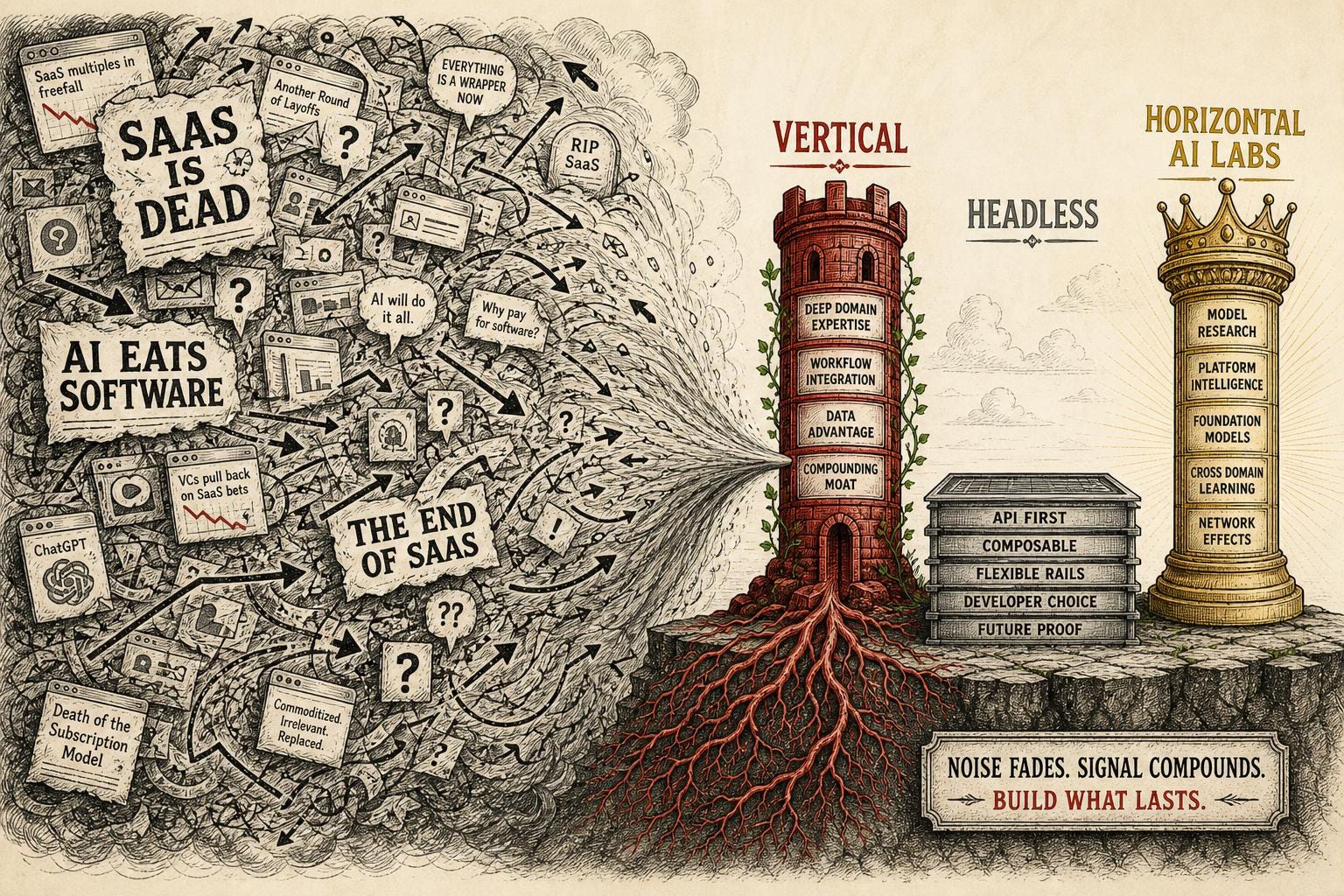
Most founders are reading this wrong. They think AI is a threat to their vertical business. In most cases it is not. It is the force multiplier that makes the system of record or vertical ai company the most valuable asset in software (behind the labs).
I wrote the full version of this in The Seven AI Kingdoms.
Here is the stripped-down map:
There are seven layers to the AI world:
Consumer AI operating systems. OpenAI, Meta, Grok. Where people start, ask, shop, create, and never leave.
Business AI operating systems. Anthropic, Google, Microsoft. The workspace itself, not a chatbot sitting next to your work.
Headless consumer software. Every app that used to be a consumer destination, now running underneath layer one.
Headless general business software. CRM, project management, docs, analytics, ticketing. Still necessary (Salesforce, Hubspot, etc.). No longer the front door.
Vertical AI operating systems. Health, law, construction, finance. Conversational on the surface, entirely different underneath. Trained on industry data, tuned for industry workflows, wrapped in compliance and human services.
Headless vertical software. Payments, payroll, scheduling, regulatory tooling. The unglamorous stack under every vertical AI OS.
AI Native Services. The exception-heavy, human-completed work that sits on top of everything.
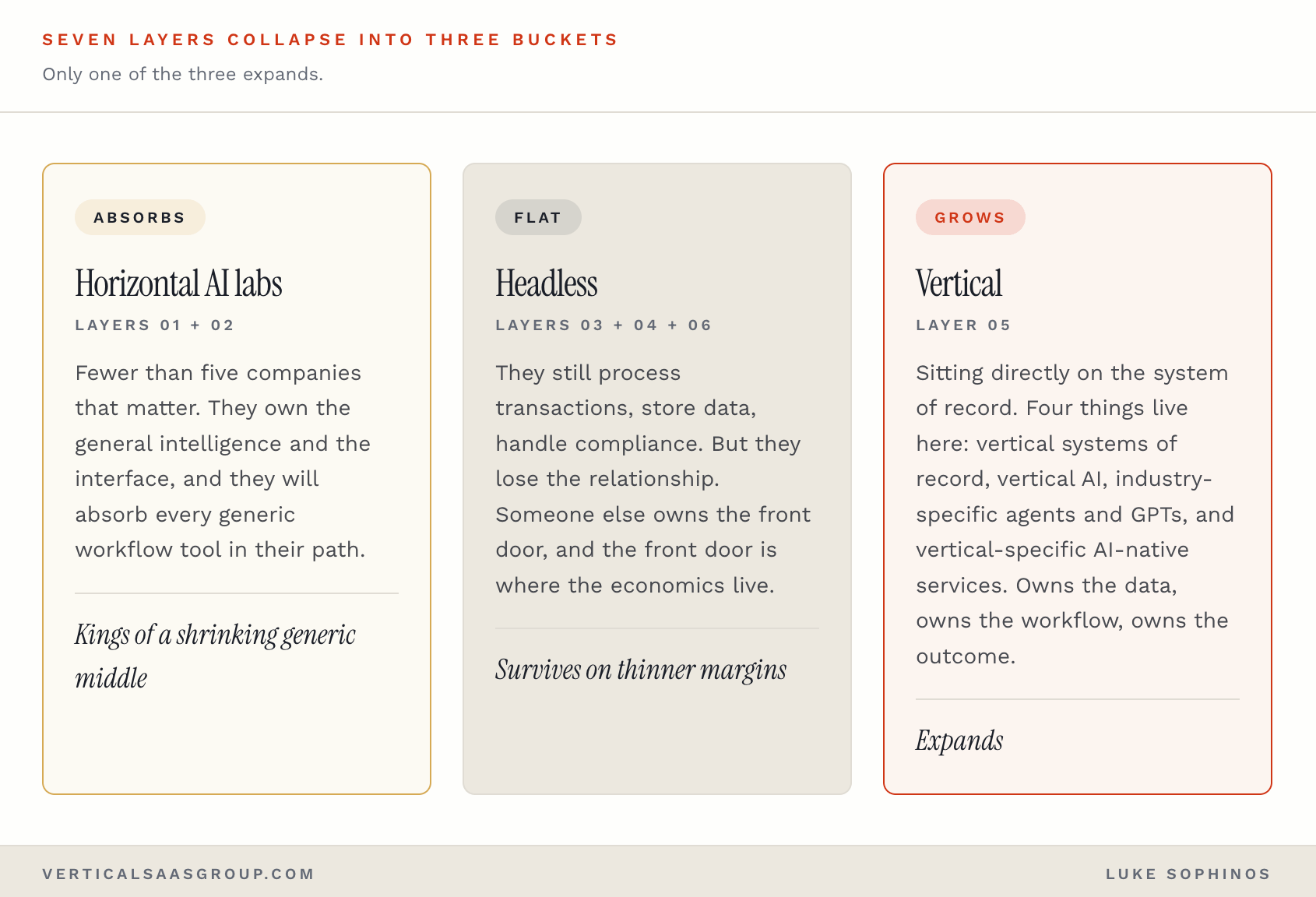
Now collapse that map into the three buckets that actually matter.
Horizontal AI labs. Layers one and two. A handful of companies, probably fewer than five that matter. They own the general intelligence and the interface, and they will absorb every generic workflow tool in their path.
Headless. Layers three, four, and six. These survive as rails. They still process transactions, store data, handle compliance. But they lose the relationship. The user no longer opens them. Someone else owns the front door, and the front door is where the economics live.
Vertical. Layer five, Systems of Record, Vertical GPT’s, Vertical AI Native Services. This is where the expansion happens.
So if we can agree on that, the important focus point for this weeks edition is the war thats unfolding inside every vertical…
The War Inside the Vertical Bucket
Once you collapse the map, the real fight is not between the three buckets. It is inside the vertical bucket. Three armies are fighting for the same territory: the vertical AI operating system.
Army One: The Vertical System of Record.
The incumbent. It owns the record: the patient, the claim, the project, the job, the student. A decade of workflow data, embedded in the customer’s operations. It has distribution, trust, compliance wrappers, and an integration surface that makes switching painful.
Its weakness is that it thinks in modules and seats. AI gets treated as a feature to bolt on. Pricing is per user, not per outcome. The data moat is real, but it is only worth defending if the company ships AI faster than the insurgents attack.
Army Two: The Vertical-Specific Agents and/or GPT’s.
The insurgent. It offers Agents but underneath it is trained on industry data and tuned for industry workflows. It attacks the highest-value knowledge work first: legal research, clinical notes, claims, quoting, compliance. It often prices with credits/outcomes and moves like a startup. No legacy, no seat-based thinking historical weights holding them down.
Its weakness is fatal if it does not evolve: it has no record. It sees the questions, but not the answers, not the transactions, not the exceptions. The models it rides on are rented and commoditizing. If a SoR ships something similar, cuts off data access, the vertical GPT’s interface is at-risk.
Army Three: The Vertical AI-Native Services Firm.
The shadow. It does not sell software. It sells the outcome: claims processed, denials overturned, reports filed, jobs quoted. It blends AI with human-in-the-loop labor, charges per transaction or per result, and owns the P&L line instead of the software budget.
This is the most underrated army. It can start in the messiest verticals, where software penetration is low and labor is the dominant cost. And as a byproduct of doing the work, it collects the operational record: every claim, every denial reason, every exception.
But it is fighting against commoditization. The work itself is replicable. The labor margin is thin. If this army is going for venture scale, it has to build something incredibly proprietary — a workflow, a data asset, a compliance wrapper, or a feedback loop that nobody else can replicate. That’s the only way the service it is offering continues to exceed every other service company out there.
What Actually Will Decide The Fight
The interface is commoditizing. Every army will have a great chat UI within two years. The model is commoditizing. Everybody rents the same frontier intelligence. What does not commoditize: the record of what actually happened, and the ability to take responsibility for the outcome.
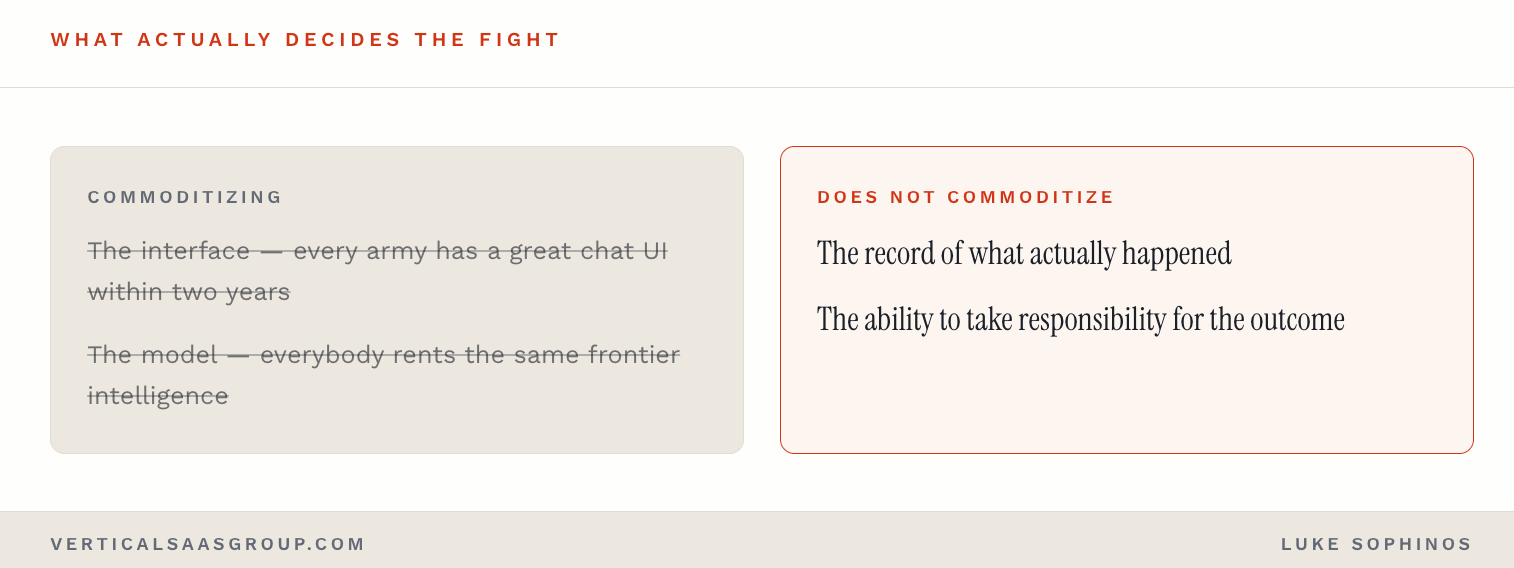
So the war is a fight for the record, fought with three different weapons.
The SoR fights with the data it already owns.
The Vertical GPT fights with the interface and the speed to build a new record from the front door.
The AI-native services firm fights with the outcome data it collects as a byproduct of doing the work.
Three endings are possible. The one you get depends on the shape of the vertical.
Absorption. The SoR wins. It ships Agents, an AI interface, prices on outcomes, etc. And it’s as good as ChatGPT but for their vertical. The services firm becomes a channel partner. This happens in deep, regulated verticals where the incumbent has a real record and the guts to move.
Displacement. The insurgent wins. The GPT or Agents becomes the new record. Fragmented, under-software’d verticals with heavy labor and weak incumbents. The new system of record gets built from the front end or from the operations, and the old tools are forced to go headless or face a slow and agonizing death.
Fusion. The endgame. Record, assistant, and service layer merge into one vertical AI operating system that sells outcomes, not just seats. Every army converges here. The question is whose DNA dominates: the SoR’s data, the Ai Agent/GPT’s interface, or the services firm’s operational grip.
The Tell
Watch who accumulates the exceptions. The GPT sees the questions. The SoR sees the transactions. The services firm sees the denials, the edge cases, the human judgment calls. Exception data is the training data for the next decade of vertical AI. Whoever owns it builds the moat.
The founder implication is uncomfortable.
If you have a system of record, you do not win by bolting on a chatbot. You win by becoming the outcome owner and letting AI compress the work until the record is the only thing left.
If you are a vertical GPT, you are racing to become a record or own the LLM itself before the model or the SoR commoditizes you.
If you are AI-native services, and you are going for venture scale, build something incredibly proprietary — because services alone will not get you there. You risk commodotization like every other service business.

You’re Running Out Of Time :-)
November 4 and 5. Miami. The second annual Vertical Software Summit.
This is the one event where the entire map I just described walks into the same room in person. And if you have been following the posts, you have seen the list. It reads like a market map of the whole category.
Healthcare founders building systems of record for clinics and practices. Construction software operators who have spent a decade in the dirt and have the scars to show for it. Legal tech, insurance, trades, field services, automotive, property management, restaurants, logistics, payments. The entire investment community comes looking to fund you.
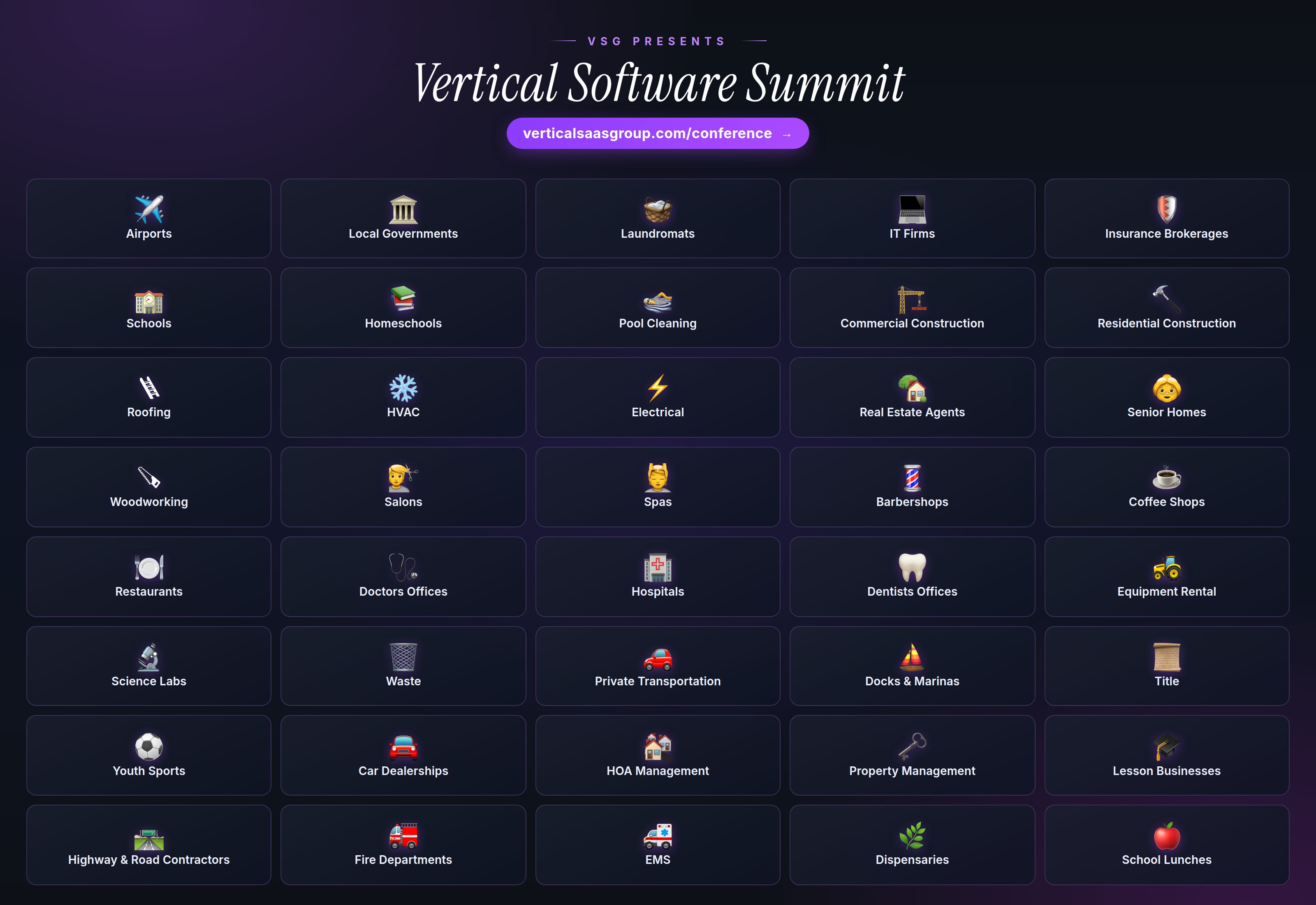
Think about what that attendance actually means. In that room, all three armies are present. The SoR founders defending their data. The vertical agent founders racing to build a record. The AI-native services firms quietly collecting outcome data on the back of the work. And the investors who are trying to figure out which one wins.
Here is the honest truth about newsletters and podcasts. You can read every Sunday edition, listen to every episode, and still miss the compound effect of spending two days in a room with three hundred people who live in your exact world. The deal that changes your company’s trajectory gets discussed between sessions. The hire that fixes your hardest problem gets introduced in the hallway. That is not marketing. That is how this community actually works.
The event will sell out. It is that simple. If you have not registered by October 1, you are gambling that a seat will still be there, and that is a bad bet.
The speakers include the people who actually built the playbooks, not the people who talk about them. The attendees are the people executing them. If you build vertical software, vertical AI, or the services layer underneath either, this is your room.
Grab your ticket here.
If you need a free one we will get you one just reply to this email :-)

How To Make Your Merchants Stop Caring About Their Take Rate (& Increase Revenue)
Right now your merchants obsess over their processing rate. 2.2%. 2.3%. They shop it. They threaten to leave over ten basis points.
Why? Because it is their money.
That single fact is the whole opportunity.
Price sensitivity in payments is a function of whose money is being spent. When the merchant pays the fee out of their own margin, every basis point hurts. When the customer pays the fee as a line item, the merchant stops caring. It sounds counterintuitive but hang on with me for a second…
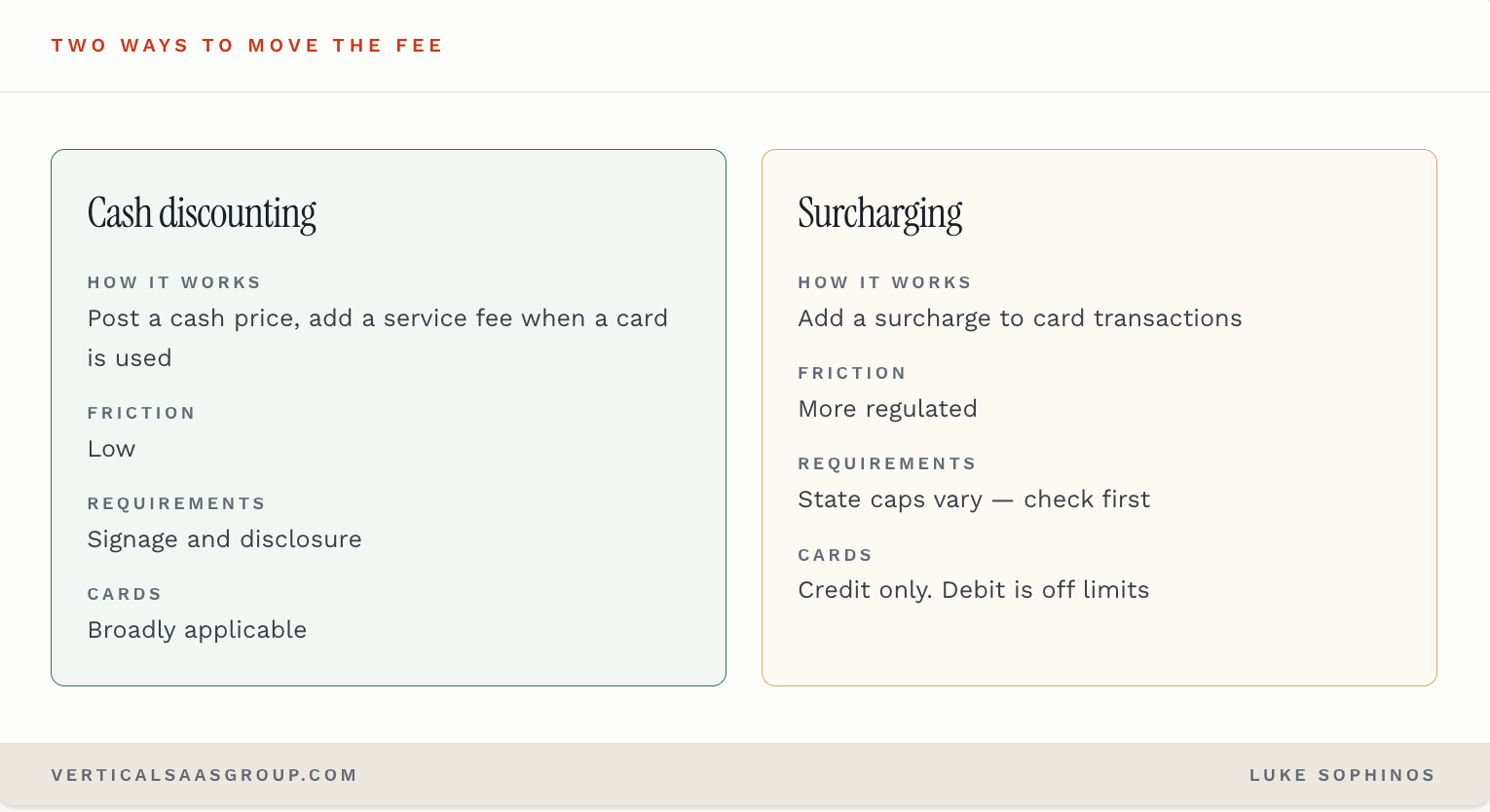
The switch is cash discounting or surcharging. Move the fee from the merchant to the customer line item.
Cash discounting: the merchant posts a cash price and adds a service fee when a card is used. Low friction. Signage and disclosure required.
Surcharging: the merchant adds a surcharge to card transactions. More regulated. Credit cards only, debit cards are off limits, state caps vary.
Now the math that matters.
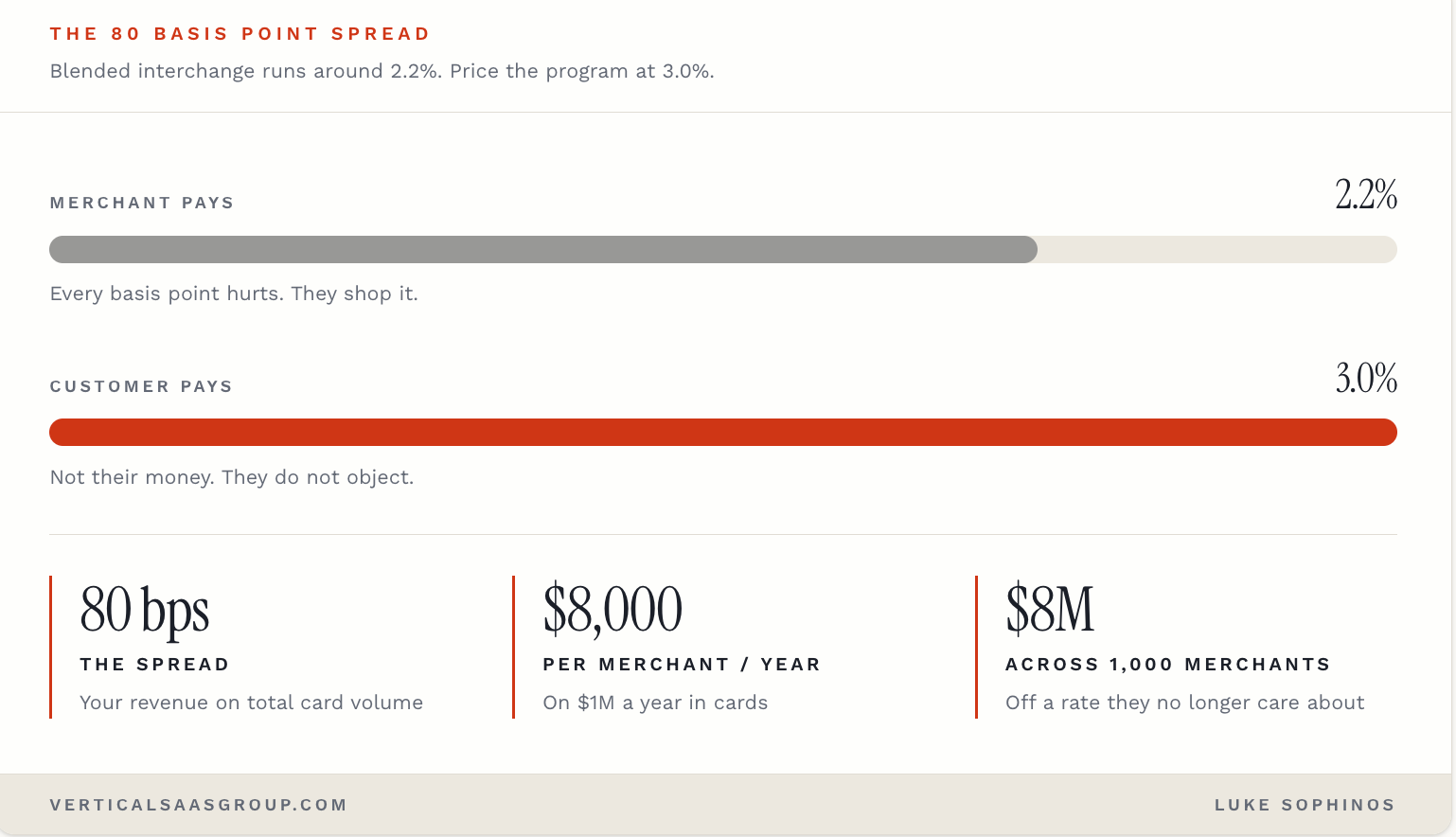
Typical blended rates runs around 2-2.5%. Under merchant-pay, you earn a thin slice on top, and the merchant watches every basis point. Under customer-pay, you set your program rate at 3.0%. The merchant no longer pays it, so they do not object. The customer pays it, and 9/10 customers just don’t really care anymore…
That 80 basis point spread on the merchant’s total card volume becomes your revenue. On a merchant doing $1 million a year in cards, that is $8,000 a year. Across 1,000 merchants, $8 million a year, collected off a rate your merchants no longer care about.
Here is the part that feels illegal but is not. The merchant loves you for this. You did not raise their cost. You moved their cost to someone else. You are the software company that “got rid of processing fees.” Churn drops. Renewals close themselves. And your payment revenue expands by the full spread.
The objections you will hear, answered:
“Customers will hate it.” Some will. That is why disclosure and signage matter. But consumers are conditioned to paying these fees now. Thank you Toast (vSaaS for restaraunts)!
“Is it legal?” Yes, in most states, with rules. Credit cards yes, debit cards no. State caps vary. Check it before you roll out. Cash discounting IS legal in every state.
“Will merchants accept 3%?” They already accept 2.2% and resent it. They will accept 3.0% and never notice, because it is not their money. That is not a joke. That is behavioral economics. They will push back but when you lean into their own consumer experience, most of them simply can’t argue with the fact that we as consumers are paying these fees EVERYWHERE today.
To close this week out, if you have experience doing this successfully respond and let me know. It’s pretty amazing and kind of counter-intuitive but I’ve just seen it work so many times across so many verticals. And boy is it powerful…
Do me a solid and forward to a friend :-)