

Today’s newsletter is sponsored by Xplor Pay. Embedded payments shouldn’t slow your growth. Xplor Pay Flex Framework helps vertical SaaS platforms choose the right model, adapt over time, and scale with confidence.

Shaped by lessons from decades of building and scaling 20+ SaaS platforms, it turns payments into a true growth lever. Read the guide to see how top platforms get it right. Read Now.
I think I’m finally starting to see where software goes from here…
Here’s the short version of the thesis: a small handful of horizontal AI Operating Systems are going to own the general workflows of consumers and businesses, and they’re going to become the most valuable companies in the world, by far. Everything underneath them gets redrawn — category by category, workflow by workflow.
At the same time, a new wave of Vertical AI Operating Systems is going to win the industries where context, depth, regulation, and services actually matter. The horizontal players won’t go all the way down into every market, they will be constantly fighting off crown seekers.
As that plays out, a massive amount of software becomes headless — still useful, but no longer the thing the customer opens. The value moves up to whoever owns the interface, the workflow, and eventually the work itself.
That’s the map. Could I be wrong on parts of it? Definitely. But the more I look at it, the more it lines up. And once you see it, it’s hard to unsee.
The way I think about it now, the new world breaks into seven distinct kingdoms:
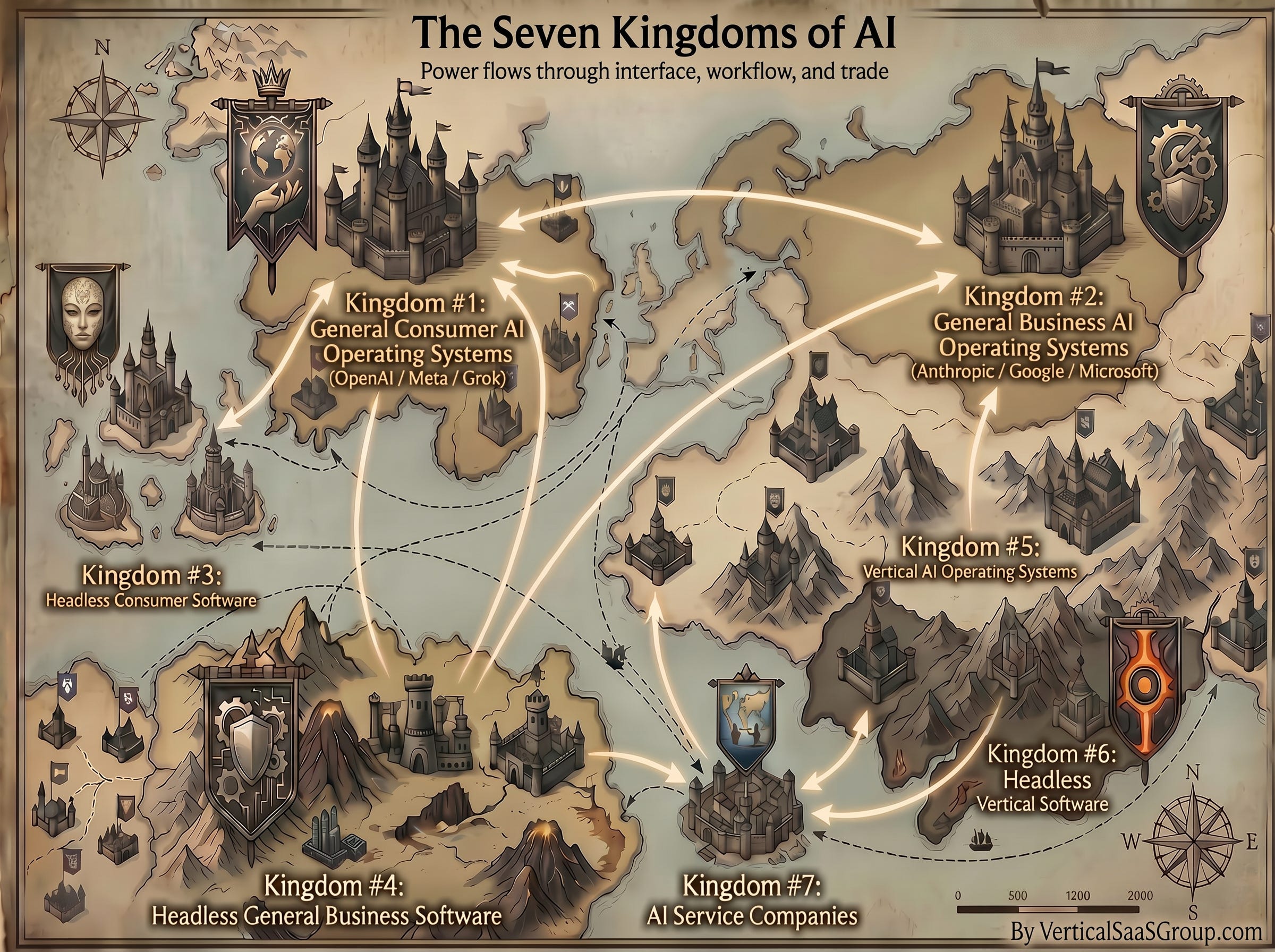
The Seven Kingdoms, In Detail
Here’s how I’d break the new stack down. Seven kingdoms. Each one with a different shape, a different set of winners, and a very different game to play.
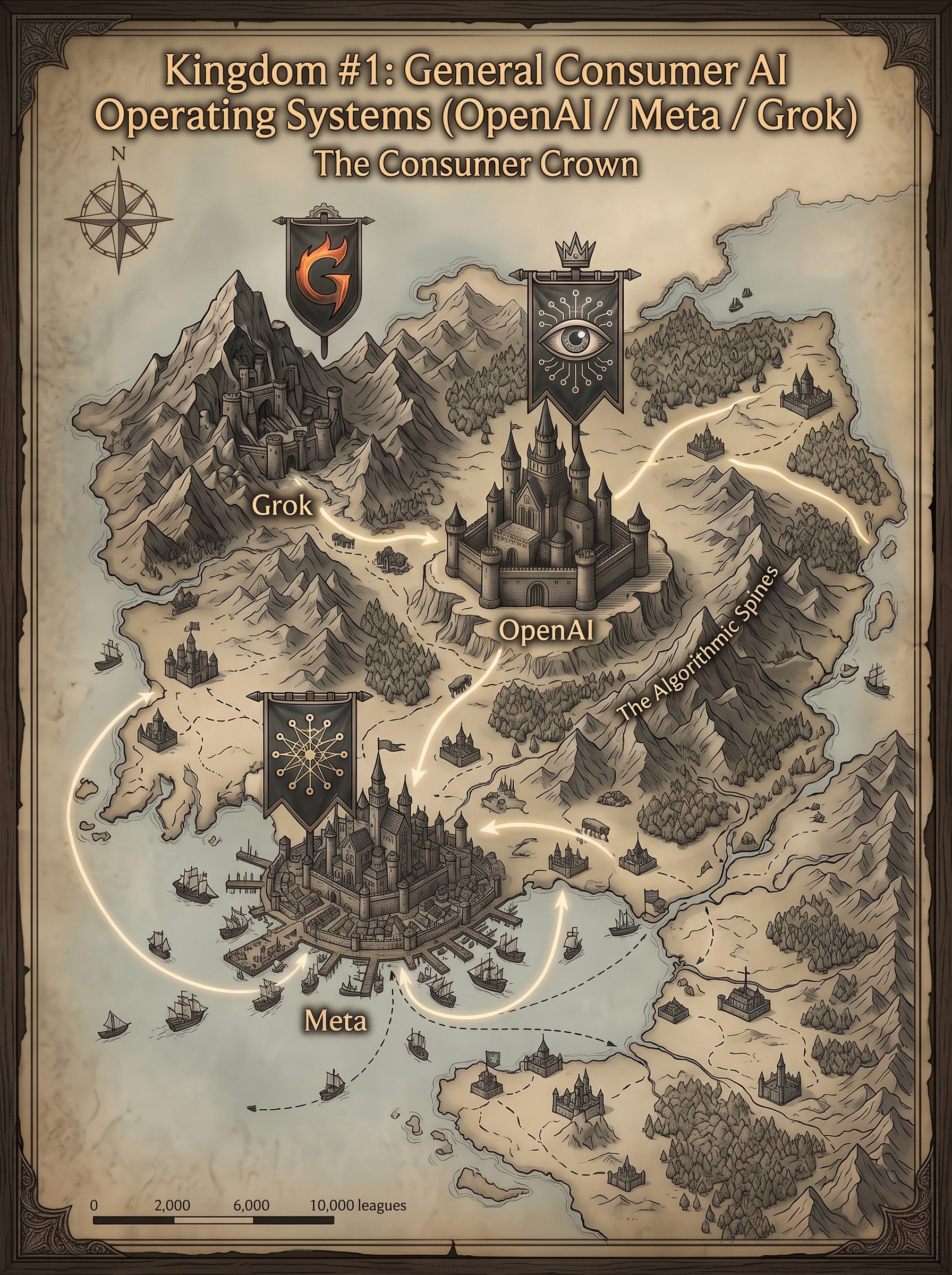
Kingdom I: General Consumer AI Operating Systems
OpenAI · Meta · Grok
GoT Parallel: Most like Dragonstone — strategic, well-defended, and built to command the serious campaigns.
This is not just another app people open. It’s the place they start and never leave. Where they ask questions, make decisions, create things, shop, research, plan, and increasingly take action.
Right now, ChatGPT is winning in consumer. It’s the closest thing we have to a default AI Operating System for the consumer internet — the place a growing share of people start when they want to ask, decide, create, research, plan, and increasingly take action.
But this throne isn’t settled. Meta has the distribution, the social graph, and the hardware ambitions to push their assistant in front of billions overnight. Grok has Elon, X, and a willingness to play by different rules. Google has Search, Android, YouTube, and Gemini sitting in front of literally billions of people every day, and they’re absolutely going to fight for the consumer surface too, as will Apple. All of them are coming for OpenAI, and the next few years are going to be a real fight.
Whoever ends up owning the consumer interface owns the relationship. This kingdom is going to be small in number and absurdly valuable.
Kingdom II: General Business AI Operating Systems
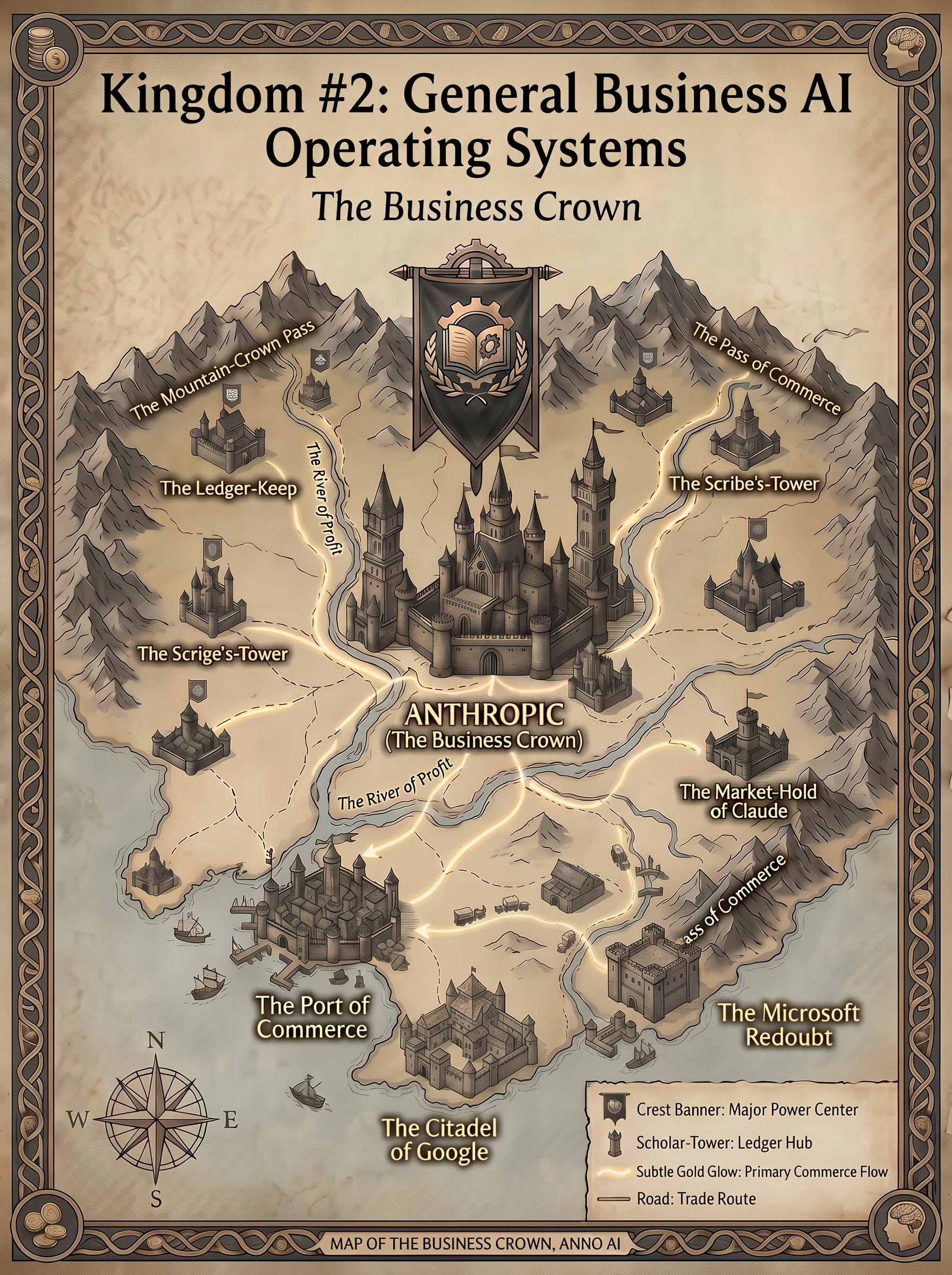
Anthropic · Google · Microsoft
GoT Parallel: Most like King’s Landing — whoever controls the capital controls attention, distribution, and power.
On the business side, Anthropic/Claude looks really well positioned to become the general business AI OS — the thing that starts to eat the horizontal business suite market the way Google and Microsoft did in prior eras. And don’t count Google and Microsoft out either. They’re going to fight like hell here. OpenAI is also pushing hard into the business layer with ChatGPT Enterprise, Teams, and a growing stack of work-focused features — they want this kingdom too, not just the consumer one.
Additionally, we are seeing all the horizontal productivity software try to win here - think ClickUp, Monday, Asana, etc.
In this new world, Claude (or whoever wins) isn’t a chatbot sitting next to your work. It is the workspace. It’s where teams write, analyze, summarize, retrieve knowledge, make decisions, and increasingly execute workflows across the general business stack.
Same playbook as the consumer side: integrate with everything, learn what matters, then absorb the most strategic categories natively.
Kingdom III: Headless Consumer Software
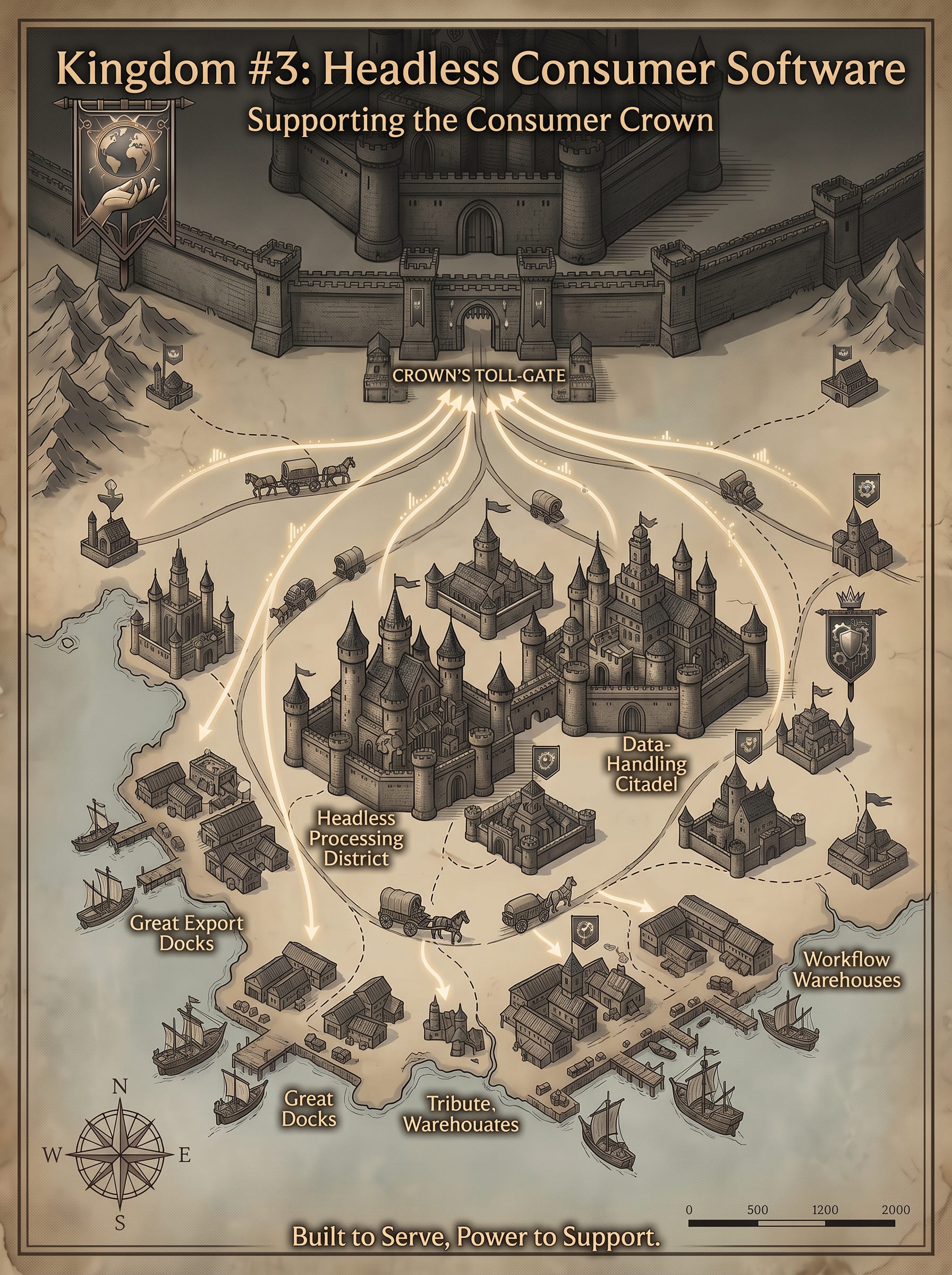
Bannermen to Kingdom I
GoT Parallel: Most like the Reach — productive, and valuable, but ultimately downstream from whoever rules the center.
Whoever ends up owning the majority of the consumer interface (ChatGPT, Grok, Meta, etc.), a lot of the consumer software you use today gets pushed underneath it. Some of it gets eaten entirely. A lot more of it survives, but as headless utilities sitting behind the AI OS — useful, even necessary, but no longer the front door.
These can still be good businesses. Think booking vacations, shopping, weddings, etc. The catch is that the platform above you can come for your category whenever it decides the margin pool is interesting enough. You’re useful. You’re just not safe.
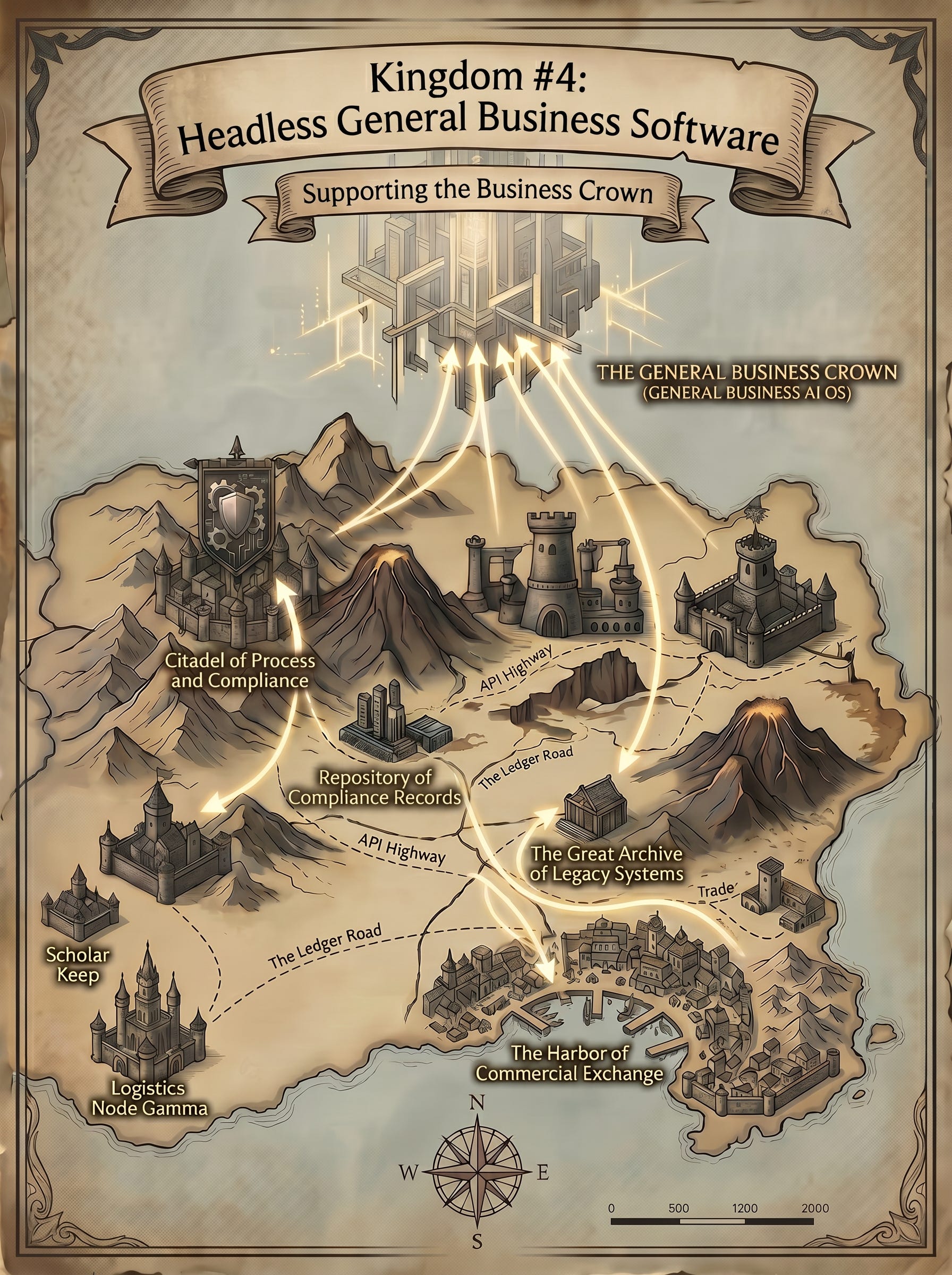
Kingdom IV: Headless General Business Software
Vassals to Kingdom II
GoT Parallel: Most like the Westerlands — full of assets and infrastructure, but expected to serve the larger war machine above them.
Same dynamic, business edition. CRM, project management, internal docs, reporting, ticketing, payments, payroll, analytics, collaboration — a lot of these tools will keep mattering, but they’ll matter less as front-end destinations if the user lives inside Claude (or Google or Microsoft’s version of it).
Plenty of real billion-dollar companies will still get built here. They’ll just be built knowing the platform above them can integrate, learn, and eventually absorb. The ones that survive will be deeply technical, painful to rebuild, and embedded enough that the platform would rather work with them than redo their work.
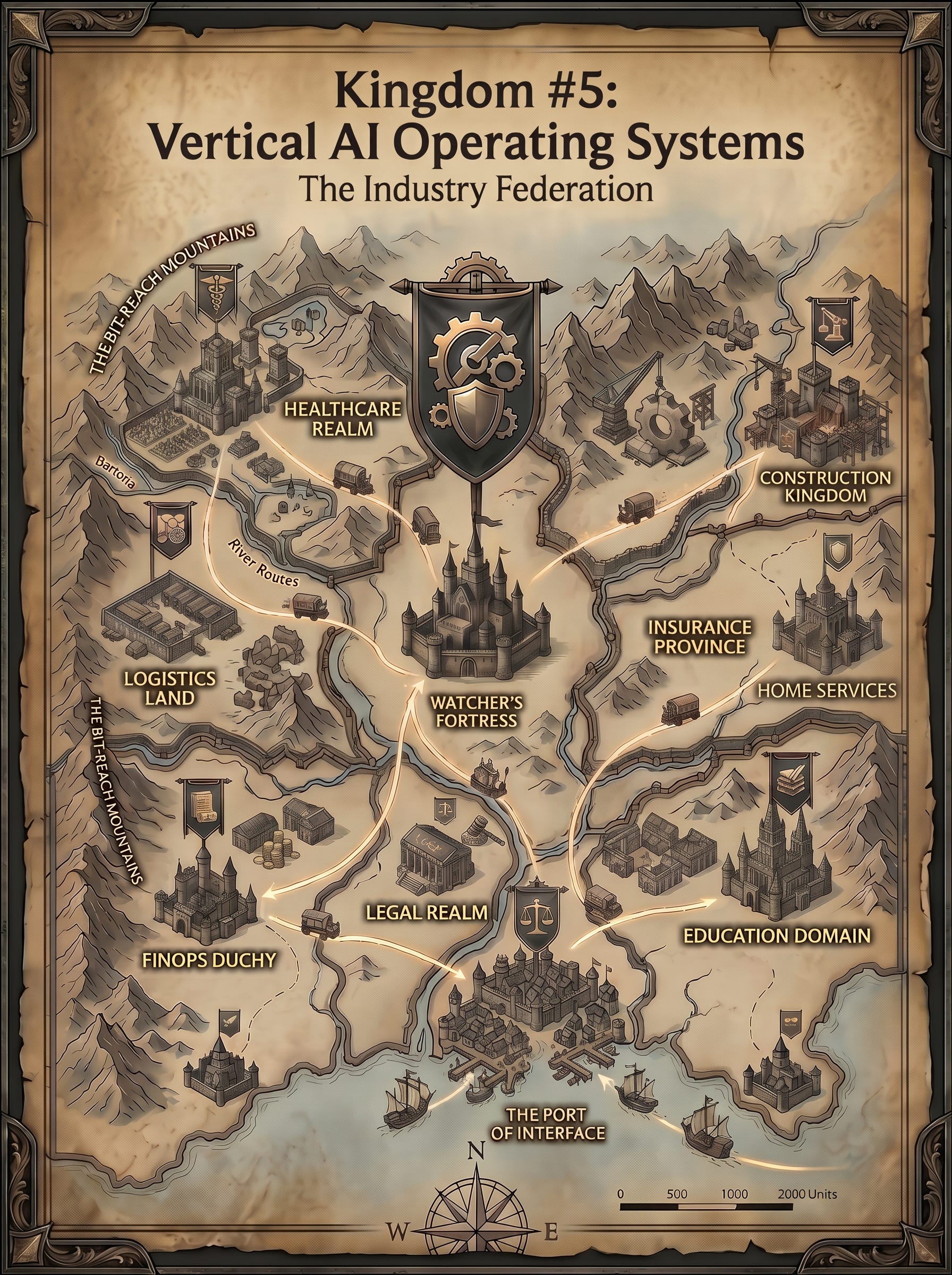
Kingdom V: Vertical AI Operating Systems
Health · Law · Build · Coin
GoT Parallel: Most like the North — too large, too complex, and too specific for any southern ruler to fully control from afar.
This is the kingdom I’m most excited about, and the one I’m spending most of my time on.
On the surface, a Vertical AI OS will often look a lot like Claude or ChatGPT. Conversational. Intelligent. Feels like working alongside a really capable AI. Underneath the hood it’s a totally different product. It’s trained on industry data, fine-tuned for industry workflows, wrapped in compliance and human services, and built to compress complex industry work into a few clicks.
Why this works: the horizontal players have an endless roadmap just chasing the most valuable headless tools. They aren’t going to go all the way down into healthcare, legal, construction, insurance, financial ops, or logistics with the depth those markets need. That leaves real room for vertical winners with industry context, regulatory depth, services, GTM, and trust.
And unlike horizontal, vertical isn’t winner-take-all. Some markets get one monopoly. Some get two or three real winners. Some support four or five strong players for a long time. That structure creates room for a huge number of $10M–$1B companies, not just a handful of trillion-dollar outcomes.
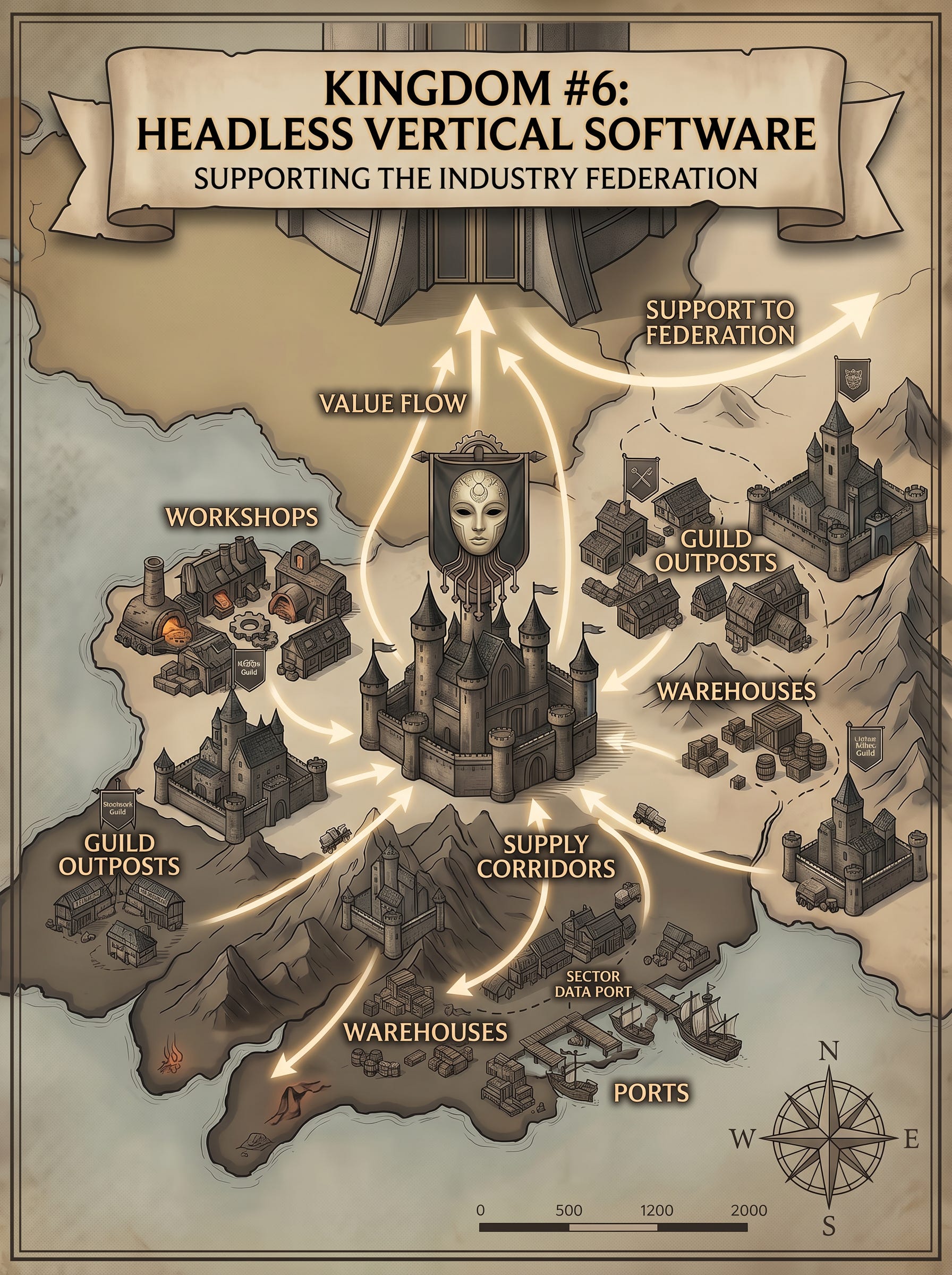
Kingdom VI: Headless Vertical Software
Bannermen of Kingdom V
GoT Parallel: Most like the banner houses of the North — not glamorous, but absolutely essential to keeping the realm running.
Underneath every Vertical AI OS, there’s a stack of tools doing the unglamorous work — industry-specific compliance, scheduling, communications, data, embedded finance, point solutions for very specific parts of an industry.
I think this is where thousands of really good bootstrapped and lifestyle businesses get built. They’re not flashy end-user brands. They solve ugly, essential, highly specific problems for the vertical AI OS layer. And because the vertical players don’t have horizontal-scale resources, they’re far less likely to absorb you. This is a much safer place to live than headless horizontal.
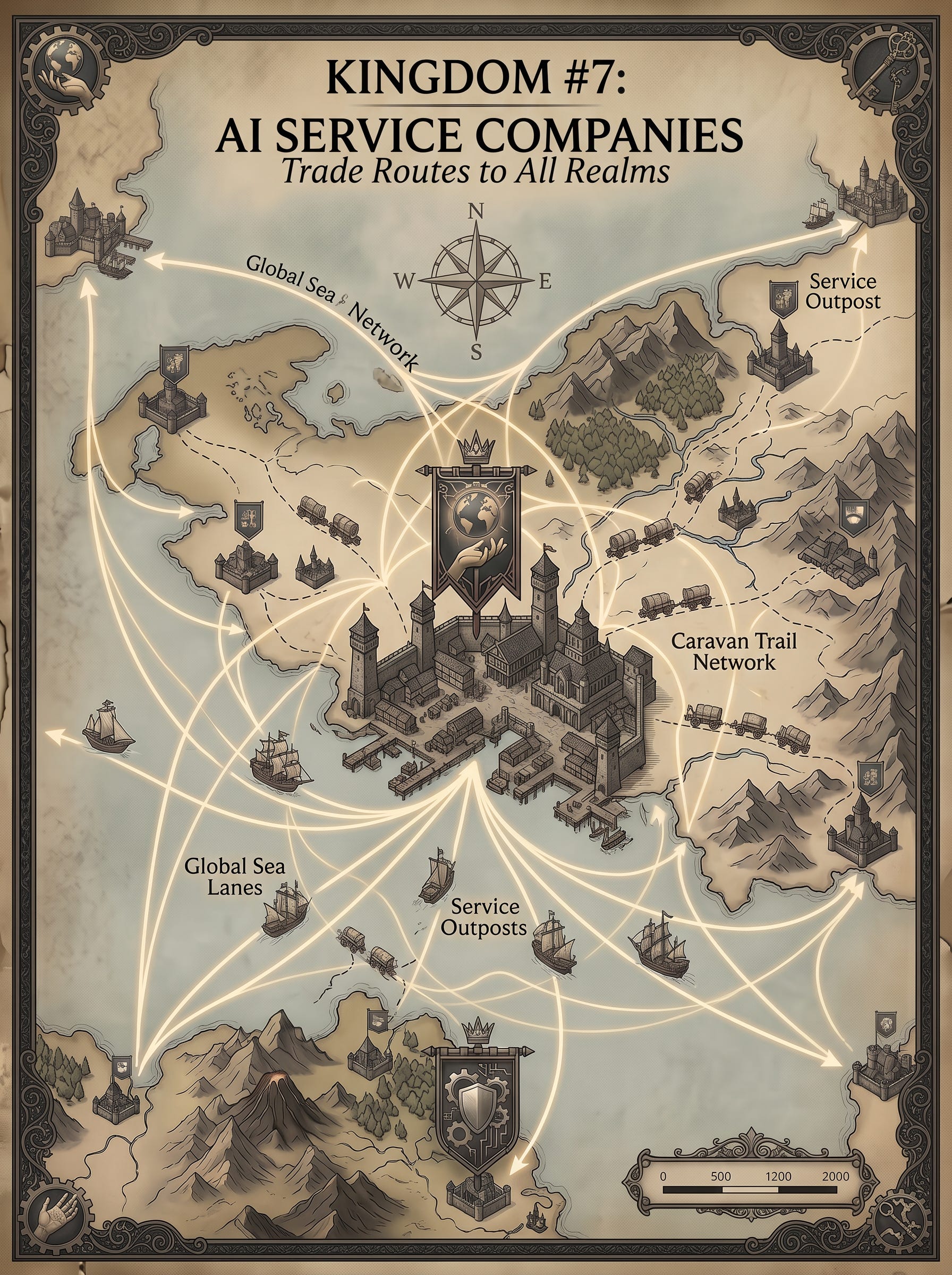
Kingdom VII: AI Services
Trade routes to every land
GoT Parallel: Most like Braavos — the wealthy Free City built across islands and lagoons, lending its services to anyone who can pay.
The last kingdom is services — and I think it’s going to be way bigger and way more defensible than people expect.
The AI OS companies want software-esque margins. They want to own the interface, the intelligence, and the highest-leverage parts of the stack. What they don’t want to do is own every messy, exception-heavy, labor-intensive workflow in the real world. That creates massive room for services companies that bring human expertise and actual work completion to both horizontal and vertical AI systems.
These businesses should be much better than old-school services companies. Better margins. Better workflows. Better software leverage. Better operating discipline. But they’re still services in the most important sense: they help the customer actually get the work done when software alone isn’t enough. That’s a great place to be.
How To Survive & Thrive In The AI OS Era
Okay — if that’s the map, the more useful question is where should you actually try to play? Here’s how I’d think about it, kingdom by kingdom.
I. Most of us should probably avoid trying to build the top-level AI OS
If I’m being honest, I think most founders should probably stay away from trying to build one of the giant horizontal AI OS companies at this point.
That market is likely going to be won by a tiny number of players, and most of them will either be today’s leaders or tech giants that come in late with absurd advantages in capital, compute, talent, and distribution. There may be a few late entrants that matter. History usually leaves some room for that. But if you are going after this layer, you need to understand what game you are actually signing up for.
You are not really trying to build a normal startup.
You are trying to build one of the most important companies in the world.
And if you do go after it, you better be prepared to spend something that looks closer to $1T+ than most people are comfortable admitting.
That’s just not the lane I’d advise most people to pick.
II. Headless horizontal software can absolutely work — but it’s a dangerous place to live
I do think there will be real billion-dollar companies built underneath the horizontal AI OS layer.
The problem is not whether they can become valuable. The problem is how much extinction risk comes with the territory.
If you are building headless software or AI that serves the horizontal giants, you have to assume the platform can come for you at any point. If your category matters enough, they can absorb it. If your margin pool looks attractive enough, they can pressure it. If your functionality feels strategic enough, they can decide it should just be native.
So if you want to build here, you need to be more than useful.
You need to be necessary.
The best companies in this layer will own something technical, painful, deeply embedded, and annoying enough that the platform would rather work with them than rebuild them. That can become a fantastic business. But it is not a relaxing place to live. You need to know that going in.
III. Communication tools can still matter — but I don’t think this is some giant greenfield for new entrants
I do think a handful of communication tools remain large and important for a long time.
Video conferencing matters. Team communication matters. There are some categories like that which are just too core to how people work to disappear overnight.
But I don’t really look at this and think, “Wow, what a wide-open new frontier for startups.”
Maybe a few products show up late and plug into the AI OS systems better than what exists today. That can absolutely happen. But if you want to play here, I think you need to be a truly exceptional product person. The bar on product quality, taste, and user love has to be incredibly high. And even then, you are going to spend your life watching your back.
The dynamic here feels much more like Snapchat vs. Facebook than some peaceful little software niche.
You can build something people love. You can carve out real value. You can even get big.
But if the giants decide your product matters, you should assume they are coming.
IV. Vertical AI OS is where I’m spending my time
This is the bucket I’m most focused on.
This is where I’m spending my time, money, and my energy because I think this is where some of the most important and durable companies of the next decade will get built.
The opportunity, in my mind, is to build the Claude Cowork for a specific industry.
On the surface, the interface may look similar to the horizontal AI giants. It will feel conversational. It will feel intelligent. It will feel like you are working alongside an incredibly capable AI. But underneath the hood, it is doing something very different. It is built on the industry dataset, the industry language, the industry workflows, the industry edge cases, and the industry realities. And because of that, it can distill very complex industry work down into just a few clicks.
That’s the unlock.
The defensibility here comes from wrapping the Vertical AI OS in the things the horizontal players are much less likely to go deep on: human services layers, compliance and regulatory depth, embedded workflow knowledge, operational expertise, trust with the customer, industry GTM, industry brand, and the kind of real-world feedback loops you only get by living inside ONE industry.
That combination is what makes this market so interesting to me.
In a lot of verticals, software alone is not enough. A model alone will not be enough either. Even a beautiful interface alone is not enough. What matters is whether the product can actually help the customer get the work done in a way that is faster, more compliant, more trusted, and more complete than the alternatives.
I also like that this market probably will not be winner-take-all in the same way horizontal will be.
Some verticals may end up with one clear monopoly. Some may have two real winners. Some may support four or five strong options for a long time. Those are competitive dynamics I can live with. In fact, I prefer them.
Because that kind of market structure creates room for a lot more outcomes. It creates room for a bunch of billion-dollar companies, but it also creates room for an extraordinary number of businesses in the $10M to $999M range. That is a huge opportunity set. A lot of great companies will get built there. A lot of private equity firms will live and die here too.
V. There will be thousands of great businesses built as headless software tools (but most will be small)
I also think there will be thousands of great bootstrapped and lifestyle businesses built in this era.
My assumption is that most of these are not flashy end-user brands.
They are headless software tools that power the AI OS layer, whether horizontal or vertical.
They sit underneath the interface. They handle narrow but important jobs. They solve ugly, essential, highly specific problems. And they become part of the stack that the AI OS relies on in order to actually function well.
Some will be data providers. Some will handle payments. Some will manage compliance. Some will power execution in very specific parts of a workflow. Some will connect fragmented systems that the AI OS needs in order to actually get work done.
A lot of these will become very good businesses.
In many cases, they will be built by founders who understand one annoying part of the stack better than anyone else and quietly turn that into a durable, profitable company.
VI. AI services will be huge — and much more defensible than people think
I also think there will be an explosion of massive AI services companies.
Why?
Because the AI OS companies will want software-esque margins. They will want to own the interface, the intelligence layer, and the highest-leverage parts of the stack. What they will not want to do is own every messy, labor-intensive, exception-heavy workflow in the real world. That creates a lot of room for services companies that bring human expertise and work completion to both horizontal and vertical AI systems.
These businesses should be much better than old-school services businesses.
Better margins. Better workflows. Better software leverage. Better labor models. Better operating discipline.
But they will still be services businesses in the sense that they help the customer actually get the work done when software alone is not enough.
That is a very good place to be. A defensible place to be. And a very large place to be.
VC’s probably will spend a fair amount of time here.
VII. The companies that move too slowly are in serious danger
The harsh reality is that a lot of companies are just not going to make this transition.
Some won’t see it clearly enough. Some will see it, but move too slowly. Some will keep pretending that adding a few AI features to an old product is the same thing as adapting to a new era.
It isn’t.
A lot of SaaS companies are going to find out the hard way that their position in the stack was weaker than they thought. A lot of services companies are going to realize too late that customers no longer want the old model of labor delivery. A lot of businesses are going to get caught in the middle: not differentiated enough to win, not lean enough to survive, and not fast enough to reposition.
That culling feels inevitable to me.
To Wrap It Up…
This isn’t me about telling you what type of company to build…
It’s about recognizing that the stack is getting redrawn in real time.
A few AI OS companies will sit at the top.
A huge amount of software will get pushed down, abstracted away, or turned headless.
Some companies will become core infrastructure.
Some will become vertical systems.
Some will become service layers.
And a lot of companies will realize too late that the value already moved.
That’s the real question now:
Or are you the company that wakes up one day and realizes it was never as defensible as it thought?
That’s why this moment matters.
Because this isn’t some slow transition that plays out over 20 years.
It’s happening now.
And the people who understand where the value is moving — before everyone else does — are the ones who get to matter in what comes next.
Godspeed.
Hear ye, hear ye—
Unto the brave founders, the bold builders, and all who would dare carve a kingdom from the new software realm — greetings.
If thou hast journeyed thus far down this chronicle, know that the gates are quietly opened. We do hereby summon thee to the
Vertical Software Summit in Miami on November 4th and 5th, 2026.
The formidable lords of every great vertical realm — founders and sovereigns of the mightiest houses — shall gather to share the chronicles of their conquests, their scars, and their unspoken strategies.
It shall be the vertical AI gathering of the year.
None like it shall come again.
Come, then. Take thy place among the worthy.
Sealed this day,
The Council of Vertical
+1 on AI services. It doesn't take much expertise to use chatbots, but operating enterprise-scale agentic AI systems does. AI services will be how people monetize their skill to manage complex AI systems.