

Today’s newsletter is sponsored by Xplor Pay.
Artificial intelligence is changing how software is built, customer expectations are evolving, and investors are rethinking what creates long-term enterprise value.

Join Xplor Pay and Luke Sophinos, Founder of Vertical SaaS Group, for an executive discussion exploring how AI, workflow ownership, platform strategy, and financial capabilities are reshaping the future of vertical SaaS. Register today and reserve your spot.
A Guide For When To Go Headless & When To Own The UI
The most dangerous assumption in vertical software right now is that owning the interface is always the prize. It was the correct assumption for twenty years. The company with the login page won.
The AI era inverts that logic, and most founders have not caught up.
A small number of horizontal AI platforms are going to own the general interfaces of the world. Everything else gets pushed into one of two camps: vertical AI operating systems that own deep industry workflows, or headless software that runs underneath everyone else’s screen. Both can be enormous. The difference is whether you choose your camp before the kings arrive, or get assigned one after.
This week: the framework for surrendering the UI layer, when to do it, when to fight like hell to keep it, and three vantage points on the same decision.
The Seven Kingdoms: where the interface is actually going
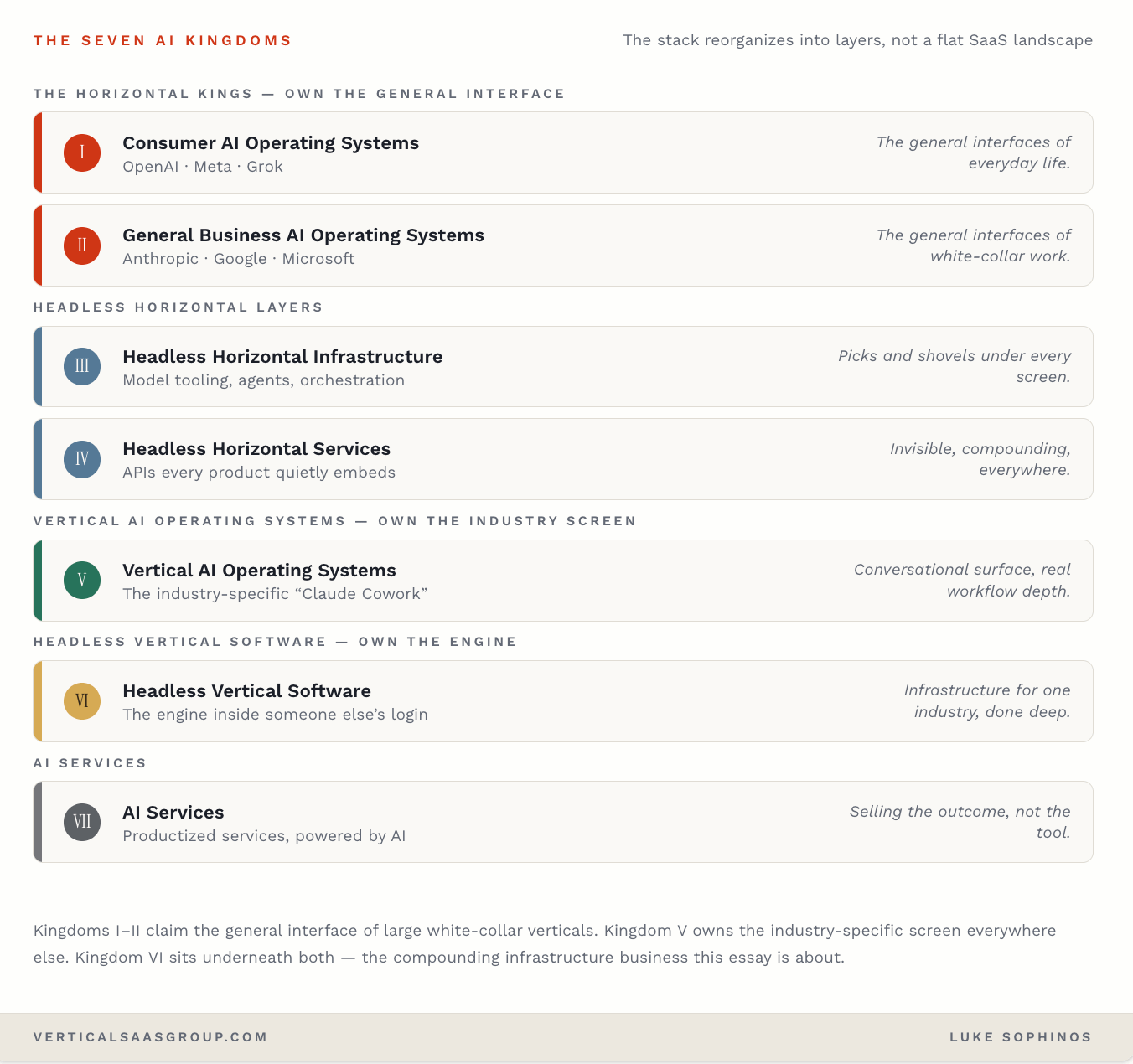
I wrote about this in Linear #174: The Seven AI Kingdoms. The short version: the AI software stack is reorganizing into seven distinct layers, not the flat SaaS landscape we came from.
Here is the mechanism worth sitting with. The horizontal kings are not going to go all the way down into every market. They cannot. Their economics forbid it. A platform worth a trillion dollars does not deploy its best model, its brand, and its distribution into a workflow that produces a few hundred million in software spend. The marginal cost of entering a big new market is basically a compliance wrapper, an industry landing page, and a sales team. For a small vertical, the same effort does not move their needle at all.
So the world filters cleanly. Healthcare, education, legal, financial services: the giants are already building the general UI there. Elevator repair, fire departments, art galleries, cemeteries: they will never come.
That means the interface layer of large white-collar verticals is being claimed by the kings. The interface layer of everything else belongs to the vertical AI operating systems: the industry-specific “Claude Cowork” that looks conversational on the surface but runs on real workflow depth, regulatory knowledge, and trust. And underneath both sits Kingdom VI, headless vertical software, quietly becoming a compounding infrastructure business.
Headless is not a consolation prize. It is a position.

Surrendering the UI Layer: When to Do It and Why
First, the distinction. The UI layer is the product your end user logs into. The interface owns the relationship, the daily habit, the data, the trust. Headless means you never see the end user. Your customer is a developer. They embed your engine inside their product, and their users never know you exist.
Examples everyone has seen from underneath: Plaid is headless despite every fintech app showing its logo on a bank selection screen. Twilio is headless. Stripe started as an API and only later earned the right to touch merchants directly. Shippo is headless. Pretty much everything in the e-commerce checkout flow you touch is someone else’s engine wearing the storefront’s clothes.
This is not new. Point Nine’s essay The Rise of Vertical APIs catalogued this a decade ago: Onfleet for delivery operations, Eligible for healthcare payments, Infermedica for diagnostic triage, Retsly for MLS data, Aftership for tracking, Commerce.js for storefront infrastructure. It split vertical APIs into two buckets: data APIs and infrastructure APIs. That essay aged perfectly. It just called the category too early.
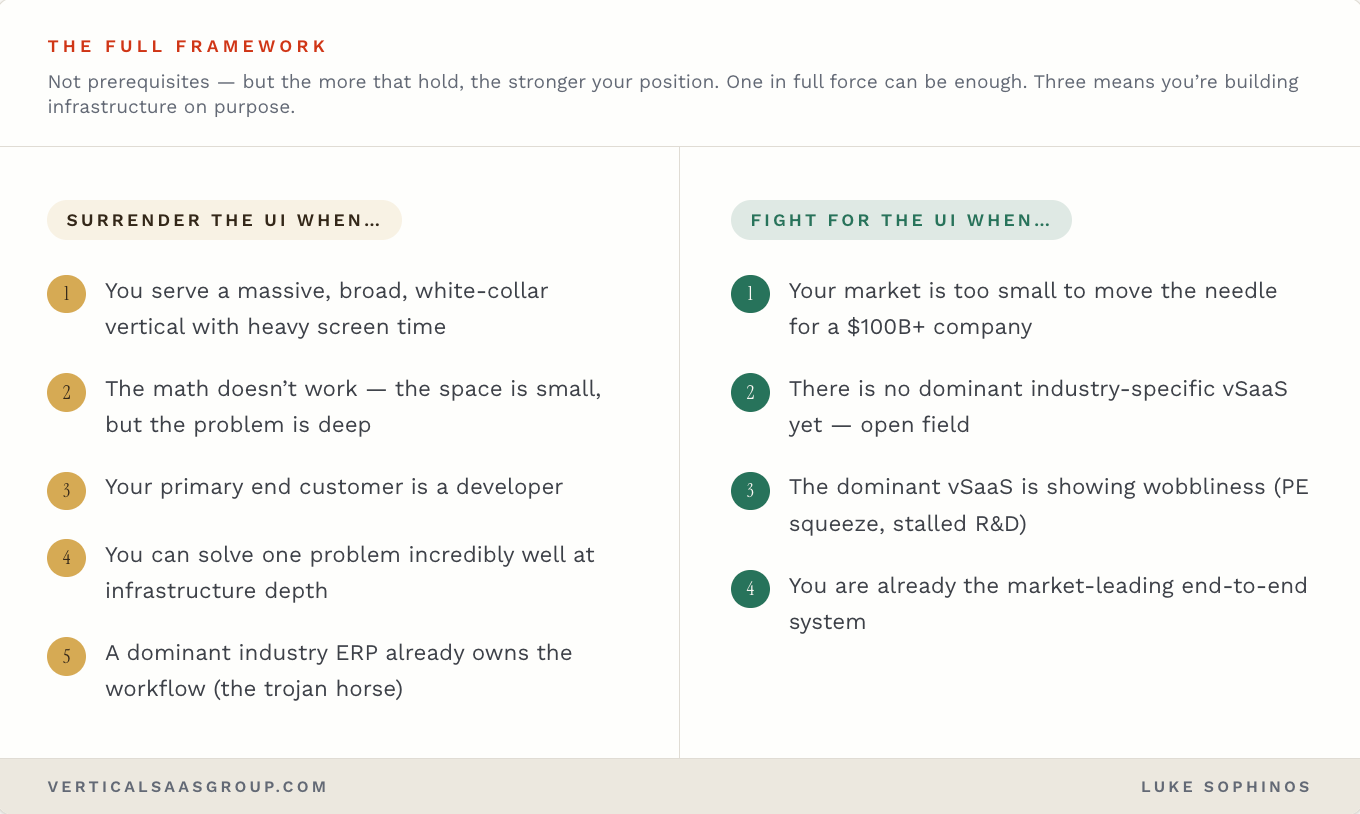
One thing up front so nobody over-rotates: these are not prerequisites. Not every point below has to be true for headless to be the right call. But at least some of them should be, and the more that hold, the stronger your position. If you have one of these in full force, that can be enough. If you have three, you are building infrastructure on purpose.
Here is when you should go headless.
1. You serve a massive, broad vertical, especially white-collar with heavy screen time.
That is where the giants go. And we can learn exactly who by looking at who they have already targeted.
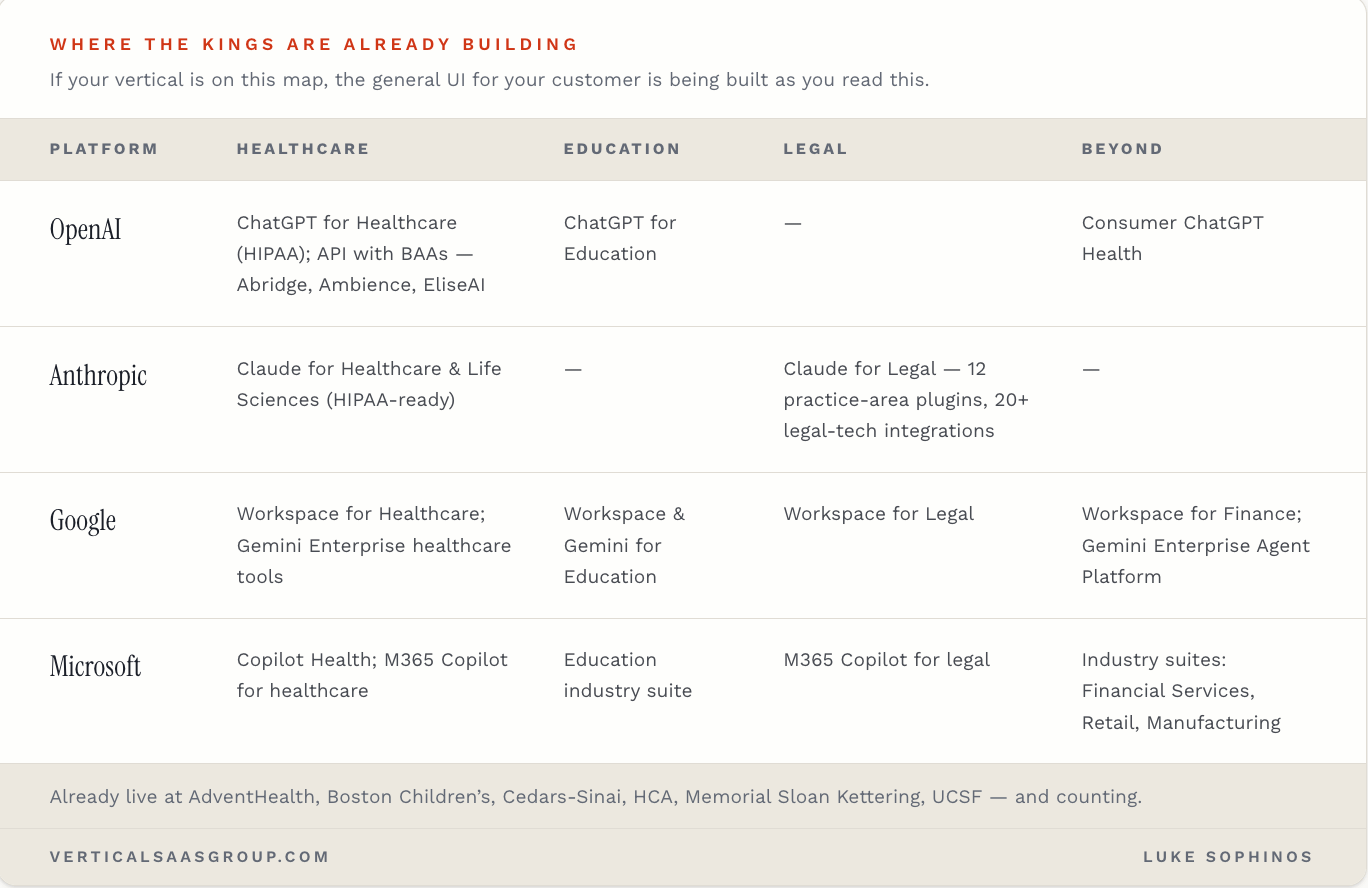
If your vertical is on that map, the giants are building the general UI for your customer as you read this. Do not fight that at the surface. You do not out-brand OpenAI inside a hospital. You win underneath them.
But there is a caveat worth stating plainly, because this is where the real openings hide. This point only applies if you are serving the broad vertical at the same altitude they are. The moment you go deeper, the game changes. Be the AI for chiropractors, not the AI for healthcare. Be the AI for behavioral health practices, not the AI for hospitals. Be the AI for a specific specialty, a specific workflow, a specific back office, and suddenly you are not competing with the horizontal kings at all. You are operating in a category they will never care about.
The rule for that move is simple and unforgiving: your slice has to be different enough, and ideally much more complex, that the broad tool is 10x worse than your solution. If a general model with a landing page gets you 80% of the way, the giant wins, because they have distribution and you do not. If your depth makes their general tool look like a toy, you win, because no amount of model quality replaces workflow specificity. Depth is the exception that beats scale.
2. The math does not work for the small spaces.
Here is a number worth sitting with. A $100B+ company needs multi-billion dollar outcomes to move its own needle. Not a billion. Multiple billions. A billion-dollar outcome is the same to them as your smallest ACV customer churning is to you. Which is quite wild to think about.
That one sentence explains more about the AI landscape than any model benchmark. It is why the kings go after healthcare and education and legal and not elevator repair. It is why their roadmap is finite and yours is not. And it is the quiet promise underneath the entire “own the UI” argument. They cannot chase you if you are too small to matter to them.
3. Your primary end customer is a developer.
If the buyer is an engineer who wants capability embedded, you are headless whether you admit it or not. The Point Nine essay is the playbook: data APIs, infrastructure APIs, compliance as a service. When your users are other products, you are not in a UI business, so stop spending like you are. No marketing site can fix a product that was built to be embedded.
4. You can solve one problem incredibly well, and it is big enough to still be a massive business.
Shippo. One multi-carrier shipping API with 40+ carriers underneath: rates, labels, tracking, address validation, all over a single REST interface. It never tried to be the storefront. It made shipping disappear as a problem, and every e-commerce platform became more valuable by embedding it. One problem, infrastructure depth, enormous TAM. That is the template. The mistake founders make is assuming that going headless means going narrow in ambition. It does not. It just means the surface is someone else’s and the engine is yours.
5. The trojan horse rule: a dominant industry ERP already owns the workflow.
If the entire industry runs on one system and the operators open it every morning, you do not win the login. You go headless, integrate into their screen, and become the layer they cannot live without. You win by being impossible to remove from inside the incumbent, not by being the second tab nobody opens.
And the trojan horse is just the starting point. There is a longer game underneath it. You integrate to get as much data as possible. You learn the workflows from the inside, the ones that never made it into any requirements doc. You map every inefficiency and every user complaint. And then, when the knowledge is complete and the moment is right, you build those workflows 10x better and launch the competing UI layer, this time from a position of total information. Every roll-up in software history is this play. The headless phase is how you earn the right to eventually own the screen.
Now the other side…
When to not go headless.
When to push hard and own the interface.
1. Your market is too small to move the needle for a $100B+ company.
If the kings will never come, the interface is the biggest prize on the board and it is yours for the taking. Niche is not a limitation here. It is a moat. The very math that pushes the giants toward healthcare is the math that guarantees they leave your vertical alone forever.
2. There is no dominant industry-specific vSaaS yet.
Open field. The interface is the prize. Take it before someone else does.
And let me be direct here, because I know a lot of you do not believe this anymore: this is the classic vertical software play, and it still works. There are still a ton of markets with four or five players that each own maybe ten percent. The other half of the industry is still running on paper, spreadsheets, or frankensteining together horizontal tools that were never built for them. That is not a mature market. That is an open market wearing a mature market’s clothes. The AI layer makes this easier, not harder, because you can reach the paper-based half of the market without building a twenty-person onboarding team.
3. The dominant vSaaS is showing wobbliness.
Private equity bought it and squeezed it. Customers hate it. Data can be pried out of it. R&D has stalled. That is an incumbent that stopped compounding, and the UI is winnable. Entrenched is not the same as strong. Some of the best businesses in this category were built by watching the category leader get hollowed out by financial engineering and simply walking in the front door.
4. You are already the market-leading end-to-end system.
Do not surrender what you already own. Put the AI layer into your own interface and widen the gap. The headless argument is for people who do not have the login page. If you already have it, you are not a utility. You are the throne.
That is the full framework. Now three vantage points on the same decision.
The Vertical Software Summit 2026
It is not a payments conference masquerading as a vertical software conference.
It is not an investor conference not allowing other investors in.
It is the only conference by vertical software and ai founders for vertical software and ai founders.
The Summit is founders, operators, investors, and all the companies that support vertical businesses talking to each other, in one room, without the noise.
Don’t wait until last minute! This will sell out soon!

Real Examples In The Wild
Metriport: the headless checkmark
Metriport is an open-source, universal API for healthcare data. One API for complete patient data, built on FHIR, providing real-time access to medical records for more than 300 million Americans. Your customer is a developer building a health product, and what they buy is access to every patient record in the country without building 40 EHR integrations themselves.
Now check it against the when-to-go-headless list.
Healthcare is the purest example of a massive, white-collar, high-screen-time vertical. Clinicians live in EHRs all day. And the giants are already here: OpenAI, Google, and Microsoft are all shipping healthcare products, while the clinicians’ actual screen is owned by Epic and the entrenched EHR incumbents. You are not winning that UI, and it would be incredibly difficult to try. And that is assuming you are serving healthcare broadly. Go a slice deeper, behavioral health, therapy practices, a specific clinical specialty, and the calculus shifts again, because now depth can beat scale. Metriport is not trying to be that slice. It is making itself useful to every slice at once.
The primary customer is a developer. The one problem solved incredibly well: access longitudinal medical records from every provider, instantly. The trojan horse: integrate underneath whatever the clinician already uses, learn the workflows from the inside, and become the data layer every health product is built on. And the dominant industry layer, the EHRs, is so entrenched that the UI war is not just hard, it is pointless.
The evidence it works: Sollis Health uses Metriport to pull prior EKGs, operative reports, imaging, and lab results in seconds, which keeps patients out of the emergency room. The infrastructure runs at 99.999% uptime and processes over 100 million requests a day. SOC 2, HITRUST, HIPAA. A YC company building the data layer for healthcare. Open source as a trust wedge with exactly the developer buyer it needs.
Metriport is building the engine of healthcare, not the screen. In a market the giants are entering, that is the right side of the table.
First Due: the UI checkmark
First Due is the fastest-growing end-to-end platform for Fire and EMS. It consolidates NERIS incident reporting, ePCR, fire prevention, pre-incident planning, scheduling, assets and inventory, hydrants, training, incident command, and mobile response into a single application with one login. Their own words: the last piece of software your agency needs to buy. More than 2,800 agencies use it, including Charlotte, Mesa, Seattle, and FDNY.
Now check it against the when-to-own-the-interface list.
The market is too small for a $100B+ company to ever care. Fire departments are thousands of fragmented agencies with mission-critical needs and small budgets. OpenAI is never building a fire records management system. The math is definitive. Even a great outcome in this market would be a rounding error on their P&L, which means the interface stays available for whoever earns it.
There was no dominant end-to-end vSaaS in the category. The legacy tools are siloed, disconnected, and universally complained about. That wobbliness is the opening, and First Due is consolidating the field with one modern, cloud-native platform that replaces the patchwork module by module. The fragmented incumbents each hold their little slice, and the other half of the market is still doing this on paper. Classic vertical software play, still working, exactly as described above.
And it is becoming, or already is, the market-leading end-to-end system. Once the fire chief logs into First Due for incident reporting, scheduling, training, and hydrant testing, that interface is the defensibility. The data lives there. The daily habit lives there. The AI layer gets added there, on top of a workflow the company already owns end to end.
First Due is building the screen on purpose. In a market the kings will never attack, the interface is not a battleground. It is a fortress.
Field Services: the interface is a red ocean, the engine is a blue ocean
Field services is the most visible vertical AI battlefield on earth right now. And that is exactly why you should think carefully before joining the fight for the login.
The market is enormous and proven. ServiceTitan went public with roughly $772 million in ARR and a market cap north of $6 billion. Beneath it: Housecall Pro for the small shops, Jobber for the middle, and a long tail of Workiz, Kickserv, FieldEdge, Service Fusion, mHelpDesk, FieldPulse, ServiceTrade, Fieldy. Above it, Salesforce Field Service and ServiceNow FSM push down from the enterprise. The software market alone is $6B+ and growing double digits.
And now the AI layer is piling on. Hundreds, probably thousands of AI upstarts, all with different logins, all pitching themselves as the AI-native operating system for the trades. Every single one trying to own the interface.
To be clear, I am not arguing the incumbents are unbeatable. I think they get beaten. ServiceTitan is a public company now, and public market pressure has a way of pulling category leaders toward financial engineering over innovation. The trades are exactly the kind of market where an AI-native upstart eventually takes the crown.
But here is the question nobody wants to answer: what are your odds of being that upstart?
If there are a thousand startups aiming at this interface, one or two win. Maybe. The other 998 get decimated. The category is enormous, the prize is enormous, and the competition is a massacre. That is not a thesis. That is a lottery ticket with extra steps.
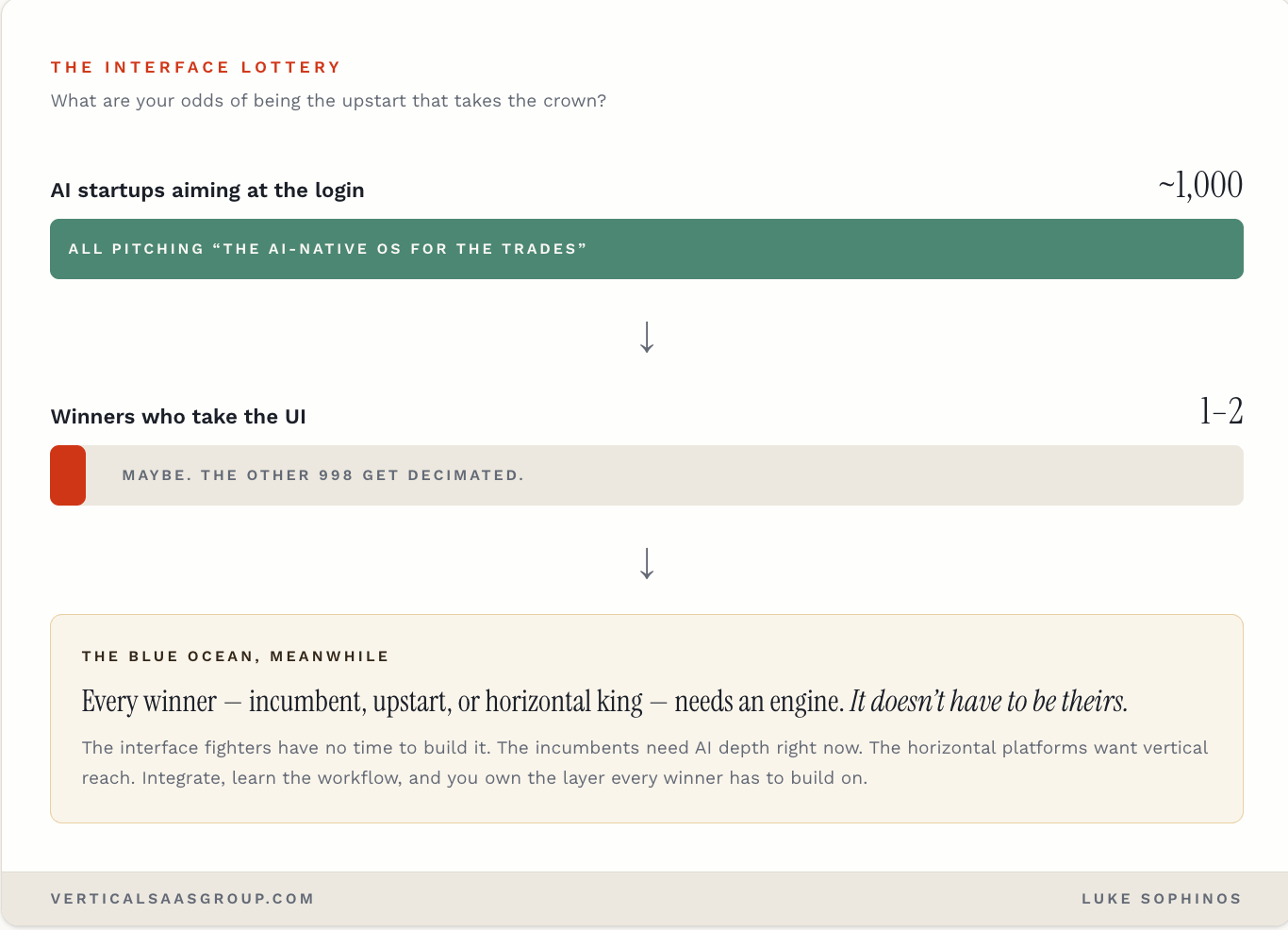
Now flip it. Instead of fighting for the login, go headless. Hook into the model layer: build on Claude or GPT and become the vertical intelligence nobody else bothers to build. Or hook into the workflow layer: integrate into ServiceTitan, Housecall Pro, or Jobber and become the AI capability they cannot live without.
That is a genuinely blue ocean. Why? Because the people fighting the interface war have no time to build the engine. Because the incumbents, even the ones who will eventually lose, need AI depth right now and cannot build it all themselves. Because the horizontal platforms want vertical reach and cannot do it alone. Because the one or two winners who eventually take the UI will need the best engine available, and it does not have to be theirs.
And here is the beauty of the trojan horse. You integrate into whoever owns the screen today. You get the data. You learn the workflow. You become structurally important. And when the UI war finally shakes out, whether the winner is ServiceTitan, an upstart, or a horizontal king, you are already inside. You do not care who wins the surface, because you own the layer every winner has to build on.
Everyone is fighting to be login number one thousand and one. The smarter play is to be the engine inside whichever login wins.
Metriport surrendered the screen and became the engine of healthcare.
First Due is building the screen on purpose in a market the kings will never enter.
And in field services, thousands of startups are fighting to be the one login that survives, when the smarter play is to be the engine that every login, winner or loser, has to build on.
The interface is not always the throne. Sometimes the throne is underneath.
Do me a solid and forward to a friend :-)