


An Interesting Bootstrapped Play
The majority of VC/PE backed vertical software company is focused on remaining the UI layer for their industry. Very few are wanting to go headless behind the AI interfaces. That’s the opposite approach of what is happening in horizontal software (Salesforce/Hubspot etc are all leaning HEAVY into headless).
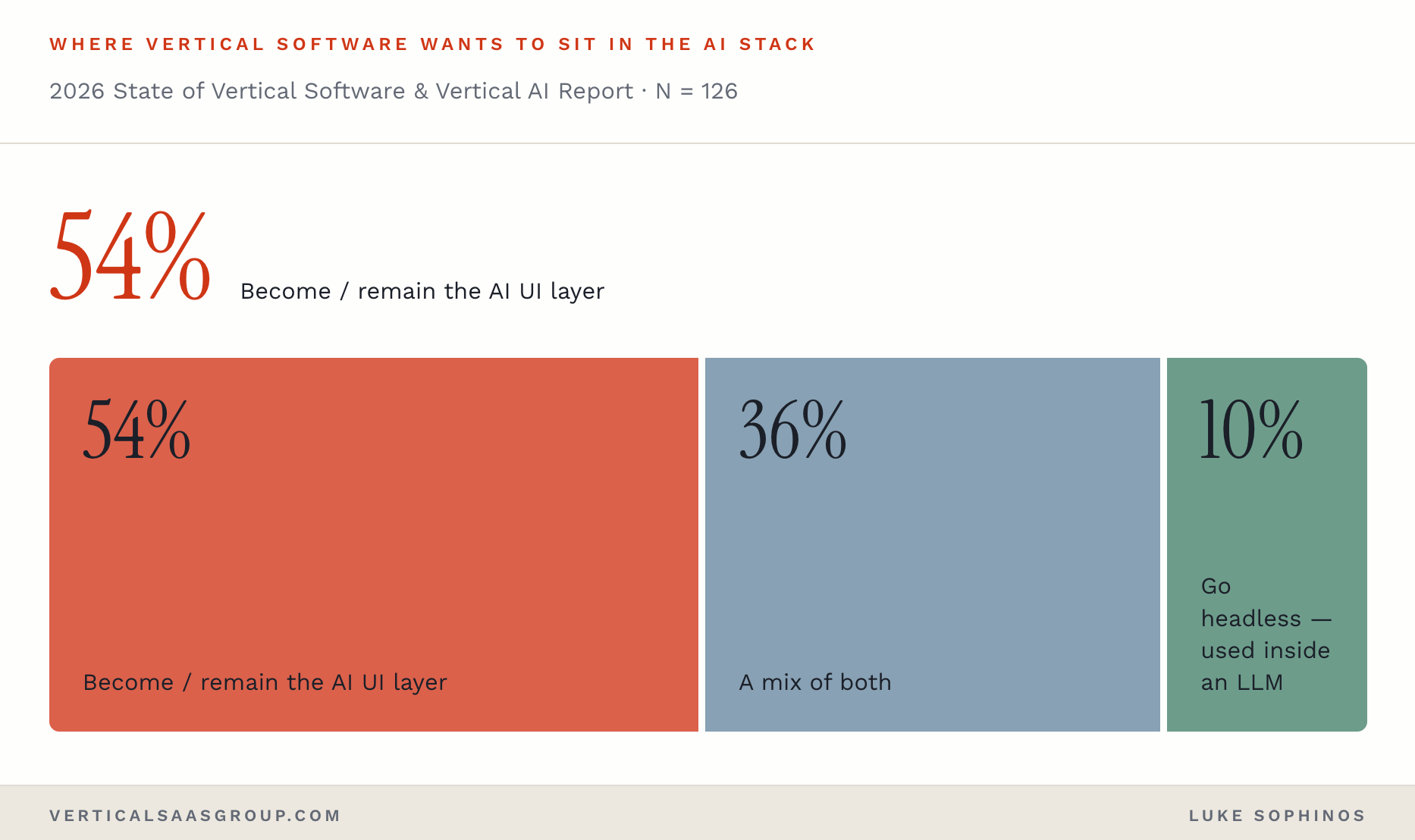
This makes sense, if vertical software can successfully remain the UI layer and just utilize the new technology to feel like an industry-specific version of Claude with a ton of proprietary data, they should be able to remain the UI of their industry.
But one interesting approach that I haven’t really seen anyone take…
Sell Claude directly into your market with an industry specific app inside.
You don't build a model.
You don't build a wrapper with your own UI, your own hosting bill, and your own inference costs.
You build one thing: the app that makes Claude fluent in your industry, inside Claude.
I view this more as a bootstrapped play, because you’re not REALLY the platform, and it definetly has some serious risks associated with it. But I think there is a real arbitrage window exists here and bootstrappers could do VERY well if they sprint at it.
Let me explain more…
Claude has an app layer now. Anthropic’s MCP Apps let you render your own interface inside a Claude conversation: a side panel, full screen, pinned to the sidebar, even your own website embedded inside the app.
Your app registers tools that Claude calls directly. It all runs on the same unified Claude experience where chat and Cowork merged this year, on every paid plan. You build it with the MCP Apps SDK, ship it as a connector, and your customer installs it into their Claude from a link. No app store gate to get started.
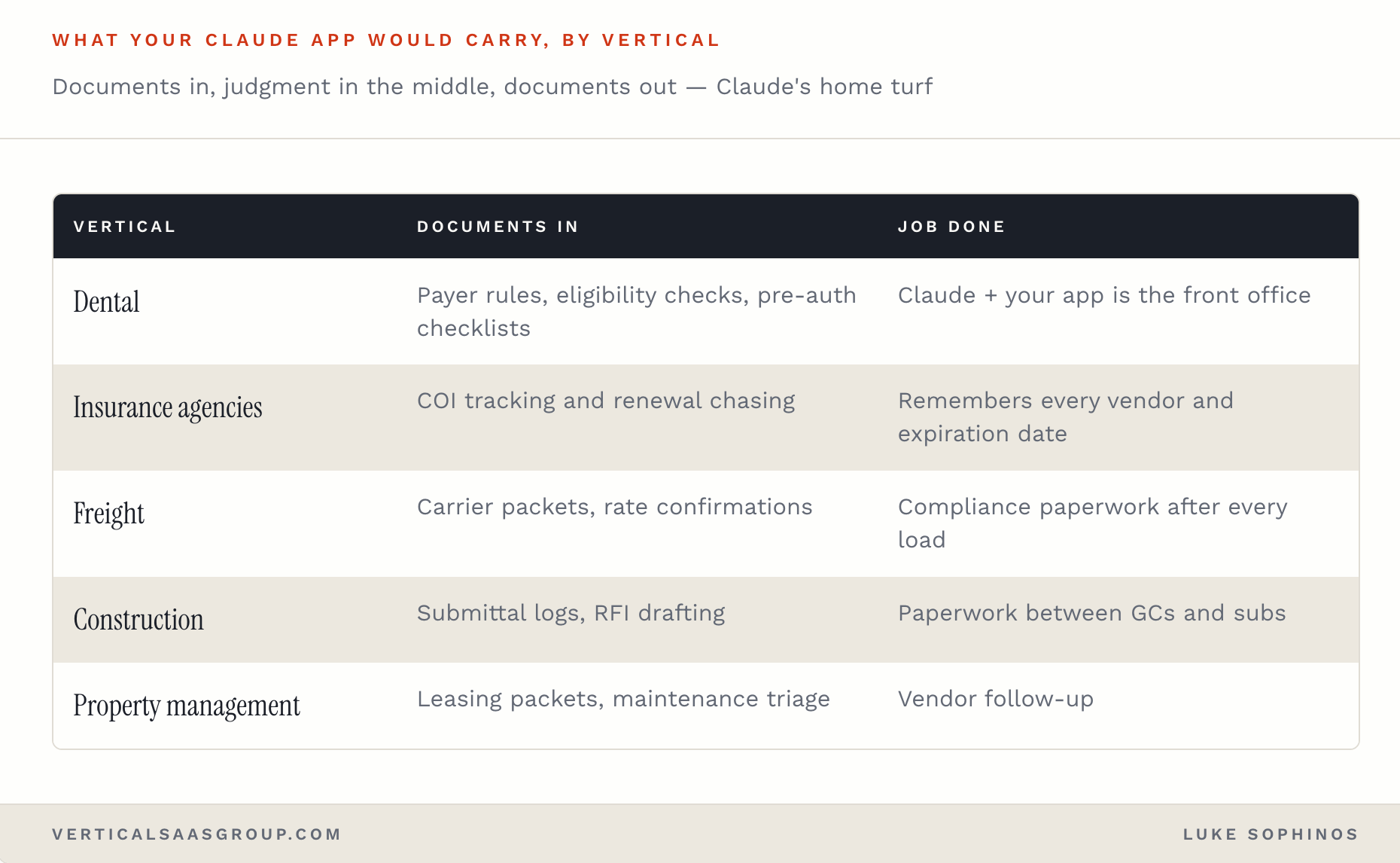
If the Frontier interface isn’t widely used in your vertical, you can be the Claude supplier of your industry
And there’s a condition that makes the supplier seat open in the first place: in most verticals, the frontier interface isn’t widely used yet.
Walk into a dental group, an insurance agency, a mid-size freight brokerage and you’ll find a ChatGPT tab at best. These markets are very much in the early adopter phase.
No one has really taught them what the model can do against their documents, nothing in their stack speaks their language. That blank is the opening. The first person to walk in, demo it on a real pre-auth or a real carrier packet, and hand over a working package becomes the person who brought the model to the market. Markets don’t forget their introducer. Every model generation after that routes through the relationship you built…
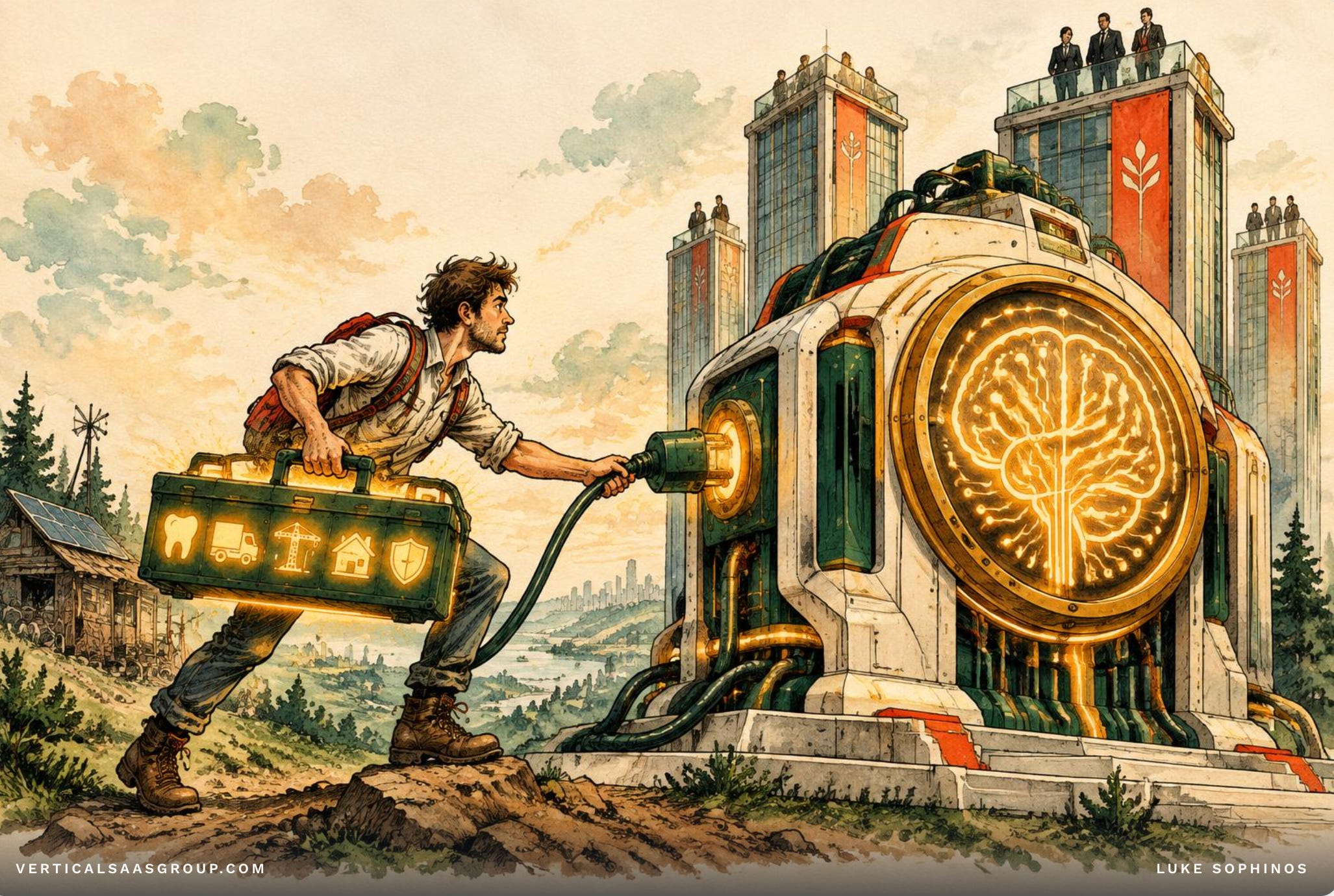
Anthropic ships an upgrade, better reasoning, longer context, cheaper tokens, and from the customer's side of the table the dental AI just got smarter. The freight AI just got faster. Not Claude. Yours.
The model improves in a datacenter, but credit lands on whoever owns the customer relationship. Sell it as the package your market buys and every model generation is a product update you didn't have to build, didn't have to pay for, and get to announce at renewal. I can't name a faster compounding loop available to a small bootstrapped software company right now.
You’re renting the engine at consumer prices. No inference bill, no GPU roadmap, no infra team. Your entire build is one MCP server plus industry knowledge. Weeks, not years. I’ve watched founders burn two years building what this takes a quarter.
But distribution is relationships. You can’t buy your way into dental with paid ads. You sell it one practice at a time, on trust, through people who already know you. That favors the operator over the funded team parachuting in. Every time.
Margins show up fast. And here’s the part VCs hate: this business doesn’t need to 100x. A tight vertical, 50-200 customers paying a few hundred a month, real margins, is a life-changing bootstrap business and a perfectly good exit to a strategic or a PE roll-up.
Now flip it. If you already own a vertical software company, and this play is aimed at you.
Your pros are also real. You own the system of record and the write path. You own the customer list. You can bundle the app, Claude, and your own product into one invoice and your interface and price it as one. Shipping this neutralizes the threat before the outsider shows up. And nobody knows the workflow better than you.
But be honest about the cons, because I get why incumbents hesitate. I really do. It cannibalizes seat revenue. Your sales team is comped on seats, not packages. The brand equity accrues to Claude, not to you. Your engineering gets split between the legacy product and the new layer. And every week you wait, some operator with no legacy to protect is building it.
The honest cons for the outsider:
The big one is write-back. In most verticals, the systems of record have no path for you. And if they do, I doubt it’s for long. Every scaled builder at the Vertical Software Summit kept talking about how they are shutting the door on API access.
Your agent drafts the pre-auth, and a human copies it into the PMS by hand.
This play becomes a brain without hands. The record system keeps its moat, and it’s not yours.
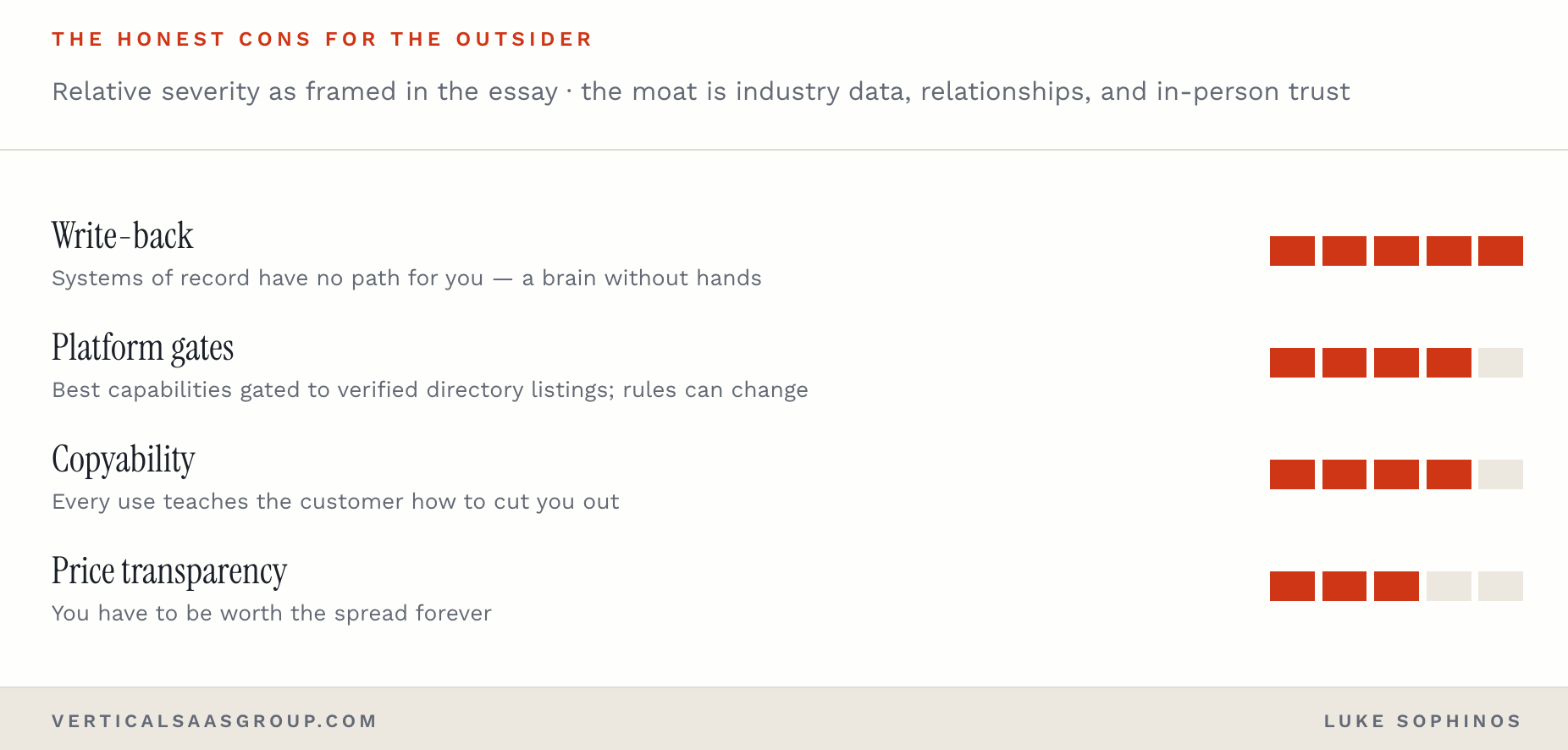
Platform gates are real too. The best capabilities (entry points, embedded sites) are gated to verified listings in Anthropic’s directory, and the rules can change under you. You’re a passenger on the Frontier Labs ship and you can get thrown overboard at any time.
Then price transparency: once the customer can see what the parts cost, you have to be worth the spread forever. And the app itself is copyable. Your moat is the industry data, the relationships, and the trust you earn selling in person. What happens if the customer wants to just cut you out and build what you have in Claude? Every time they use their product you’re teaching them how to do that. You probably need to wrap services/other offerings into this to make it not worth leaving.
Small markets. Big margins. Weeks to ship.
This is a really interesting bootstrap-shaped opportunity and the funded world is scared to talk about it.

Your Software Is Creating More Value. But Could It Actually Hurt Your Revenue?
If an AI agent saves a customer $20,000 a year in labor costs, why are we still charging a few hundred dollars per software seat?
A reader raised that question in the comments on a recent issue of Linear, where I’d explored how AI is shifting vertical SaaS from helping customers complete tasks to actually delivering outcomes. It stuck with me because it exposes a growing disconnect between the value software creates and how we charge for it.
For years, the SaaS model has been straightforward. More employees using your software means more seats, more subscription revenue, and a bigger customer account. But AI starts to challenge that equation.
Imagine a veterinary SaaS platform that introduces AI to handle appointment scheduling, patient reminders, and administrative follow-ups. The practice saves hours of work every week and potentially grows without hiring additional staff.
That’s a meaningful business outcome. But if the software company still charges primarily by employee seat, how much of that additional value does it capture? And if customers eventually need fewer seats, could the platform generate less revenue while delivering more value?
A recent survey from Tight and Vertical SaaS Group found that 44% of surveyed vertical software founders and operators include AI in their existing seat-based pricing. Only 15% reported using outcome-based pricing for AI.
That doesn’t mean seat-based pricing is wrong. It’s predictable, familiar, and works well for plenty of businesses. But it raises an important question about whether traditional pricing models will continue to reflect the value AI creates.
I don’t think there’s going to be one winning model. Some capabilities will make sense as subscriptions. Others might justify usage-based fees or pricing tied to measurable outcomes. And there’s another piece of the equation worth considering: transactions.
Go back to that veterinary practice. AI might help it operate with fewer administrative employees, but it’s still seeing patients, collecting payments, and managing its finances. Ideally, it’s doing more of those things as the business grows.
If payments are embedded into the software, the platform can generate revenue from transaction activity rather than relying entirely on how many employees log in. Payments revenue isn’t automatic, of course. Adoption, volume, and economics all matter.
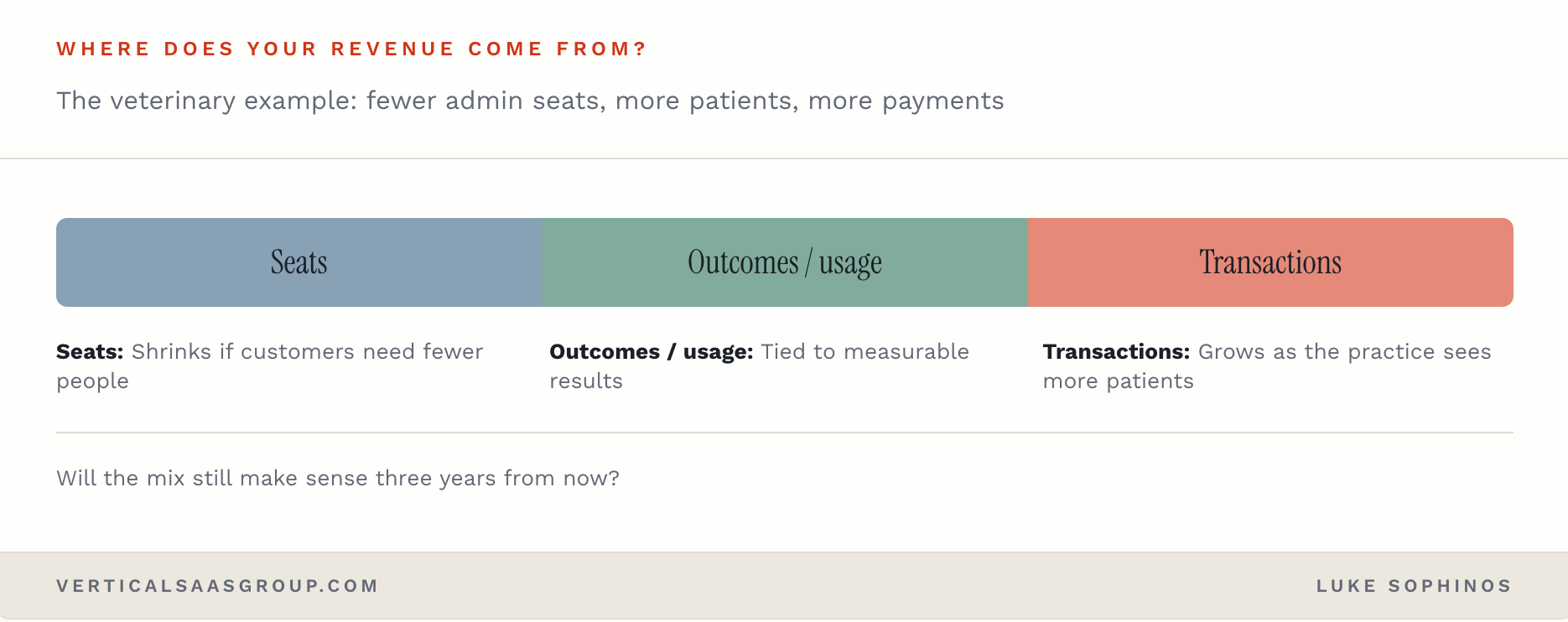
I wouldn’t abandon seat-based pricing or immediately start charging for every AI-generated outcome. But I would take a hard look at all the different ways my platform makes money.
How much of our revenue depends on the number of people using our software? How much is tied to the outcomes we deliver or the transactions we facilitate? And will that mix still make sense three years from now?
If AI allows your customers to accomplish more with fewer people, that’s a win. Your business model should benefit from that success, too.
As you rethink how your platform generates revenue, it’s worth considering where embedded payments fit into the equation. Xplor Pay has put together a practical framework for building a payments business that evolves as your SaaS platform grows.
Because the next generation of vertical SaaS winners won’t just create more value for their customers. They’ll figure out how to capture more of it, too.

Here’s a number pair that should reorganize how you think about this decade.
Procore took fourteen years to reach an estimated $100M in ARR. Legora took eighteen months.
That’s not a typo, and it’s not one lucky company.
It’s the headline finding of the 2026 State of Vertical Software & Vertical AI Report, which I presented at the Vertical Software Summit earlier this month.
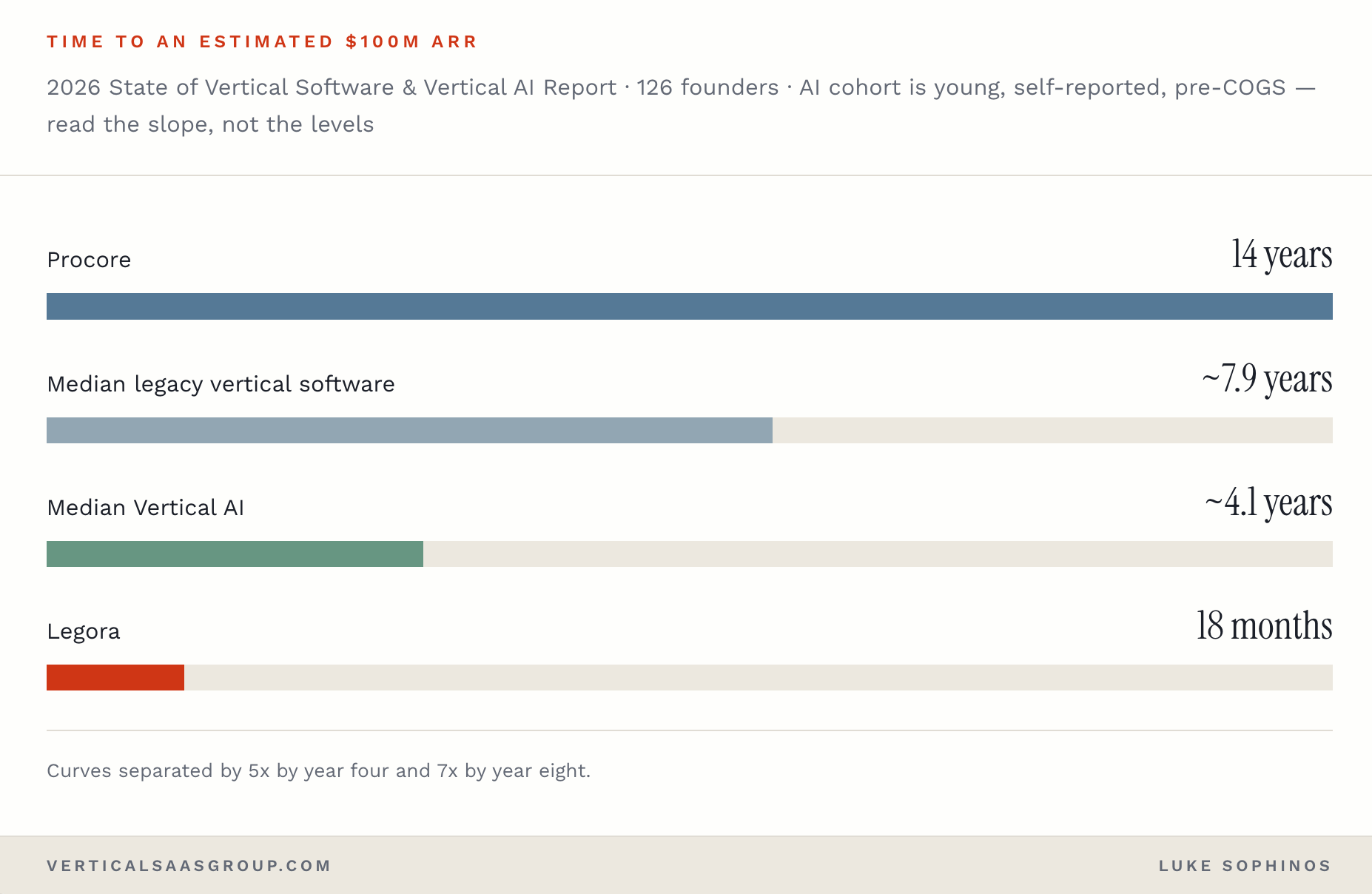
126 founders across all stages filled it out. Four of the six Vertical AI companies in the cohort crossed estimated $100M ARR in under six years. Legora got there faster than Wiz and faster than Deel. And OpenEvidence went from zero to an estimated $150M in revenue in a few months, with 300,000 doctors on the platform. Doximity, the closest thing that industry had to a fast winner, needed a decade.
Before you write this off as young-company hype, the report carries its own honest caveat: the AI cohort is young, self-reported, and pre-COGS, while the legacy medians sit against audited, mature financials. So treat the slope, not the absolute levels, as the finding. And the slope is stark.
Median Vertical AI companies hit the mark in about 4.1 years. Median legacy vertical software took about 7.9.
Two curves that start in the same place, separated by 5x by year four and 7x by year eight.
The last generation of vertical winners needed a decade to do what this generation is doing in thirty-six months.
The reason is structural, and it loops straight back to today’s breakdown. Veeva, Toast, ServiceTitan and Procore didn’t grind for a decade because they were slow. They ground because enterprise sales cycles, onboarding services, and integrations built one customer at a time were the price of admission.
Vertical AI dissolves a lot of that.
The survey also shows the market split in two: 69% of respondents are building headcount-replacing agents, 67% are building copilots, and the difference between those products is whether yours improves a person’s decision or takes responsibility for finishing the job. That second one is the write-back question from Section One, asked at market scale.
The full report is free.
All 126 founders’ worth of benchmarks, the ARR curves, the automation coverage data, every chart behind the numbers above.
Get the free report here (I can’t fit it in an email): https://verticalsaasgroup.com/stateofverticals2026q4
Happy building friends.
See you Wednesday,
Luke
Do me a solid and forward to a friend :-)