

Today’s newsletter is sponsored by Xplor Pay. Launching embedded payments is one thing. Building a program that drives merchant adoption, revenue growth, and long-term enterprise value is another. Xplor Pay’s Investor-Operator Guide to Embedded Payments examines why payments programs often underperform after launch and what high-performing vertical SaaS companies do differently.

Drawing on firsthand experience building and scaling more than 20 vertical SaaS platforms, the guide offers practical insights for founders, operators, and investors looking to maximize the value of embedded payments. Download the free guide. Heading to the Vertical Software Summit, November 4–5? Xplor Pay will be there. Let’s talk about how to get more value from your embedded payments program.
I’m sure you’ve seen 100+ posts/breakdowns by now on Anthropics IPO BUT I read the S-1 from a vertical software / vertical ai founder+operator+investor perspective. Not a stock analyst. And the filing tells you exactly what they believe and where they are headed…
The word SaaS appears 0 times.
The word agent appears 177 times.
The word legal appears 127 times.
They are doing two specific things:
#1. They are building a new intelligence layer every software company rents from.
#2. They are building the application layer for 7 verticals (today) and more in the future.
And the way they decide when to go direct should scare the hell out of anyone building on top of them.
Let’s get into it…
The Layer Every Software Company Rents From
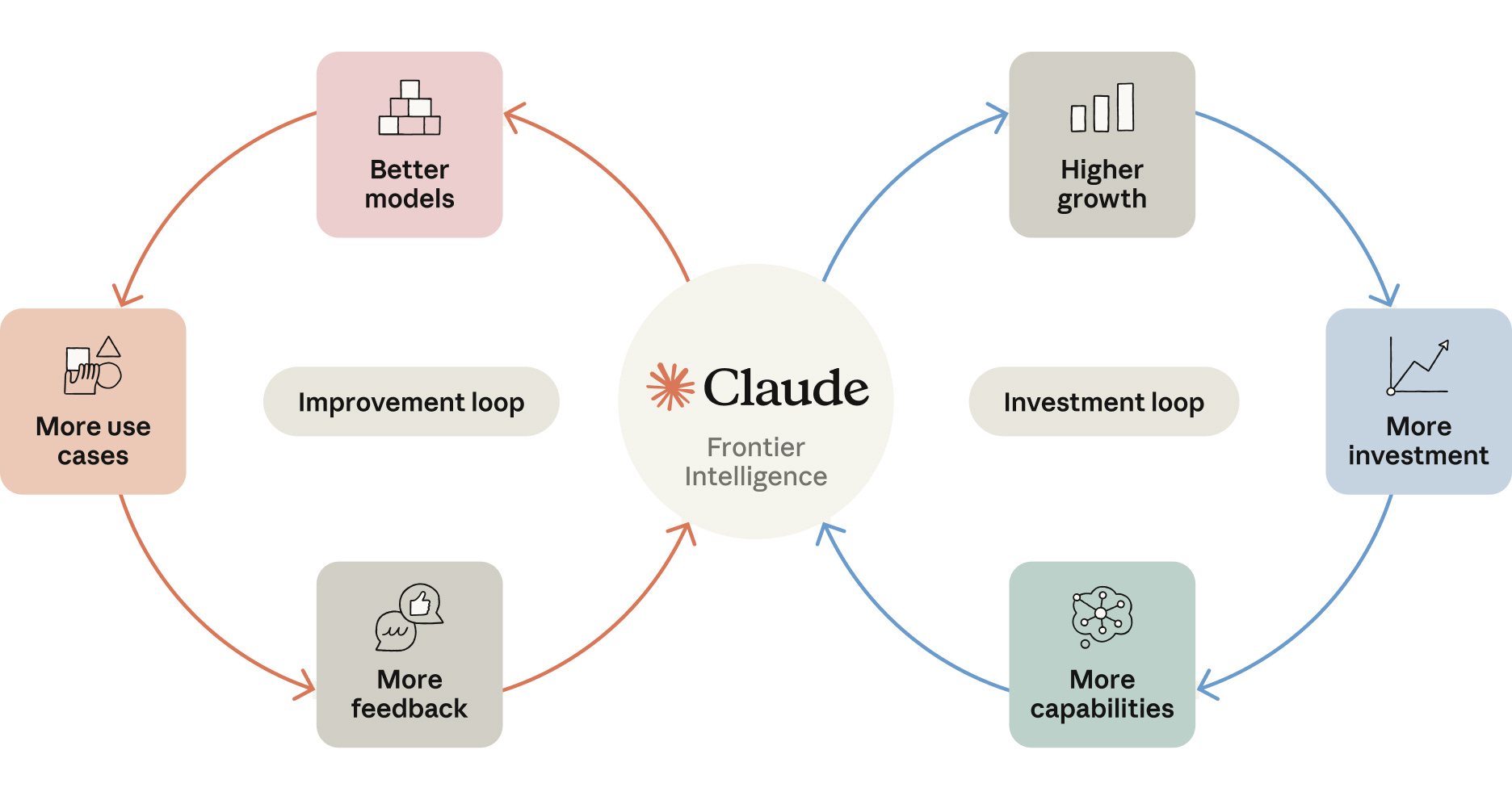
There is one page in the filing that summarizes the whole company. Not the vision page. A diagram.
Core advantages drive enterprise adoption. Adoption drives the financial model. Two loops feed back into each other.
That’s the whole thesis. Improvement loop and investment loop. A research lab that behaves like a vertical software operator drew it.
Where they think value is going. The progression chart in the business section is the clearest strategy statement in the filing.
Chatbots answer questions.
Copilots work inside one app.
Virtual collaborators take a goal and run the whole thing.
Their own example: an agent that reconciles 14,302 transactions, flags variances, drafts the MD&A commentary, builds the CFO deck, and routes it for sign-off.
38 minutes. No human in the loop.
That’s not a chat product. That’s an end-to-end orchestrator + employee.
The stack. Three layers. Models at the bottom. Platform primitives in the middle: Agent SDK, Model Context Protocol, agent skills, managed agents. First-party apps on top.
Here’s the sentence that matters:
They build first-party apps “to deliver fully integrated solutions where we
have a distinct viewpoint on the workflow.”
-Anthropic S-1
Read it again.
They are deciding which workflows to own. And they’re handing everyone else the tools to build workflows they’ll run on Anthropic intelligence. That’s the AWS playbook. Give away the primitives. Compete where the value is highest.
The default move: rent intelligence to everyone.
Start with what the filing doesn’t say. It never claims to replace software.
The revenue mix says it for them. About $3.8 billion of 2025 revenue is usage-based. Metered intelligence, sold through APIs, cloud marketplaces, and agents. That model works on any industry. That’s the point.
They believe their horizontal model is good enough to sell directly (either to a application layer provider OR direct w/o resources or industry branding) which means they don’t believe they need to build for septic pumping. Or port-a-potty rental. Or well drilling. They sell the intelligence. Somebody else does the workflow work.
The exceptions: seven verticals.
Where the horizontal layer isn’t enough, they go direct. Seven of them, named in the filing:
Financial Services
Financial Advisors
Healthcare
Life Sciences
Legal
Education
Government
And they tell you the selection criteria in one line. Vertical solutions for “industries where domain specificity and regulatory requirements make general-purpose tools insufficient.”
That line is doing a lot of work.
Regulated. Huge contract values. Top-down buyers. Workflows where model quality IS the moat. Notice what’s missing. None of the seven is the fragmented middle we all live in. No septic. No chimney sweeping. No mobile detailing. No pool service.
And here’s the tell. These verticals don’t own systems of record. The filing lists the integrations: EHRs and the CMS Coverage Database for healthcare. Relativity and Ironclad for legal. Custodial platforms for advisors.
They plug into the incumbents instead of replacing them.
The filing even describes partnering with private equity firms to push “AI services” into mid-sized companies. That’s a services business wearing a model company’s clothes.
The asymmetry nobody is pricing.
Now the structural fact. And to be clear, this is my math, not theirs. The filing never spells it out.
If you build a vertical product on Claude, you buy their intelligence at retail.
If Anthropic decides your market is worth entering, they buy the same intelligence at cost.
Same models. Their gross margin is structurally better than yours. In your own vertical.
They come close to admitting it. The competition section:
“we may from time to time compete with enterprise software and application companies in select categories.”
Select categories. That’s the hedge.
But the cost basis underneath those categories is the same compute they sell to you at a markup.
That’s why the seven verticals matter more than the number seven. They’re the markets Anthropic thinks are worth the cost of going direct. Everything else sits in the rent-don’t-build bucket by default.
Your market is safe until it isn’t.
Anthropic isn’t replacing systems of record. It’s renting intelligence to every industry at retail and entering the seven verticals it names at cost. Priced like compute. Sold like enterprise software. With a margin advantage over everyone building on top of it.

The Playbook: Pick the Workflow They Won’t Sell
If you run a vertical AI company, the S-1 is a free strategy memo. Here’s how to use it.
Pick the workflow they will not sell.
Their posture splits the world in two. Verticals they rent to. Verticals they enter. You want to live in the first group permanently. And build like you might get forced into the second.
The entry list is enterprise top-down. Banks. Hospitals. Law firms. Governments.
The fragmented middle is structurally unattractive to them. A septic pumping company with 12 trucks can’t pay usage-based frontier model pricing at Anthropic’s unit economics.
So your SMB vertical is safe from direct entry.
But not from the cost asymmetry. Somebody else serving that vertical on top of Claude gets undercut the moment your market makes their list.
Run two tests. Be honest.
Test one, the entry test. Is your workflow on their list, or likely to join it? High ACV, regulated, top-down, model-quality-sensitive? Watch your back.
Test two, the wrapper test. Could your product exist as a prompt on their platform? Then you’re a feature. And their platform primitives page is the list of features you’ll get outbuilt on at a cost basis you can’t match.
If your moat is the ugly integration, the compliance burden, the payments flow, the boots-on-ground distribution, the workflow data the model layer will never collect, you’re a business.
Rent their intelligence, own the workflow, and assume the rent can be repriced or cut off by the landlord.
Build so that switching to a second model provider is a weekend swap. Not an extinction event.
One more thing. Read their case studies like a roadmap. The filing includes them for a reason. They show which workflows Anthropic thinks are valuable enough to brag about.
Which means they show you what’s coming next…

The Proof: Two Companies, One Pattern
Two case studies in the filing tell the whole story. And they rhyme.
First, Eli Lilly. Customer since 2024. Claude rolled out to over 50,000 employees. 5x expansion since the initial deployment. Active engagement above 85% across legal, tech, finance, oncology, and research.
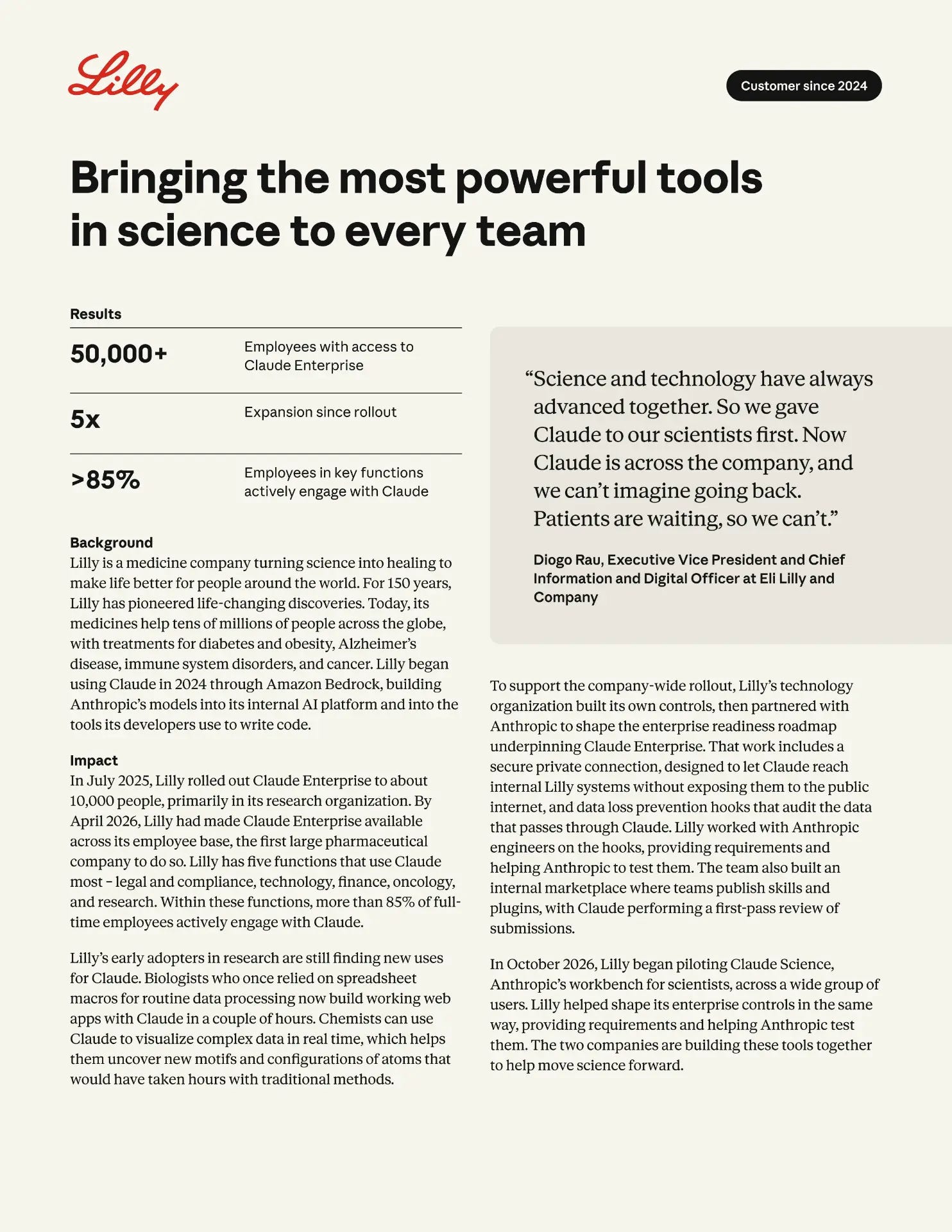
The detail that matters is the order of operations. They delivered it to scientists first. Then it diffused across the enterprise.
That’s a vertical wedge. Not a horizontal rollout. Grab the highest-value workflow in the building first. Expand outward from there.
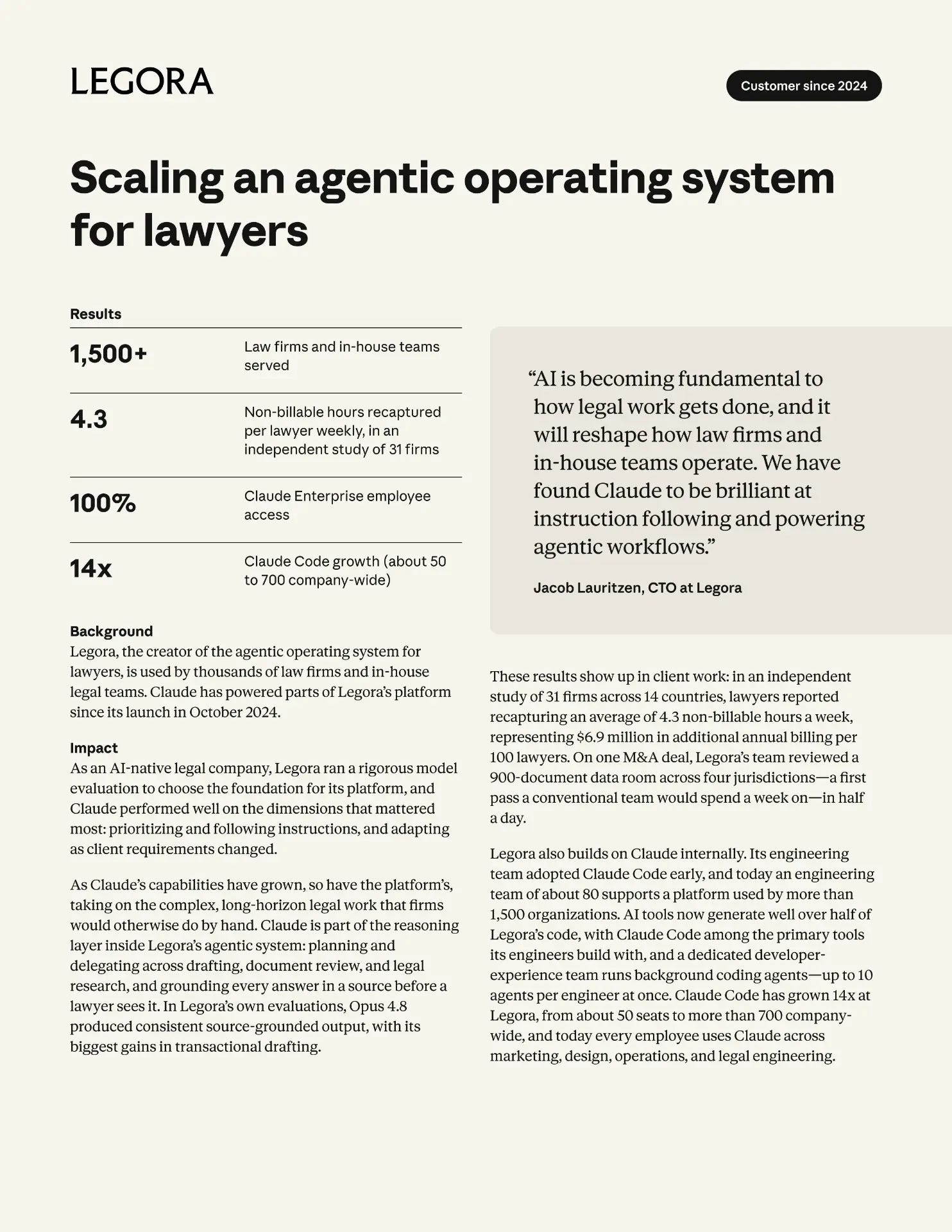
Second, Legora. An AI-native legal company that built an agentic operating system for lawyers on Claude. Drafting. Document review. Legal research with source verification.
The numbers: over 1,500 law firms served. 4.3 non-billable hours recaptured per lawyer per week. That’s $6.9 million in additional annual billing per 100 lawyers. And Claude Code adoption inside Legora grew 14x, from about 50 engineers to over 700.
Here’s the part most people will miss.
Anthropic is positioning itself in the S-1 as NOT being a competitor to Legora.
A vertical AI company built a workflow product on the model layer. Sold it into 1,500 law firms. And Anthropic captured the usage underneath.
So has Legora built a workflow so deep, so wired into how law firms actually operate, that Anthropic may have a hard time taking that relationship away without becoming a legal software company? Or is this just the first act to their own platform…
Legal is on their entry list…
That’s the question for every company in Legora’s position should be thinking about.
Especially if your industry is on their list.
Is your workflow ownership deep enough that the platform needs you more than you need the platform?
Because that’s the next decade of vertical AI. The model layer rents intelligence to everyone by default, at retail pricing. It enters only the verticals it calls out, at cost. Someone else owns the customer, the workflow, and the trust.
The question isn’t whether you work with the platform.
It’s whether you own enough of the workflow that the platform needs you.
Do me a solid and forward to a friend :-)