

Build to Last,
or Get Eaten Alive.
Everyone is arguing about whether AI kills SaaS. Meanwhile, the person who has been in the room for basically every modern software wave — PayPal, Square, and now two decades at Khosla Ventures — just dropped one of the coldest take I’ve heard on vertical AI yet.

That’s why this conversation with Keith Rabois matters. Keith is a managing director at Khosla, a former lawyer turned operator turned legendary investor, and he’s quietly assembled an incredible vertical AI portfolio: Spellbook, Rogo, Comp, Basis, State Affairs, and more. He’s also watched one of the biggest AI outcomes of the era — Cursor — get acquired, and he’ll tell you exactly why he believes their independent future was bleak.
Keith’s core argument this week: the biggest question in AI isn’t how fast you grow. It’s whether you’re building a durable, independent company, or a product the frontier labs swallow.
He also explains why he’s completely reversed his lifelong allergy to enterprise investing, why he’s bearish on AI roll-ups, and why he thinks vertical software incumbents like Toast and ServiceTitan look a lot like web-era companies facing the mobile transition.
If you’re building or investing in vertical AI, this episode will challenge how you think about your company.
It did for me…
This Weeks Vertical Titan:
Keith Rabois (Managing Director @ Khosla)
Keith’s path to this thesis is unusual for an AI investor: he started as a lawyer. He’ll tell you himself — “I’m a former lawyer” — and that background shows up all over this conversation, especially when he breaks down why most contracts that currently burn six-figure outside counsel bills are just cutting, pasting, and shuffling.
But Keith made his operating name in payments, not law. He was part of the PayPal generation and then Square, and the through-line of both companies shaped everything about how he invests: use product and marketing instead of salespeople. Target SMBs, even micro merchants. Never build a business that depends on hiring a hundred AEs who ramp on a predictable schedule.
He’s been openly blunt about it, he had an allergy to salespeople, which turned into an allergy to enterprise investing. His words: “I know nothing about selling to enterprise. I’ve never had any success doing this. Why the hell would I invest in something?”
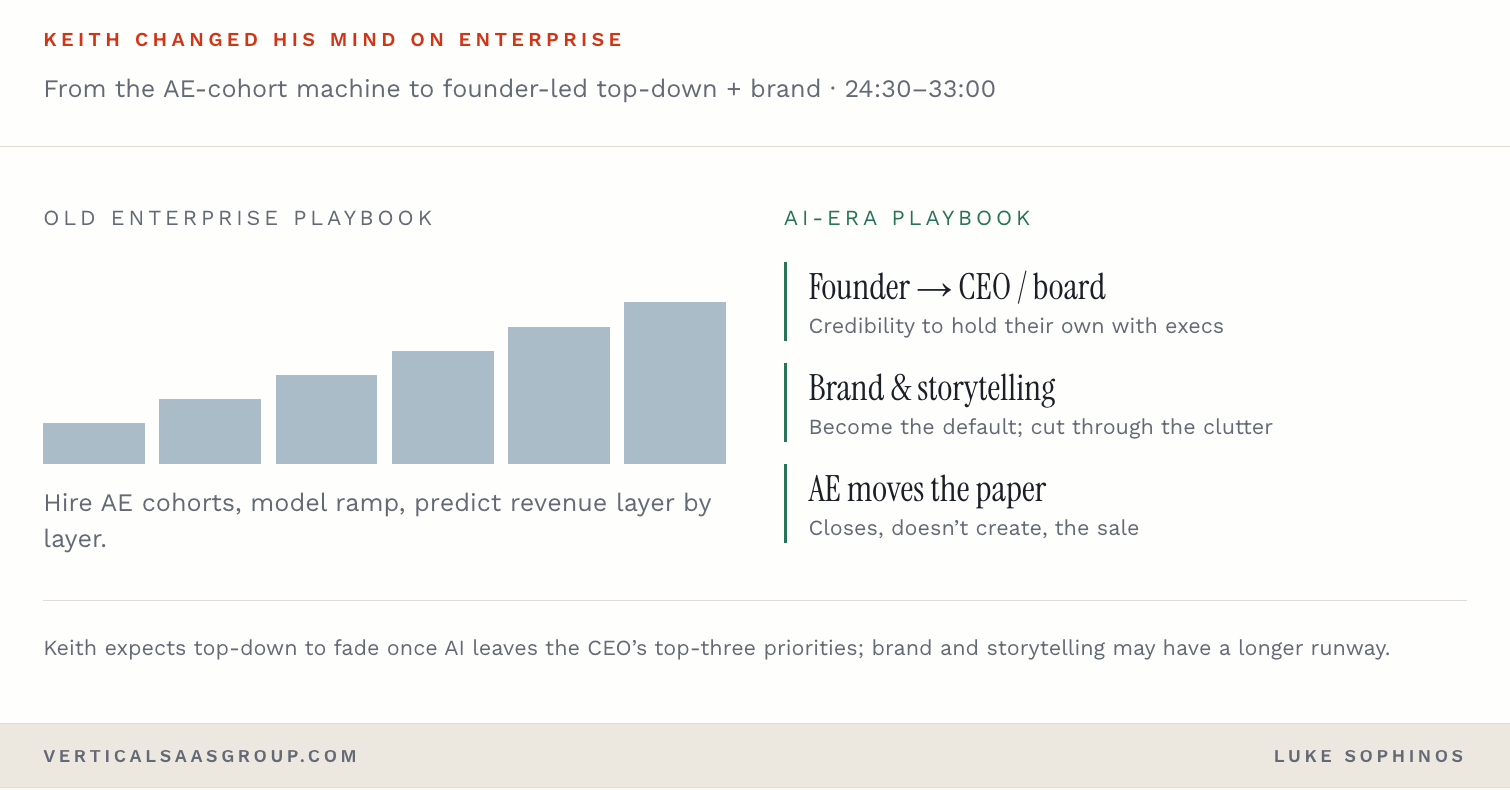
That allergy is now gone, and the reason it’s gone is one of the most important ideas in this episode. In the AI age, the fastest-growing vertical application companies are selling top-down — founder goes straight to the CEO or the board — and coupling it with brand marketing that makes them the default name in an entire industry.
That’s a GTM playbook Keith spent his career using, now bolted onto enterprise. When the playbook gets reinvented, everyone’s back at zero, and that’s exactly the kind of market he wants to compete in.
So what is he actually backing? A portfolio that almost reads as a thesis on its own:
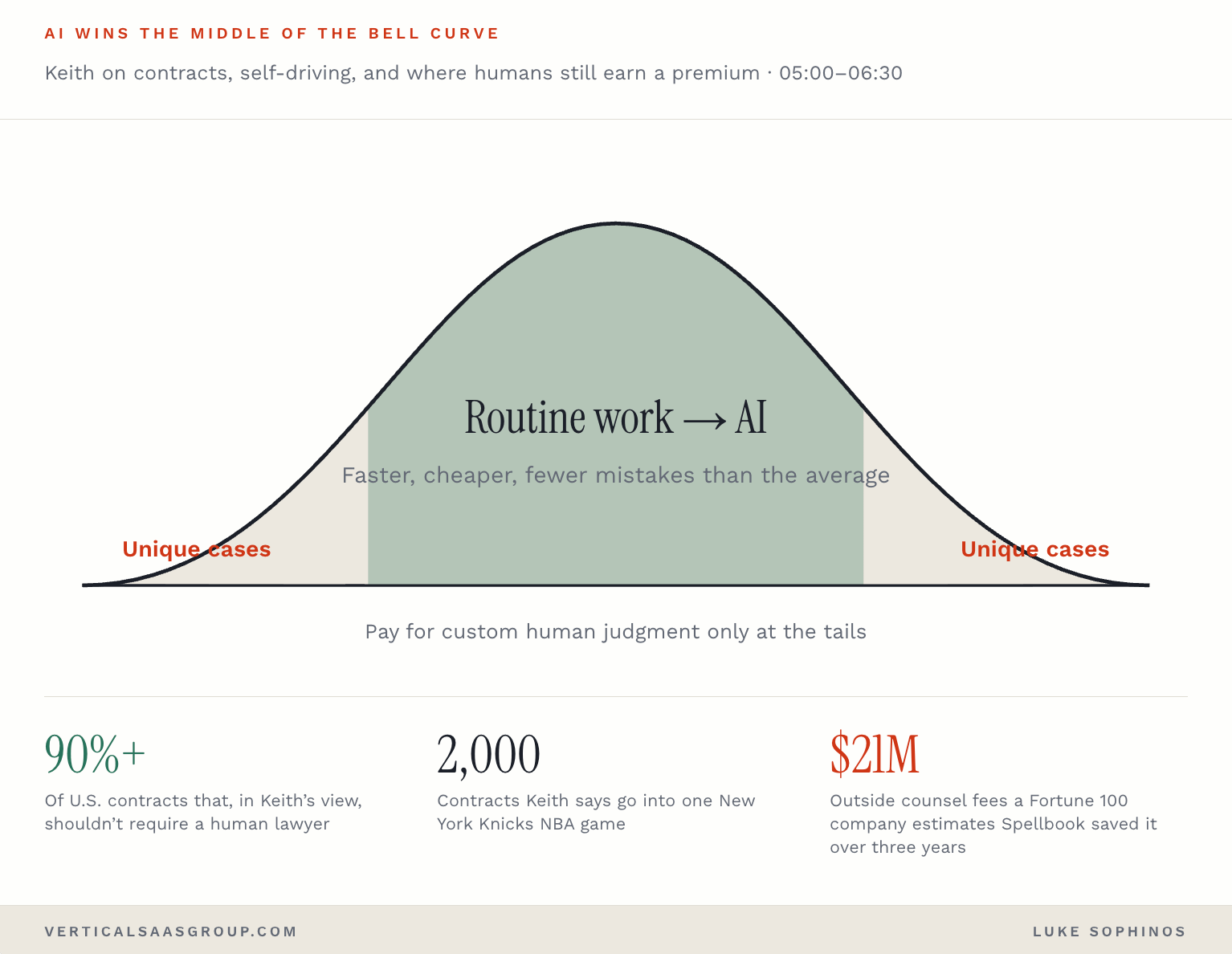
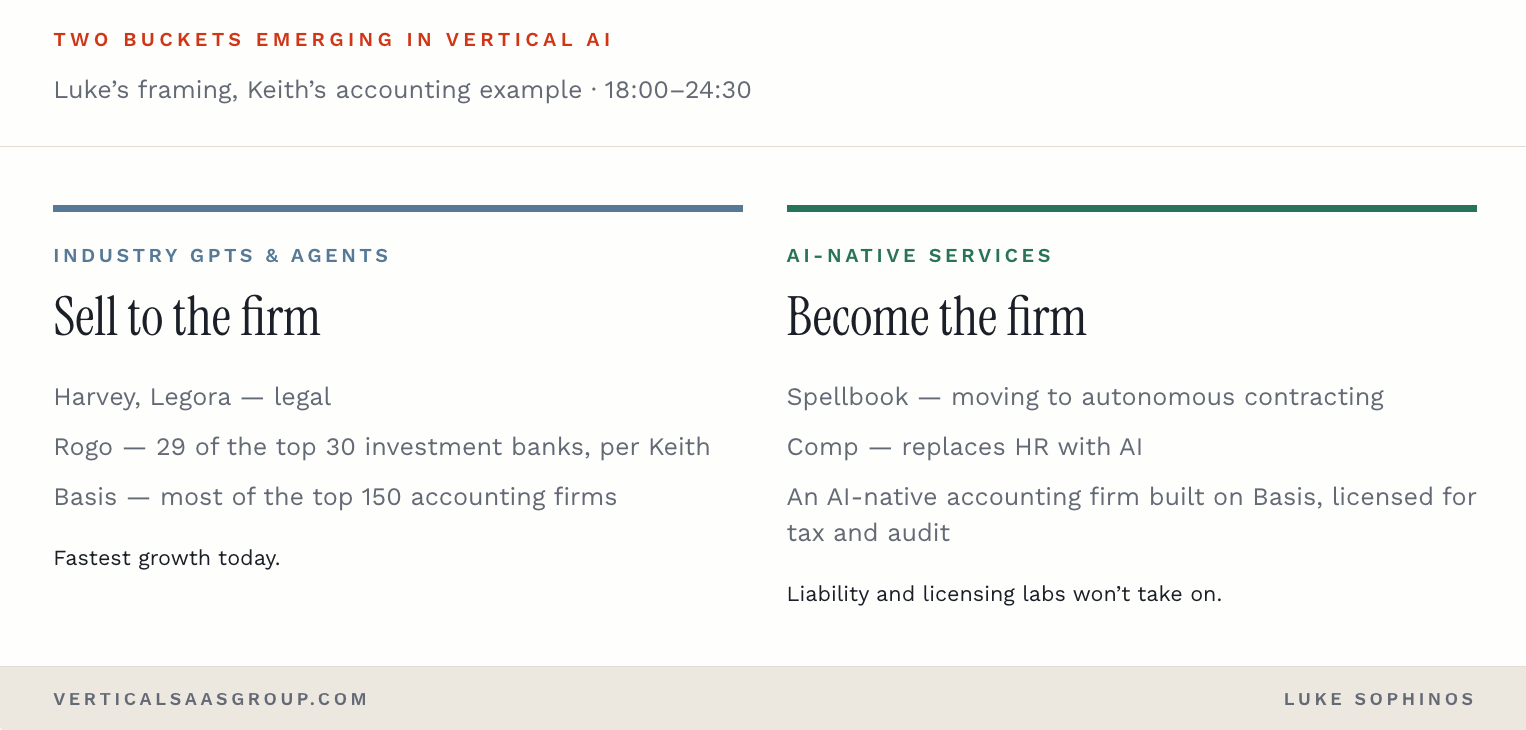
Spellbook: moving from contract copilot to autonomous contracting. There’s no reason 90-some-odd percent of contracts in the United States require a human lawyer. They saved one Fortune 100 company $21 million in outside counsel fees over three years — by the customer’s own estimate.
Rogo: Vertical AI for investment banking, now used by 29 of the top 30 investment banks in the world (Keith’s line on the holdout: “the other one eventually will”).
Comp: replaces entire HR departments with AI, launched in Brazil with large public companies, now launching in the US.
Basis: vertical AI for accounting, selling to most of the top 150 accounting firms, making closing the books “automagical” in the middle of an accountant shortage. Plus a second bet: an AI-native accounting firm built from first principles that actually runs on top of Basis.
State Affairs: legislative monitoring for the Fortune 1000, built on data that is public but not accessible.
Ramp: not classic vertical AI, but the metaphor he keeps returning to: one CFO, one app, controlling everything the finance org needs to do.
The thread connecting all of them is Keith’s underwriting question: not “how fast can this grow in 2026” but “what could this be in 2030 — and will it be a sustainable, independent company then?” Everything below is built on that distinction.

Keith’s 15 Playbooks:
Fifteen founder and investor takeaways drawn from Keith’s veiws on defensibility in the age of frontier models:
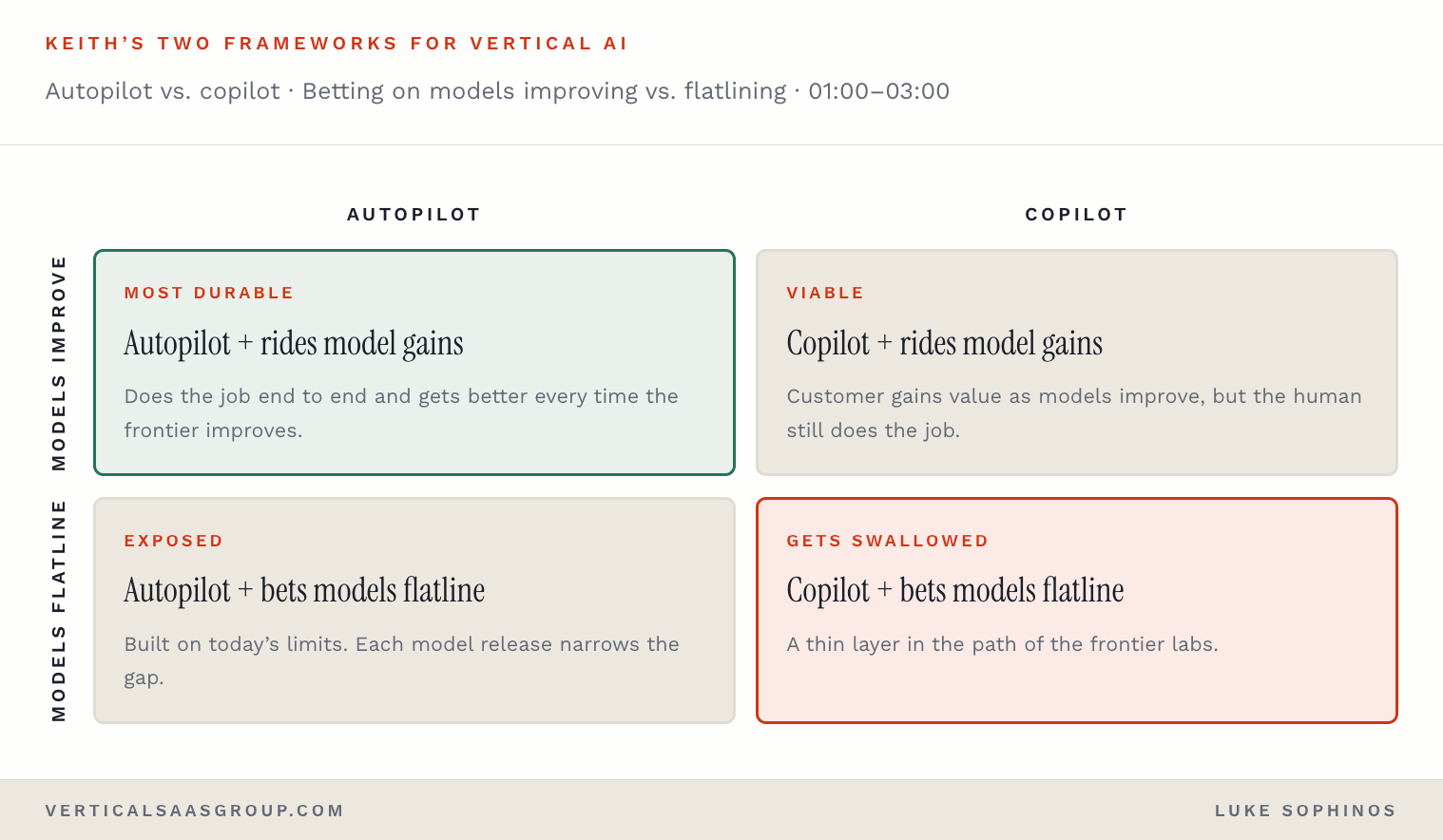
01. Autopilot beats co-pilot.
Companies that move toward autopilot — AI does the work, not assists it — are more defensible than co-pilots. Spellbook isn’t selling contract review; it’s making contracts happen “almost instantaneously, with less mistakes, less pain, and less cost than humans.”
02. Never build a business that requires frontier models to flatline.
If your strategy depends on models NOT continuously improving so you can build value on top, you’re in a bad place. Model improvement is a tailwind to ride, not a threat you hope freezes.
03. Attack the middle of the bell curve; charge for the edges.
Waymo is 5–10x safer than humans on most roads, but humans still win on roads never traversed. AI will make fewer mistakes than the average American lawyer on mundane contracts — pay humans a premium only for truly custom judgment.
04. The SAFE note lesson: standardize complexity away.
YC collapsed a $5–20K legal process into a few bullet points. Most contracts are SAFE-note-shaped. The deepest insight: the way to collapse a market’s cost structure isn’t automating the old work — it’s simplifying the work itself.
05. Own the whole workflow, not a sliver — slivers are where frontier labs eat.
Comp replaces the entire HR function. A sliver isn’t what the customer wants and makes you dependent on the frontier labs. Function-level ownership is both the value prop and the shield: “there’s no way Anthropic is going to replace HR departments.”
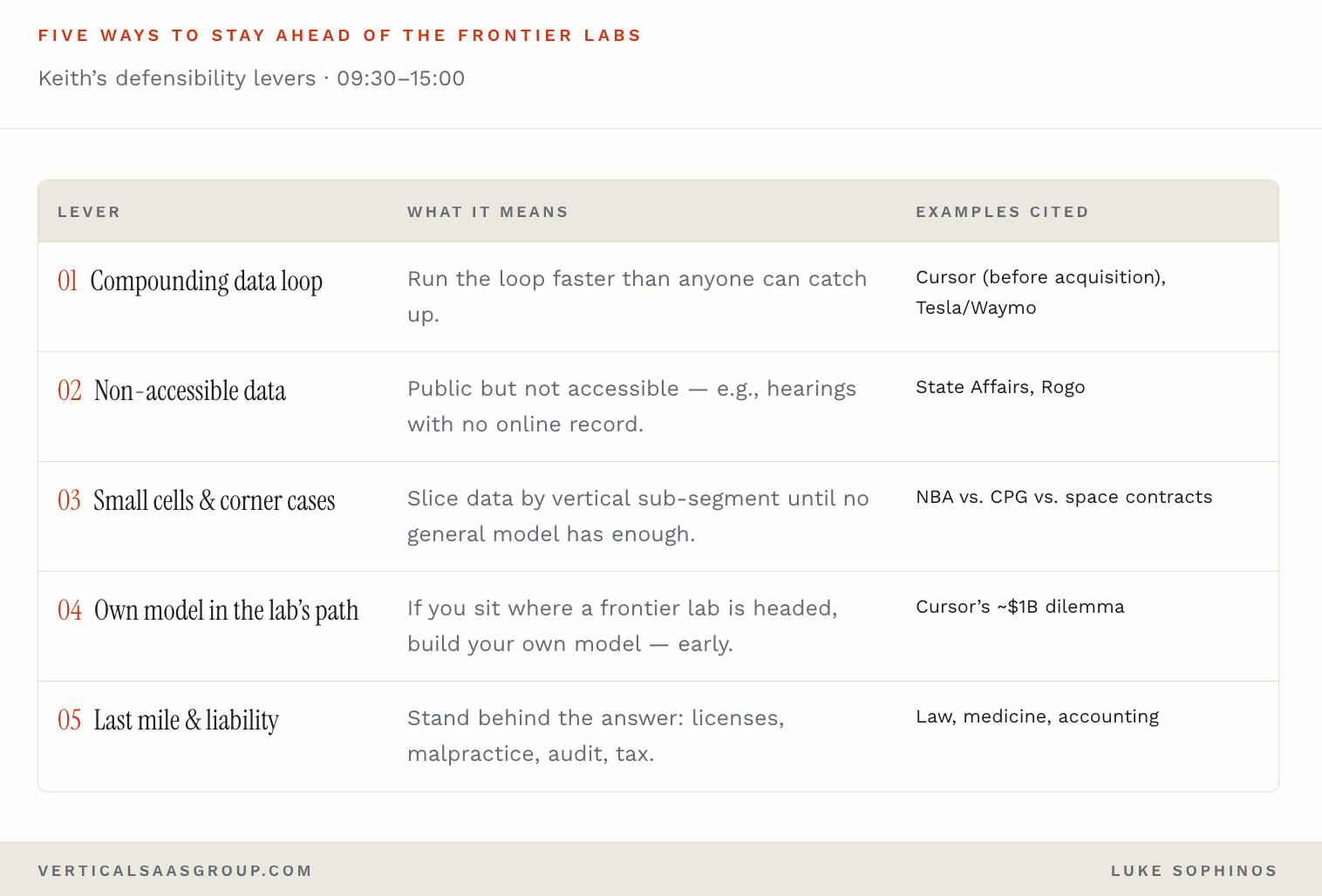
06. Compound the data loop, then slice it thin.
Cursor’s independent future was bleak because they didn’t invest fast or deep enough in their own models before the acquisition math won. The survivors: a compounding data loop, data sliced by sub-vertical (an NBA services contract ≠ a rocket-launch contract), and corner-case depth in fields like law.
07. “Public” data isn’t accessible data.
In Wisconsin, if you don’t attend the legislative hearing, the data effectively doesn’t exist online. The gap between public and accessible is a real moat against models trained only on what’s scrapable — that’s State Affairs’ entire wedge.
08. Know whether the last mile is the product.
In law and medicine, 99% right isn’t the product — someone must stand behind the answer. Getting this wrong in either direction kills you: too much service in a commodity vertical kills margins, too little in a liability vertical kills the sale.
09. Accounting has all defensibility dimensions in one market.
Closing the books is frontier-accessible (Basis). Audits require a third party by definition. Taxation carries penalty liability. One industry, three different games — Khosla funded two companies to cover them.
10. Top-down sales work because AI is on the CEO’s agenda — and that’s temporary.
Every board is asking “how do we adopt AI?” Any time you’re a top-three CEO priority, founder-to-CEO sales works. When the wave crests, that window narrows — and if you’re not a priority, top-down is actively your enemy. Brand has the longer runway.
11. One founder must be able to hold the room.
The new enterprise motion requires a founder with the credibility to go toe-to-toe with C-suite and board members. The AE moves the paper; the founder creates the sale.
12. Storytelling is the new enterprise distribution.
Up-and-coming enterprise startups being recognizable to half a podcast audience used to be a “zero” probability. Today Rogo is unavoidable in investment banking and legal AI dominates tech Twitter. Treat brand as a distribution channel with a budget line — research, content, becoming the category shorthand.
13. Work backwards from 2030, then fight for the gap years.
The industry-GPT strategy is where all the fastest zero-to-$100M stories live — but fast growth ≠ durable company. Cursor is the warning. You need traction and durability, which usually means a wedge that funds the long game.
14. Most startups need the Tesla playbook, not the Waymo playbook.
Waymo mapped every road on Google’s balance sheet. Tesla built a great car first and turned every car on the road into a free data collector. Startups without infinite capital need the wedge that’s a real business and generates the data loop as a byproduct.

15. Front-load capital only when there’s a step function.
Sequence financing around inflection milestones. If no milestone can be hit below a $50M raise, front-loading is rational. Most big raises aren’t doing that analysis — they’re absorbing market excitement.
We wrapped the conversation with Keiths Bullish / Bearish takes
Keith ended the conversation with an unusually clean scoreboard. No hedging, no “it depends” — a short list of things he’s actively bullish on, and a short list he’s steering clear of. If this episode leaves you with one exercise, run your own company through it.
Bearish:
AI Roll-Ups
“More business fundamental value is created on growth than cost reduction.” His benchmark: Ramp — seven straight quarters of 100%+ annualized growth at breakeven or better. When he ran the numbers, the only public stock with that profile was Nvidia.
Vertical Software Incumbents
Look at your home screen: the apps you use most are not the internet companies of the prior era. A new wave gets built AI-from-the-ground-up in every vertical — and every vertical has a vacant seat for that company.
Bullish:
Deep Tech
Deep tech is a risk-type definition, not a vibe. If the primary risk is “can this actually be built?” it’s deep tech; if the risk is “will customers buy at the price we like?” that’s market risk, standard software. Classify your company honestly.
Podcasts
A unique voice always finds an audience. Distribution is being rebuilt, and a distinctive point of view travels further than ever.
The episode in one line: don’t build a product the frontier labs swallow, build the company they can’t.
Autopilot over co-pilot.
Own the whole workflow.
Bet on models improving.
And make sure what you’re compounding — data, trust, brand — it’s something a general model can’t scrape.
See you next week.
— Luke
Thanks for reading LINEAR. I reply to every email…
Have any questions, feedback, comments? Let us know, we work for you!