

Today’s newsletter is sponsored by Xplor Pay. Launching embedded payments is one thing. Building a program that drives merchant adoption, revenue growth, and long-term enterprise value is another. Xplor Pay’s Investor-Operator Guide to Embedded Payments examines why payments programs often underperform after launch and what high-performing vertical SaaS companies do differently.

Drawing on firsthand experience building and scaling more than 20 vertical SaaS platforms, the guide offers practical insights for founders, operators, and investors looking to maximize the value of embedded payments. Download the free guide. Heading to the Vertical Software Summit, November 4–5? Xplor Pay will be there. Let’s talk about how to get more value from your embedded payments program.
Alright, let’s get to it…
Every industry is going to pick its AI platform over the next few years.
For most of them it will be a pick that lasts for a very long time.
There are only three potential winners in every industry:
The frontier labs. The incumbents. The AI-native upstarts.
In every vertical one of them wins. Which one it is depends on the industry, the team, the strategy, and the execution. Not on who has the best model.
Nobody can name the winners yet. Anyone who says they can is selling something. What you can do is learn what each one is good at, where each one breaks, and which conditions inside an industry push the outcome one way and leverage that know-how to emerge the winner.
That’s this week…

The three-way race for the industry platform.
For years, the vertical SaaS pitch was pretty straightforward. Build the system of record. Get the customer to put their business in it. Layer on payments, payroll, and other products. Become very hard to rip out.
AI opens another door. Instead of asking someone to buy a better database, you can offer to do the work.
Scenario #1: The frontier labs suck up the industry
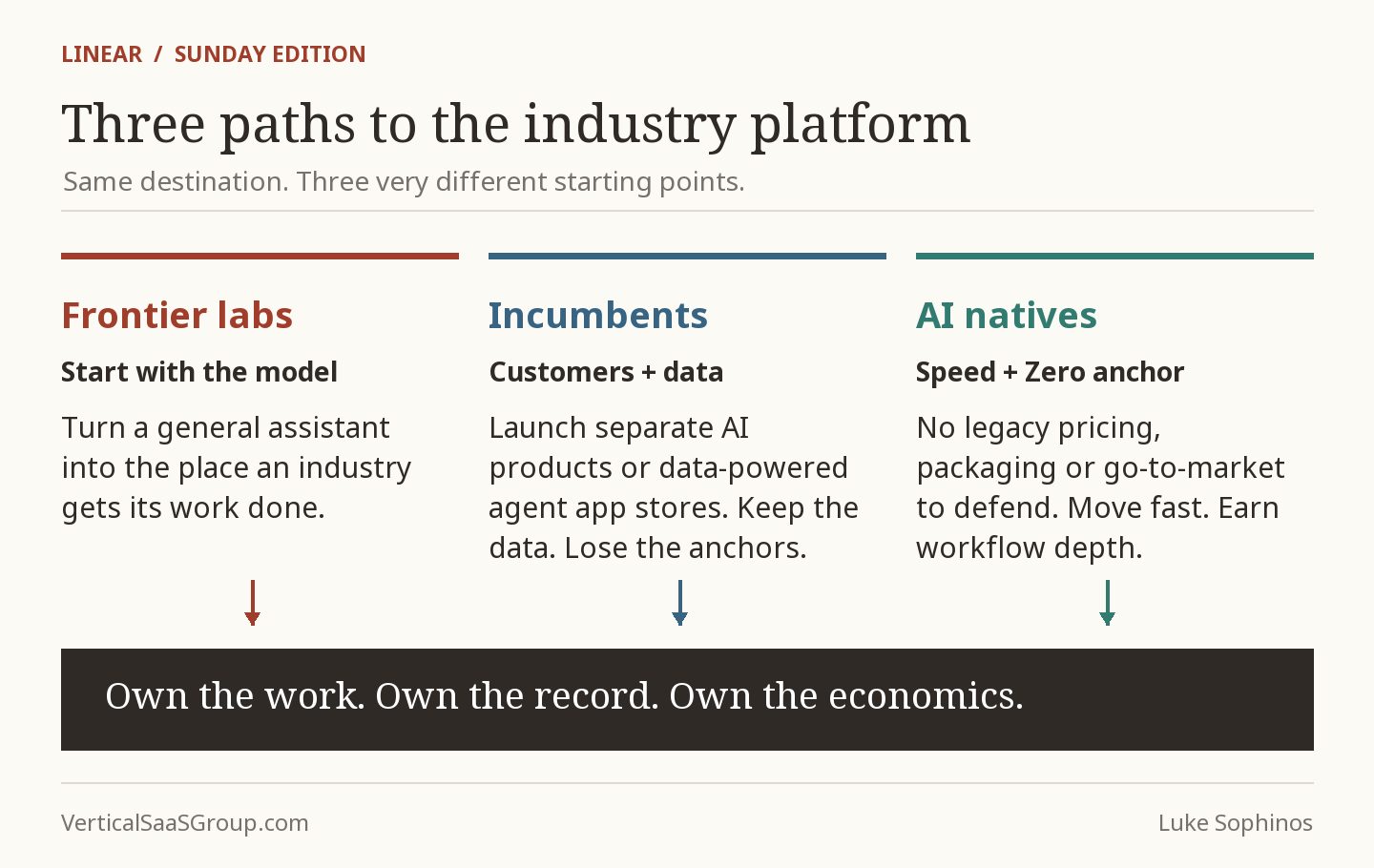
This one usually starts in industries where most customers already have ChatGPT or Claude open. Typically those are industries with heavy knowledge work and a lot of screen time in the day to day. The model gets better. It gets access to the customer’s files and tools. Then it starts completing the industry-specific tasks they used to buy separate software for.
At some point, the customer asks a very uncomfortable question: why am I paying for another application?
The lab does not need to rebuild every legacy database on day one. It can become the work surface above those databases. If the customer starts every task there, it has a shot at owning the relationship.
But the missing pieces are industry-specific UX/UI, industry-specific go-to-market, and an industry-specific brand. A model that can do the work is not the same thing as a product the customer knows how to use, knows how to buy, and trusts with their business.
There is a big assumption underneath this entire ecosystem: the model companies have to leave room for the companies building on top of them to make money.
If they decide the application market is winner-take-all, that assumption gets shaky. Your supplier becomes your competitor. It controls what you pay for the model while deciding what to charge the customer for its own product.
Theoretically, a lab could give its competing application away for free to win the market. You still have an API bill, support costs, and a business to run. Matching free can mean losing money on every customer.
Free does not mean the lab has no costs. It means it can choose to absorb them or subsidize the product from another part of its business. It does not even need to raise your API price to squeeze you. Cutting its own application price can do the job.
That is why it matters so much how the labs see this market. If they want a healthy ecosystem, their partners need workable economics. If they want every customer relationship for themselves, the companies renting their intelligence could find it impossible to make money.
Scenario #2: The incumbents use AI to keep the customer
The incumbent already has the records, the permissions, the billing relationship, and the customer’s trust. Those are real advantages. Especially in industries where moving systems is painful and mistakes are expensive.
But installed distribution is only useful if you turn it into a better product. A chat button sitting beside the same old workflow is not a defense.
I think the better move is to spin up a separate AI product. Keep the data advantage. Leave the historical pricing, packaging, and go-to-market behind. The new product should not need permission from the old revenue model to win.
Or become the platform other agents build on. Give them permissioned access to the industry’s data, build an agent app store, and charge a toll-road tax. You do not have to build every agent if you own the road they need to travel.
Scenario #3: The AI natives take the industry
The starting edge is speed plus zero anchor. No existing pricing to protect. No packaging to preserve. No old go-to-market motion telling you how the new product has to be sold.
Workflow depth is something the upstart has to earn. Its advantage on day one is the freedom to move faster and build the business around what AI can do now.
That industry agent is the wedge. The system of record gets built underneath it as customers hand over more of the workflow.
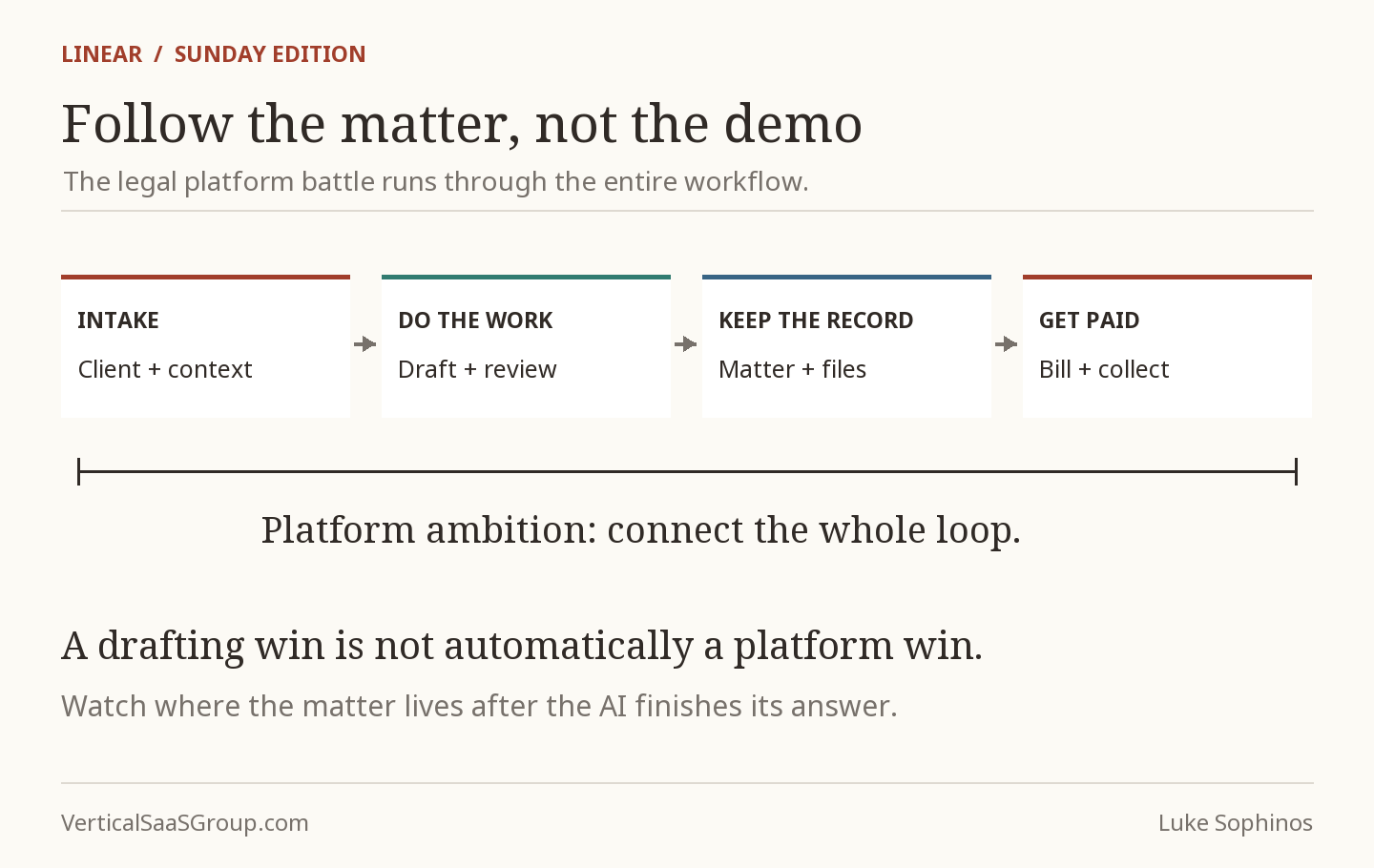
First you draft the document. Then you manage the matter. Then you own the client record and the invoice. Not every company gets through that sequence. But that is the platform ambition.
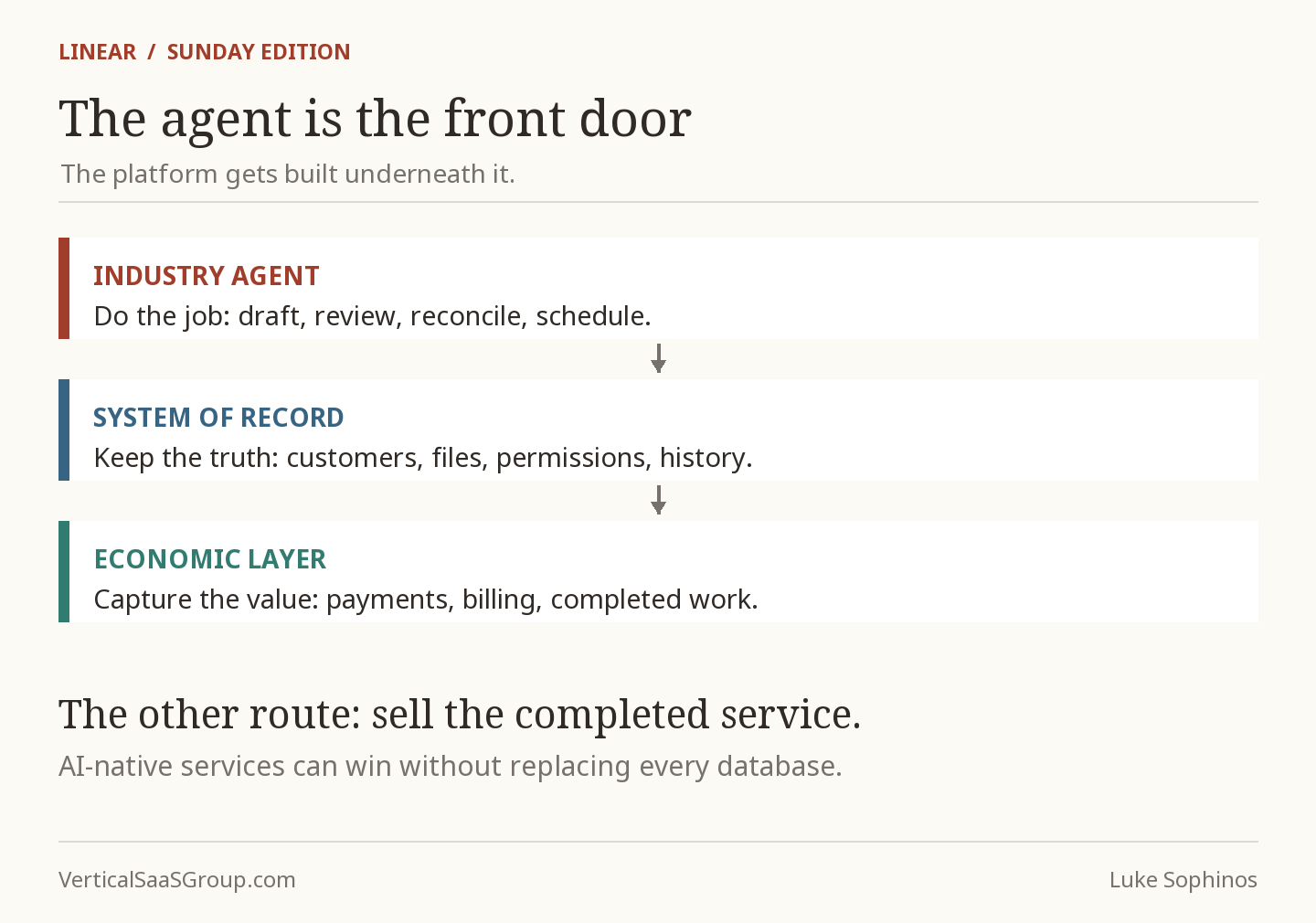
There is another version of the upstart: the AI-native services business. It does not sell software seats. It sells the completed job, with software doing more of the work behind the scenes.
That company can win the customer’s budget without owning every record. A great specialist can also build a very good business without becoming the whole platform. This is not a prediction that every other company disappears.
5 seats left for the Vertical Software Summit.
We will sell out in the next ~24 hours.

How each bucket wins.
If I were building in one of these industries, I would start with the customer, not with a model comparison.
Where does the work begin? Who holds the useful context? Who gets blamed when the answer is wrong? And how much pain will the customer tolerate to switch?
If you are an incumbent, keep the data and lose the anchors
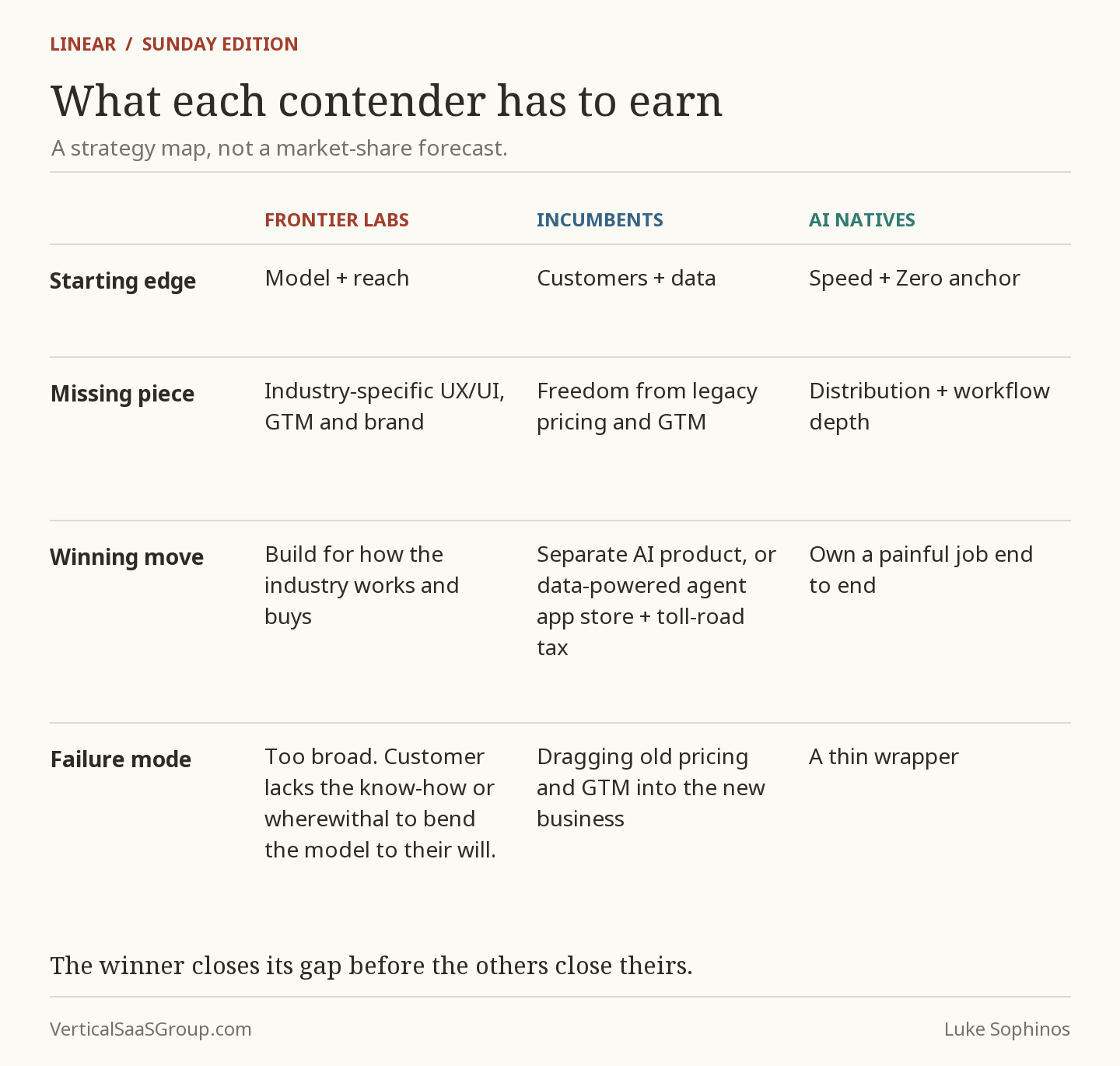
I would spin up a separate AI product. Not another tier bolted onto the old pricing page. A product with its own pricing, packaging, and go-to-market, built around the work AI can now complete.
Your historical business should not dictate how the new one gets sold. If an agent does the work of five seats, charging for five seats is not automatically the right answer. Let the new product find its own economics.
What you absolutely should carry over is the data advantage. Years of industry-specific records, context, and outcomes can make the AI dramatically more useful. The ambition should be to use that dataset to make the AI 100x better for your customer, not to decorate the old product with a chatbot. That is the target, not a measured claim.
The other opportunity is an agent app store. Let specialists build agents on top of your permissioned data and integrations. They build the applications. You own the rails and charge a toll-road tax.
That could be a fee on paid agent usage or a share of transactions. The point is to get paid when work moves through your platform, even when someone else builds the agent.
Keep customer permissions and data boundaries intact. A data advantage does not mean handing every developer every customer’s records.
The failure mode is dragging historical pricing and go-to-market into the new business until it moves like the old one. You have the dataset the upstart wishes it had. Do not attach the anchors it is happy to avoid.
If you are an AI native, go narrow before you go wide
Use the speed. Use the lack of anchors. Test a new price, a new package, or a new way to reach the customer without checking whether it cannibalizes a decade-old business.
Find the job people hate doing and already spend real money on. Own it end to end. Not the first draft. Not the demo. The finished, checked result.
Measure what the customer cares about: time saved, work completed, money collected, errors avoided. Get close enough to the workflow that you learn the exceptions nobody put in the spec.
Then expand into the adjacent work. Capture the records your agent needs. Become harder to replace because you understand the business, not because you made the export button hard to find.
If you take the services route, own the delivery too. The customer is buying the result. Your margin depends on what it costs to produce a reliable one, including the human review.
The upstart path is strongest where existing software barely touches the actual work and the labor bill is much bigger than the software bill.
Another path: build an industry-specific LLM
You do not have to outbuild OpenAI/Claude at everything.
You can build a model that is better suited to the work your industry actually needs done.
That might mean adapting an open-weight model, fine-tuning a model with a partner, or training a specialist for a narrow, valuable task. The inputs matter: industry data you have the right to use, expert feedback, and tests that reflect the real job.
The goal is not to win a general benchmark. It is to produce a reliable result at a cost that leaves you a margin.
But be honest about what you own. A custom model built with a frontier lab is not automatically an independent model you can run wherever you want. Hosting, licensing, and inference costs still matter. Owning more of the model layer only reduces supplier leverage if you actually control how it gets deployed and what it costs to serve.
I would test the business against two scenarios: your model bill goes up, and your model supplier launches a competing product at zero dollars. Can you switch models? Can you serve some work yourself? Does the customer still pay for the industry product, the context, and the result?
None of this requires every upstart to train its own frontier model. But your business has to survive the next model release and the next pricing decision. Those are two different risks.

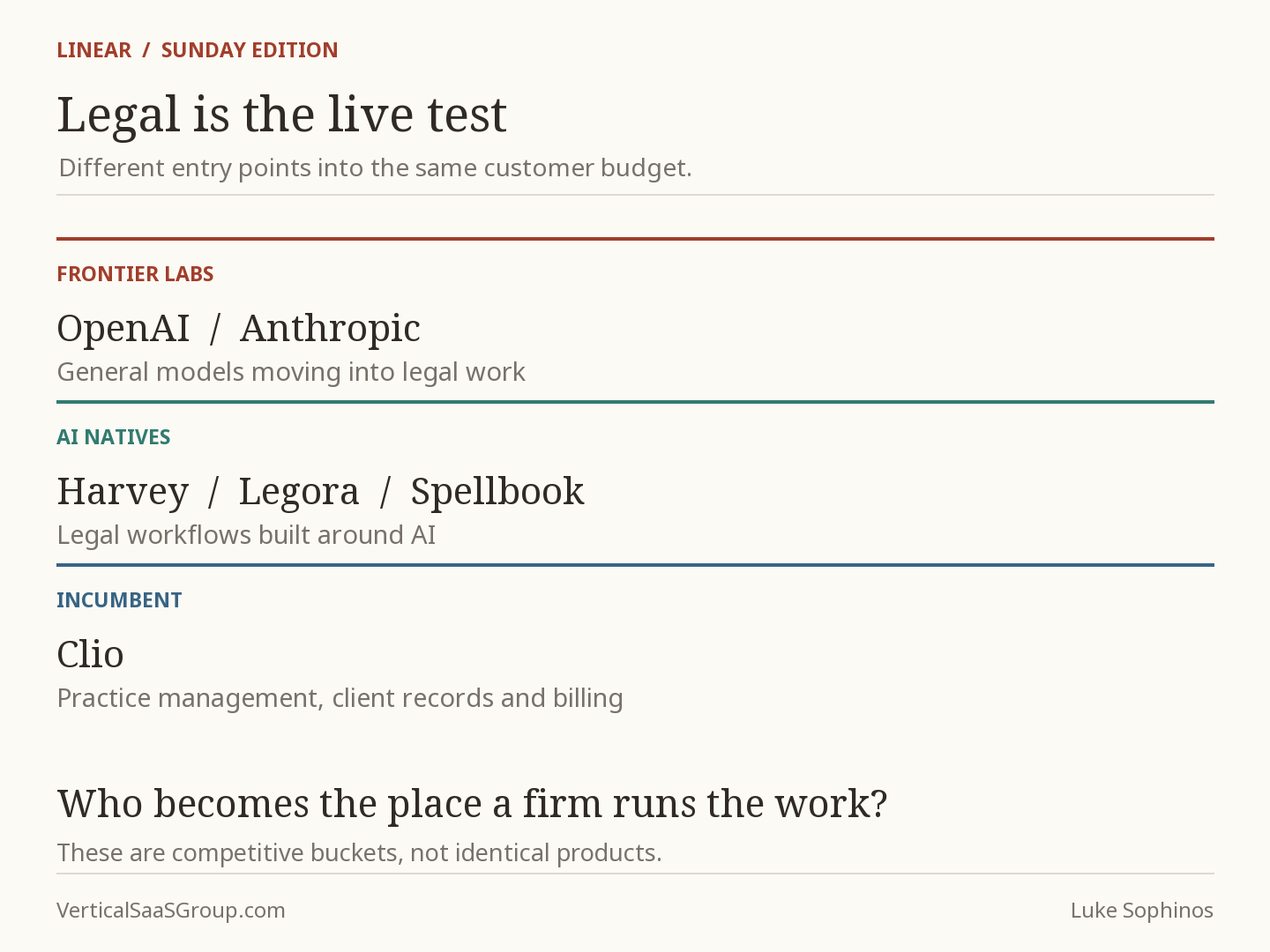
Legal is the first vertical where we are watching this play out.
You have the frontier labs: OpenAI and Anthropic moving into legal work.
You have the AI native upstarts: Harvey, Legora, Spellbook, and plenty of others.
You have the incumbent: Clio.
Three starting points.
An increasingly overlapping ambition.
The labs have a straightforward opening. Legal work is full of documents, language, research, and reasoning. Those are exactly the tasks frontier models are getting better at. The more useful the general tool becomes, the more work a lawyer may try to do there first.
The AI natives are betting that a model alone is not the product.
Harvey’s platform spans legal research, drafting, review, document analysis, and workflows. Legora is building around connected legal work, including document understanding, organizational knowledge, and intake. Spellbook has a particularly clear wedge in contract drafting and review inside Microsoft Word.
Harvey is also an example of the industry-specific model path. OpenAI has documented its work with Harvey on a custom-trained case law model. This is not just a legal interface sitting on a general-purpose model. It is an effort to specialize the model itself for the work. [1]
Harvey has also described co-building a tax assistant with PwC and OpenAI using custom models and expert feedback. The direction is clear: industry knowledge can shape the intelligence, not just the screen around it. [5]
That does not mean Harvey has built an independent foundation model or eliminated its dependence on model partners. It means the upstart has another place to compete: the industry-specific model layer, alongside the product, brand, and go-to-market.
These are not interchangeable companies. A contracts tool, a platform for a large firm, and a practice-management system can serve different buyers and different parts of the day. But each successful wedge puts its owner in a position to ask for more of the workflow.
Then there is Clio. It starts on the other side of the problem. Matter management. Client information. Time tracking. Billing. The operational record of the firm.
Clio’s October 2025 announcement of Clio Work tied legal intelligence to matter and practice data. That shows why the incumbent’s dataset matters. My bet on the next move is a separate AI product that uses that context without inheriting all the old commercial rules. Or an agent ecosystem that pays Clio for access to those rails. That is the opportunity I see, not a claim that Clio has already done either.
The frontier labs can also supply models to the upstarts. An incumbent can buy or partner with a specialist. These buckets compete for the customer while doing business with each other.
That makes the race more interesting, not less.
Here is what I am watching.
Not which company has the best answer to a legal question in a demo. Where does the lawyer go when a new matter arrives? Where does the work get assigned? Where does the approved document live? What system sends the bill?
If the lab owns the place lawyers do the work and everything else becomes a connected tool, the lab has the leverage.
If the AI native owns the workflow, the context, and eventually the record, the upstart has the leverage.
If Clio turns its data into a better standalone AI product, or the rails an ecosystem of agents pays to use, the incumbent has the leverage. The advantage is the data. The old pricing and go-to-market do not have to come with it.
Legal has not produced a single, settled winner.
And the winner for a solo attorney may not be the winner for a global firm.
That is the point. In every vertical, one of these groups becomes the platform of choice. Which one wins depends on the industry, the team, the strategy, and the execution. Not on who has the best model.
And if you are building on someone else’s API, watch their economics as closely as their capabilities.
You need a better product and room to make money selling it.
Someone is going to become the platform your industry runs on.
Do not assume it is the company that owns it today.
That is the question I would be asking in every vertical right now.
And man, I would be planning strategy accordingly…
Do me a solid and forward to a friend :-)