

Last week to get your tickets to Vertical Software Summit…
If you don’t pull the trigger this week, you’ll miss the boat
on the Superbowl of Vertical Software!
Low-Tech Markets.
High-Trust Moats.
Every founder is asking some version of the same question right now: if AI makes software easier to build, what stops my customer — or the next startup — from replacing me?
But there’s a big difference between a person who spends all day at a desk and an outfitter who’s running a lodge, coordinating guides, and scouting from a truck. The second customer doesn’t want to become a software builder. They want the business to run.
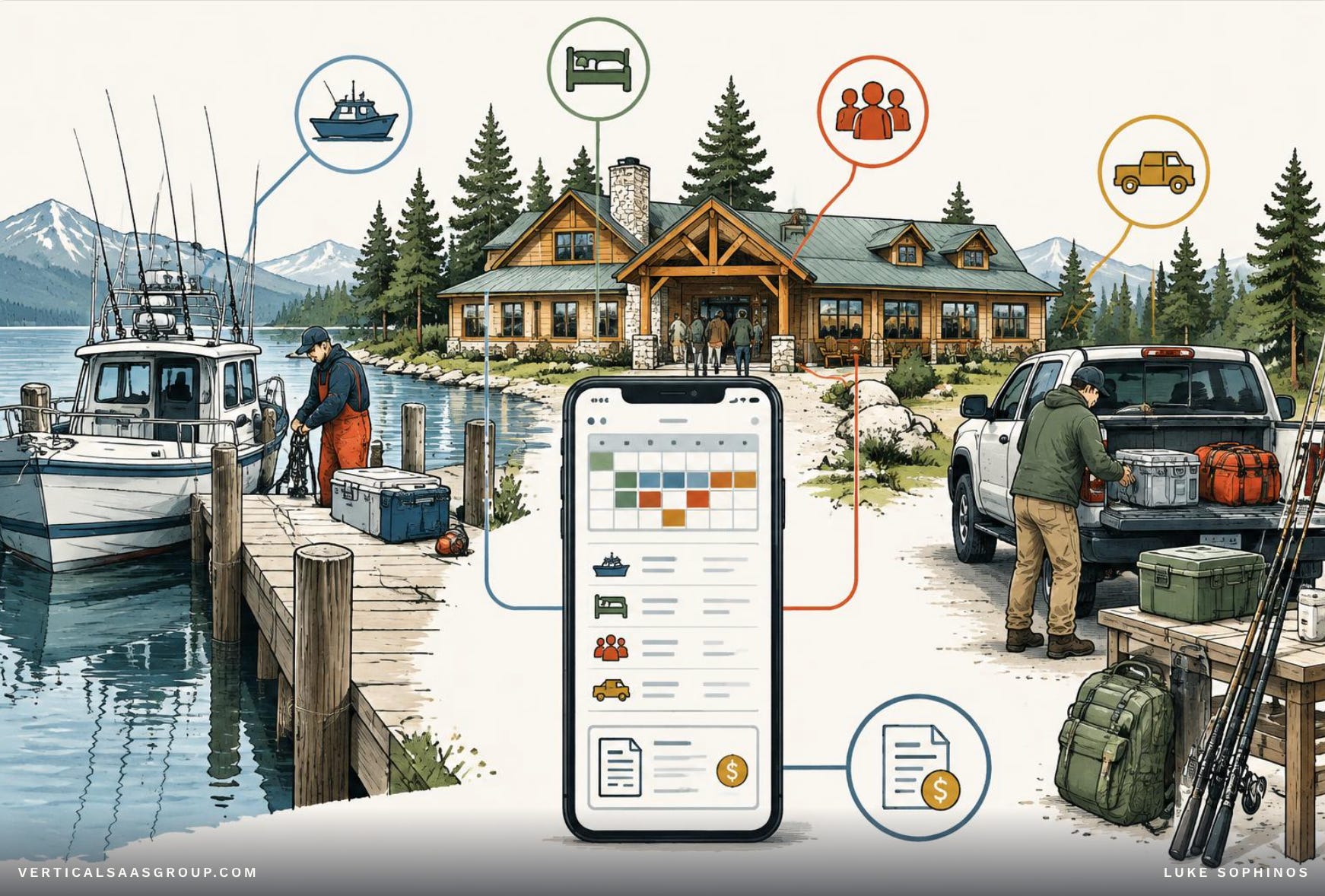
That doesn’t make low-tech markets immune to AI. It makes the opportunity different. The model labs are teaching customers what’s possible. The vertical platform has to turn that curiosity into actual work: a booking, an invoice, a report, a follow-up.
This week on Verticals, Nic and I sat down with Joel Moreau, co-founder of Mallard Bay, to talk about what that looks like in one of the most overlooked corners of vertical software: outfitters, fishing charters, and adventure lodges.
We dug into the moat beyond the software, onboarding that no longer takes weeks for some operators, the shift from software budgets to operating outcomes, and why a room full of guides eating crawfish might be a better distribution strategy than another polished sales demo.
The throughline wasn’t a better model. It was trust. In low-tech markets, you don’t win by asking customers to become more technical. You win by making the technology useful on their terms.

This Weeks Vertical Titan:
Joel Moreau (Co-Founder @ Mallard Bay)
Joel grew up on a ranch in West Texas, watching his uncle operate an outfitter. His co-founder ran a duck hunting lodge in Louisiana. Mallard Bay started while the team was at LSU, initially as a marketplace for outdoor trips. In the conversation, Joel describes it as a roughly five-year-old business with a roughly three-year-old SaaS motion.
That background matters. The team isn’t trying to learn this customer from a spreadsheet. Joel says many of their account managers and account executives have outdoor-industry experience themselves. One runs a fishing charter in Louisiana.
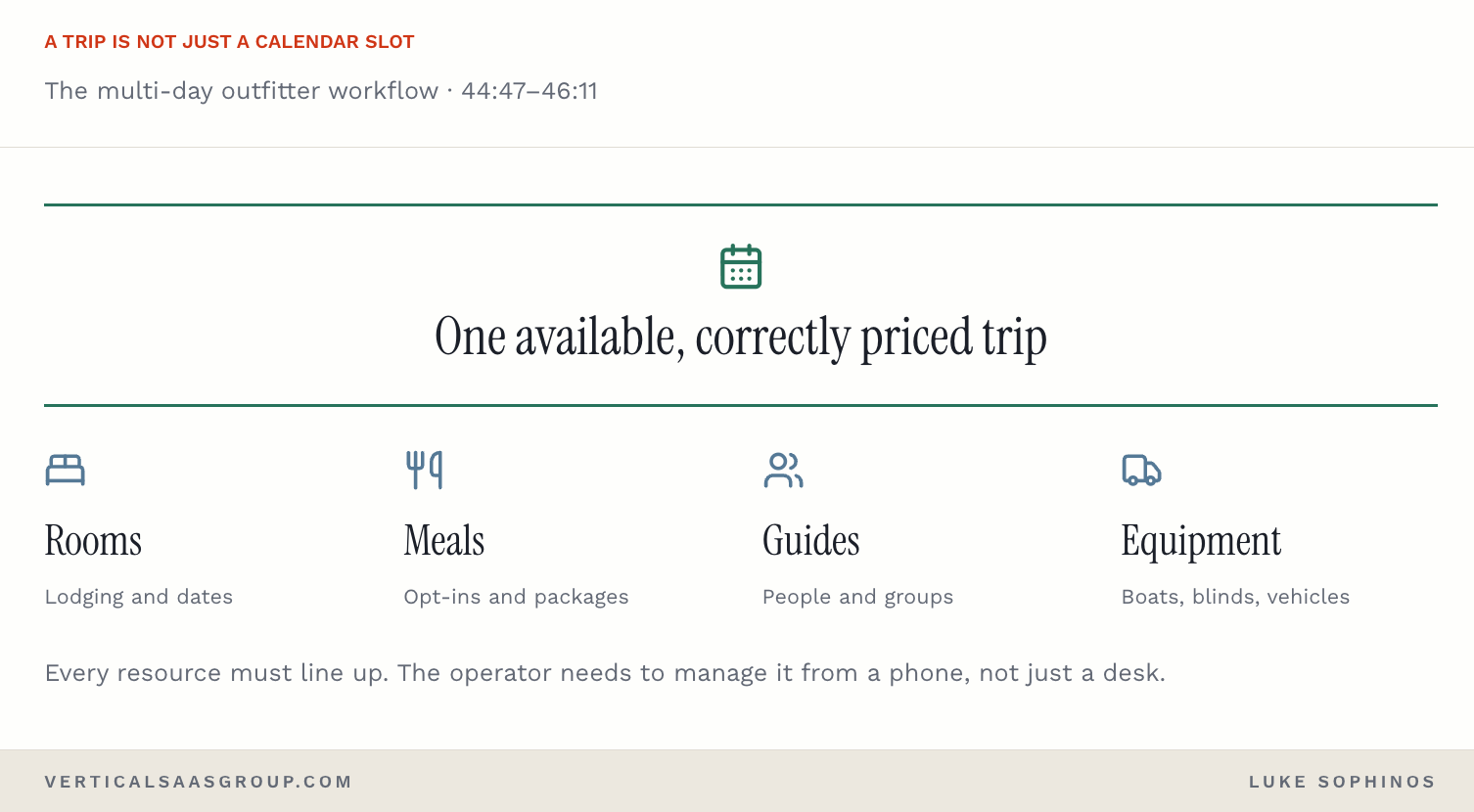
Today, Joel says Mallard Bay serves about 600 outfitters across North America. Its platform brings together payments, calendars, resource management, CRM, and the pricing and packaging these businesses need. These aren’t always simple one-hour activities. They’re often multi-day experiences with rooms, meals, guides, boats, vehicles, and groups that all have to line up.
The customer can be running something that looks like a boutique hotel with an activity business layered on top — without ever owning a laptop. That’s why mobile access and purpose-built workflows aren’t cosmetic product choices. They’re the difference between software that works in this market and software that doesn’t.
Mallard Bay’s in-app assistant, Suzy, is becoming another way to get work done: help build listings, understand availability, create reports, and support sales and marketing. Joel says it is some operators’ first real interaction with AI.
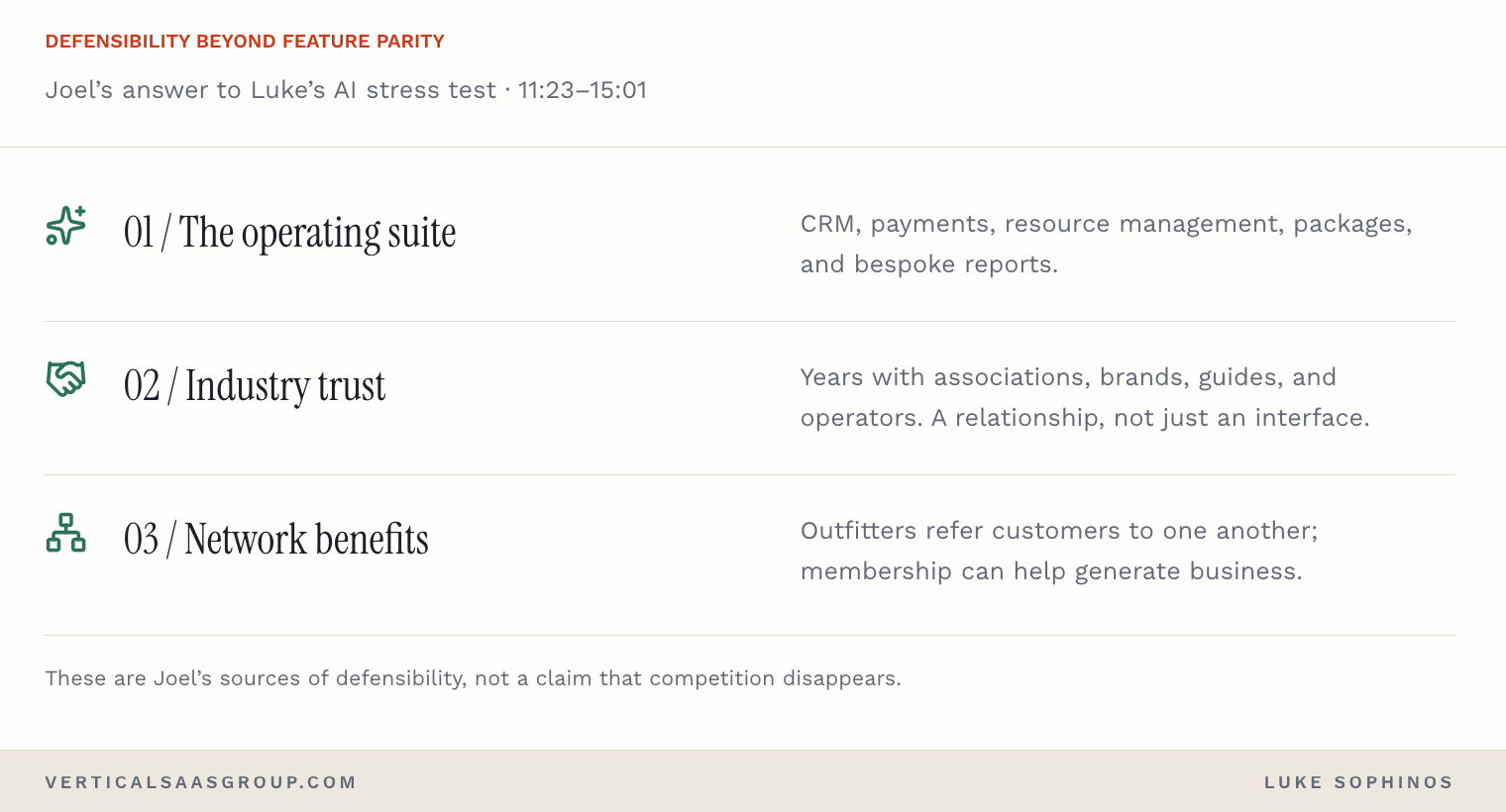
His answer to the defensibility question is layered: build the complete operating suite, earn the industry’s trust, and add network benefits that help customers grow. A competitor can match a feature. Matching five years of relationships is a different problem.

Joel’s 15 Playbooks:
Sixteen founder takeaways drawn from the conversation — an editorial synthesis, not a numbered framework presented by the speakers. Reported results, hypotheses, and experiments are kept distinct.
01. Don’t confuse AI curiosity with a customer building your replacement
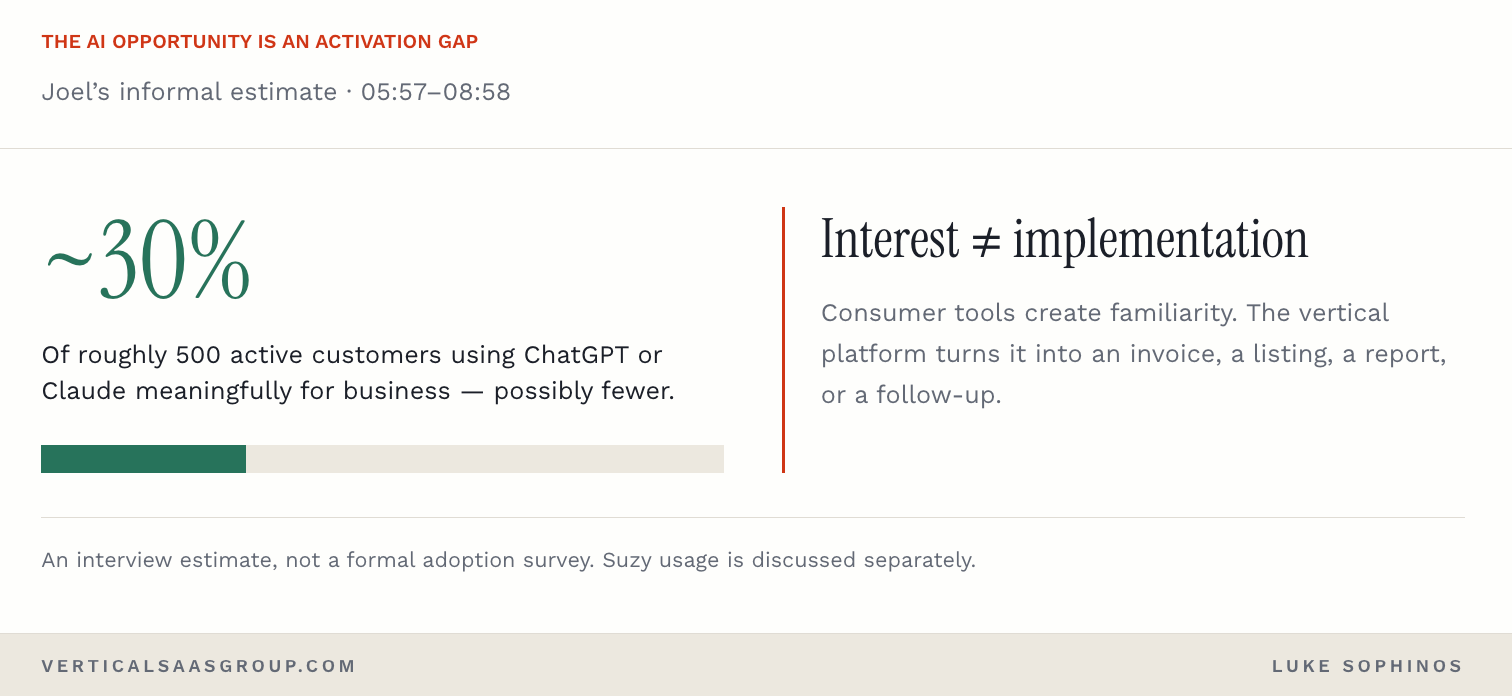
Joel is seeing more operators use ChatGPT and Claude for research, graphics, and marketing. He isn’t seeing his customer base vibe-code its own operating systems. His informal estimate is that around 30% of roughly 500 active customers — possibly fewer — are using those tools in a business-beneficial way beyond basic experimentation.
That is a data point from this market, not permission to stop worrying. Joel is already seeing smaller competitors attack narrow slices of the industry. Separate the risk of customer-built tools from the risk of new point solutions. They are not the same threat.
02. Let the model labs educate the market. You make AI useful
Nic’s point: this wave is consumer-first. Operators encounter AI in their personal lives before they buy it for the business. Joel sees the major labs’ advertising warming up customers for an assistant inside the app they already use.
That’s an opening, not a moat on its own. Don’t compete with a general-purpose search box. Become the place an operator goes when they need something done — send an invoice, understand resources, build a listing. Familiarity creates demand. Execution captures it.
03. Attack the onboarding valley of despair first
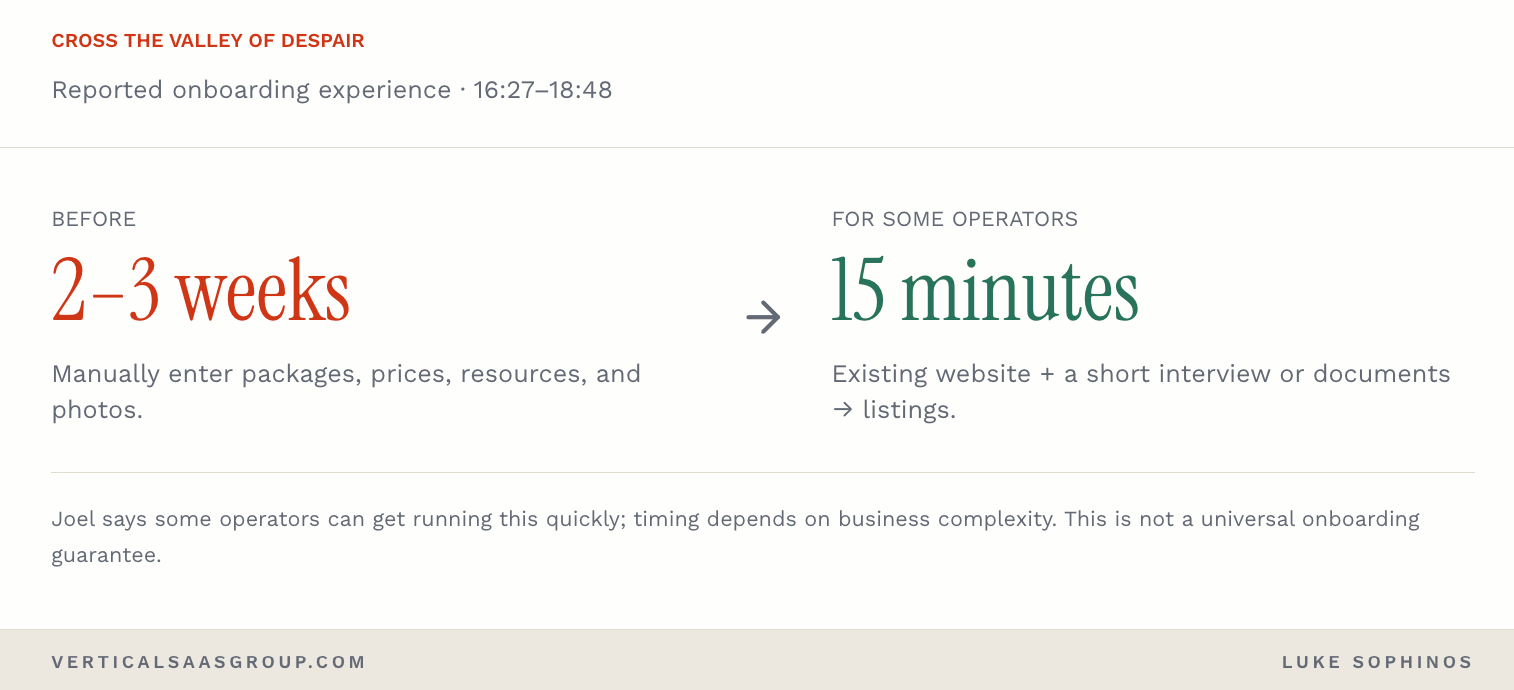
For Mallard Bay’s first few years, signing a customer wasn’t the same as activating one. Operators still had to enter prices, packages, resources, and photos before they could actually book through the system. That gap consumed time and human help.
Joel says Suzy can use an existing website, a short interview, or uploaded documents to build listings. The reported change: from two to three weeks of onboarding to as little as 15 minutes for some operators, depending on complexity. This isn’t a universal promise. It’s an example of AI removing the work that stands between the sale and the value.
04. Build for the actual resource graph, not a generic booking slot
A multi-day lodge experience can require a room, selected meals, a guide, a blind, a group, and a vehicle. Every piece has its own availability. Every package can have its own price. A clean calendar alone doesn’t solve that.
Joel’s product distinction is the combination of these workflows, accessible from a phone while the operator is out in the field. If you’re building in a niche, map what must be true for the transaction to happen. That operational detail is where a horizontal tool often falls short.
05. Use AI where the permutations break the old product model
A fly-fishing guide in Montana and a one-boat charter in Florida can need different reports for different agencies. Building an endless menu of standard reports isn’t an elegant answer to that complexity.
Joel describes letting the operator explain what they want to extract, then having Suzy return a report they can download or save for future use. The lesson is to turn repeated bespoke requests into a flexible workflow. The operator still needs to check that the output meets the requirements of whoever will receive it.
06. Turn labor-heavy services into a product expansion wedge
Mallard Bay previously offered a sales-engine service staffed by people who called and followed up with an outfitter’s leads. Customers liked having an outsourced sales team. Scaling it meant hiring more people.
Joel says agents now automate much of that follow-up process. This is a more interesting AI opportunity than another writing feature: take a service customers already value and make it less dependent on adding headcount. The outcome to measure is the work completed and the business generated, not the number of messages an agent produces.
07. Change the budget comparison — then prove the result
Joel’s standard-plan example is $399 a month, historically justified by consolidating several separate tools. That’s a software-versus-software comparison.
In one marina conversation, the buyer instead described five full-time people paid $60,000 each to answer phones and asked whether that team could become two. That was a buyer’s question, not a demonstrated staffing reduction. But it shows how the comparison changes when the product does work rather than just organizes it.
Nic argues that willingness to pay can expand with outcomes. I agree with the direction, but the labor-budget thesis has to be proven. Don’t turn a hypothetical reduction or Nic’s illustrative revenue-lift example into a customer result.
08. Don’t make your customer learn token economics
Joel is actively thinking about outcome-based pricing and a credit-based layer on top of subscriptions. He says Mallard Bay is tracking token usage, but hasn’t fully figured out or rolled out that new pricing model.
Operators understand a cut of payments because it’s familiar in the industry. Usage pricing for an AI assistant may be a different conversation. Before passing through a new unit of cost, make the unit of value understandable. The company still has to protect its margins; the customer shouldn’t need to understand a model provider’s bill to understand yours.
09. Stress-test the business at true feature parity
I pushed Joel on a future where anyone can describe the software they want and have AI build it. His answer wasn’t just that the full suite would be hard to reproduce. It was that, even at parity, Mallard Bay has relationships with associations, brands, guides, and operators built over years.
Nic makes a related point: a database or an interface is a weaker foundation for defensibility than it used to be. Ask what survives if a competitor copies your screens. Trust, distribution, a working operating suite, and real customer benefits are better answers than a prettier UI.
10. Give the network a reason to keep growing
Joel describes referrals between outfitters inside Mallard Bay. A tuna charter in South Louisiana can refer a customer who wants to fish for tarpon in Florida to another operator on the platform.
The software is no longer only a way to save time. The network can help generate business. That’s the distinction worth testing: does being part of your platform create value that another standalone tool cannot? Build the benefit, then measure whether customers actually use it.
11. Borrow trust from the people your customer already listens to
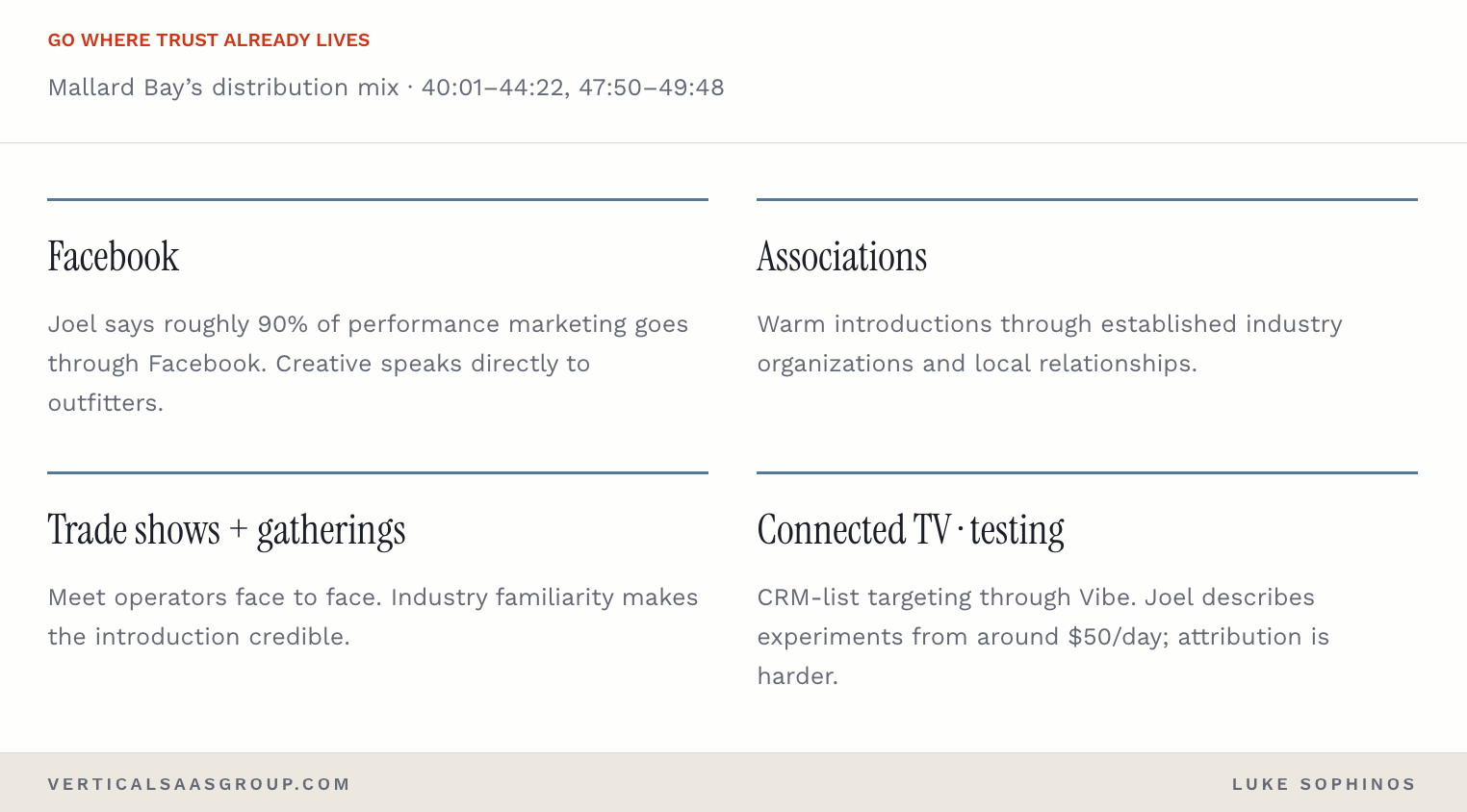
Mallard Bay works with industry associations, including the Montana Outfitter and Guides Association, and Joel describes warm introductions through those relationships. He also points to partnerships in Alaska and Michigan.
His advice is straightforward: identify the people and organizations your buyer already trusts, then find an incentive that makes the relationship work for them too. In an offline market, the introduction can matter as much as the pitch. You don’t get to skip earning credibility just because your product is good.
12. Distinguish demand creation from demand capture
Joel says roughly 90% of Mallard Bay’s performance marketing goes through Facebook, where many outfitters already spend time and source customers. The creative speaks directly to them, often using other outfitters.
But form fills aren’t the whole problem. Some operators don’t know a purpose-built solution exists. Mallard Bay is testing connected TV through Vibe, including targeting based on CRM lists. Joel describes starting around $50 a day, with more demanding creative and harder attribution. Treat it as an experiment with a learning goal, not a universally proven acquisition channel.
13. Sometimes the best sales motion is showing up
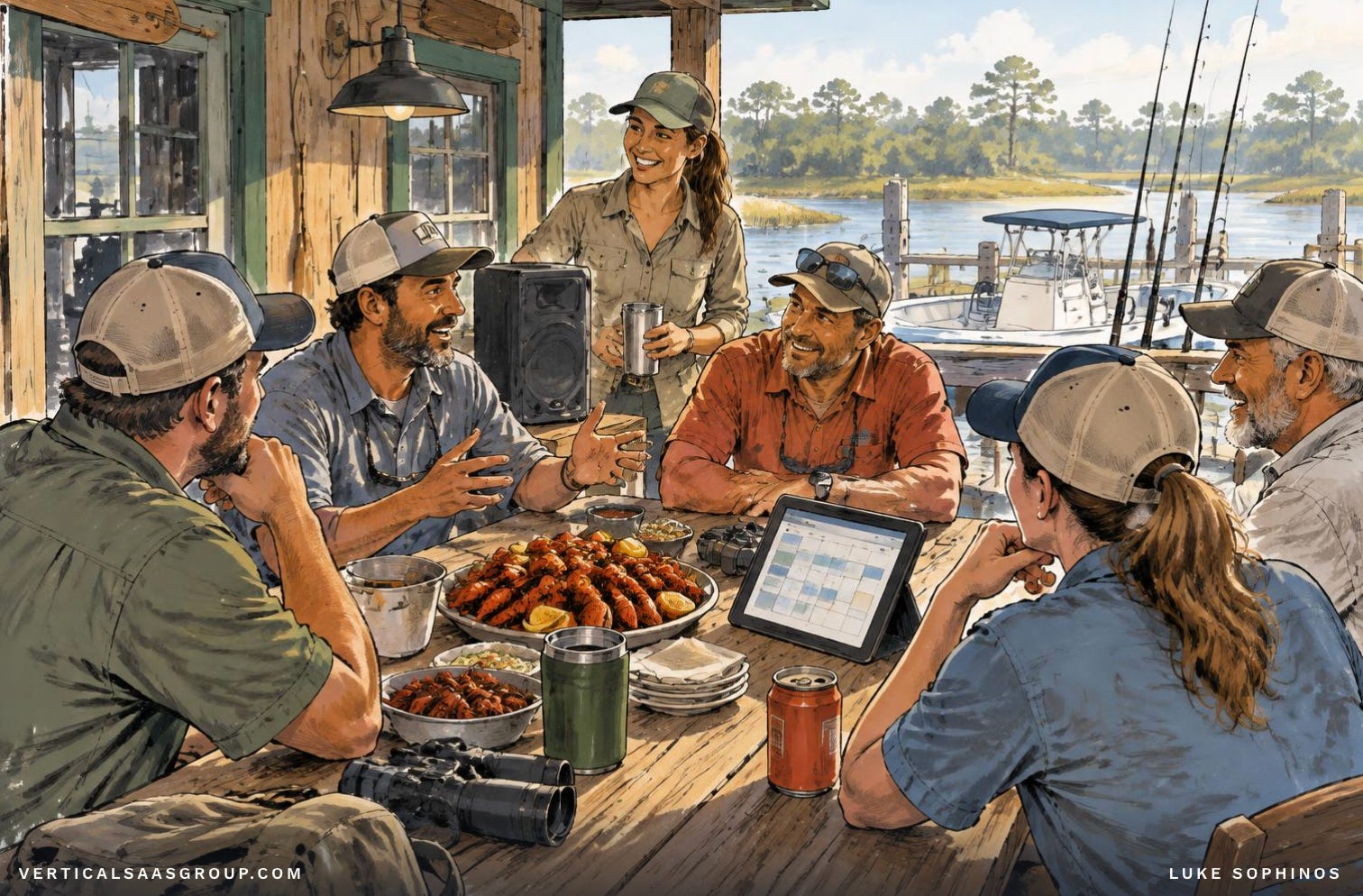
Joel describes early gatherings in places like Venice, Louisiana: free crawfish, beer, gear, and a short introduction to Mallard Bay. The founders met operators in person, and the operators left knowing who was behind the product.
At trade shows, the team has also shifted some budget from a booth toward after-event parties with other brands. This isn’t a recipe for every market. It’s a reminder that industry familiarity can turn a cold software pitch into a credible conversation. As Joel puts it: “Trust is the value to solve for.”
14. Reward activation with something the customer actually values
Joel’s retention example is gifting an outdoor speaker when an operator reaches a meaningful booking milestone. He contrasts the value of a customer doing $10,000 versus $200,000 in bookings through the platform with the much smaller cost of the gift.
Don’t confuse a gift with product retention. The point is to recognize behavior that deepens the customer’s use of the system, with something that fits their world. Joel also mentions direct mail and an iPad sent with the app as experiments or anecdotes — not scaled, proven programs.
15. Make the supply discoverable — and keep the human taste
Joel wants to get previously hard-to-list outdoor supply into more distribution channels. The difficulty isn’t just finding another marketplace. It’s expressing the operator’s dates, availability, lodging, and unusual pricing in a way a channel can use.
He also sees consumers asking more detailed travel questions and argues for consistent, answer-ready information across websites and social channels. But faster content production doesn’t eliminate editorial judgment. Joel describes a 10–80–10 process: shape the inputs, let AI do much of the work, then apply human taste to the final pass.
His sharpest creative boundary: outdoor customers notice fake imagery. Don’t substitute synthetic ducks or scenery for authentic photography of the experience you’re selling. Our illustrations here are explicitly editorial concepts, not photographs of Mallard Bay, its team, or its customers.
To Wrap It Up…
The low-tech market isn’t a place where AI doesn’t matter. It’s a place where the last mile matters enormously.
The operator may already know ChatGPT exists. They may even use it. But they still need someone to understand the business, turn messy information into a working system, and earn the trust required to act on their behalf.
That’s the opportunity Joel is building toward: a complete operating platform with AI that makes the work easier, industry relationships that make adoption possible, and network benefits that help customers grow.
My takeaway for vertical founders: don’t wait for every customer to become an AI expert. Remove the onboarding work. Solve the weird workflow. Meet the customer where they already are. Prove the outcome. And keep earning the right to do more.
Trust is the value to solve for.
— Luke
Thanks for reading LINEAR. I reply to every email…
Have any questions, feedback, comments? Let us know, we work for you!