

Last week to get your tickets to Vertical Software Summit!
If you don’t pull the trigger by Sunday, you’ll miss the boat this year!
What’s Still There If Everyone Has Your Code?
Over the last few weeks I’ve gotten more panic calls from founders than I have in a long time.
They all sound the same: “Luke, the model companies are getting really good. I’m getting a little scared.”
It’s a fair fear. Here’s a story that makes it concrete. The founder of a multi-billion-dollar vertical SaaS company was negotiating to buy a smaller vertical software company in his space. The seller kept dragging it out, pushing for a bit more leverage here and a bit more there. Then a big model release dropped. The buyer sat down over the weekend and coded up a pretty passable version of the target’s app.
He went back to the seller and said, more or less: your customer base is still valuable to us. Your company is worth less now. You could have closed six weeks ago.
That’s where vertical software is right now. Code that used to take years to build can get roughly copied in a weekend. So the real question for every founder in this space is no longer “what did we build?” It’s “what’s still ours when somebody else has the code?”
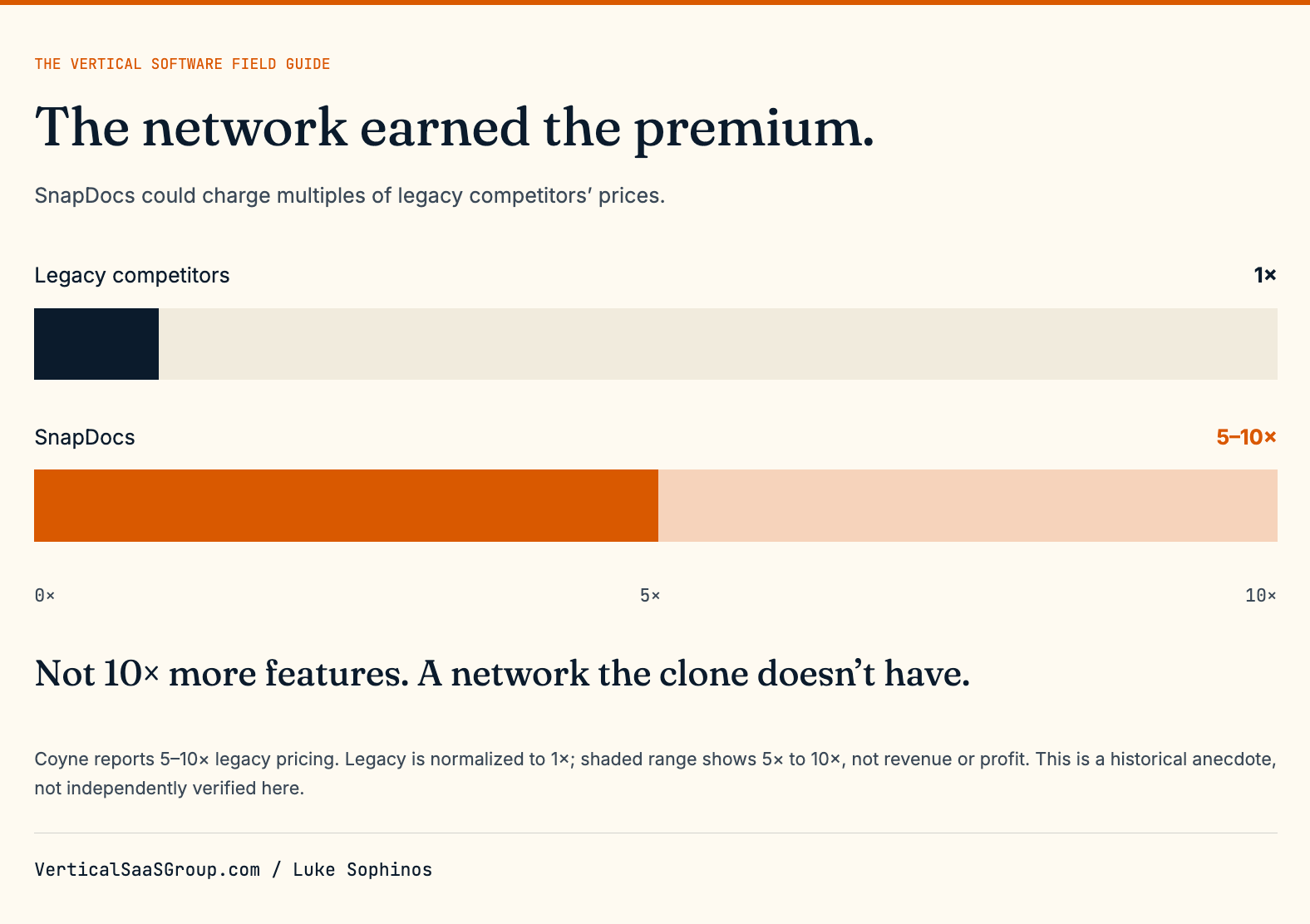
Nobody I know has thought about that question more than Coyne Lloyd. He was on the founding team at SnapDocs, a company that charged 5–10x what incumbents charged before AI and would have kept that premium even if a competitor had the whole codebase. He’s incubated companies at Fractal, built two embedded companies, and angel invests across the category.
Coyne and I trade notes in private a lot. This was our first public jam session, and we covered a lot: data moats, marketplace dynamics, group purchasing, process power, embedded, AI rollups, selling your data to the labs, and the coming flood of competitors in every vertical.
This Weeks Vertical Titan:
Coyne Lloyd (Founding Team @ Snapdocs, Layer, Reach)
Coyne is the rare person in vertical software who has seen the category from almost every angle: early operator, incubator, founder, and investor.
SnapDocs: the AI company before AI. Coyne was on the founding team at SnapDocs, a mortgage closing product. The problem sounds simple until you live it. Mortgages keep moving online, but somebody still has to put pen to paper with a notary or attorney. Say you live in New Jersey, your husband is on an oil rig in Alaska, and your lender and title company are both remote. Someone has to get packages and notaries to every location and get the thing signed before the deadline.
SnapDocs started by managing that workflow. In Coyne’s words, it was only “marginally better” than the existing tools. What set it apart is how it was built. Coyne puts it like this: before AI, SnapDocs was a workflow tool that sold per unit of work, ingested the knowledge of knowledge workers, and ultimately replaced those knowledge workers. That’s the pitch half of today’s vertical AI companies are making.
Over time SnapDocs became a marketplace. Notaries and attorneys had their own profiles, and they spent more time on SnapDocs than on any other platform. It also built a data moat: with visibility into almost every notary and attorney in the country, it knew who the bad actors were. That’s why it could sell against legacy competitors at 5x and sometimes 10x their price.
Fractal: underwriting economies of scale. Coyne later became a partner at Fractal, where he incubated and launched vertical software companies. He’s candid that the thesis back then leaned on software’s own kind of economies of scale. If you sell the software that runs a big hospital system, it’s valuable because it has so many screens, buttons, and complex logic that it takes forever to rebuild. Like a GM assembly plant, but in code.
He believes that moat is going away, and he’s been saying so for a while.
Layer and Reach: betting on embedded when VCs said not to. After Fractal, Coyne co-founded Layer Financial, which he describes as the only embedded bookkeeping platform, and Reach (embedreach.com), which offers embedded marketing and AI go-to-market tools: ad buying, AI voice, email and SMS. Vertical software platforms are the customers. Skimmer, the pool-cleaning software company, uses both.
He started around the time ChatGPT launched. A lot of VCs told him he was an idiot: you don’t own the end customer, and once the platform thinks it’s paying you too much, it’ll cut you out. Three years on, the models keep getting better and that keeps not happening. Better models have let Layer and Reach offer more, not less.
Why Coyne matters right now. Most people asking “is my vertical software company defensible?” are guessing. Coyne has an actual answer from a company that commanded a premium for reasons that had nothing to do with code. He applies that lens to everything: incumbents, embedded, rollups, data deals. And he’s honest when he’s been wrong, which in this market is worth a lot.
Coyne’s 20 Voice AI Hacks
Below are the biggest playbooks Coyne surfaced, plus a few from my side of the table.
1. Defensibility in the Weekend-Clone Era
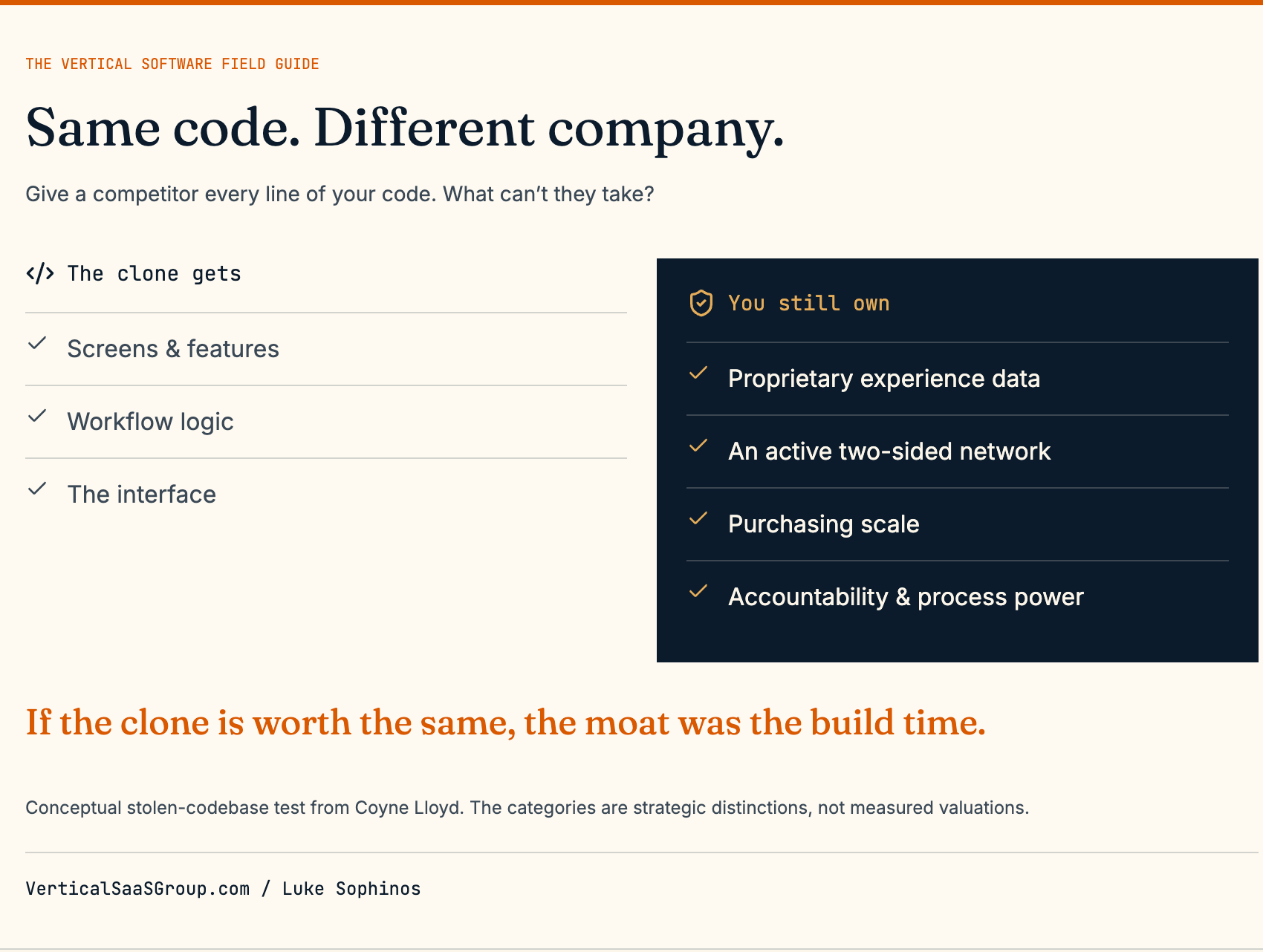
Run the “stolen codebase” test every quarter
Coyne’s thought exercise is the most useful thing you’ll read this week:
If your competitors had a complete copy of your codebase, but not your data or your network, what would they be worth compared to you?
At SnapDocs the answer was “a lot less.” Even with every line of code, a competitor still would have sold at a big discount to SnapDocs. If your honest answer is “about the same,” your moat was the time it took to build, and that moat is gone.
My addition: don’t run this once. Run it with your exec team every quarter. Assume the model companies let anyone spin up your exact software tomorrow. What’s still valuable?
The move: Put this on next quarter’s exec agenda. List everything you have that survives a full codebase leak. If the list is short, that’s your strategy problem.
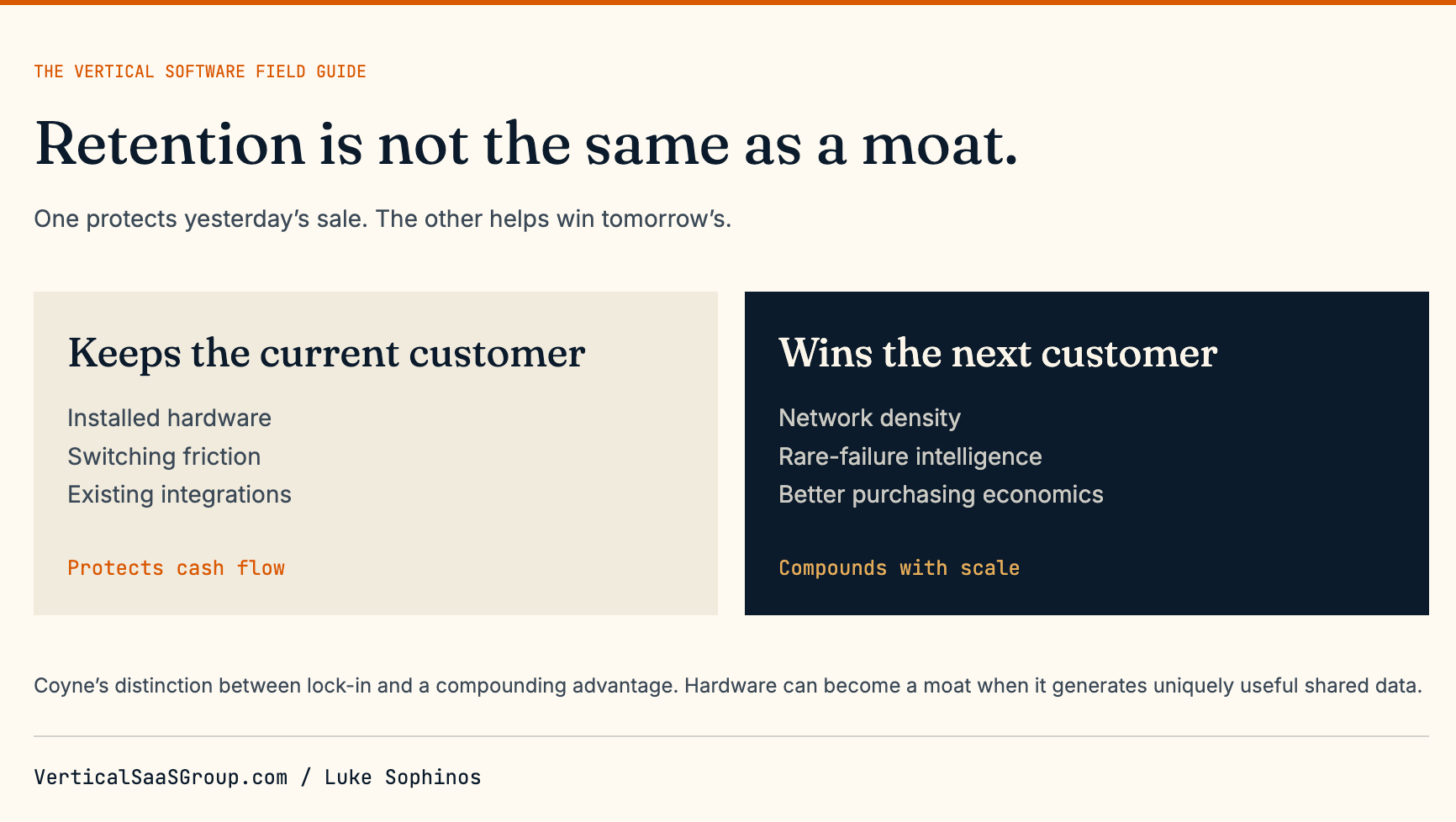
2. Lock-in protects your cash flows. A moat wins the next customer. Know which one you have.
I brought up hardware lock-in as a moat. Think Alex from Senson, who has physical point-of-sale hardware on laundry machines. Coyne pushed back, and he’s right.
Hardware lock-in keeps your cash flows. Nobody wants to rip out installed hardware. But it doesn’t build an advantage over time. Tech companies are valued on expected growth. An iPad you bought from China doesn’t help you win the next account.
Lock-in is something Constellation would pay for. If you’re running a business to protect cash flow, that’s fine. If you’re running a venture-backed growth business, it’s not enough.
The move: Sort your defenses into two buckets: “keeps current customers” and “wins new ones.” Most companies are heavy on the first and light on the second.
3. The only question that matters: does everything you have help you win customer #1,001?
Coyne’s example: a camera on sports fields that makes and reviews game tape. On day one, the AI can tag every tackle. Now picture a much smarter model. If one system has seen every game on every field, home and away, it can tell you this quarterback struggles in the rain.
That’s when the hardware becomes a real moat. If a competitor is on 10 fields and you’re on 1,000, then with the same code and the same hardware, you’re worth more to the 1,001st customer.
Coyne’s claim is bold: that dynamic is the only category of value he can see holding up in these verticals. Every vertical has some version of it. Your job is to find yours.
The move: Find the asset that becomes more valuable as models get better. Data that compounds with scale is the target. Software that models can rebuild is not.

4. Start as a tool, then become the marketplace
SnapDocs didn’t launch as a marketplace. It launched as a workflow tool for offices that each managed their own list of notaries and attorneys.
The change came when notaries and attorneys got their own profiles. Those profiles let them work with everyone on the other side of the deal in one place. Suppose a notary spends more time on your platform than any other. A competitor who copies your software has nothing to offer them.
The move: Find the other side of your customer’s workflow: contractors, vendors, providers, freelancers. Give them their own identity and reason to log in. That’s how a tool turns into a network.
5. Build your data moat on rare disasters
My favorite story of the episode. Every so often, a notary agrees to a $200 signing, gets the signed documents, and then says: “I don’t remember saying $200. I think it was $1,000.” The deal has to close on time or it’s dead. Now everyone is scrambling over who pays.
These blowups are rare. That’s exactly why scale matters. If you can’t see nearly every notary and attorney in the country, you can’t know who the bad actors are. SnapDocs could, so it knew.
Avoiding disasters is a moat that gets stronger with every transaction, and a new entrant can’t recreate it.
The move: List the rare, expensive failures in your vertical: fraud, no-shows, holdups, compliance misses. Ask if you have enough volume to predict them. If so, make that the product.
6. Your price premium should come from the network, not features
SnapDocs charged 5–10x what legacy competitors charged. Coyne’s view is that it held because most of the value came from network effects, marketplace dynamics, and data, none of which a competitor gets by copying the code.
This is important because a lot of founders think pricing power comes from a better UI. In a world where a better UI takes a weekend, it doesn’t.
The move: If your pricing rests on features, plan for it to compress. If it rests on network or data, you’ve earned it.
7. Complexity isn’t a moat anymore. Regulation and a sign-off requirement still are, for now.
Coyne’s line on complexity is brutal: a person built that complex thing. That person had a bad night’s sleep and got COVID three months ago. An agent with none of those problems can probably work through the complexity.
Same goes for “thorny integrations.” Some say the model companies will never do the integration grind. Coyne thinks integrations will just keep getting easier. My view: they’ve gotten much easier where both sides cooperate, mostly in horizontal developer tools and MCPs. In most verticals that hasn’t happened yet. Plenty of PE-backed CEOs are going into “lockdown mode.” But computer-use agents are getting good, so I don’t know how long lockdown holds.
What still holds: regulation and a required human sign-off. If an accountant or lawyer has to bless the output, someone has to be the responsible party. That buys time. Coyne’s caveat is that culture and the law could change too.
The move: Stop listing “complex product” or “hard integrations” as moats in your board deck. Replace them with something that still holds when an agent has unlimited patience.
8. Group purchasing is an economy of scale that lasts
We talked about the “digital franchise” model: wrapping your system of record with services, supplies, and real-world economics. Coyne added a sharper point. Selling the goods the work requires gives you an economy of scale that actually lasts, because you can become the biggest buyer.
The example is Moxie (Coyne is an investor, and Dan from Moxie has been on the show). Coyne believes Moxie is the largest purchaser of injectables in the country. That buying rate can’t come from anywhere else, and it cancels out what Moxie charges its customers. In Coyne’s words: Moxie is a company where you could copy the codebase and it doesn’t matter.
Same logic as Slice with physical supplies. The tradeoff: physical goods get a much lower multiple than software. It still adds real defensibility, and I think people underrate it.
The move: Find the biggest recurring input your customers buy. Can you pool their purchasing so the savings beat your price?

9. Process power is the AI-era moat to watch
Coyne brought up 7 Powers (his signed copy from the Acquired guys is on his shelf). We’ve covered several of those powers already: scale, network effects, brand. The one he’s most excited about is process power: like TSMC, where people just don’t know how to make the chips.
As AI starts doing the work, Coyne expects a version of process power to appear in different verticals: your AI knows how to do things other AI doesn’t.
His test: in which fields is someone with 20 years of experience much better than someone with 2? That’s where process power lives. His long-running belief is that a vertical platform should capture the value of everyone in the industry who doesn’t wear boots or gloves, and maybe one day, when robots arrive, the boots-and-gloves work too.
The move: List the jobs in your vertical where 20 years beats 2 years. Those are where your AI should learn first.
10. The threat isn’t OpenAI. It’s the swarm.
Most founders assume the model companies are coming for their vertical. In most verticals, I don’t think so. They’re too small, or the labs would rather sell picks and shovels to whoever goes after them. The real risk is white-collar, screen-heavy workflows where you’re “just a database” or “just a workflow tool.”
Coyne said the real pressure is somewhere else. A friend who runs a venture incubator told him vertical incubation is much harder than it used to be. Seven years ago, you could find a dusty incumbent Constellation had bought, build something cleaner with a mobile app, and take the market. Now, building is so easy that there might be three companies in each of the next four YC batches, all with $10M raised, all bidding you down.
And it might not even be venture-backed. It could be a 23-year-old whose mom or dad works in the industry and charges 90% less.
The move: Plan your competition as “a dozen well-funded clones plus a bootstrapped kid,” not “OpenAI.” Then go back to Playbook #1.

A few rapid fire hot takes from Coyne to close us out
Most bullish public vSaaS (5-year view): Toast. Coyne is a shareholder. There’s a lot to do for restaurants (Owner has shown that), and Toast “does not seem to be asleep at the wheel.”
Most bearish: ServiceTitan, a long Toast/short ServiceTitan bet “with a very low degree of confidence.” His reasons: lots of smart people he knows are coming after it, its customers vary a lot and skew upmarket in ways that make it vulnerable, and he thinks much of its best talent has left or lost its edge. (ServiceTitan folks, he invited you to prove him wrong.)
Most bullish private, growth-stage: Vesta (Coyne is an investor). Mortgage is huge, with a lot of work that AI will eventually do. Technically Series B, but heavily funded by big names, and up against what Coyne called basically a monopoly last valued around $20B at acquisition.
See you Sunday,
— Luke
Thanks for reading LINEAR. I reply to every email…
Have any questions, feedback, comments? Let us know, we work for you!