

Today’s newsletter is brought to you by the Vertical Software Summit. It’s probably your last week to snag a ticket / apply to attend before we are sold out.
100+ investors, ~300 vertical founders/operators.
5+ billion dollar vSaaS Founders/CEOs.
Don’t miss it!
Check out the conference / snag you ticket here.
If you need a free ticket - we will get you one - don’t sweat the price tag :-)
A roadmap to owning the outcome
For most of the history of vertical SaaS, we’ve built software that helps people do their jobs better. We digitized workflows, replaced spreadsheets, reduced clicks, automated repetitive tasks, and pulled fragmented processes into one system.
Those things created enormous value.
But I think AI is pushing us toward a different question:
What happens when the software doesn’t just help customers do the work, but starts taking responsibility for getting some of it done?
A few weeks ago, I had a conversation with Mark Passifione and Daniel Burton from Xplor about where vertical SaaS is headed with AI. I kept coming back to how differently we may need to think about product value. For years, we’ve asked questions like: How do we save customers time? How do we make the product easier to use? How do we increase efficiency?
Those questions still matter. But what if we could start asking how our platforms help customers grow revenue, improve profitability, or produce a better business outcome? That’s a very different product conversation.
I don’t think the answer is to automate every workflow we can find. The more important question is which outcomes are worth taking on, and more specifically, how do you actually get there.
If I were running a vertical SaaS company today, I’d be looking for the intersection of four things: an outcome that materially improves the customer’s business, a workflow my platform deeply understands, proprietary context that helps me make better decisions, and enough control over the workflow to actually take action.
Here are the steps I’d take to pull this off:
Step #1: Map the Work
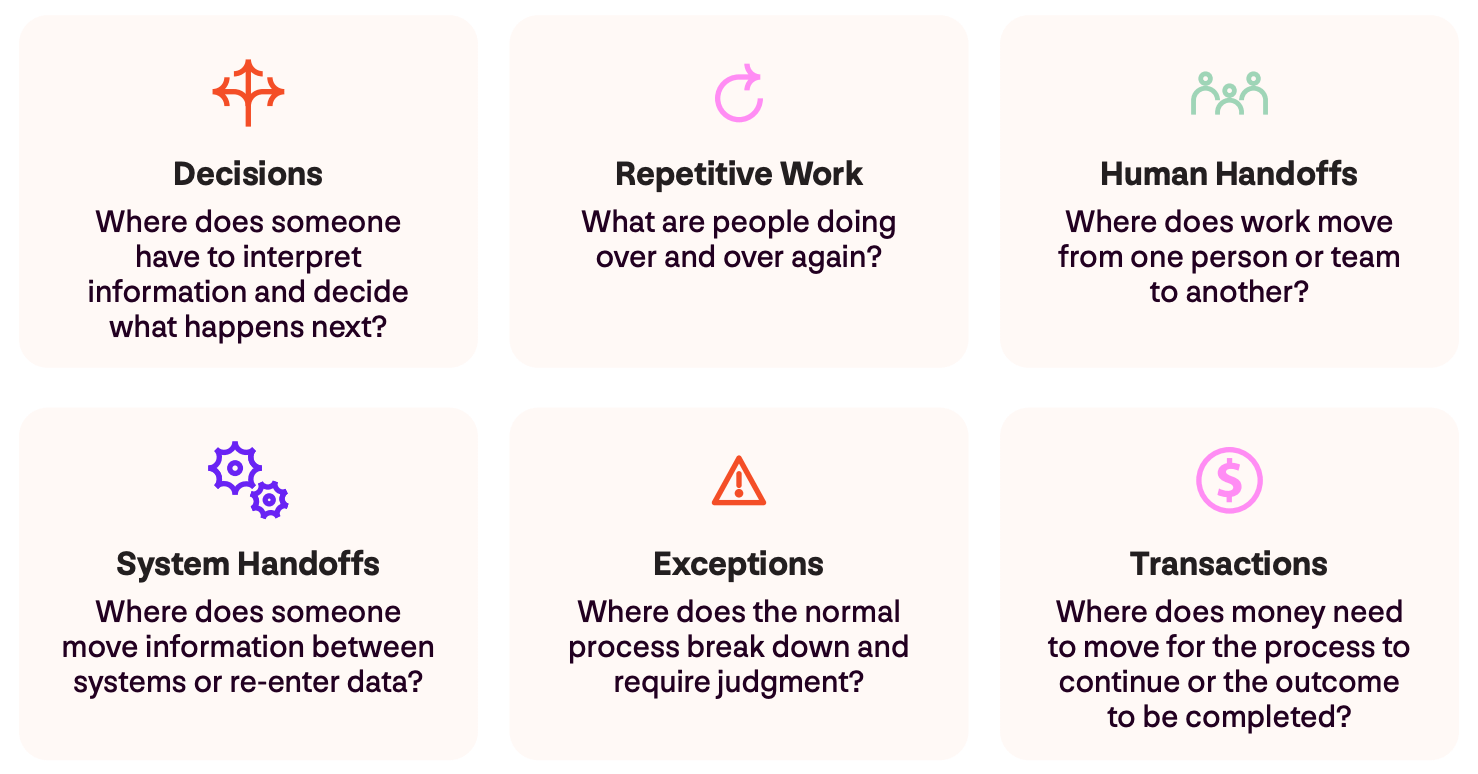
The first step toward becoming more agentic isn't choosing an AI model or building an agent. It's understanding the work. Map an important customer process from Point A to Point Z. Then look beyond the screens and features and ask what is happening at every stage.
Look for:
Step #2: Choose the right place to start
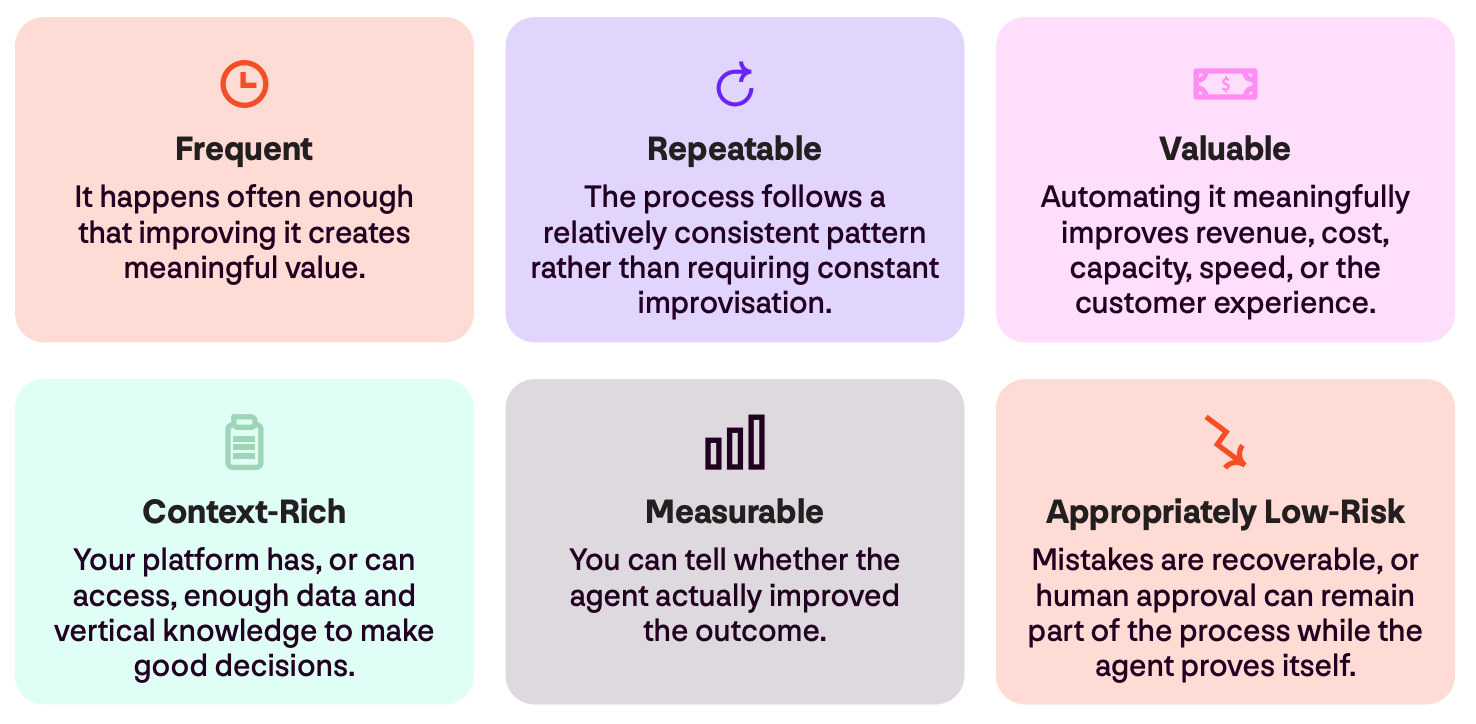
Once you’ve mapped the work, resist the urge to automate everything. The strongest starting point usually isn’t the biggest or most complicated process. It’s a clearly defined piece of work where an agent can create meaningful value, the outcome can be measured, and mistakes can be managed.
Bessemer calls this approach progressive delegation: start with a manageable portion of the workflow, keep humans involved where judgment or risk requires it, and expand the agent’s responsibilities as reliability and trust increase.
Look For Work That Is:
Step #3: Build the context before you delegate
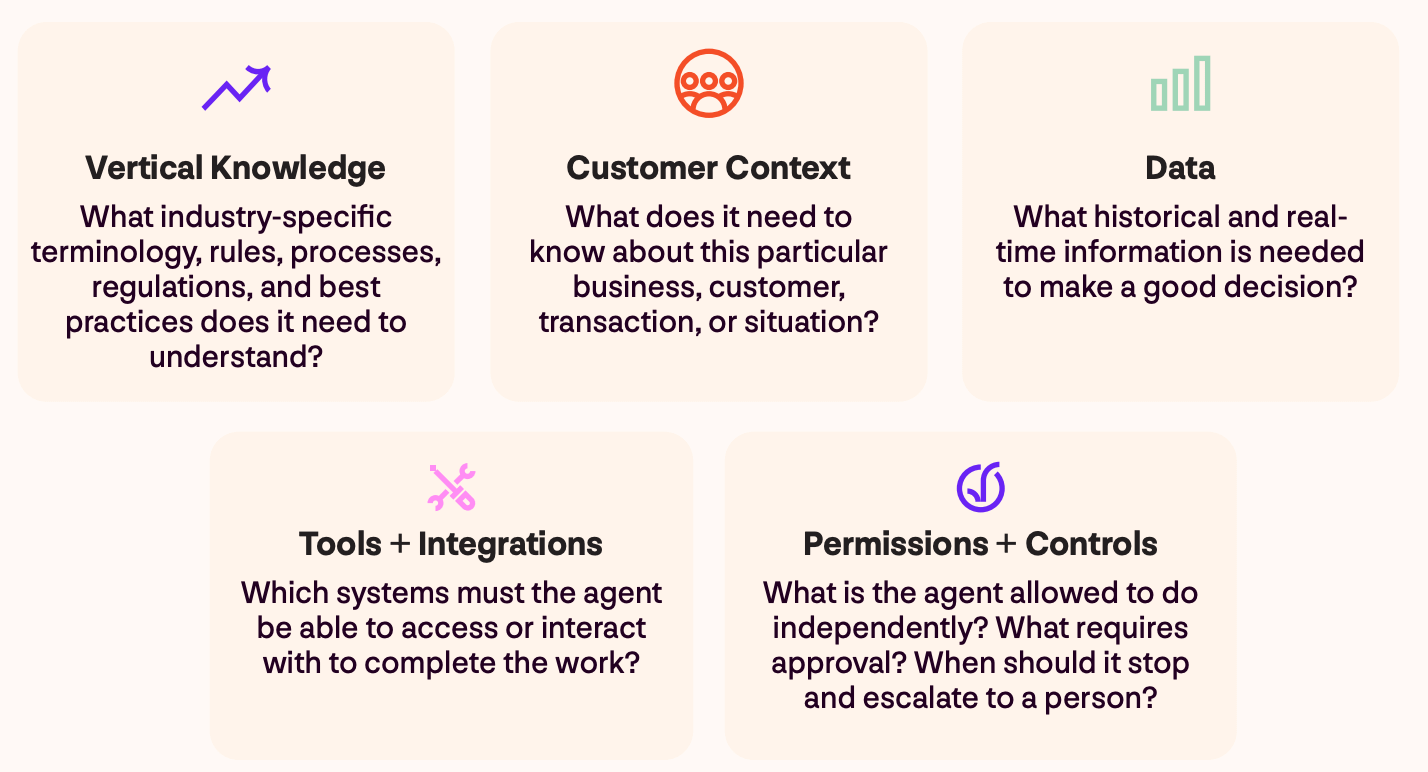
An agent is only as useful as the context it has and the actions it can take. A general-purpose AI model may be able to answer questions about an industry. But performing meaningful work inside that industry requires much more: customer data, workflow context, business rules, integrations, permissions, and the ability to interact with the systems where the work actually happens.
This is where Vertical SaaS platforms may have an important advantage. They already sit inside the workflows of a specific industry. They understand how customers operate, what information matters, where processes break down, and what needs to happen next. The opportunity is to turn that context into action.
Understand what the agent needs to do the work successfully:
Step #4: Increase Autonomy as Trust Grows
Moving toward agentic workflows doesn’t mean handing an entire process to AI on day one. Autonomy can increase over time. The right level depends on the work, the risk involved, the quality of the available context, and how reliably the agent performs.
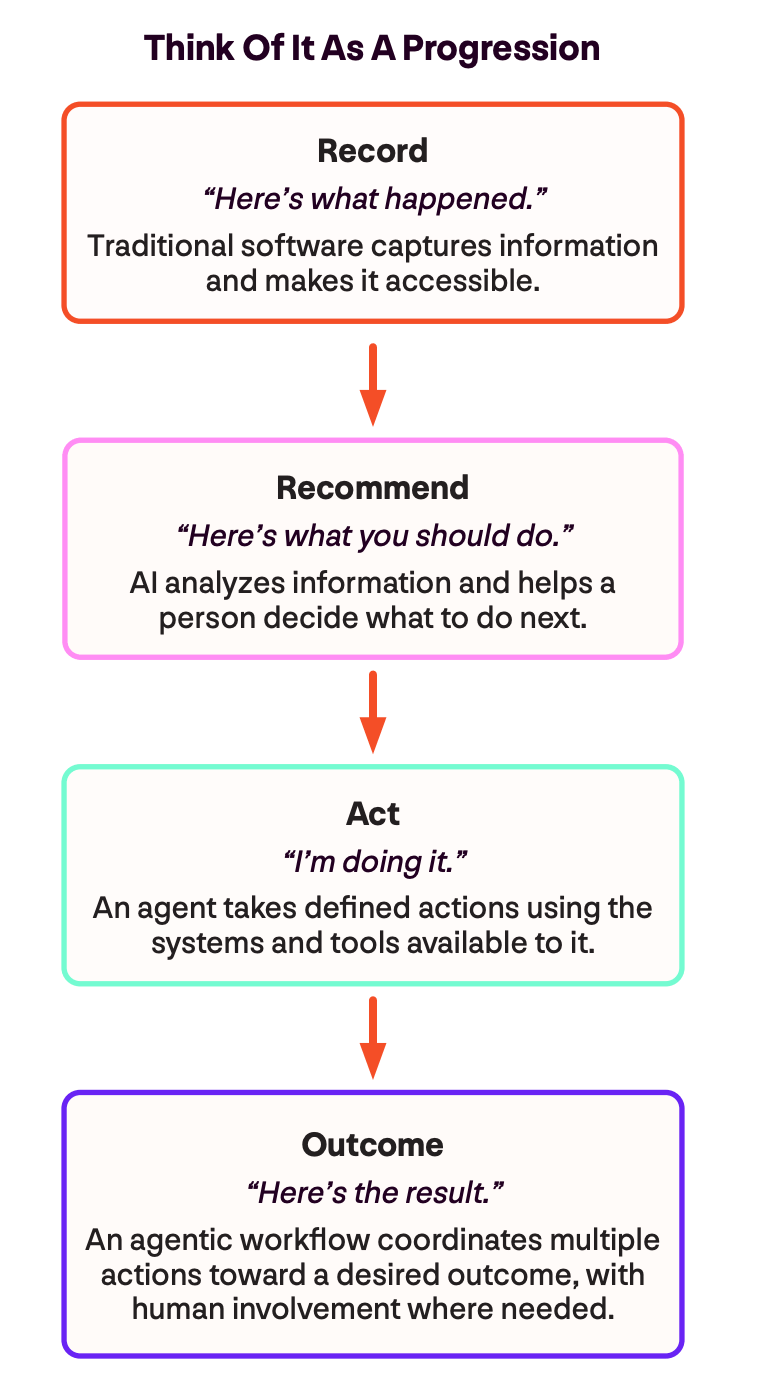
A simple way to think about the progression is:
Crawl | Agent Assists
The agent understands the context and helps determine what should happen next. It might analyze information, surface insights, make recommendations, prepare an action, draft a response.
The human decides and acts.
Walk | Agent Acts
The agent begins executing clearly defined portions of the work. It might complete repetitive tasks, update systems, coordinate defined actions, initiate an approved process, escalate exceptions.
The human provides oversight, approves higher-risk actions, and handles exceptions.
Run | Agent Orchestrates
The agent coordinates multiple actions across a workflow toward a defined outcome. It might interpret intent, determine the next best action, work across multiple systems, execute within defined permissions, adapt based on results, escalate when confidence, authority, or context is insufficient.
The human sets the boundaries and remains accountable for the process.
Step #5: Connect Commerce to the Outcome
Many business workflows eventually reach a moment when something has to be purchased, paid, refunded, billed, renewed, or otherwise transacted. If an agent is responsible for helping complete the workflow, stopping at the transaction creates a new handoff.
That’s where agentic commerce enters the picture. Agentic Commerce Isn’t “AI Making Payments” It’s the ability for commerce to become one of the actions available to an agent as it works toward an authorized outcome.
Think about the progression:

And once the platform can act, the economics get interesting. If you’re no longer just selling a tool someone uses to perform a task, but actually helping produce the outcome, what customers are paying you for starts to change. In some cases, the opportunity may extend beyond traditional software budgets into work historically performed through services or labor.
I think that’s the bigger strategic shift. The next great vertical SaaS companies may not be defined only by the workflows they digitize or the features they build. They may increasingly be defined by the outcomes their platforms can reliably deliver.
So here’s the question I’d be asking:
If your platform could reliably deliver one customer outcome instead of simply giving customers the tools to achieve it, which one would fundamentally change the value of your business?
Want to go deeper? Watch my discussion with Mark and Daniel and get Xplor’s practical roadmap for moving from vertical SaaS to agentic.
Watch the Discussion + Get the Practical Roadmap →

How to understand the value of your company
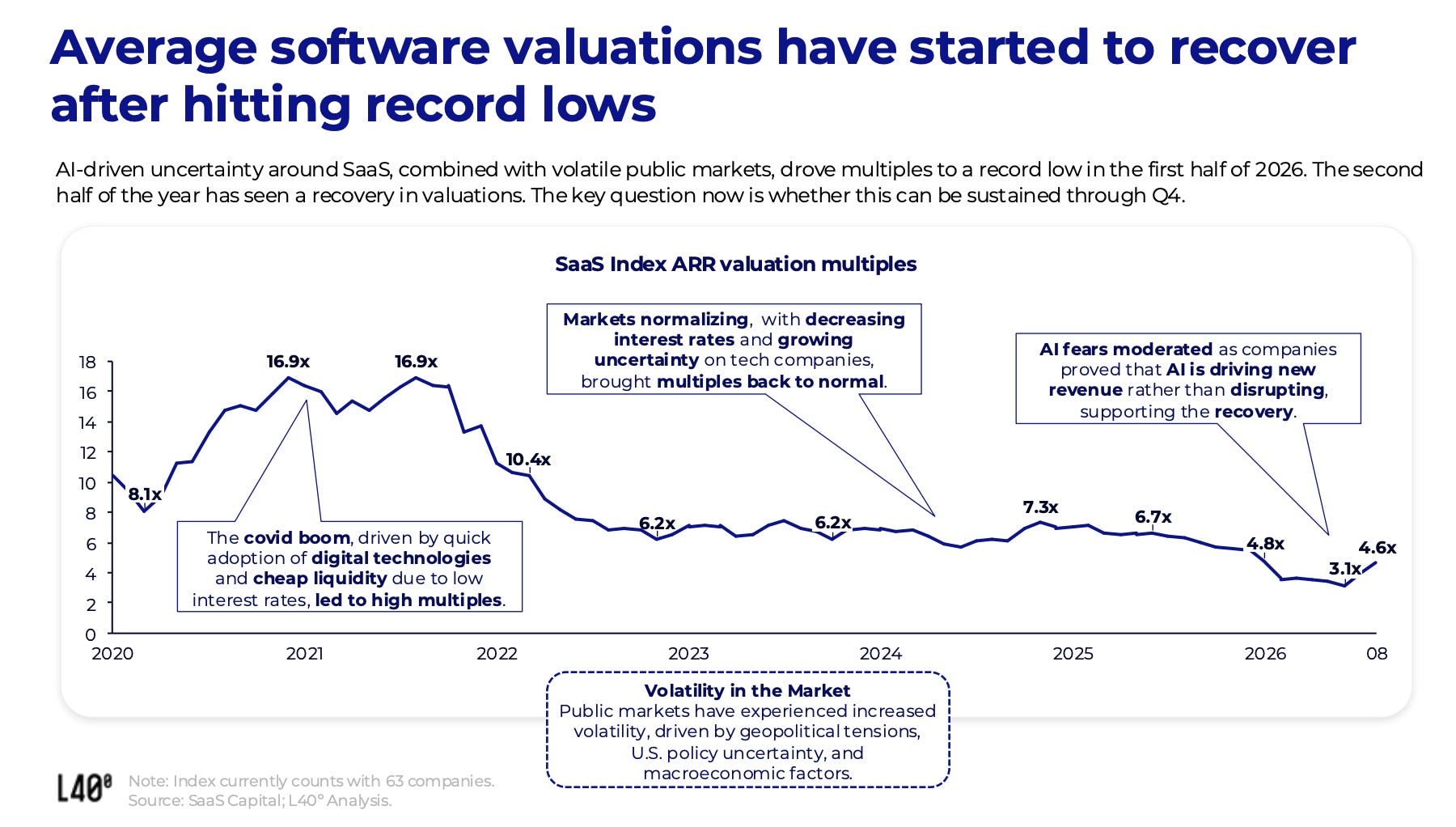
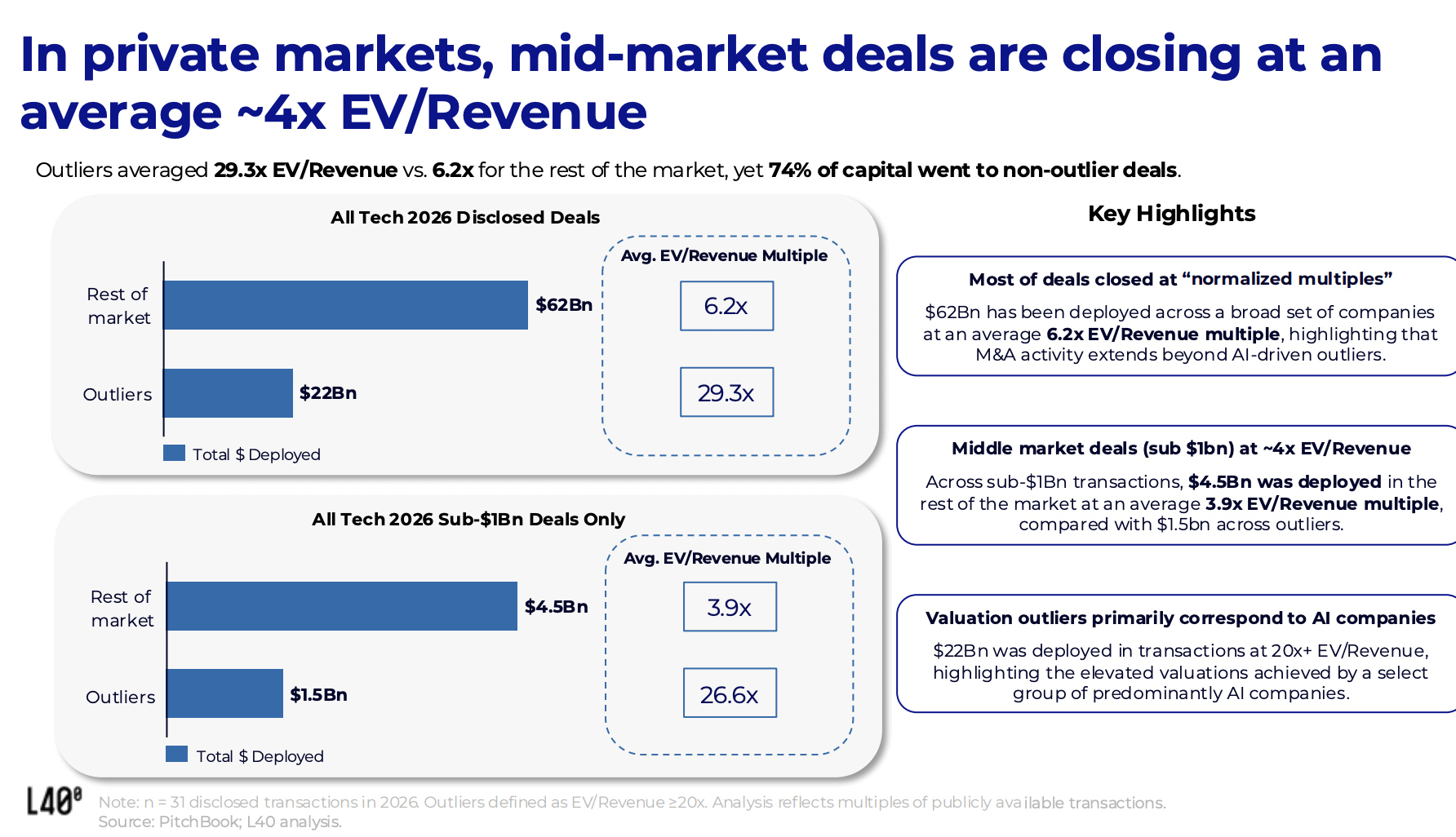
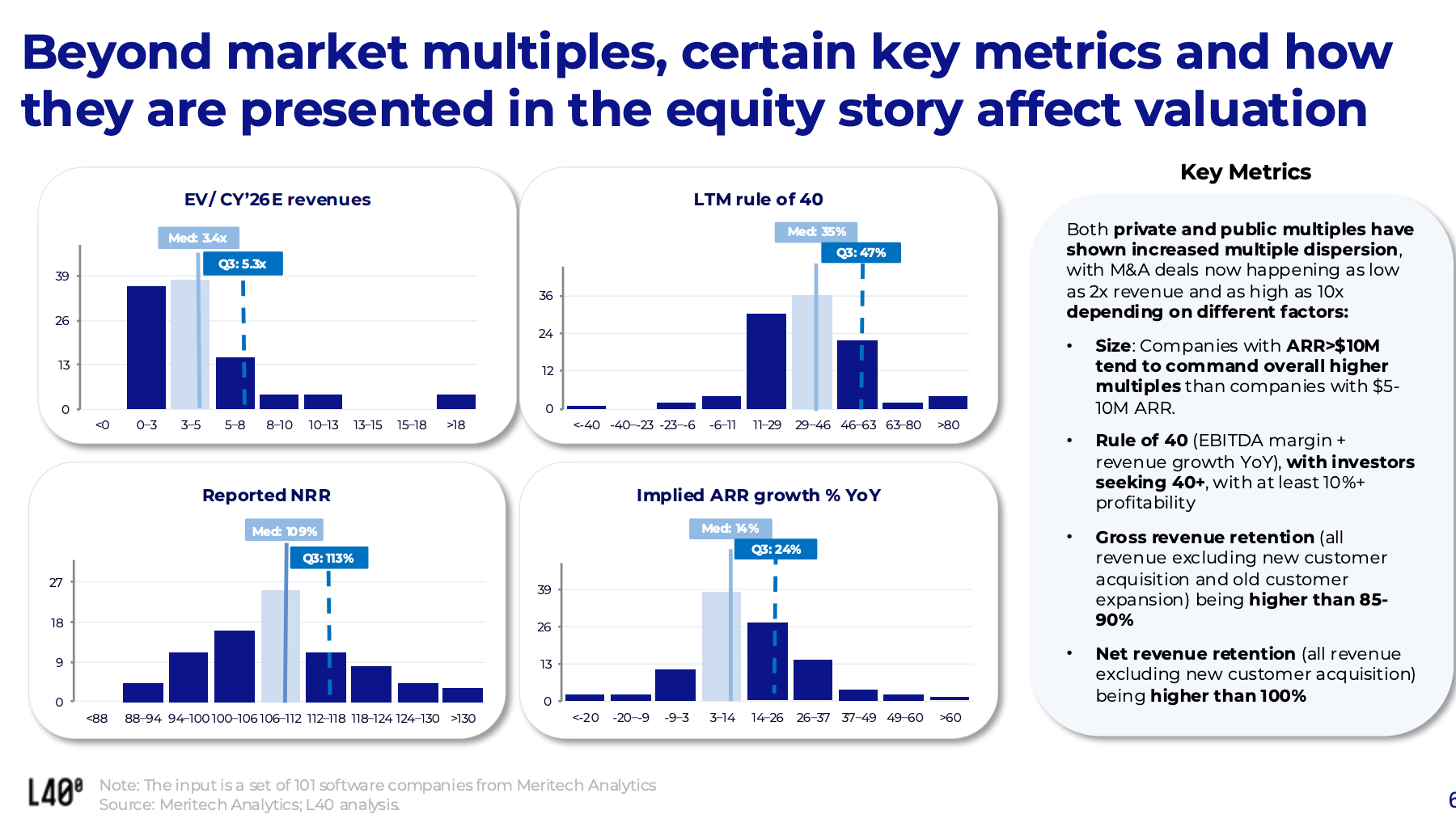
My friends at L40 dropped a great report on software valuations, and it has some incredible data in it I thought would be valuable to you all.
Vertical Software IS the Anti-Hype Bet
Most founders want to work on something their friends think is cool.
Nick Evans picked lab software.
Before QBench, Evans was the 5th employee at Reverb, the marketplace for guitars and gear that eventually sold to Etsy. Reverb was not a category any generalist founder would have picked. Hobbyists trading used amps. Niche inventory. A buyer base most tech people did not understand and did not want to. But the workflow was deep, the community was real, and the business compounded into a meaningful outcome inside a niche the broader tech world mostly dismissed.
That experience taught him something that defines every real vertical software founder. The work is not glamorous. The work is the opposite of glamorous. And the people who thrive in it are the ones who stop needing it to be.
So when Evans looked at where to spend the next decade of his career, he did not chase AI infrastructure or developer tools or whatever was trending that quarter. He went to LIMS. Laboratory Information Management Systems. Cloud software for contract testing labs running cannabis panels, environmental samples, food safety workflows, and clinical research. A category that gets almost no coverage, almost no venture attention, and almost no competition from generalist founders who want to be on a podcast.
That is the trade.
Being a vertical software founder means spending years learning a workflow nobody at your dinner table cares about. It means getting excited about sample chain of custody and instrument integrations and regulatory audit trails. It means your TAM slide will never impress a generalist VC, your category will never trend on X, and your conference will have fluorescent lighting and a buffet instead of a rooftop in Cabo. The upside is real, but the day to day is unglamorous in a way most founders are not actually built for.
That is why the category stays open. Not because the opportunity is hidden. Because the work filters out everyone who needs external validation to keep going.
The lesson for anyone thinking about building in vertical software is worth sitting with.
The anti-hype bet is a real bet. It is not a guaranteed one. Plenty of boring verticals stay boring because the economics do not work or the buyer will not pay. But the founders who win in vertical software almost always share one trait. They stopped caring whether the category sounded impressive and started caring whether the workflow mattered to the customer.
Evans has done this twice now. Reverb inside a hobbyist marketplace nobody respected. QBench inside a lab software category nobody notices.
The pattern is not the vertical. The pattern is the willingness.
Willingness to go somewhere unsexy. Willingness to learn a workflow most people would find tedious. Willingness to build inside a category that will never make you look cool at a party.
So here is to celebrating the boring. Because it is in the boring where you can compound for years and years, and you may just end up with something quite special.
QBench is an example of that.
///
See you Wednesday,
Luke
Do me a solid and forward to a friend :-)
Outstanding article, really spoke to me.