

We’ve only got ~50 seats left for the Vertical Software Summit.
Which means I think it sells out over the next week
If you’ve been waiting to grab your ticket, now is the time :-)
(12 folks registered just yesterday)
Is the phone your platforms
next territory to own?
If you’re building vertical SaaS, you already know the game: own more of your customer’s workflow, own more of their wallet, own more of their data. That’s how you go from a $200 ACV tool to a $20K platform. That’s how you build a moat the horizontals can’t touch.
So here’s the uncomfortable question for every vertical SaaS founder reading this: why don’t you own the phone yet?

In most of the verticals we care about — healthcare, home services, auto, dental, legal, trades, death care, financial services, fitness — the phone call is still the #1 revenue surface. It’s how new customers come in. It’s how existing ones get served. It’s where quotes get given, appointments get set, bills get paid, and complaints get handled. The call is the business.
And yet most vertical SaaS platforms have ceded that entire surface to RingCentral, Nextiva, AT&T, Vonage — carriers who are now using the voice AI wave as a pretext to push their products into your accounts, with your customer’s data flowing into their models.
This week on Verticals, we sat down with Mike Sharp, Founder & CEO of Dialstack, to talk about why the phone stack is the next territory every vSaaS founder should be annexing, and the specific playbook for doing it without becoming a regulated phone company yourself.
Mike has done the full lap — he built the carrier side, then operated on the vSaaS side, then built the infrastructure he wished existed when he was the operator. If you’re running a vertical SaaS platform and the phone isn’t on your roadmap, this edition is for you.
This Weeks Vertical Titan:
Mike Sharp (CEO @ Dialstack)
Mike has spent ~20 years at the exact seam where this issue lives: telco meets vertical SaaS.
He co-founded Jive Communications in the mid-2000s, selling VoIP directly to SMBs alongside the early innings of RingCentral and Dialpad. He grew Jive to ~$100M ARR and sold it to LogMeIn (now GoTo), continuing to grow it inside. That gave him a decade-plus of operator reps on how dependent small businesses are on the phone — and how rich the data running through it actually is.
Then he did the thing that makes Dialstack sharp: he spent a few years leading a vertical SaaS healthcare rollup — ~$200M in revenue across 17 brands. And in every single one of those portfolio companies, the same thing kept happening — the platform wanted the phone system. Not a voice AI agent duct-taped on top. The whole thing: the lines, the hardware, the extensions, the 911 stack, the data, the workflow.
The options for actually owning it were brutal:
Build it yourself → become a regulated phone company, chase 42,000 US tax and fee jurisdictions, handle FCC filings, 911 compliance, carrier interconnects, and an infinite corner-case roadmap your investors do not want to hear about.
Refer out to RingCentral → watch them price into your account, upsell your customer, and eventually launch their voice AI directly against you.
Neither option expands your platform. Both shrink it.
Dialstack is the third door. It’s the embedded phone stack for vertical SaaS — telephony, hardware, 911, regulatory, number porting, and voice AI orchestration — all packaged behind your brand, inside your product. The analogy Mike uses is the one that lands: Stripe did this for payments. Dialstack is doing it for voice.
The reason it matters right now is timing. Carriers are no longer sleepy incumbents — they are actively building voice AI and selling it directly into the SMBs your platform serves. Every quarter a vertical SaaS founder waits to own this surface, more of their customer’s data, revenue, and workflow gets quietly annexed by a carrier that will eventually compete with them head-on.
Mike’s whole thesis for vSaaS founders is simple: the phone is the most valuable unowned territory inside your customer’s business. Go take it.
Kevins 20 VERTICAL GTM Hacks
These are truly a masterclass, carve out the time to read them and you won’t regret it…
1. Treat the phone stack as a territory, not a feature
Every vertical SaaS has a “surface area map” of their customer — the workflows they own and the ones they don’t. The phone is almost always the biggest unowned surface, and in call-heavy verticals (healthcare, home services, auto, dental, trades, legal, death care), it’s often the #1 revenue-generating workflow in the entire business. If you don’t own it, someone else is monetizing your customer’s most important channel. The frame isn’t “should I add voice AI?” The frame is: “this is my customer’s primary revenue surface — why don’t I own it yet?”
2. Voice AI without owning the phone system = half pregnant
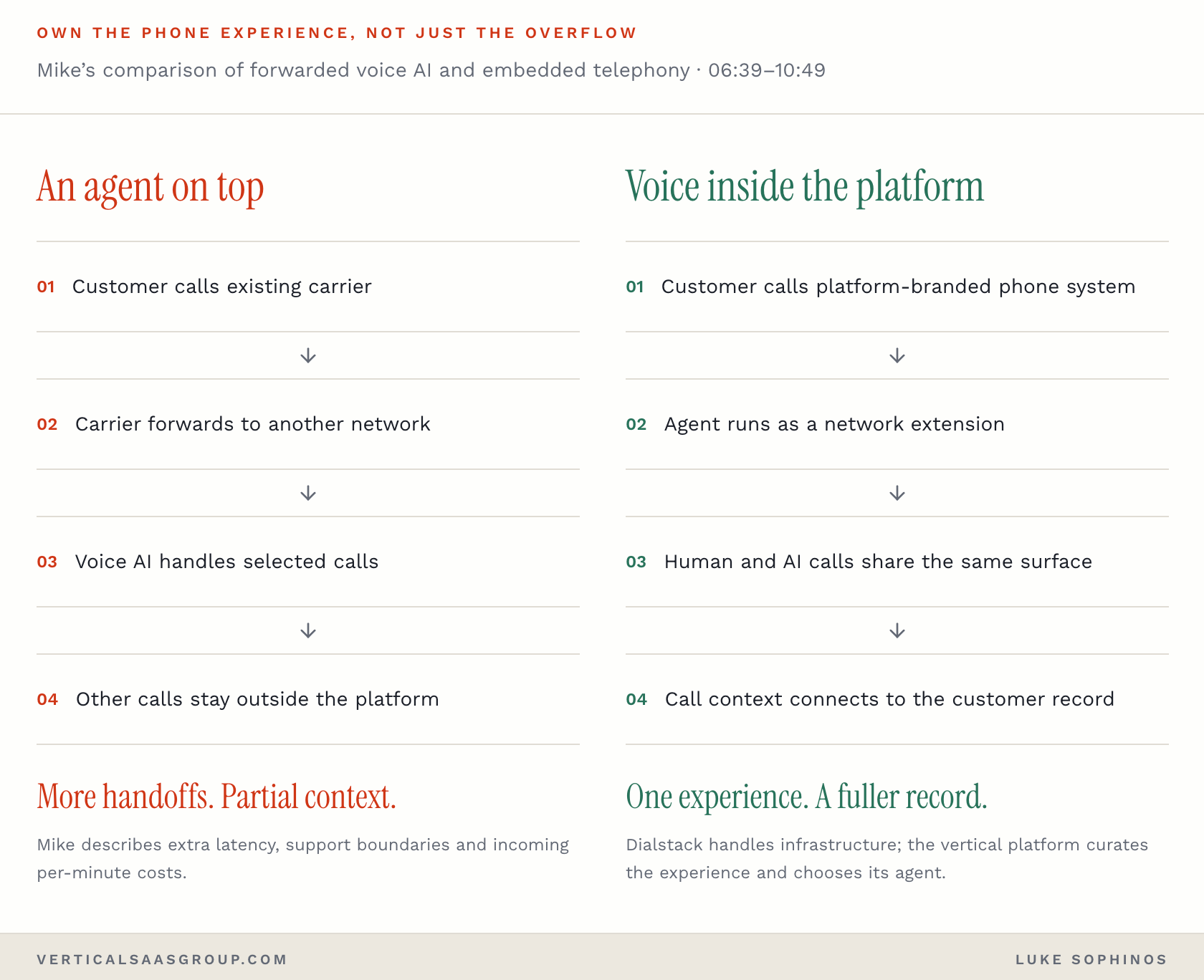
This is the sharpest line Mike delivered, and vSaaS founders need to internalize it. If you launch a voice AI agent but your customer’s phone system still lives at RingCentral, you only get the calls that get forwarded to you. Everything else — direct dials, outbound calls, the receptionist’s cell, the extension that bypasses your agent — is invisible to your platform. Your reporting is fragmented, your data set is partial, and your customer experience is split between two vendors. Half the calls = half the data = half the moat.
3. If you don’t own the phone system, you’ll be competing with the phone company inside a year
Read the RingCentral, AT&T, and Vonage investor decks and earnings calls. Voice AI is their #1 growth narrative. They are not sitting still. Every vSaaS platform that is “integrated with” or “forwarding to” a traditional carrier is, in Mike’s words, “just creating pipeline for RingCentral.” The incumbent carriers will use your integration to learn your customer, then launch their own vertical voice AI into that account. Own the stack, or feed the people who will replace you.
4. Don’t become a phone company — rent the regulated layer
Owning the phone experience ≠ owning the regulatory burden. There are 42,000 US tax and fee jurisdictions that want a cut of every phone call. There’s 911 compliance, FCC filings, state PUC licensing, carrier interconnects, and an endless tail of corner cases. Your investors don’t care that you built it. Your customers don’t care that you built it. Rent that layer, brand it as yours, keep the data, keep the revenue, skip the regulated misery.
5. The real moat is “curation of the experience,” not the model
Mike was blunt: “There’s nothing magic about voice AI.” The moat for a vSaaS platform isn’t the LLM — your customers can pick Retell, ElevenLabs, VAPI, or Gemini Live and it won’t change your defensibility. The moat is that you own the full voice surface, you have the customer context, you have the system of record, and you curate the entire experience inside your vertical. The carriers can match the model. They cannot match the vertical workflow depth.
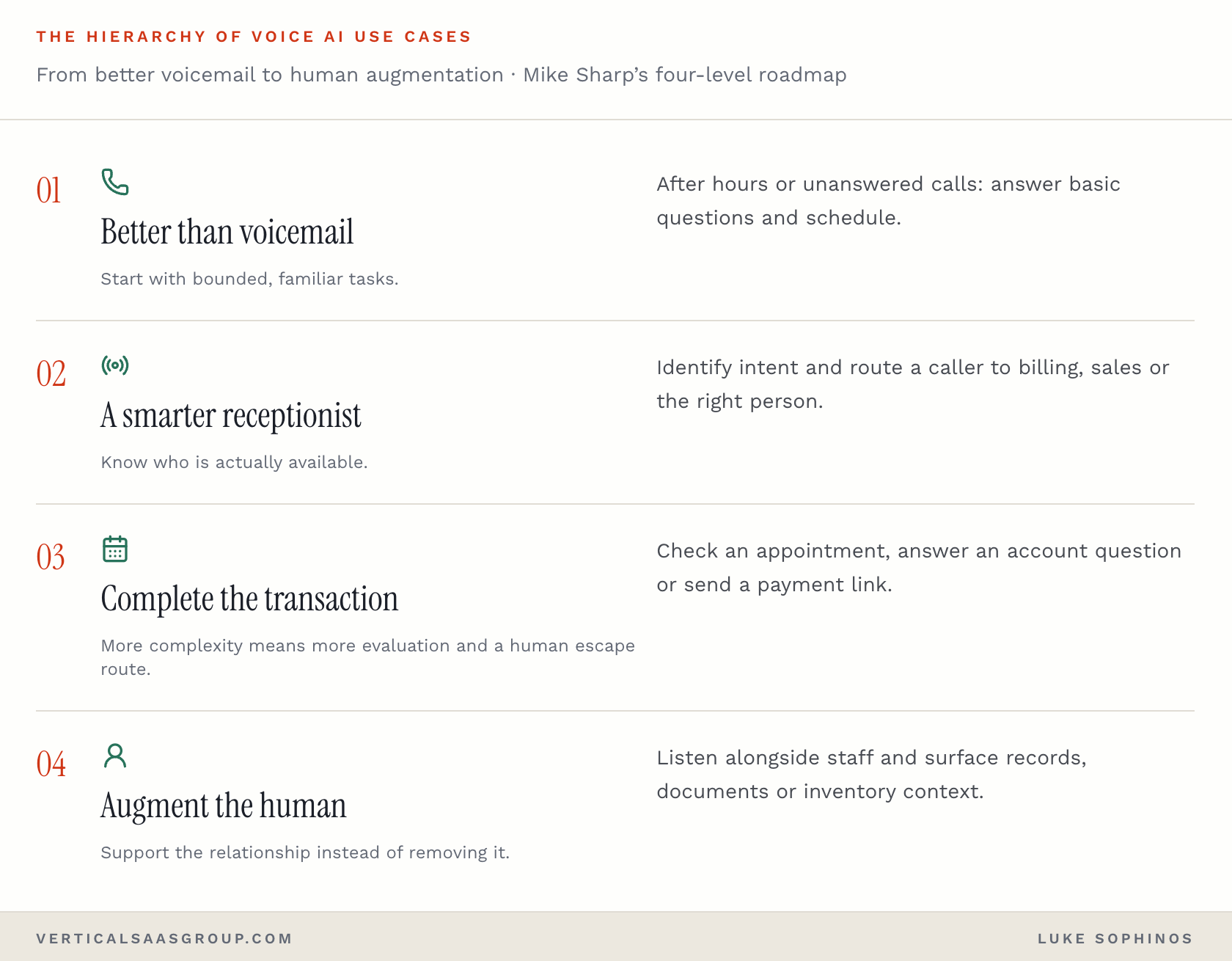
6. There is a Maslow’s Hierarchy of voice AI use cases — start at the bottom
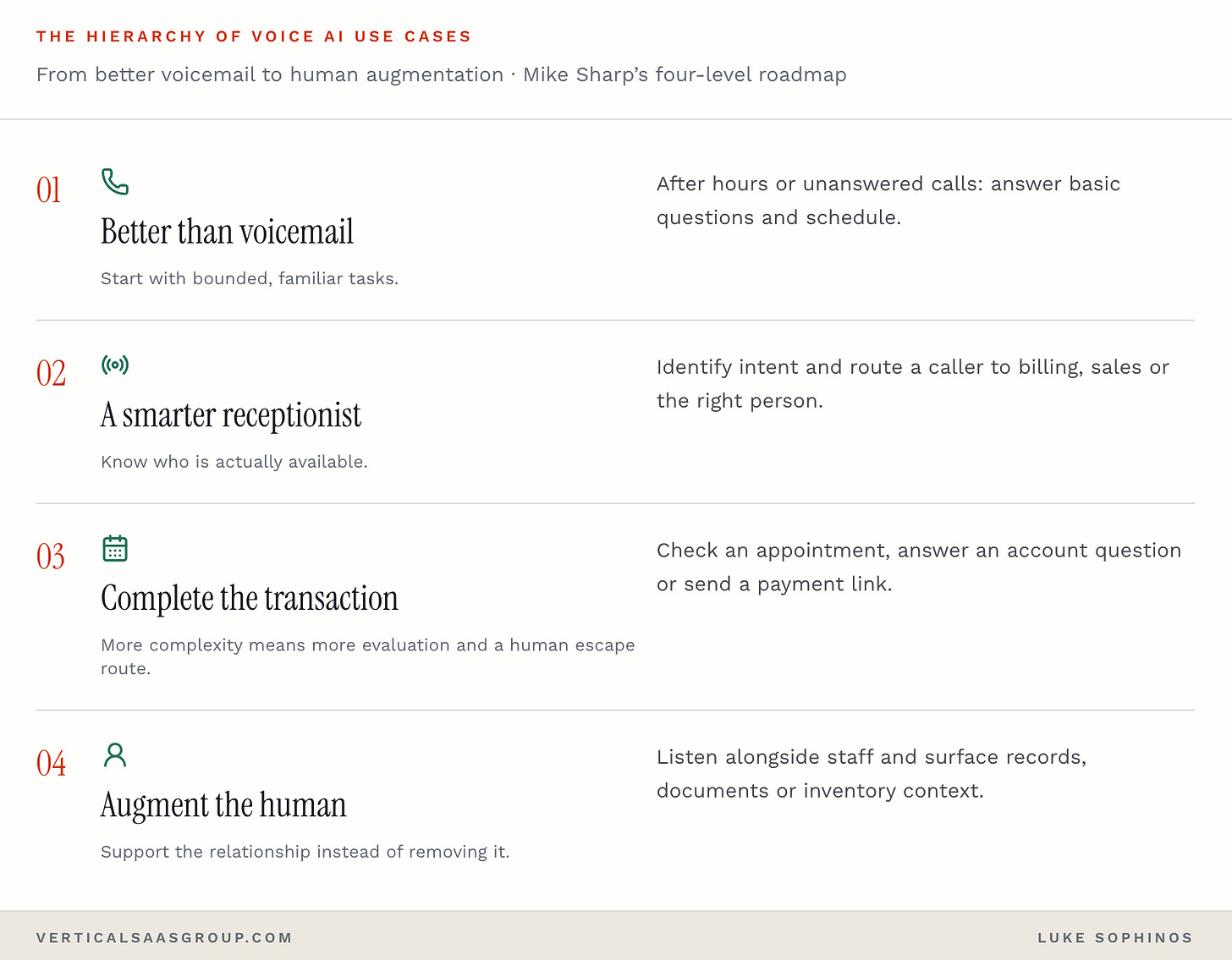
Mike’s stack, from table-stakes to frontier, is a useful roadmap for every vSaaS deciding where to deploy voice AI first:
Level 1 — “Better voicemail.” Voice AI picks up what humans don’t. Lowest risk, highest adoption. Start here.
Level 2 — Virtual receptionist / smart routing. Agent triages the call and routes to the right human.
Level 3 — Transactional task completion. Agent pays bills, answers account questions, triggers texts. Shakiest today — this is where consumer frustration lives.
Level 4 — Augmentation (the “embedded Gong” use case). Agent listens to human-to-human calls and surfaces answers, SKUs, documentation, and compliance prompts in real time. This is the use case Mike is most excited about, and the one most vSaaS founders are sleeping on.
7. Augmentation beats replacement in SMB verticals
In SMB verticals, direct labor replacement is rarely the right wedge. The receptionist is often the owner’s neighbor, cousin, or spouse. Owners don’t want to fire her — they want her to be better at her job. Deploy voice AI as an augmentation layer first: screen pops, call logging, inventory callouts (”that furnace is on 6-week backorder — here are two alternatives”), real-time compliance prompts. You get adoption, you get data, you earn the right to automate more over time.

8. “Who is this voice AI actually serving?” is the eval question that matters
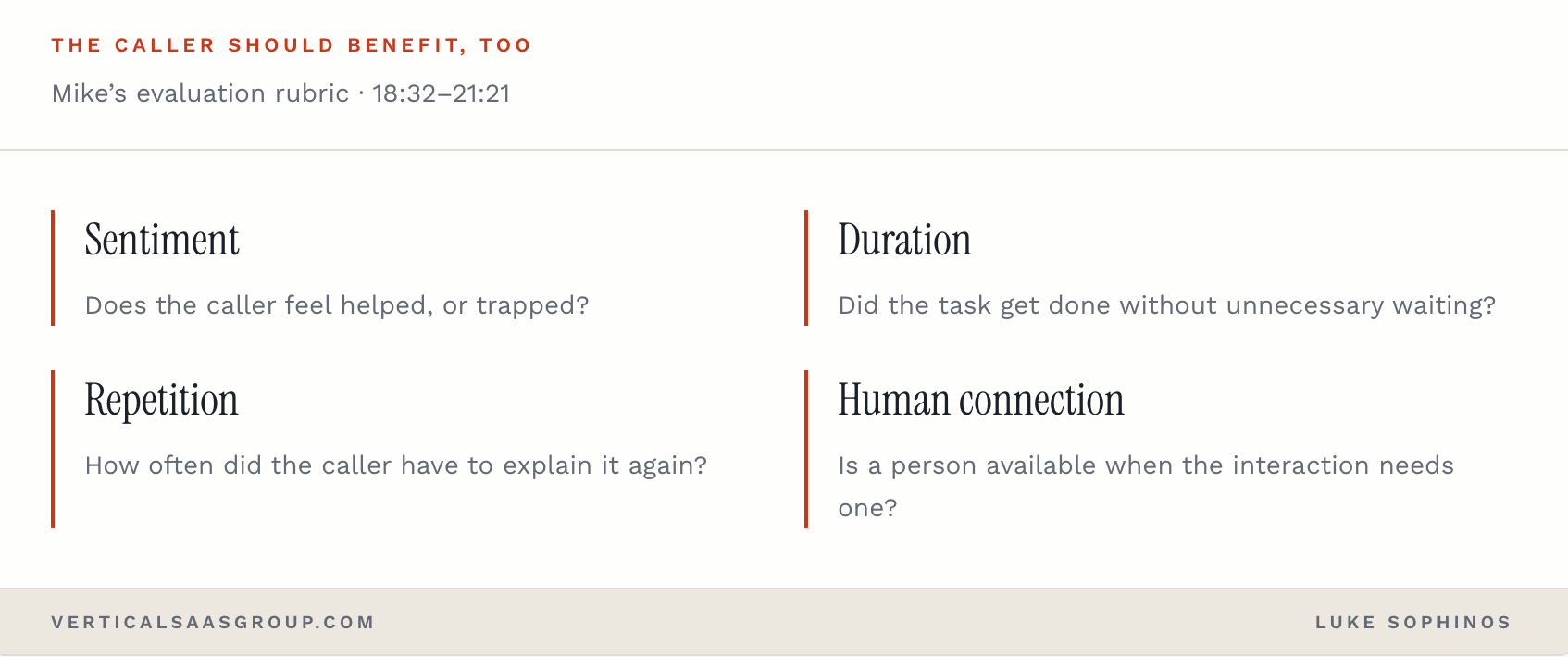
The consumer sniff test is instant. If voice AI makes the caller’s life faster and easier (IRS verification, appointment confirmation, drive-thru ordering), they love it. If it’s obviously deployed to save the business money at the customer’s expense, they hate it and start pounding “zero, zero, human, human.” Build evals around sentiment, call duration, and repetition count, but anchor every deployment decision in: who does this actually serve?
9. Match voice AI to the emotional weight of the call
Not every vertical should be automated the same way. Mike’s example: in death care (funeral homes, crematoriums), every call needs a human — people are grieving. Scheduling a dental cleaning? Automate it. Tax filing confirmation? Automate it. Grief, major medical news, legal defense? Keep the human. Mapping the emotional weight of each call type inside your vertical is table-stakes product work for any vSaaS deploying voice.
10. Your customer’s data is your Jerry Jones oil field — don’t lease it
Luke’s line in the episode is the one every vSaaS founder should tattoo somewhere: “Vertical SaaS founders are sitting on Jerry Jones oil fields and most of them don’t know it yet.” The call transcripts, the system-of-record data, the vertical-specific context — this is the asset that makes your voice AI 30 points better than a generic model. Don’t pipe that data into RingCentral. Don’t pipe it into a third-party voice vendor with conflicting incentives. Keep it, own it, train on it.
11. The same base model + vertical-specific harness = ~30-point performance swing
The benchmark data is clear: take any frontier model and wrap it in a vertical-specific context layer (your system-of-record data + domain content), and you get a ~30% performance improvement over the same model deployed generically. The implication for vSaaS founders is huge — you don’t need to train your own model to win. You need to own the data and the deployment context. That is a game vertical SaaS platforms are structurally positioned to win and horizontals are not.
12. Use voice as a product expansion lever, not a feature
Most vSaaS founders Mike talks to haven’t deployed voice yet, especially at the $5M–$20M ARR band. The ones who have are seeing real revenue lift, not just stickiness. Replacing a $300/month RingCentral line with your own branded phone stack at a competitive price is a new revenue line, a new margin pool, and a new reason your platform is impossible to rip out. Voice is not one product — it can be 5 modules (telephony, voice AI receptionist, ambient scribe, embedded copilot, outbound campaigns). Price it that way.
13. The compliance tailwind is coming — be the vendor that handles it for your customer
TCPA, state-level consumer protection, FCC enforcement on robocalls — all of this is getting more aggressive, not less. Your SMB customer has zero chance of navigating it alone. If your platform owns the phone stack, compliance becomes a wedge, not a liability. You handle consent, opt-outs, recording disclosures, and jurisdictional nuance. They sleep at night. You charge for it.
14. The surprise frontier: Big B-to-Big B voice
Everyone is chasing SMB and consumer voice AI. Mike’s early signal: massive B2B voice flows (insurer-to-insurer, distributor-to-distributor, broker-to-carrier) are still shockingly analog, with billions of dollars moving across phone calls that look like 1998. For vSaaS founders serving industries with heavy inter-company phone workflows (insurance, logistics, wholesale distribution, benefits, healthcare payer-provider), this is an underpriced wedge.
15. The timing argument: three years ago voice was impossible. Today it’s inevitable.
Mike doesn’t blame any vSaaS founder for not pulling voice in 3–5 years ago. It was too hard, too regulated, too crappy. All three of those things have changed simultaneously:
Voice AI is good enough for a growing set of use cases (and improving monthly).
Embedded voice infrastructure now exists (Dialstack and peers abstract the regulated layer).
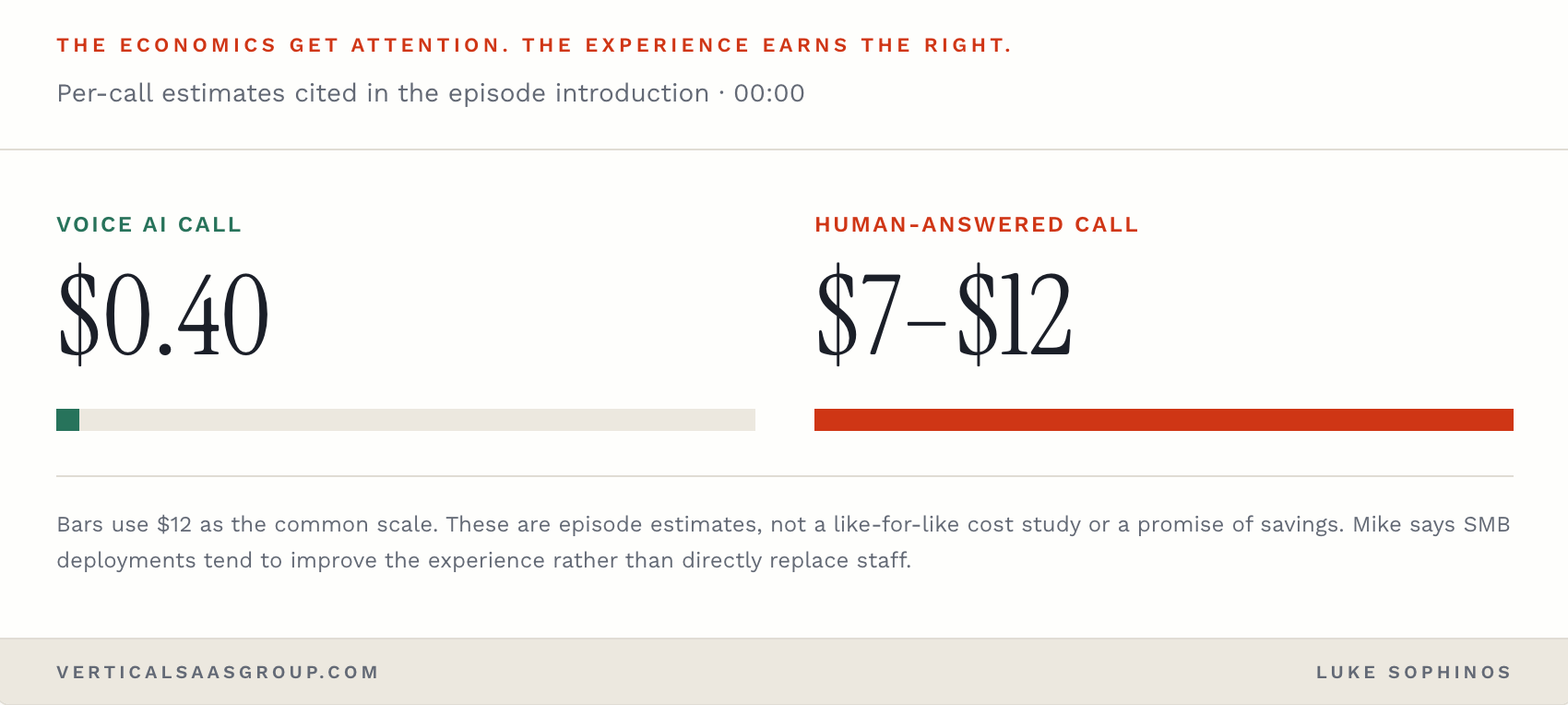
The economics have inverted — a voice AI call is ~40¢, a human call is $7–$12.
The cost-benefit math on owning the phone has flipped. Three years ago, “don’t own it” was the right call for most vSaaS founders. Today, it’s negligence.
Closing
If you’re a vertical SaaS founder, write down every workflow inside your customer’s business. Circle the ones you own. Draw a square around the phone stack.
That square is almost certainly the biggest unowned, most data-rich, highest-revenue surface left on the board — and the carriers are coming for it with voice AI as the wedge. You can own it, or you can watch RingCentral own your customer.
Go watch the full episode with Mike Sharp on VERTICALS below:
Reply to this email with what you’re building. I read every one.
— Luke
Thanks for reading LINEAR. I reply to every email…
Have any questions, feedback, comments? Let us know, we work for you!