

Today’s newsletter is sponsored by Xplor Pay. Launching embedded payments is one thing. Building a program that drives merchant adoption, revenue growth, and long-term enterprise value is another. Xplor Pay’s Investor-Operator Guide to Embedded Payments examines why payments programs often underperform after launch and what high-performing vertical SaaS companies do differently.

Drawing on firsthand experience building and scaling more than 20 vertical SaaS platforms, the guide offers practical insights for founders, operators, and investors looking to maximize the value of embedded payments. Download the free guide. Heading to the Vertical Software Summit, November 4–5? Xplor Pay will be there. Let’s talk about how to get more value from your embedded payments program.
Alright, let’s get to it…
Three things I’ve been chewing on this week:
Why the two-week sprint is dead and what’s replacing it
How to actually transition out of founder-led sales
How to add an agent marketplace into your system of record (and why to do it now)
Let’s dig in.

The old world of software development was a game of telephone.
Customer → CEO’s head → PM → engineer → shipped product.
If you were lucky, there was an actual customer at the start of that chain. More often it was the CEO’s gut, or a sales/cs rep’s war story, or something a board member said last Tuesday.
Ever played telephone as a kid? Think about how much got lost between the first whisper and the last. Now imagine that game played over six weeks, across three Jira tickets, two sprint planning meetings, and a PRD nobody reads to the end.
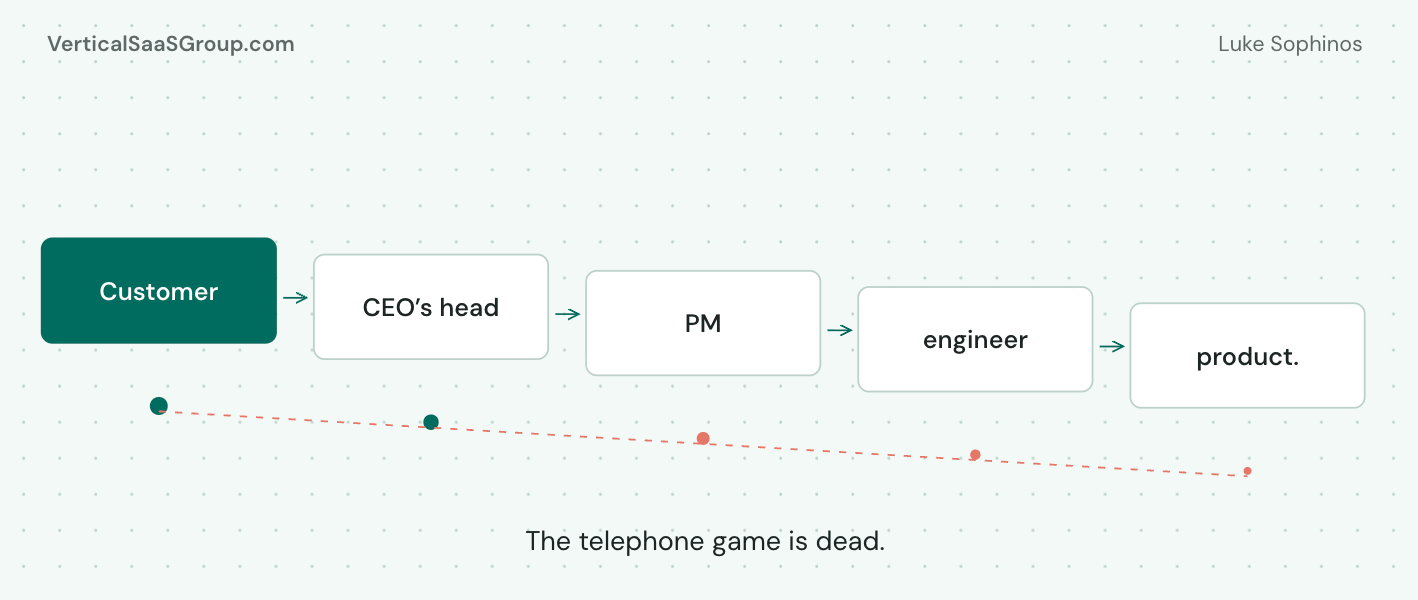
That’s how most vertical SaaS companies still build product.
The whole Agile religion made sense in 2015. Engineering was the bottleneck. Shipping was slow. The ceremony was worth the overhead. In 2026, engineering is not the bottleneck anymore. Context is. And the sprint does nothing to close the context gap. It just dresses up guesswork in ritual.
What’s actually working now
The best teams I’m seeing have blown this up.
They’ve handed the first draft of the product to the person who actually knows the customer.
Head of CS owns the industry-specific module. She’s on calls every day. She knows which workflows matter. She prototypes the first working version herself using modern AI build tools. Not a Figma mock. A working thing.
A sales leader owns the CRM module. He knows every field that matters and every one that doesn’t. He prototypes it.
Head of ops owns the back-office. Head of implementations owns onboarding. Each one ships a working first draft of the thing they live in every day.
I know “vibe coding” is the term that caught on, but if you’re a vertical SaaS CEO saying that to your board or your customers, you sound unserious. These leaders aren’t vibing. They’re prototyping a solution to a problem they understand better than anyone in the building. It feels more like operator engineering than vibe coding.
What engineers actually do now
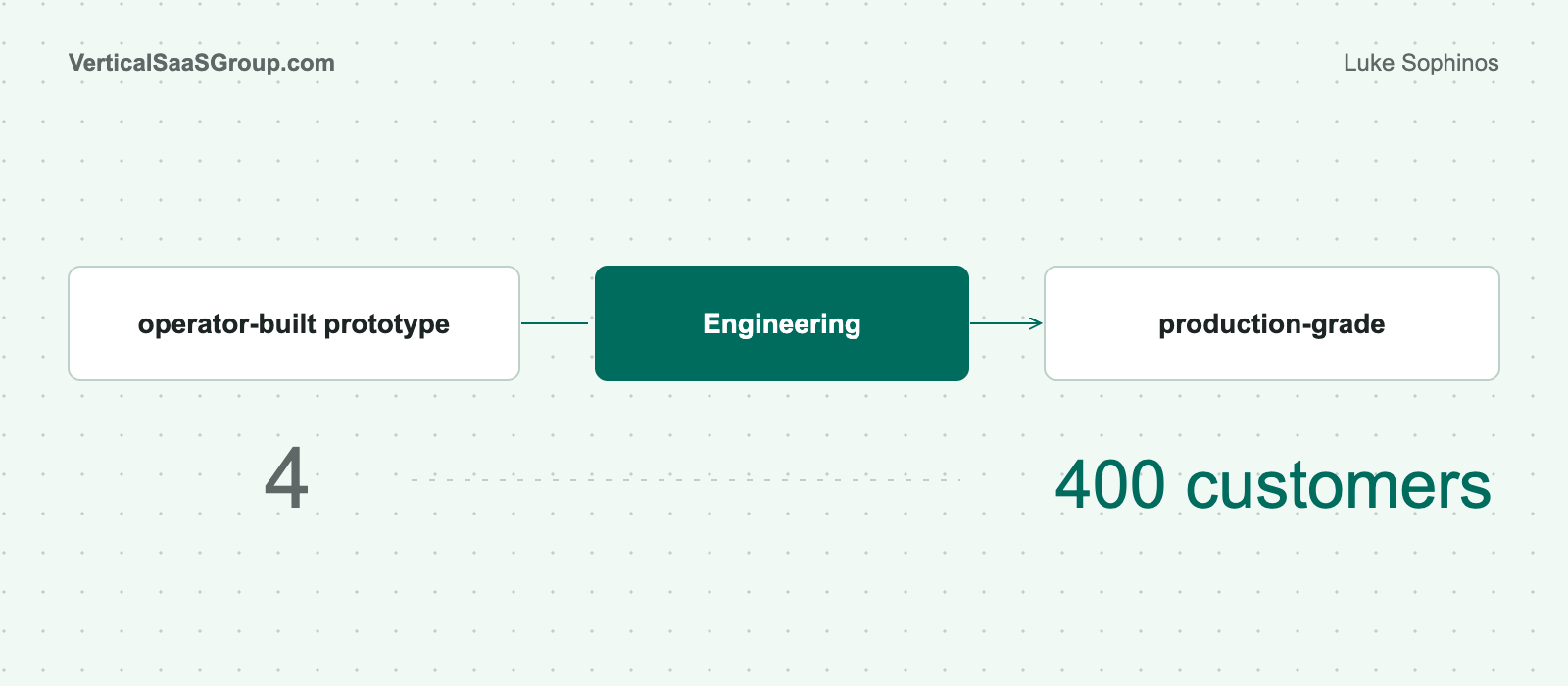
Engineering becomes the industrialization layer. They take the operator-built prototype and make it production-grade, secure, scalable, multi-tenant, and commercially viable for 4,000 customers instead of 4.
The prototype replaces the PRD. It’s a working spec. It answers 90% of the questions a traditional PRD leaves open.
Comp follows responsibility. Engineers get paid on uptime, bug count, scalability, infra cost per customer. Domain leaders get paid on adoption and outcomes inside their function. Nobody gets paid on story points. Nobody gets paid on hitting a sprint commitment that was made two weeks before anyone understood the problem.
You know how many engineers are probably coding their sprint committment in a few hours and then working on side projects to fill the day? At non ai-native companies, it’s a lot. That should scare you…
The bar for your leaders
Here’s the uncomfortable part. Every leader on your exec team now needs to be able to prototype the system they run.
Not maintain it. Prototype it.
If your head of CS can’t put together a working prototype of her module in a weekend, you’ve hired the wrong head of CS for 2026. If your head of sales can’t prototype the feature he continues to hear about on sales calls that the customers actually want to use, he can’t explain it clearly enough for anyone else to build it either. If your CEO can’t prototype the dashboard enterprise customers keep telling him about, the context is still trapped in his head and the telephone game starts all over again.
The prototype is the point. It’s how you kill the telephone game. The leader builds a basic working version of what they actually want (even if its crappy its fine). Engineering takes that and makes it real.
The two-week sprint is dead. The telephone game is dead. What’s replacing them is faster, closer to the customer, and honestly a lot more fun.
Final week to get tickets to the Vertical Software Summit !
Register today and reserve or miss out on the Vertical AI event of the year !
98% sold out…

Transitioning From Founder-Led Sales to a Real GTM Machine
Founder-led sales works until it doesn’t.
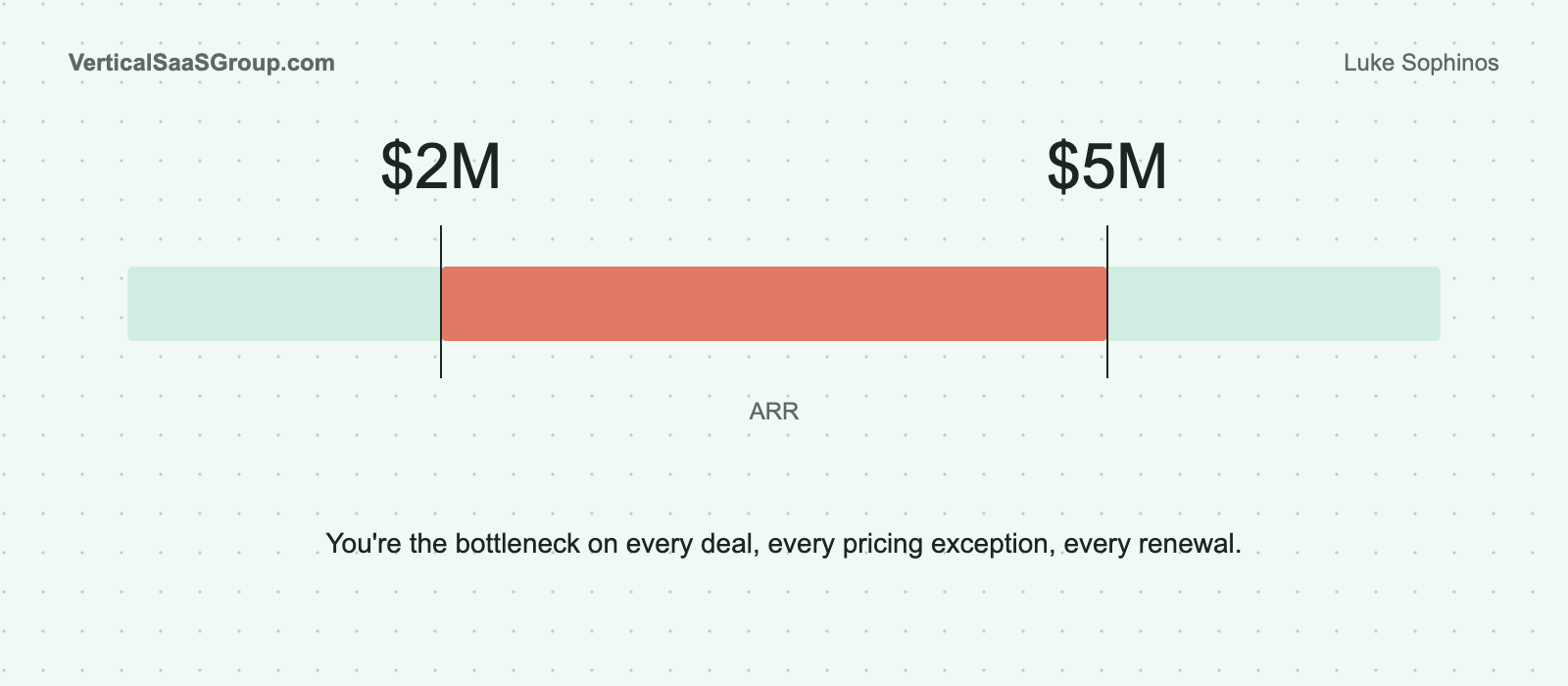
For most of us, it breaks somewhere between $2M and $5M in ARR.
You’re the bottleneck on every deal, every pricing exception, every renewal. Pipeline that used to feel abundant starts feeling fragile.
Here’s the thing: if you’re reading this and nodding, you’ve already done the hard part. You know at least one channel that’s working. Maybe it’s cold outbound to a specific persona. Maybe it’s conferences. Maybe it’s warm intros from your advisor network. Maybe it’s inbound from your Twitter presence.
You don’t need to go find your motion. You already found it. Now you need to scale it.
Here’s the step-by-step.
Step 1: Pick your ONE channel and ignore everything else.
Not two. Not three. One.
The temptation at this stage is to say “we’re going to do outbound AND inbound AND partnerships AND events.” Don’t. You don’t have the bandwidth or the data to run multiple channels well. Pick the one with the clearest signal and double down.
Everything else goes on the “later” list.
Step 2: Document EVERYTHING. This is the single most important thing you’ll do all year.
The founder who skips this step is the founder who hires reps, watches them fail, blames the reps, and starts over 12 months later.
What to document:
Every stage of your sales cycle. First touch to closed-won. Name each stage. Define what moves a deal from one stage to the next.
The pitch, verbatim. Record 20 of your own calls. Transcribe them. Pull out the exact words you use. The three objections you hear every time and exactly how you handle each one. The five questions prospects ask when they’re close to buying.
The demo script. Not an outline. The actual script. What you say in the first 30 seconds. What you click first. Which feature you lead with for which persona. Where you pause for questions.
A recorded demo video. You, giving the demo, start to finish. This becomes the gold standard every rep is measured against.
A screen recording of your actual workflow. Hit record, do a day of calls, let your future reps watch it. What you click, where you go, how you take notes, how you follow up, how you handle the no-show.
The pricing conversation. The exact words. Where you anchor, when you discount, what you refuse to concede.
The follow-up cadence. Email templates. Timing. Subject lines that get opens. Subject lines that die.
This takes two to three weeks of real work. Do it anyway. The founder who refuses to document is the founder who stays trapped in the sales seat forever.
Step 3: Hire in pairs. Always. Two AEs, not one.
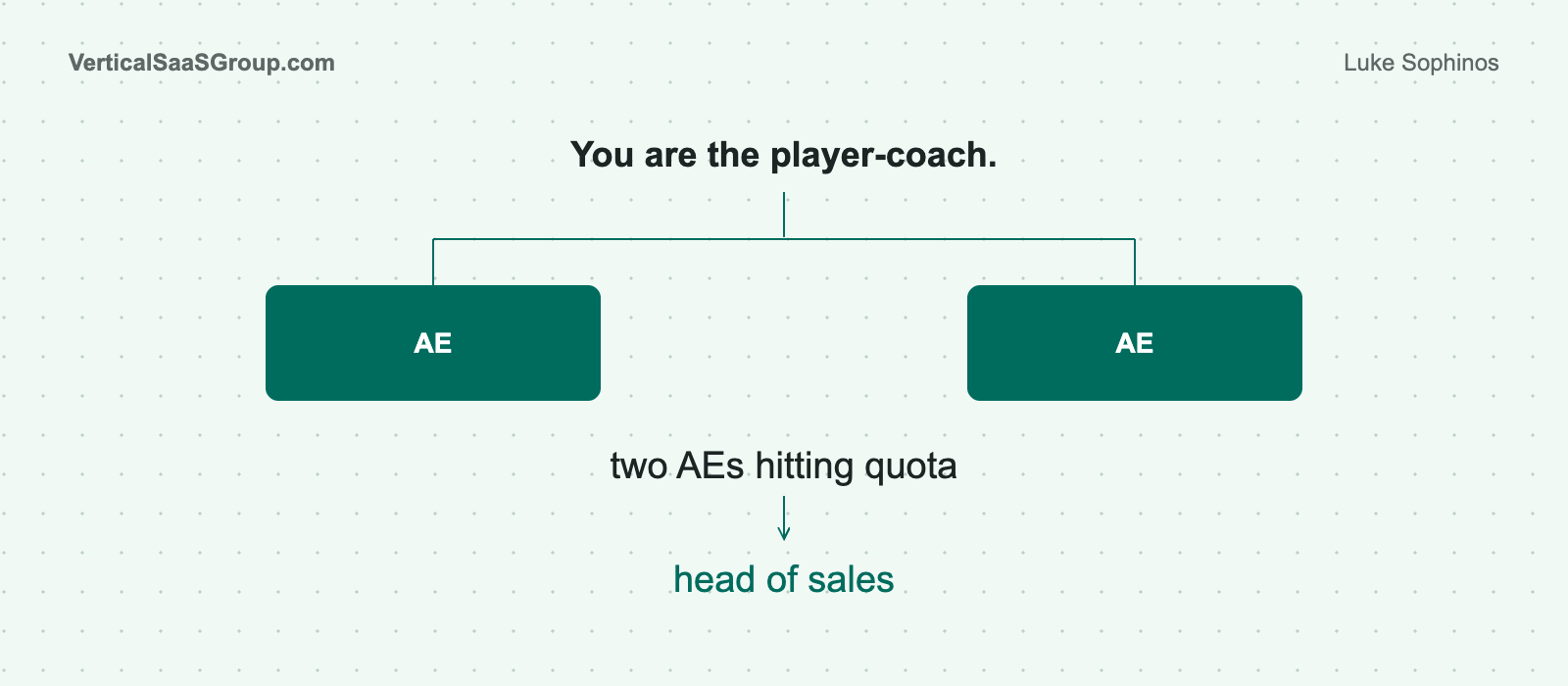
Do NOT hire a head of sales yet. Do NOT hire a player-coach yet. You are the player-coach. This is your job for the next 12 to 18 months.
Hire two AEs. Not one. One rep always fails. If you hire one and they wash out, you have no idea what happened. Was it the rep? The playbook? The ICP? The comp plan? You can’t tell. If you hire two running the same playbook and one succeeds, you’ve got your answer.
If you can only afford one, wait until you can afford two.
Your job the moment those two AEs start: onboard them against the playbook you built in Step 2, run their deal reviews, listen to their calls, close with them when needed. You are their manager. That’s the job.
Step 4: Iterate the playbook weekly, not quarterly.
The playbook you documented in Step 2 is version 1.0. Every week, update it based on what your reps are hearing. New objection? Add it. New way of framing the problem that landed well? Add it. Something stopped working? Delete it.
The playbook is a living document. The founder who writes it once and files it away gets stale in 90 days.
Step 5: Only hire a head of sales once you have two AEs hitting quota. And then slowly turn the dial.
This is the step everyone screws up. Two different ways.
First screwup: hiring the head of sales too early. Do not hire a head of sales to figure out the motion. Do not hire one to “build the team.” Do not hire one because your board asked when you’re hiring one. A head of sales cannot build a system that doesn’t exist yet. 95% of sales leaders have spent their careers scaling systems other people built. Hire them before the system is proven and they’ll spend their first year building something you’ll rebuild in year two.
Two AEs hitting quota is the signal. Not before.
Second screwup: once the head of sales is in the seat, letting them go on a hiring spree. Any head of sales (or CEO) who says “let’s hire 20 AEs now” is in for a rude awakening. I did it. It doesn’t work. Painful mistake.
This is a marathon, not a sprint. The right move is to slowly turn the dial. Add two AEs. Make sure the economics still work. Add two more. Check again. If pipeline velocity drops, if win rates slip, if ramp time stretches, pause. The channel that supported two reps may not support ten. The channel that supported ten may collapse at twenty. The only way to find out is to add capacity gradually and watch the numbers.
The right head of sales understands this. The wrong one wants to build an empire in six months.
Step 6: While the head of sales scales channel one, YOU go find channel two.
Here’s the mistake that haunts founders. You scale your first channel. You hit the plan. You exhale. You start working on product strategy, or fundraising, or your next hire.
Then one day, 18 months later, the channel that got you here stops working.
Channels change. What works today usually doesn’t work forever. Outbound email that printed money in 2022 was dead by 2024. SEO plays that minted companies in 2019 got crushed by AI overviews in 2025. Conference pipelines dry up when your category gets crowded. Warm intro networks saturate.
The moment you have a head of sales scaling your first channel, your job is to go hunt for the second one. Not to delegate it. Not to put it on next quarter’s roadmap. To actually go do it. You, or someone you deeply trust, should always be exploring the next channel.
Test outbound in a new segment. Test a partnership motion with an adjacent software company. Test paid acquisition. Test a conference you’ve never been to. Test an industry influencer play. Document what you learn.
You don’t want to wake up one day with 20 reps and a channel that no longer works. That’s an existential threat. The founders who survive channel decay are the ones who were already hunting for the next one 12 months before they needed it.
The common theme
You already found what works.
The job now isn’t discovery.
It’s documentation, duplication, and discipline.
Document everything. Hire in pairs. Stay in the sales seat until two AEs are hitting quota. Then and only then bring in the head of sales who scales it, slowly, one dial-turn at a time. And the whole time they’re scaling channel one, you’re out hunting for channel two.
Founder-led sales isn’t something to escape as fast as possible.
It’s the raw material you use to build the machine that eventually replaces you.

Adding an Agent Marketplace Into Your System of Record (And Why to Do It Now)
If you run an established vertical SaaS, you’re the system of record for your industry. The data lives in you. The workflows run through you. The seat licenses have worked.
That’s not the question.
The question is whether you still hold that position in 2030.
Because here’s what’s happening. AI agents are showing up in every vertical, and every one of them needs context to be useful. That context lives inside your platform.
Right now, whether you know it or not, third parties are starting to scrape it through your API, build agents outside your walls, and charge your customers directly. Every one of those agents is quietly accumulating the customer relationship on top of your database.
Do nothing for three years and here’s the range of outcomes.
Best case: you wake up as the Oracle underneath someone else’s workflow layer. Still a real business. No longer the center of gravity.
Worst case: someone slowly makes you irrelevant as they harvest your data for years until you’re no longer needed at all. The agents become the system of record. You become the legacy headless database nobody opens anymore.
Neither one is a future worth sleepwalking into.
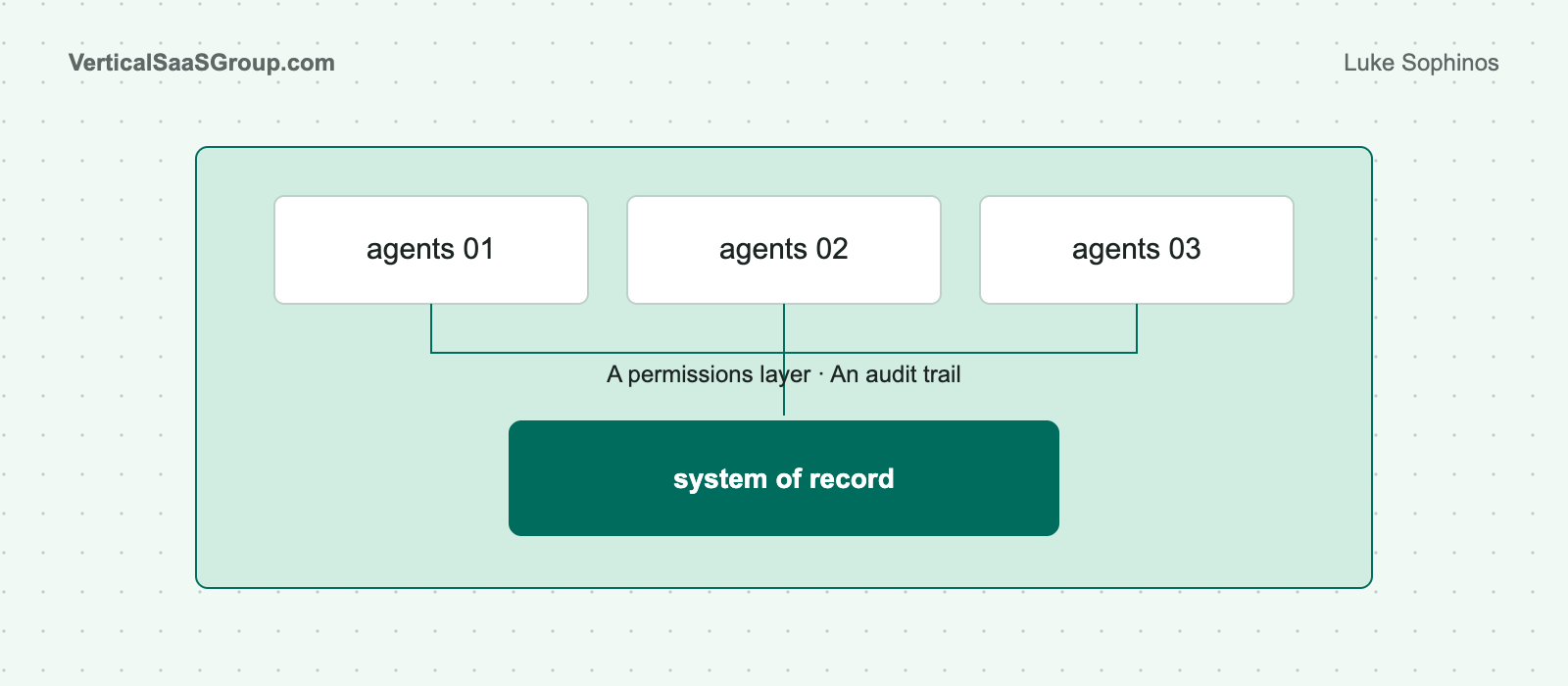
The move is to open the platform and let agents build inside your walls, with your blessing, under your governance, running on your rails. You stay the system of record. You add a transactional marketplace on top. The moat gets deeper, not shallower.
Here’s the step-by-step.
Step 1: Study app stores like a religion.
Before you build anything, go to school on the companies that got this right.
Apple’s App Store. Google Play. Shopify. Salesforce AppExchange. HubSpot. Atlassian Marketplace. Chrome Web Store. Figma. Even the failed ones like BlackBerry World and Windows Phone Store, because the failures teach you more than the wins.
Understand what worked. Understand what didn’t. Understand the rev share decisions, the submission processes, the discovery mechanics, the quality controls, the developer relations motions, the pricing models, the dispute processes.
Then replicate the parts that fit your vertical. This is a solved problem at the pattern level. You don’t need to reinvent anything. You need to adapt proven playbooks to your industry.
Any exec team that tries to build a marketplace without first spending a month studying every app store that exists is going to make expensive, obvious mistakes.
Step 2: Build the agent rails.
Nothing happens until you have the infrastructure.
You need:
Clean APIs/MCPs with real documentation, versioning, and sandbox environments
A permissions layer so agents only access the data a customer explicitly authorizes
A metering and billing layer that tracks every agent action and handles rev share automatically
An audit trail so every agent action is logged, attributable, and reversible
A security review process so you decide which agents are allowed on the platform
If you launch a marketplace without this infrastructure, one bad agent leaks customer data and your entire marketplace is dead on arrival. The incumbents who nail this become platforms. The ones who don’t become cautionary tales.
Step 3: Find 5-10 companies to launch it with.
Pick developers who already understand your vertical. Give them early access, white-glove support, co-marketing, and a direct line to your product team. Help them succeed.
Why this matters: the first 10 agents on your marketplace define what the marketplace is. If they’re great, you attract great developers. If they’re mediocre, you attract mediocre developers and the marketplace never recovers. The hand-picked phase is how you set the quality bar.
Keep this phase quiet. No press release. No “marketplace is live.” Just a working ecosystem of 10 serious developers shipping real agents to real customers.
Step 4: Require every customer to use YOUR interface to access agents.
This is the step that separates platforms from pipes.
Think about iOS. You don’t install apps on an iPhone by going to a developer’s website. You go to the App Store. The interface is Apple’s. The payment is Apple’s. The discovery is Apple’s. The developer builds the app, Apple controls the entry point. That’s how Apple captured the economics and the customer relationship.
You need the same thing in your vertical.
Build a Claude-esque interface inside your product where customers can discover, install, authorize, and run agents, both the ones you build and the ones third parties build. The user experience is yours. The data access runs through your permissions layer. The billing runs through your rails. The audit trail is yours.
If customers can bypass your interface to use third-party agents on your data, you’ve built a pipe, not a platform. Make the interface so good and the integration so clean that nobody wants to go around it.
Step 5: Do a massive agent app store launch.
Think Steve Jobs on stage announcing the App Store in 2008.
This is not a quiet “we have a marketplace now” blog post. This is the biggest launch moment in your company’s history. You’ve been building the rails. You’ve got 10+ real agents with real customer traction. You’ve got the interface that makes it all work. You’ve got the economics figured out.
Now you tell the world.
A keynote-style launch event in your vertical. Press. Partner announcements. Customer testimonials. A pre-populated marketplace with real agents your customers can turn on tomorrow. Developer sign-ups open. Marketing budget turns on. Sales enabled.
The reason to make it a huge moment: you want every developer in your vertical to know, on the same day, that your platform is where serious agents get built. You want every customer to know their system of record is now also their agent command center. You want every competitor to realize you just redefined the category.
Soft launches lose this moment. Blog posts lose this moment. Big launches own it
To wrap it up
You already have the hard asset. You own the system of record. The question is whether you turn it into a platform or let someone else build the platform on top of you.
Study the companies that got this right. Build the rails. Pilot with a handful of serious developers. Own the interface. Launch like Apple.
The incumbents who make this move in 2026 will look like category-defining platforms in 2030. They’ll be the Shopify of their vertical.
The ones who don’t will spend the back half of the decade watching third parties monetize the data they spent 20 years collecting.
Pick your story.
Do me a solid and forward to a friend :-)