

Today’s newsletter is sponsored by Xplor Pay. Vertical AI could represent an opportunity 10x bigger than SaaS. But capturing it will take more than adding AI features.

Luke Sophinos, Mark Passifione, and Daniel Burton explore what it takes to move from vertical SaaS to agentic, where software begins doing more of the work and driving outcomes. Watch the discussion on demand and get the practical roadmap for identifying where to start, proving value, and expanding from there.
Watch the Discussion + Get the Roadmap →
Every vertical SaaS founder is sitting on a gold mine and most of them do not know it yet.
Here is the setup. You spent years building software for one industry.
Ugly workflow.
Boring category.
Real customers.
Real revenue.
The kind of company nobody in Silicon Valley (other than me probably :-)) writes about until it exits for a billion dollars.
Here is the part most founders miss: for nearly all of of you, the model companies have no interest in building an industry-specific solution for your market.
OpenAI is not going to build a in dentistry. Anthropicis not going to launch a product for Trade Schools. These are tiny markets to them. Fragmented. Regulated. Hard to sell into. The economics do not work for a horizontal company that would rather sell you tokens to you than hire a specialty sales team.
That is the entire opening.
The model companies built something extraordinary and priced it per token. Your job is to take that raw horsepower and wrap it in the one thing they will never build for your industry: scaffolding that turns a general model into something your customers cannot live without.
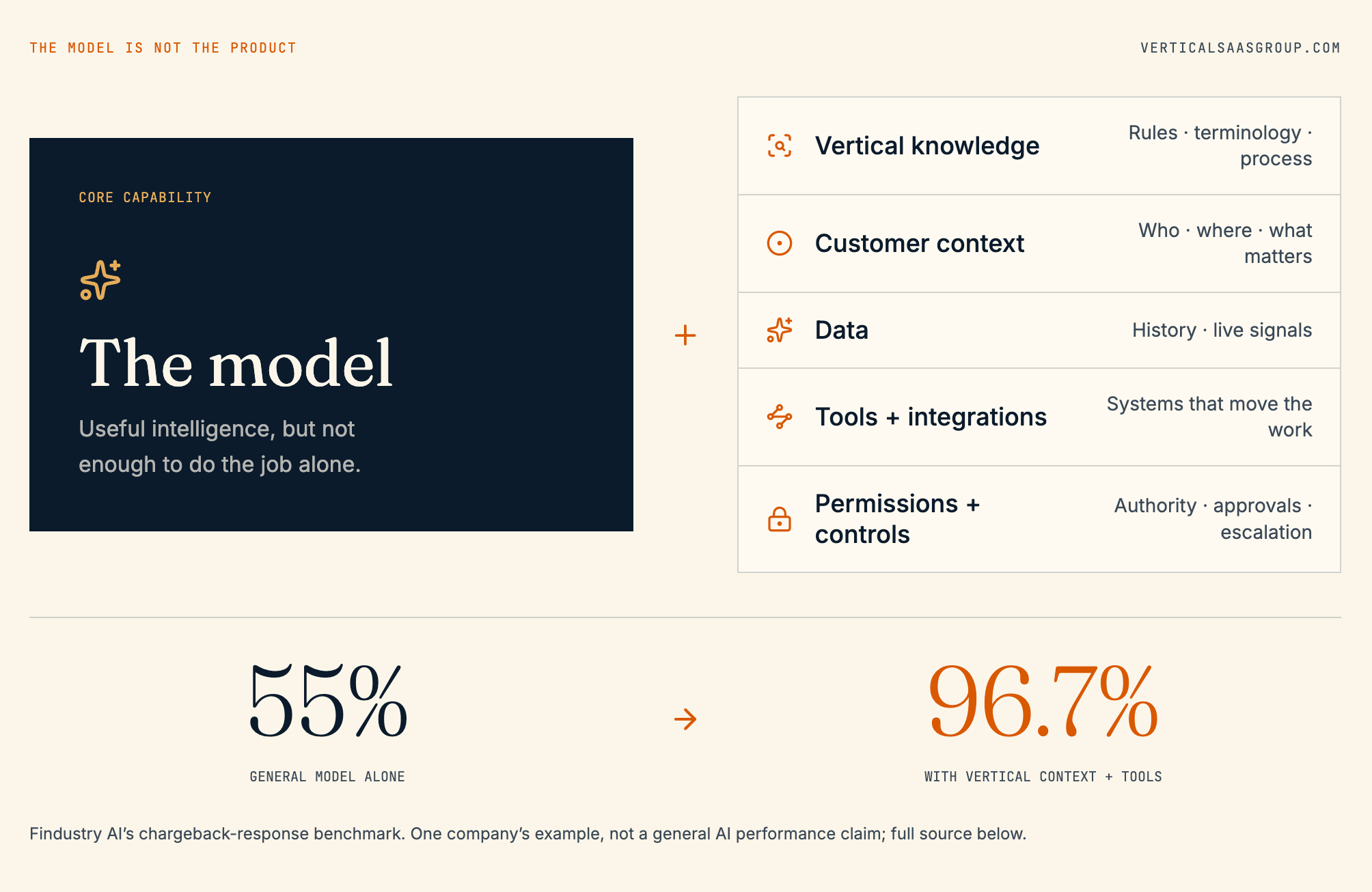
Findustry AI ran a benchmark on what this looks like in practice. GPT-5.5 tested on chargeback responses. Alone, the model scored 55%. Wrapped in Findustry’s vertical scaffolding — industry data, workflow tools, expert rules, permissions, customer context — it scored 96.7%. Same model. 41.7 points of difference. Not from a better model. From better scaffolding.
That is not a payments story. That is the pattern that is starting to show up across every serious vertical AI company.
OpenEvidence beats the next best frontier model on a physician-graded benchmark by 12.1 points. Over 350,000 clinicians use it.
Hippocratic AI took clinical accuracy from 80% to 99.38% across four model versions. Evaluated by 6,234 licensed clinicians on 307,000 real patient calls.
Harvey beat the human lawyer baseline on Document Q&A 94.8% to 70.1% in a third-party benchmark. Beat lawyers. Not GPT. Lawyers.
Abridge cut word error rate on clinical conversations 24% below Google Medical ASR. Google. A $2 trillion company. Losing on medical transcription to a startup because the startup built better scaffolding.
Four verticals. Same pattern. The companies building scaffolding are running away with their categories, and they are doing it on top of the same models available to everyone else.
Here is the part vertical SaaS founders need to hear.
You have every raw material needed to build this scaffolding. Ten years of screens. Ten years of edge cases. Ten years of your best customers teaching your product how their industry actually works. Nobody else in the world has that. Not OpenAI. Not Anthropic. Not any horizontal AI startup with a great demo and $50M in seed funding.
The horsepower is rented. The rest is yours. You just need to build the scaffolding. And the founders who do it first are going to dominate their industries in ways that would have been impossible five years ago.

The scaffolding is what turns a horizontal model into an industry-specific gold mine.
The Findustry image above lays out the five components cleanly. Vertical knowledge. Customer context. Data. Tools and integrations. Permissions and controls. That is what turned a 55% model into a 96.7% product. That is the shape of the scaffolding.
The model companies will never build any of these for your industry. They do not want to. Every dollar you spend on their API is a dollar they get without hiring a single salesperson who understands your buyers. That trade is fine for them. It is a massive opening for you.
Here is how each layer plays out in real vertical AI companies right now.
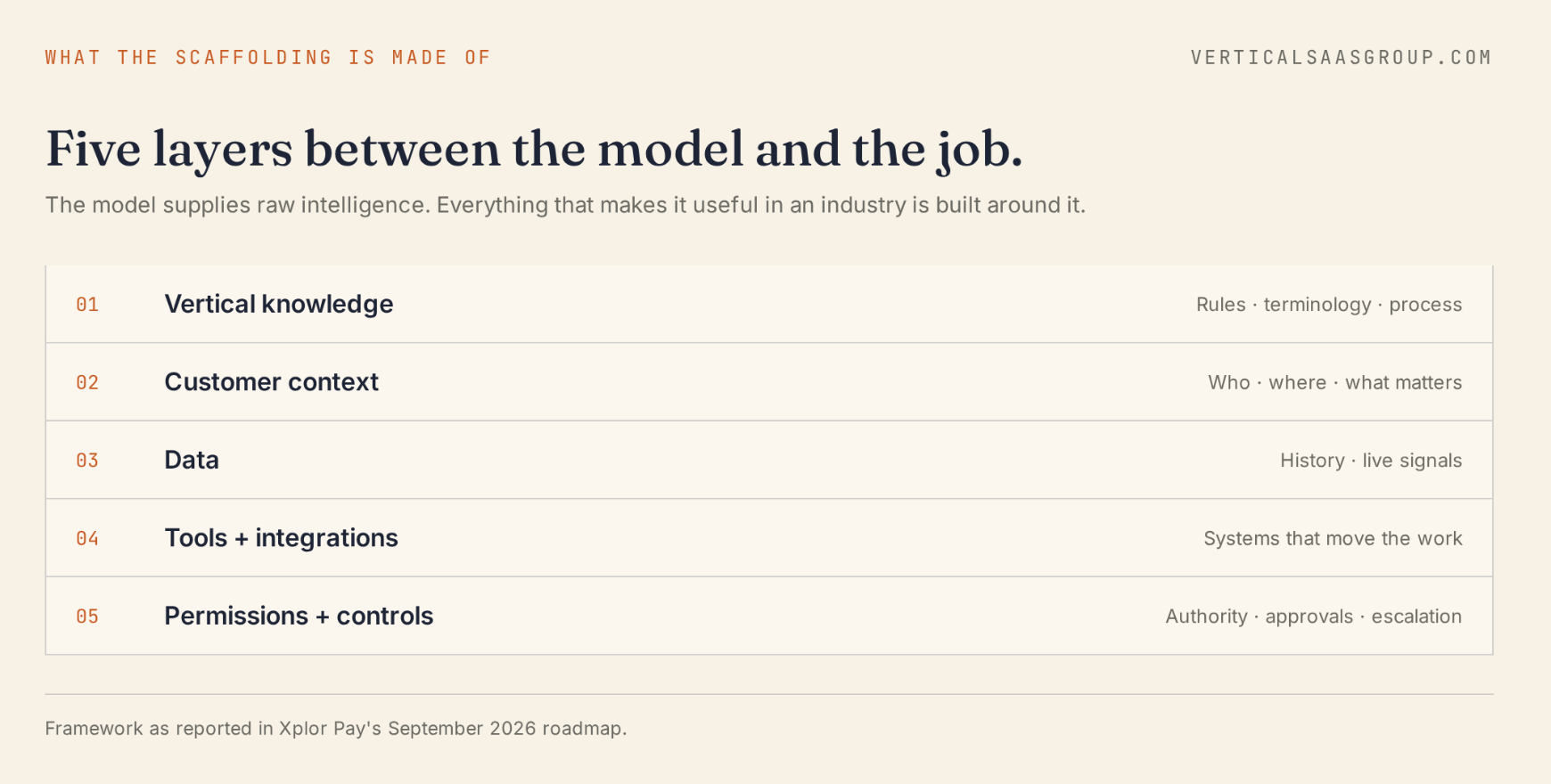
Vertical knowledge and data. OpenEvidence locked up exclusive multi-year deals with NEJM, JAMA, Nature, NCCN, and Cochrane. Trained on 35 million peer-reviewed papers a general model cannot legally touch. Your version is the industry data your customers generate every day that nobody outside your product ever sees.
Customer context. Hippocratic has 6,234 nurses on retainer grading every weird patient interaction their AI has ever had. Every mistake feeds back. That is how they went from 80% accuracy to 99.38%. Your version is sitting in your support tickets, escalation logs, and the heads of your best CSMs.
Tools and integrations. A model that can draft is a copilot. A model that can execute is an agent. The model companies will never wire tools into your customer’s stack. That is your job. Every workflow your product already runs is a callable tool. Harvey turned legal workflows into tools that beat human lawyers on four of seven tasks.
Permissions and controls. Compliance rules. Approval thresholds. State regulations. Payer quirks. Denial codes. Your best operators know every one of them. A horizontal AI company has ML engineers who have never worked a day in your industry. That gap does not close with more compute. It only closes with operator judgment encoded into product, and that only exists inside companies like yours.
Nail one layer and you build a nice AI feature. Nail all five and you build a company that owns the category.
The model companies gave you the intelligence. They will not give you the scaffolding. That gap is the entire opportunity.

How to actually build the scaffolding that dominates your industry.
models, pick a use case that demos well, and ship a copilot. Six months later they have a nice feature and no real advantage.
Wrong sequence. Here is the one that actually wins.
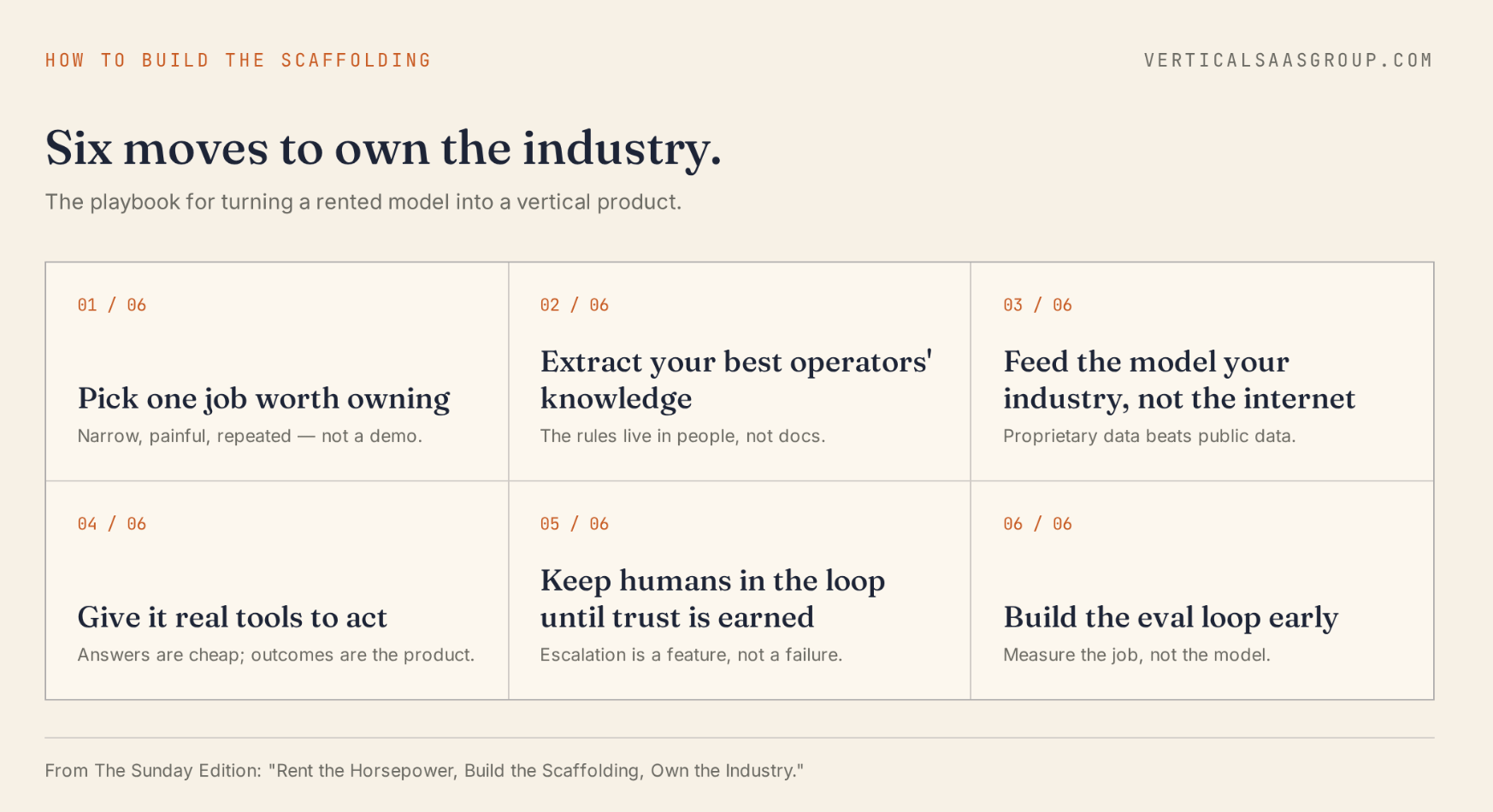
One. Pick one job worth owning.
Not a feature. Not a chatbot. One job in your industry that is expensive, painful, frequent, and measurable. The kind of job your customers currently pay people to do. That is where the economics work in your favor. Everything else is a distraction.
Two. Extract what your best operators know.
Sit down with the smartest domain experts in your company. Interview them on the messiest cases they have ever handled. Record it. Write it down. Turn it into structured examples the model can learn from. This is the single most valuable data engineering work you will ever do. Most of it has never been written down anywhere.
Three. Feed the model your industry, not the internet.
The general model already knows the language. It does not know your industry. Give it access to your corpus, your customer history, your workflow logs, your regulatory documents. Nothing else. That is what separates a copilot from a category winner.
Four. Give the model real tools to act.
Every workflow already in your product is a candidate tool. Expose them one at a time. Start narrow. Prove reliability. Then expand. The moment your model can actually complete a job instead of just describing it, you have a different kind of company.
Five. Keep humans in the loop until trust is earned.
Progressive autonomy beats maximum autonomy every time. A model that can do one job with approval is a feature. A model that can do that same job at scale without approval is a business. The path between those two is measured in months of proving reliability inside real workflows.
Six. Build the eval loop early.
Your best operators become your graders. Real cases become your benchmark. Every failure gets logged and fed back into the system. This is how Findustry proved a 41.7 point lift. This is how OpenEvidence, Hippocratic, Harvey, and Abridge all compound their lead. Without it, you are guessing.
The model is 1% of the work. The scaffolding is 99%. It does not demo well. It does not fundraise well. It is exactly what separates a real vertical AI company from a wrapper on top of ChatGPT.
The good news: your existing product is doing most of the work already. You are not starting from zero. You are turning ten years of built-up context into the one thing the model companies will never build for your vertical.
If this newsletter resonates, the Vertical Software Summit is the room in person.
Every serious acquirer, founder, and investor in vSaaS is coming.
Register today and reserve your spot before it sells out!

Four vertical AI companies. Four different industries. One pattern.
And every one of them built their advantage on top of the same models available to everyone else.
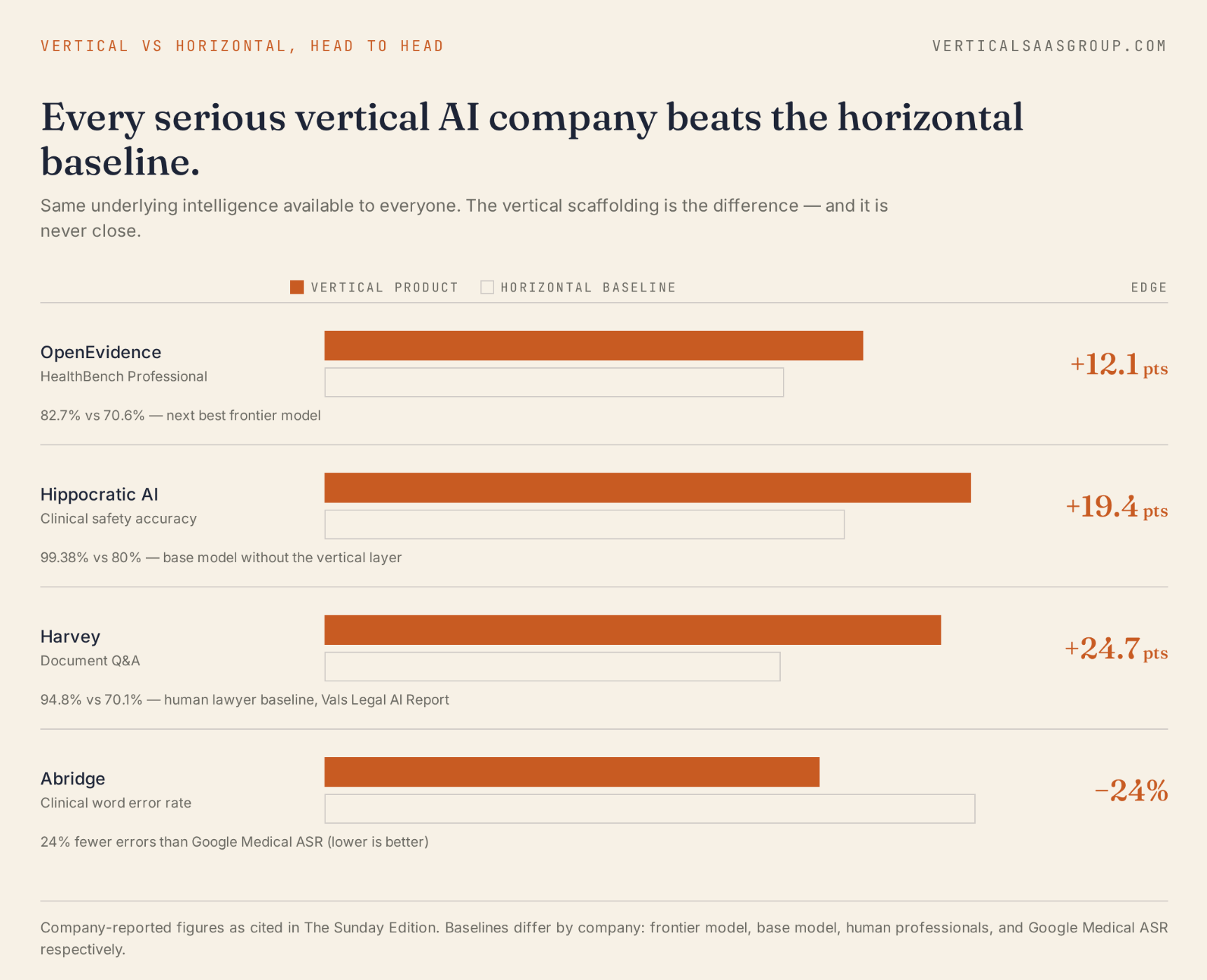
OpenEvidence. Built the data layer nobody else could get. Exclusive content deals with NEJM, JAMA, Nature, NCCN, and Cochrane. Trained a specialized model on 35 million peer-reviewed papers. Scores 82.7% on HealthBench Professional. That is 12.1 points above the next best frontier model. Over 350,000 clinicians use it. OpenAI could not build this. Not because they lack the engineering talent. Because the licensing deals took years to negotiate and cost more than any horizontal player is willing to spend on a single vertical.
Hippocratic AI. Built the expert labeling infrastructure nobody else would build. 6,234 licensed clinicians on retainer, averaging 11.5 years of experience each. Evaluated 307,000 real patient calls. Clinical accuracy went from 80% pre-Polaris to 99.38% at Polaris 3.0. Severe harm errors driven from 0.06% to 0.00%. Anthropic is not going to hire 6,000 nurses. That is not a horizontal business. It is a vertical business built on top of horizontal models.
Harvey. Built the workflow tools no horizontal model can wire into a law firm. Beat the human lawyer baseline on four of seven tasks in the independent Vals Legal AI Report. Document Q&A: 94.8% vs 70.1%. Document Summarization: 72.1% vs 50.3%. Transcript Analysis: 77.8% vs 53.7%. Vertical AI beating trained human professionals. The model companies did not do that. Harvey did that, on top of models the model companies built.
Abridge. Built the medical-specific accuracy layer that a horizontal ASR could never justify. 24% relative reduction in word error rate on clinical conversations vs Google Medical ASR. 83% reduction in transcription errors on new medications. 15% improvement on accented English. Google has been working on medical speech recognition for over a decade with unlimited resources. Abridge beats them because Google does not care enough about clinical conversations specifically to build the last mile. Abridge does.
Four companies. Four verticals. Not one of them tried to compete with the model companies.
They used the model companies. They rented the horsepower and built the scaffolding the model companies would never build. And in doing so, they turned commodity intelligence into industry-specific gold mines.
That is the play. The model companies gave you an unbelievable gift. They spent tens of billions of dollars building something extraordinary and then priced it per token. Your only job is to wrap that horsepower in ten years of industry context nobody else in the world has.
The horsepower is rented. The scaffolding is yours. The industry is waiting.
See you Wednesday,
Luke
Do me a solid and forward to a friend :-)