

Today’s newsletter is sponsored by Xplor Pay. Vertical AI could represent an opportunity 10x bigger than SaaS. But capturing it will take more than adding AI features.

Luke Sophinos, Mark Passifione, and Daniel Burton explore what it takes to move from vertical SaaS to agentic, where software begins doing more of the work and driving outcomes. Watch the discussion on demand and get the practical roadmap for identifying where to start, proving value, and expanding from there.
Watch the Discussion + Get the Roadmap →
The Summit is six weeks away. Last year we turned away 100+ people who waited too long. This year the room is bigger, the speakers are unbelievable, and the investor list is heavy. If you build in vertical software or vertical AI, this is the place to be.

Below: the founder who met his Series A lead in that building — and closed $16M a few months later — the complete playbook for raising your next round while you are there, and who is actually on stage at the Vertical Software Summit in 2026.

Mark Hoadley met his Series A lead at the Summit. Four months later, Frontier Growth wired $16M.

Act I: The ServiceTitan education
Before he founded anything, Mark Hoadley spent nearly four years in sales at ServiceTitan — watching, up close, what a billion-dollar vertical software company actually looks like from the inside. He learned how the trades buy software, why embedded payments matter, and what a real vertical go-to-market motion feels like. But he also saw the limits: he watched ServiceTitan struggle to expand into adjacent recurring-services trades and ultimately have to acquire its way in. Most employees would file that under “not my problem.” Hoadley filed it under “never let that happen to my company.”
Act II: Software from the museum
Meanwhile, his brother-in-law Ben Sikma was working M&A in waste management, and every operator he diligenced was running software that belonged in a museum. In Mark’s words: “Sometimes we’d talk about how this one reminds us of the Oregon Trail, this reminds us of the cell phone Michael Douglas used in Wall Street.” Clunky. On-prem. Written in the 90s. A $145 billion industry — the one that keeps every community in America functioning — running on paper route sheets and gut instinct, with two dominant incumbents that later merged, leaving haulers with almost no real alternative.
So in November 2020, they built one. Hauler Hero is the all-in-one operating system for waste haulers: CRM, billing, routing, dispatch, customer portal, fleet visibility. And — the ServiceTitan lesson applied — deliberately multi-product from day one, rather than a point solution with expansion dreams. It is harder to build. It is also much harder to rip out.
Act III: The AI dividend
Here is the part of the story that matters most in 2026. Because Hauler Hero built a modern cloud system of record from the start — a clean, proprietary data model of every customer, route, truck, and pickup — it became the perfect substrate for AI when the wave arrived. While legacy incumbents are trying to bolt AI onto 90s on-prem databases, Hauler Hero ships agents that sit natively on the data.
The proof is already in production. Their customer service AI agent — think Intercom’s Fin, but for waste haulers — now handles roughly 60% of inbound support interactions. And their camera product pulls images from third-party cameras on garbage trucks straight into a command center, automatically reviewing the exceptions that break a normal day: cans that are overloaded, damaged, or simply not where they are supposed to be. That is not a demo. That is AI doing physical work in a physical industry, powered by a data model the incumbents cannot replicate without rebuilding from zero.
Act IV: The room
Now the part that matters for this newsletter.
In October 2024, Mark showed up at the inaugural Vertical Software Summit in Miami. Dave Pandullo from Frontier sat on the VSaaS investor panel. They connected in person — not over a cold email, not on a Zoom screen, but in the room, with context, surrounded by people who already understood what a good vertical software business looks like.
Four months later, in February 2026, Frontier Growth led Hauler Hero’s $16M Series A, with Disruptive Founders Fund, Somersault Ventures, and several ServiceTitan executives participating. Total funding past $27M. When asked why Frontier, Mark’s answer was simple: of every investor at the table, Frontier had the deepest vertical SaaS expertise.
That is not a coincidence. That is what happens when the right founders and the right funds share a room and real conversation replaces cold outreach.
Mark is registered for the 2026 Summit too — and he is not the only one with that story. Multiple founders from year one told us they met the financier who led their next round in that building.
The lesson is simple. The best vertical software rounds do not close on Zoom. They close after a real conversation between people who actually understand the category. The Summit is one of the few rooms in the world where enough of those people show up at once for that to happen naturally.
If you build in vertical software or vertical AI — and you plan to raise, hire, sell, or learn in the next 18 months — the ROI of two days in Miami is hard to beat.
(and remember if you need a free ticket we will get you one!)
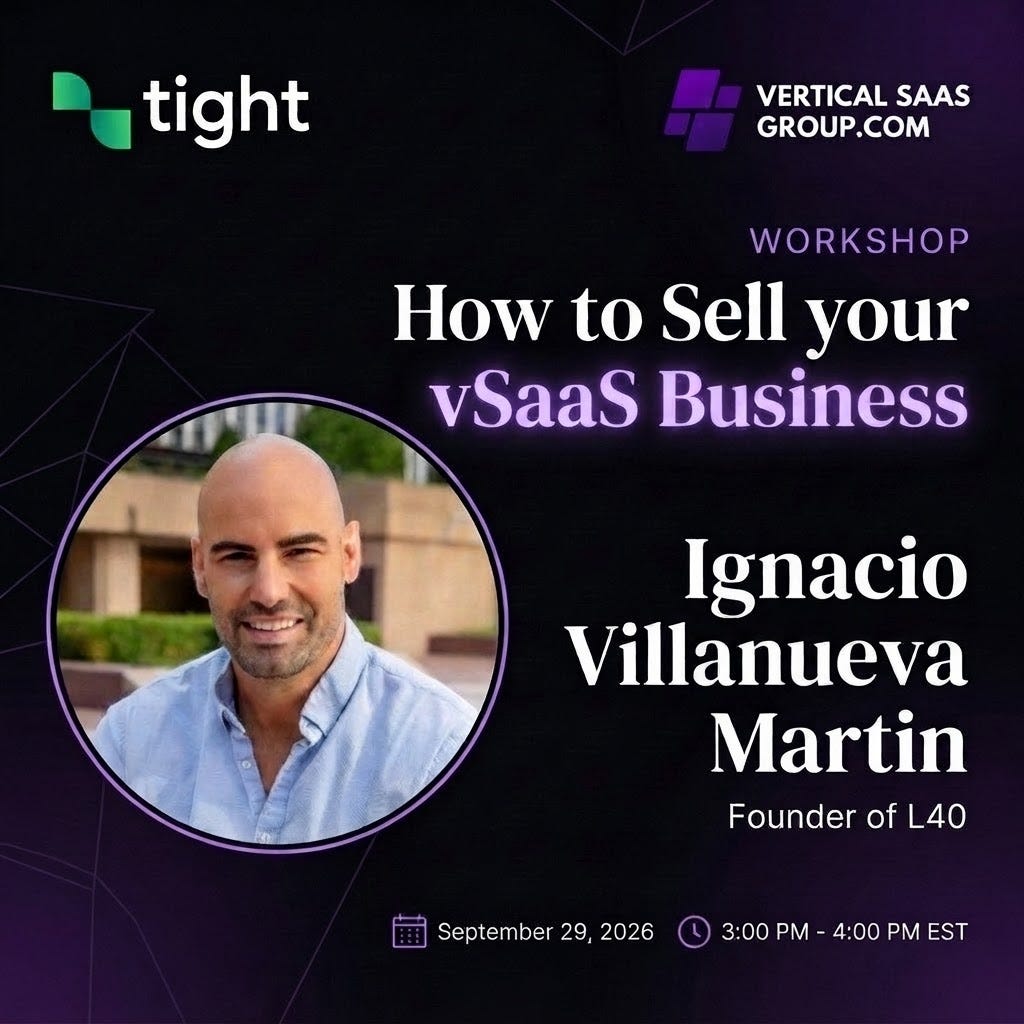
I’m hosting a workshop about selling your vSaaS business with Ignacio Villanueva Martin, founder of L40, on September 29th. We’ll cover valuation drivers, buyer types, and how to position your business for exit. Click the link right here to register.

How to raise your next round at the Summit
Hoadley’s story is the proof. Here is the repeatable part — the playbook any vertical software founder can run to turn two days in Miami into a closed round. The investor list this year is heavy. These are the funds that have already secured their tickets — not a wishlist, not a “likely to attend.” Confirmed, paid, and walking into the Rubell on November 4:

All actively looking to write checks into vertical software and vertical AI. Most founders will waste this. Here is how to not waste it — before, during, and after.
Before Miami: build the pipeline
1. Treat it like a curated pipeline, not a conference.
Build a short list of the 10 to 15 funds that actually match your stage, ARR, and vertical. Not the biggest names — the most relevant ones. A $3M ARR construction SaaS should not be chasing Thoma Bravo; a growth equity firm writing $50M checks cannot help you, and the hour you spend trying is an hour you did not spend with the seed-to-A fund that can. Know who leads your round and who follows. Write the list down. Rank it.
2. Warm intros beat cold walkups.
LinkedIn every partner attending. Ask for 15 minutes before Miami — a specific ask, referencing their vertical thesis, with your one-liner and ARR in the first message. If they say yes there, they will say yes in person. The founders who get meetings on-site are the ones who booked them three weeks earlier.
3. Prepare your mechanism sentence.
Every founder shows up calling themselves the AI-native leader in their space. Every investor tunes that out by 10am on day one. What cuts through is a single sentence explaining why your workflow is hard to displace — data, payments, compliance, distribution. “We process the hauler’s payments and own their route data” lands. “We’re building AI for waste” does not. Pick one mechanism and own it.
On the ground: run a real process
4. Book coffee meetings
Thirty-minute blocks. The panels feed the coffee conversations — reference what the investor just said on stage and you are instantly differentiated from the 19 other founders they met.
5. Qualify fast and honestly.
Ask directly in the first five minutes: do they lead, what check size, what ARR floor, have they done your vertical before. A fast no is the second-best outcome — it buys your time back. The worst outcome in Miami is a polite maybe that eats three follow-up calls and dies in December.
After: where rounds actually close
The Summit gives you the top of funnel; only your process converts it. Founders who close rounds from the Summit are almost always the ones who ran the tightest post-conference process.
The five mistakes that burn investor trust in Miami
Chasing logo funds over fit. A brand-name firm that does not do your stage will politely waste your afternoon. Relevance beats prestige, every time.
Leading with AI adjectives. “AI-native” is table stakes vocabulary in 2026. Mechanism — data, payments, compliance, distribution — is the differentiator.
Showing up without numbers. This crowd reads vertical SaaS metrics fluently. “We’re growing fast” without ARR, NRR, and margins reads as “not ready.”
The Summit does not raise your round. But it does compress six months of investor outreach into two days — if you show up ready.
(and remember if you need a free ticket we will get you one!)
Who is actually speaking at the Vertical Software Summit

The playbook only works if the room is full of the right people. Here is who is actually on stage in 2026. Most conferences over-index on people who talk about vertical software. This one over-indexes on people who have built it. That distinction matters more than ever in 2026: the questions that decide whether your company survives the AI transition — do you own the workflow, the data, the payment rail, the compliance burden — are not theoretical to anyone on this stage. They answered them with a balance sheet.
Here is some folks on stage, and the specific reason each person is worth your two days:
Fred Voccola · Simpro & Kaseya
The only operator running two separate billion-dollar vertical software businesses at once — Kaseya for IT services, Simpro for the trades. Most people treat each vertical as a one-off. Voccola is the living proof that vertical software is a repeatable skill: the playbook for winning one ugly, fragmented, workflow-heavy industry transfers to the next. If you want to understand how the category compounds, he is the case study.
Cecilia Ziniti · Founder & CEO · GCAI
One of the fastest-growing vertical AI companies around. The growth curve does not look like SaaS — it looks like software plus embedded outcomes. If you are trying to figure out what “AI-native vertical software” actually means in dollars and retention rather than in pitch-deck adjectives, this is the talk to sit in the front row for.
Danielle & Leah Cohen-Shohet · Co-Founders · GlossGenius
Beauty software done right — a category most VCs ignored for a decade, they just raised at $1B+. The classic ugly-workflow-hides-a-great-business story, plus a masterclass in payments-led vertical SaaS economics.
Sam Youssef · Founder & CEO · Valsoft
100+ vertical SaaS acquisitions, approaching $1B of ARR. If AI roll-ups are the trending narrative, Sam has quietly run the actual playbook for years — sourcing, pricing, integrating, and holding vertical software at a scale almost nobody else has attempted.
Andreas Huber · Founder & CEO · First Due
Founder & CEO of First Due — the Vertical Software platform for Fire, EMS, and Law Enforcement agencies. Built a $1B+ company without venture capital to redefine how public safety operates.
Plus 30+ founder and CEO speakers running businesses from $1M to $1B in ARR, and leading CxOs on AI, FinTech, Customer Success, GTM, and Product.
The pattern hiding in the lineup
Read the list again and one thing jumps out: nobody on that stage got there by writing a good pitch deck. Every one of them got there by figuring out something ugly about their vertical that everyone else missed — a workflow so unglamorous that talent ignored it, a buyer so fragmented that sales teams gave up, an incumbent so stale that customers had forgotten software could be good.
That is the real curriculum of the Summit. Not “what is AI doing to SaaS” panels. The specific, unglamorous mechanics: how Bookman priced against government procurement, how GlossGenius attached payments, how Valsoft integrates an acquisition in 90 days, how Voccola decides which adjacent vertical is winnable. These are operator details you cannot get from a podcast, because the people who know them rarely talk in public.
The ugliest workflows hide the best businesses.
This stage is a room full of people who proved it.
(and remember if you need a free ticket we will get you one!)
Do me a solid and forward to a friend :-)