

We’ve only got ~50 seats left for the Vertical Software Summit.
Which means I think it sells out over the next week
If you’ve been waiting to grab your ticket, now is the time :-)
(12 folks registered just yesterday)
The Art of Vertical Go-To-Market
Most founders think they’re ready to scale sales the moment they close a Series A. The board wants growth. A competitor just raised. The plan says “hire 10 AEs.” So they do.
And then nothing happens.
This week, I sat down with Kevin Wilson, the CRO at Skimmer, a vertical SaaS company serving pool cleaning businesses. Kevin has built go-to-market engines across three different vertical software companies—Fiix (maintenance teams), Supermove (moving and storage), and now Skimmer—taking them from pre-revenue to exits and multi-million dollar ARR runs.
What makes Kevin different is that he’s lived the entire vertical SaaS GTM playbook: founder-led sales, SMB motions, enterprise motions, PLG vs. sales-led, multi-product strategies, and M&A integration. He’s also built sales teams in some of the most overlooked, blue-collar industries in the world—the kinds of markets where a case of beer moves deals faster than a ritzy campaign.
If you’re building vertical software and struggling to figure out when to scale, how to hire, or what channels actually work, this conversation is a masterclass. Kevin doesn’t deal in theory. He deals in what works—backed by years of doing it, breaking it, and doing it again better.
This Weeks Vertical Titan:
Kevin Wilson (CRO @ Skimmer)

Kevin Wilson didn’t start in SaaS. He started in his dad’s landscaping business, typing up customer quotes on WordPerfect late at night.
He grew up in a blue-collar family—his dad ran a small landscaping company, and most of his extended family were small-town farmers. He watched his dad risk everything: years of his life, the family’s savings, his physical health. Kevin saw two things clearly: how hard small business owners work, and how badly they’re underserved by technology.
That shaped his entire career.
Kevin was the first person in his family to go to university. He went into finance and banking, hated it, and decided to bet on software. He Googled “largest Canadian tech company,” found OpenText in his backyard in Waterloo, Ontario, walked over his resume, and took a 75% pay cut to become a BDR.
From there, he spent time in true enterprise sales at D2L (EdTech), where he dealt with million-dollar quotas, six-figure deals, multi-year RFPs, and selling to government buyers. It was brutal, multi-threaded, and heavy. But it taught him process.
Then he joined Fiix, a blue-collar SaaS company serving maintenance teams in discrete manufacturing. He helped grow that business from $1M to $30M ARR before they sold to Rockwell, a Fortune 500 company. Post-acquisition, Fiix became a $50M revenue business unit. It was a top-ten Canadian exit at the time.
After that, he joined Supermove pre-revenue—vertical SaaS for moving and storage companies. He built the sales motion from scratch, lived through founder-led sales, and took the company to $10M ARR before the Series B.
Now he’s at Skimmer, vertical software for pool servicing companies. Skimmer has 8,000 customers across the U.S. and runs the full operational stack: marketing, lead management, scheduling, routing, servicing, billing, and accounting. They’re building the OS for pool service businesses. They run both a strong PLG motion and a sales-led motion. They recently moved from one product to four products. And they just acquired a pool construction software company, letting them own the workflow from pool build all the way through ongoing service.
Kevin is building Skimmer because he understands the people he serves. He knows what it’s like to work in a business where you go home physically exhausted, where technology feels out of reach, and where software companies don’t speak your language.
That’s why he’s credible. That’s why he wins.
And that’s why his approach to go-to-market is different.
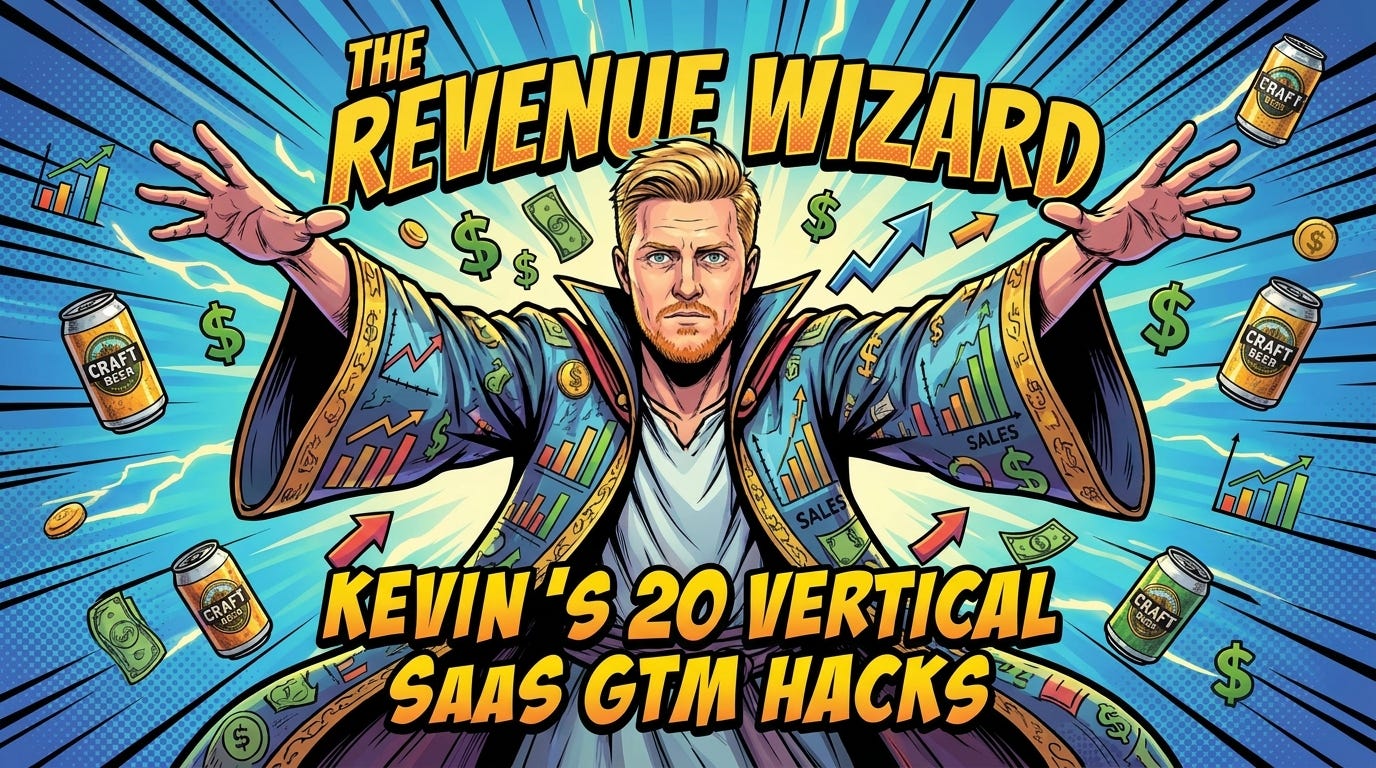
Kevins 20 VERTICAL GTM Hacks
These are truly a masterclass, carve out the time to read them and you won’t regret it…
1. Don’t Scale Sales Because the Board Wants Revenue—Scale When You Have Product-Market Fit AND Go-To-Market Fit
Kevin subscribes to the Mark Roberge school of thought: you’re ready to scale when you have both product-market fit and go-to-market fit.
Product-market fit means customers are succeeding consistently. GDR (Gross Dollar Retention) is the truth. You need to know your leading indicator of early retention—if X happens within Y timeframe, you have a customer for life. Make it scientific. Track what percentage of customers by cohort are hitting that early sign of retention.
Go-to-market fit means you can acquire and retain them scalably. LTV/CAC should be greater than 3. Payback should be less than 12 months. Magic number should be better than 1.
Most founders scale when the board wants more revenue, right after a big Series A, or when a competitor ramps up. That’s emotional. Don’t do it. Scale when the math works.
2. Scale is a Pace, Not an Event
Kevin has been handed plans that say: “We just raised a big round. Go hire 10 AEs.”
That almost never works.
Instead, hire two AEs in month one. Always hire in twos, never just one. When you hire two, you can tell if it’s the rep or the process or the systems that’s broken.
Then watch the speedometer. Track retention, onboarding completion, leading indicators of success, and unit economics. If things are breaking, slow down and fix it. If things are holding, accelerate. Go hire two, then four, then eight.
Also think about where to scale: by product, by market, or by channel. At Skimmer, pool service is highly seasonal. It’s different in the sunbelt states versus the non-sunbelt states. That shapes where they deploy resources.
If you’re running an SMB motion and testing an enterprise motion, separate them. Scale what’s working first. Don’t try to make it all work at the same time.
3. The Founder Should Own Go-To-Market Fit Discovery, Not the First Sales Hire
Too many founders outsource channel testing to their first sales hire. That’s a mistake.
Kevin’s philosophy: the founder should literally test a bunch of channels before hiring a salesperson. Build a spreadsheet. Cold calls are a channel. Ads are a channel. Conferences are a channel. Test two at a time. Track reach, conversion, and funnel metrics.
Almost always, nine out of ten channels suck and one works. That’s normal. You only need one to work.
And that one channel changes over time. Pre-COVID, during COVID, and post-COVID all had different winning channels. GTM fit is not static.
Once you know the math works—once you can prove that a fully-loaded AE costing $10-15K/month can generate $30-50K/month in ARR—then you hand it off to a sales leader.
4. Founders Should Never Get Out of Sales
Kevin sees this mistake constantly: founders hire an AE or a sales leader, and then they disappear. They think, “Great, I don’t have to worry about this anymore. I can go focus on product.”
That’s wrong.
Even at Skimmer, approaching serious revenue, Kevin still has the CEO join every single enterprise customer first call. Not mid-cycle. Not at the end when negotiating. The very first call.
The CEO tells the founder story. The CEO creates a direct line so the deal can move faster if needed. The CEO adds credibility.
The key is doing it in a way that’s respectful of your sales leader. You don’t want them to feel like you’re always peering over their shoulder or parachuting in. Have that conversation early in the hiring process. Find a way to keep the founder in the deal without undermining the sales leader.
5. Hire Two or Three AEs at Once, Not One
Jason Lemkin says hire two AEs—two in the bag. Some people now say three.
Kevin agrees. If you hire two, you can tell if it’s the rep or the process. If you hire three, that third person can really separate themselves from the rest, and you start to see patterns more clearly.
Never hire just one. You won’t know what’s broken.
6. Only Scale What’s Working—Test Everything Else
In later-stage growth (Series B, Series C), Kevin’s rule is simple: only scale what’s working.
Dissect your business by product, by market, by channel. Scale the motion that’s working. Keep testing the things that aren’t working, but don’t invest heavily until they start working.
When those other motions start to work, apply the same disciplined approach: hire two AEs, track velocity metrics, and then scale.
7. Good Sales Leaders Have “Leader-Market Fit”
The number one mistake founders make when hiring a head of sales is hiring someone who hasn’t done their stage.
Kevin calls this “leader-market fit.” Ideally, this person has done your stage and one or two stages bigger. Don’t hire the Salesforce executive who ran a $100M+ revenue team and bring them into a product-market fit or go-to-market fit phase. That doesn’t work. They can’t operate at that altitude.
If you can’t find someone who’s done the next stage, hire someone who’s done your stage well, and then bring in a consultant, a mentor, or a board member who’s seen the next stage. Give them a couple basis points of equity. Use them for feedback.
Also, make sure they’ve grown teams with your velocity metrics. If you’re SMB vertical SaaS, don’t hire someone from horizontal mid-market or enterprise. The motions are completely different.
8. The Four Attributes of a Great Sales Leader
Kevin’s sales leader scorecard has four core areas:
1. Great Coach
They have to develop people quickly. Kevin’s bar: 20 calls reviewed per week. Not just reviewed—coached. Synchronously or asynchronously. If the leader can’t coach, the team won’t ramp.
Interview tip: Have them show you coaching plans and results. Or send them call recordings from your team and have them give you written feedback.
2. Hiring
They have a nose for talent. They can hire the best people inside or outside the org. They’re not afraid to hire people better than them. Junior sales leaders often make the mistake of hiring down because they’re scared of being overshadowed.
Interview tip: Have them name the AEs they would bring with them. Look at those people’s LinkedIn profiles. Call them. It’s a great back-channel reference and shows you how they lead.
3. Strong Operator
They know the business inside and out. They understand how to control their business. If I pull this lever, this outcome happens. In SMB vertical SaaS, feedback loops are tight. You have to be able to tinker with the machine.
Interview tip: Ask them to screen-share their current calendar. Have them walk you through their operating rhythm. What do MBRs look like? Team meetings? One-on-ones?
4. Collaborative Peer Relationships
They build trust with functional leaders across the business. They optimize for the entire business, not just their sales team. They play well with the head of customer success, the head of product, and the head of marketing.
Interview tip: Don’t just call the references they give you. Go find the director of demand gen, the director of onboarding, the director of CS. Call those people. You’ll learn way more about who this person actually is.
9. The DNA of a Great AE: PhD, Curiosity, Adaptability, Intelligence
Kevin has a detailed scorecard for hiring AEs. The highest-weighted category is core attributes—the DNA.
He calls it PhD: Persistency, Heart, and Desire.
If their parents couldn’t change them in the first 18 years of their life, you’re not going to change them either.
Interview tip: Have them talk through the most difficult thing they’ve had to do in their life. If they give a fluffy answer like “adjusting to university,” call bullshit. Go deeper. You’re testing vulnerability and grit.
Curiosity: Do they genuinely care about solving the customer’s pain, or are they just asking the disco questions they’re told to ask?
Interview tip: Leave ample room in the interview for them to ask you questions. Do they ask second- and third-layer questions based on your answers?
Adaptability: This used to be “coachability” for Kevin, but he’s refined it. The best reps have the shortest delta between receiving coaching and implementing it.
Interview tip: Do a case study. Have them pitch their current solution (if they’re a BDR) or Skimmer (if they’re not). Pause the role play. Ask them how they think they did. Give them one piece of coaching. Then have them run it back. Did they implement the coaching immediately, or did they do it the exact same way?
Intelligence (Pattern Recognition): Can they convey complex ideas simply? Skimmer sells to pool pros. Some of the technology is complex. If you just show them every feature, they’re overwhelmed. Great reps distill it down to punchy, simple value statements.
Interview tip: Have them talk about something they’re passionate about and explain it to you like you’re 10 years old.
Beyond DNA, Kevin looks at skill set (sales craft) and previous experience (industry knowledge). But DNA is the most heavily weighted.
10. Industry Experience is Overrated in Sales Roles—Use It in CS Roles Instead
Kevin has hired a lot of industry people. Most of the time, it doesn’t work.
If someone has 10 years in the pool industry but scores low on DNA and skill set, it’s a no-hire. The exception: if they score high on everything and have industry expertise, that’s the holy grail.
But if they only have industry expertise, Kevin will hire them as a consultant for a few months to accelerate his own learning. Or he’ll put them in support, onboarding, or customer success. He’s seen industry vets thrive in those roles.
The mistake: hiring them as AEs. Their Rolodex runs out after the first quarter, and then they can’t generate new pipeline.
11. Ramp Based on Sales Cycle Time
Kevin’s ramping philosophy is tied to average sales cycle.
For a 30-day sales cycle (most SMB vertical SaaS):
Month 1: 100% quota relief. Onboard intentionally.
Month 2: 50% quota relief. Build pipeline.
Month 3 (day 61-90): Full productivity. They should hit 80%+ of quota every month.
If your sales cycle is six months, your ramp might be 6-9-12 months.
Kevin’s philosophy: “Hire fast, onboard intentionally, fire fast.”
12. You Can Tell if a Rep Will Make It in Their First Week on the Phones
At Skimmer, the goal is to get a rep on the phones by week four.
Kevin says you can usually tell if they’ll make it in that first week. The best reps close a deal on their first day. In week one, they’re already pacing toward their monthly target.
If they don’t close a deal in the first week, if they’re not pacing in the first or second week, they typically don’t make it.
Your gut feel is usually right. Kevin has made the mistake of holding on to reps or leaders way too long. You should almost always move on.
13. Fire Fast: <50% Quota in Month Three = PIP
Once a rep is out of ramp (month three), if they hit lower than 50% of quota, they’re put on a PIP immediately.
If they hit 50% or lower again the following month, they’re managed out.
If they hit 80% or more during the PIP, they’re removed from the PIP.
If they hit between 50-80%, the PIP is extended one more month.
Kevin’s approach to coaching out is fact-based, not emotional: “This isn’t working out. We both know it. Here’s where you stand relative to your peers. This isn’t the right environment for you. Here’s a package. Let me know if I can help you find your next company.”
He’s placed reps in other businesses where they’ve thrived. It’s not personal. It’s about fit.
14. Niche Down on ICP—The Riches Are in the Niches
Kevin’s career has one through line: size down on the ICP. Get really tight on your Ideal Customer Profile. Start with the perfect accounts—your serviceable, obtainable market, not your full TAM.
You’ll grow much faster if you niche down.
At Fiix, they were in 25 different verticals at one point. When COVID hit, food manufacturing exploded, so they went hard on just food manufacturing. That’s when they started ripping. The product got better. Marketing got sharper. Sales messaging got more dialed in. All velocity metrics went up.
Don’t go attack your entire TAM right now. Niche down, especially in the early days. Then as you penetrate that slice of the market, start expanding.
15. Don’t Worry About Burning Through Your TAM Too Fast—Focus on Rigor
At Skimmer, there are roughly 50,000 pool servicing companies in the U.S. Kevin only wants to serve a specific segment with the outbound motion. PLG handles the lower end of the market.
For mid-market and enterprise (which is still small business at the end of the day), Kevin had a target list of 5,000 accounts. He deployed two BDRs against that list. He knew that if they worked the list rigorously, they’d get through it in nine months.
He was okay with that. He wanted to grab all the low-hanging fruit early. Then widen.
Kevin’s philosophy: as long as you’re not touching the full market every 30 days or every 3 months, you’re fine. Every six months is probably okay. And it also depends on the nuances of the business. At Skimmer, new business goes down in summer months because pool pros are in the field and don’t have time to take a cold call. But in the off-season, when pool season closes, it fires back up.
The key: get through your targeted TAM rigorously, not spray-and-pray. Then recycle those accounts with new messages and new angles.
16. Use AI to Enrich Third-Party and First-Party Data—That’s the Biggest Needle Mover
Kevin says there’s a lot of “AI theater” on LinkedIn. But the biggest needle-mover AI play at Skimmer has been enriching third-party and first-party data.
Third-party data: Information on your target accounts and contacts. At Skimmer, they target owner-operators. But the key is finding unique, competitive, moat-building information about your ICP that you can scrape on the internet. Kevin credits Jordan Crawford with helping them here.
First-party data: Skimmer’s reps are on 4-5 customer calls a day. All that information is in call recordings. They use a tool called Attention to populate that data back into the CRM.
The results:
100% CRM accuracy. No deals go missing.
90% forecast accuracy on the first day of the month, every month.
190 minutes saved per rep per week in manual CRM work. That’s one or two more customer calls per week.
Pipeline is up. Close rates are up. Average quota attainment is up.
This is table stakes now. If your CRM is a mess, your sales team is flying blind.
17. Use Permissionless Value Props (PvP) to Break Through
Kevin credits Jordan Crawford with the concept of Permissionless Value Props (PvP).
The idea: deliver a piece of information—via email, text, or call—that is so valuable the prospect would pay to receive it.
At Skimmer, they have 8,000 customers across the U.S. They have all the pricing information. They know what the average zip code charges for pool cleaning.
So they send a message to a prospect: “Do you know you could charge $45 more per month? Here’s the average in your zip code. Here’s what your competitors are charging. Go raise your prices.”
No ask. Just value.
Then the BDR follows up two days later.
This has been game-changing for Skimmer’s outbound results. And it’s all powered by that third-party and first-party data collection.
18. The “Case of Beer” Campaign—A Play on Sam Blond’s Champagne Strategy
Kevin’s favorite GTM motion is the case of beer campaign.
It’s a play on Sam Blond’s champagne campaign, but adapted for blue-collar verticals.
Skimmer ships a case of beer to the pool shop. Technicians come back after a tough shift, punch out, and there’s a case of beer waiting for them in the lobby. There are a few marketing slicks in there, but no CTA, no ask.
The message: “Congrats on another peak season. Have a beer on us.”
It’s communal. The owner comes in, sees their technicians having a few beers, joins in.
A day or two later, the BDR follows up. Subject line: “Hope you enjoyed the beers.” Then they make the ask.
Conversion rates: 70-75% conversion to demo. 70-75% to close.
Why does it work? Because these are blue-collar business owners. Send them a case of beer, and it goes a long way.
19. Conferences Are Where Blue-Collar Small Business Owners Go to Learn
Kevin is a big believer in conferences for blue-collar vertical SaaS.
These are small business owners who are spending days not cleaning pools to go learn something new to elevate their business. They’re growth-minded.
Skimmer goes to all the major conferences. They do dinners with select prospects. They invite a customer to the dinner, because the customer sells it for them.
Kevin asked one of his customer advisory board members if the “steak dinner thing” was overplayed. Should they do something more exciting, like a bayou tour in New Orleans?
The customer looked at him and said: “Dude, burger and beer. That’s all it takes.”
In-person is back. With AI, people want to connect belly-to-belly, eye-to-eye. Blue-collar buyers want to shake your hand before doing a deal. For any deal size over a certain level, Skimmer goes on-site. They spend a day with the customer and their people.
20. Hire a Go-To-Market Engineer to Standardize AI Workflows
Skimmer recently hired their first go-to-market engineer, who reports into the director of RevOps.
Before this, Skimmer ran AI plays in a very decentralized way. Everyone got a license of OpenAI, Claude, and other tools. The result: slop bombs. At one point, there were five different ROI calculators circulating.
The GTM engineer runs all the simulations, runs all the tests, and builds production-grade AI tools. Then they ship them standardized across go-to-market.
The stack: Clay-heavy. Orbital. Jordan Crawford’s tools for third-party data. Attention for AI-based coaching and first-party data population.
This role has been huge for Skimmer. It’s the difference between AI theater and AI that actually moves the business forward.
If you want to hear more from Kevin, he’ll be speaking at the Vertical Software Summit this year. He’s the sales wizard of vertical SaaS, and he’ll talk to whoever wants to listen.
See you Sunday.
— Luke Sophinos
Thanks for reading LINEAR. I reply to every email…
Have any questions, feedback, comments? Let us know, we work for you!