

The SaaSpocalypse is officially over
But who wins each vertical from here?
Everyone spent the first half of 2025 screaming SaaSpocalypse. Then the software indexes quietly clawed their way back — apps and vertical apps roughly 60% off the lows, infrastructure ripping close to 90% on the back of consumption-based tailwinds — and the conversation shifted overnight.


The real question was never whether SaaS was dying. The real question was who inherits each vertical from here.
Because underneath the recovery narrative, something much more interesting is happening. In every vertical, there are now three sets of hands reaching for the same set of workflows: the legacy system of record that has been embedded for a decade, the industry-specific GPTs that are growing faster than anything we have ever seen in vertical software, and the AI-native services companies quietly stealing labor budgets one enterprise at a time.
That is the fight of the next five years. And it is going to be uneven, messy, and enormously lucrative for the founders who read it correctly.
This week’s edition is a debate — Nic and I sat down and stress-tested how we would actually play this from each seat: the insurgent attacking an SOR, the incumbent trying not to get flanked, and the operator trying to figure out where the M&A money is finally going to move. Below is the founder profile of who is winning right now, and the playbooks we pulled out of the conversation.
Vertical Software Summit
We are already 80% sold out so if you’re considering coming to the Vertical
Software Summit this November, now is the time to grab your ticket.
All information at the link below.
It’s truly the best few days of the year in vertical software and vertical AI.
This Weeks Vertical Titan:
The AI-Native Operating Company
This week is a little different. Instead of a single founder profile, the “Titan” is the new archetype emerging across every vertical — the AI-native operator company that is quietly reshaping how incumbents get displaced.
Think of EvenUp in personal injury law, Abridge in clinical documentation, Harvey in legal, Magic School and Lagora in K-12, Camber in healthcare reimbursement, OpenEvidence in clinical decision support, Datagrid in construction, Brellium in payer/provider compliance, Ninja in MSP, and Hanover Park in fund administration.
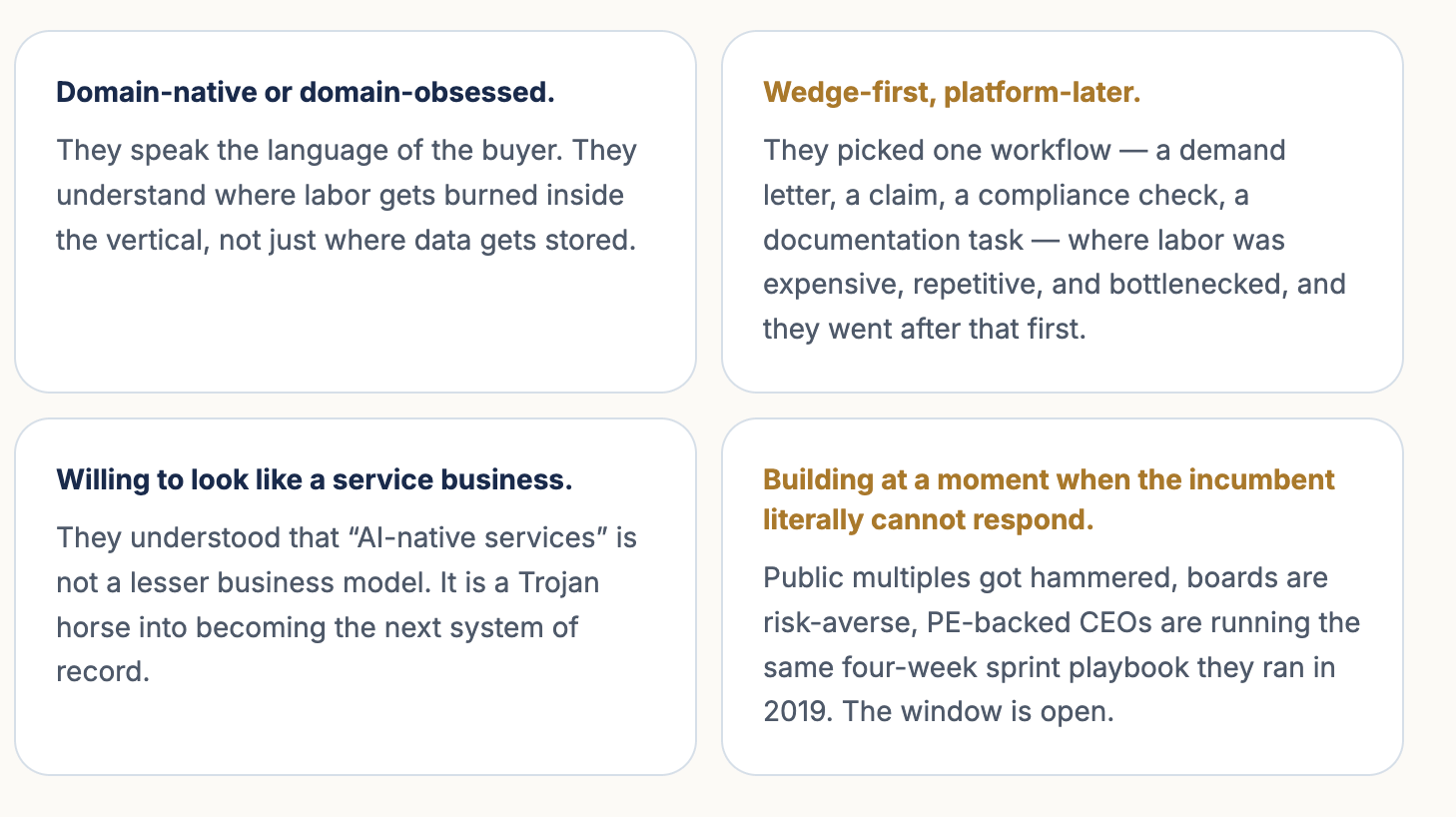
The reason this archetype matters is that these companies are proving something the incumbent SaaS world has not fully internalized yet: in the AI era, whoever owns the work owns the workflow, and whoever owns the workflow eventually owns the system of record.
“These are not point solutions. They are the front door to their verticals.”
EvenUp started with demand letters and is now going full stack. Abridge started with documentation and is now creeping into the Epic footprint. Harvey started as, in Nic’s words, “a wrapper” — and just released Tenet at a $15B valuation, worth more than LexisNexis. The founders building them are five years ahead of the incumbents they are attacking.
Four ways through the incumbent
Ten moves for the next chapter (post-SaaSpocalypse)
01. Post-SaaSpocalypse, retention is still a vertical story
Horizontal application-layer software is where net retention is under the most pressure right now. Vertical still has a structural retention advantage, and the consumption-based businesses at every layer — Mongo, RingCentral, and anyone whose model scales as agents scale — are the ones benefiting most from the AI cycle. If you are building vertical, do not accept horizontal churn dynamics as your benchmark. Your industry knowledge should compound into stickier revenue than the SaaSpocalypse discourse suggests.
02. There are only four ways to beat an entrenched SOR — pick one honestly
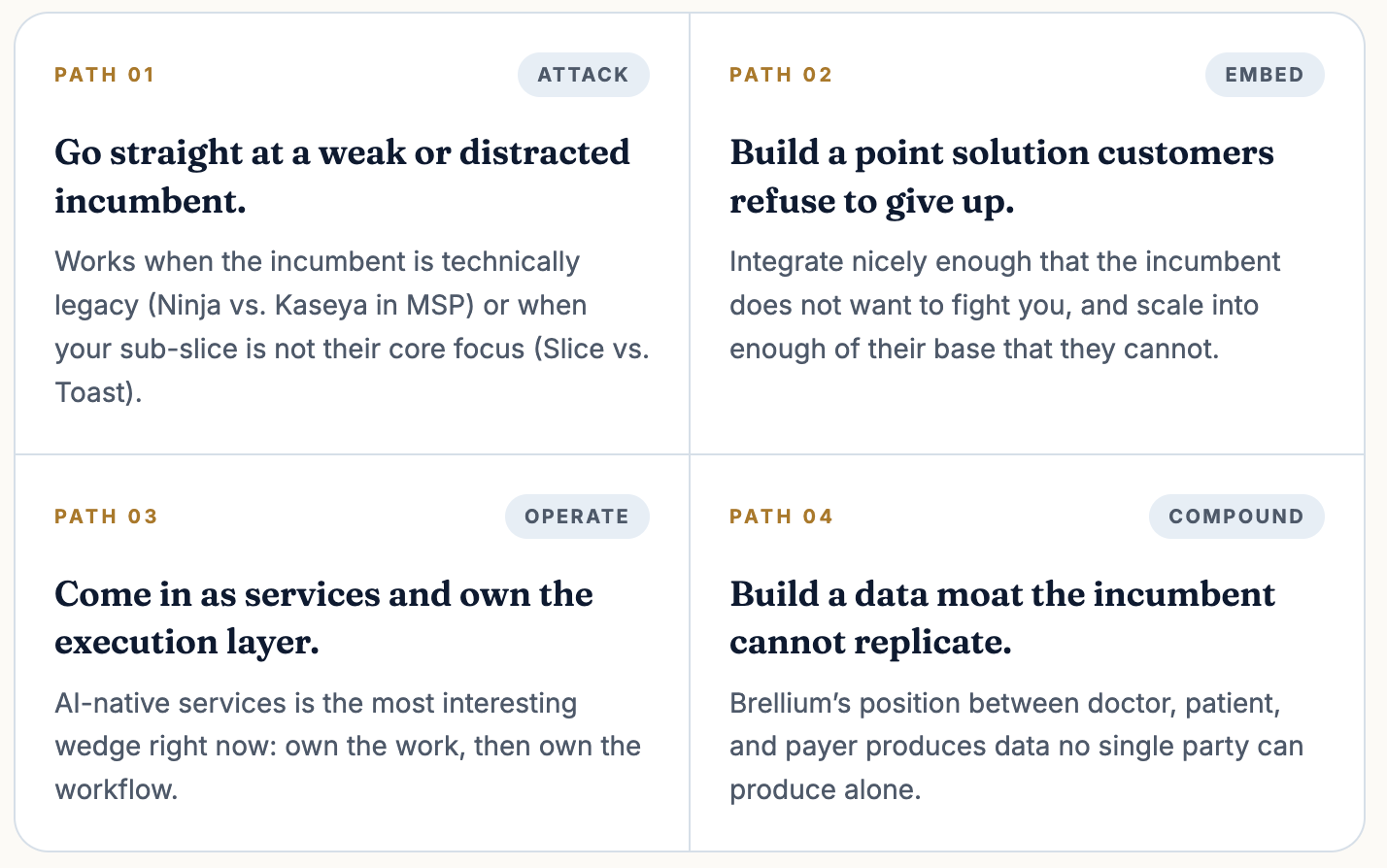
Nic laid these out cleanly. Every insurgent should be able to state which one they are running: go straight at a weak or distracted incumbent; build a point solution customers refuse to give up; come in as services and own the execution layer; or build a data moat the incumbent cannot replicate. If you cannot clearly identify which of the four you are running, you probably do not have a real strategy against the incumbent yet.
03. AI-native services is a wedge into becoming the next SOR — not a lesser business
The most under-appreciated move in vertical AI right now: go in as forward-deployed services, look like an employee of the customer, automate every workflow you touch with AI, and quietly build your own system of record in the background. By the time you come out commercially, you have already migrated the customer. This is the Palantir move, retooled for vertical. Hanover Park is running it in fund admin. EvenUp ran it in plaintiff law. It is a legitimate path to becoming the incumbent — not just competing with one.
04. Pick a market where the SOR barely matters
In some verticals, nobody logs into the system of record. Fund admin is one. A lot of flame-more-services categories are like this. If the buyer does not care about the underlying record system, the services-forward player can win the whole thing without ever fighting a UI battle.
05. The M&A wave is coming — build for it now
There has not been much M&A yet, but the setup is here: vertical AI is still mostly Series A, incumbents are just starting to realize they cannot build fast enough internally, and the successful precedent is now on the board (EvenUp trajectory, Datagrid → Procore, Evolution IQ’s ~$800M exit at what appeared to be a 50x-plus multiple after only a few years). The next 18–24 months are going to be a strategic buyer’s market for vertical AI companies with real customer traction. If you are a founder who wants to sell into an incumbent, now is the time to make your AI horsepower visible and legible.

We’re doing an initmate webinar on ‘How To Sell Your Vertical Software Company’ on September 29th from 1-2pm MST. Only allowing 15 founders in.
07. Losing the “reselling tokens” argument is worth it to keep the real estate
Yes, being in the business of marking up OpenAI credits is not glamorous. But losing the daily interface — the screen your users open every morning — is worse. A 5% spread on AI usage while retaining the operational surface area you spent a decade building is a trade every incumbent should be willing to make. The interface is the moat. The margin will follow.
08. Every incumbent needs a new wedge — even if they graduated from “wedge thinking” a decade ago
This one is subtle. Most incumbent CEOs think of “wedge product” as an early-stage exercise they finished years ago. That is wrong. In the AI era, incumbents have to run the wedge playbook again — pick one product, one workflow, one net-new experience, and launch it standalone. Chapter one is starting over whether you like it or not.

09. Most PE-backed incumbents will not adapt — and that is the opportunity
Blunt take from Luke: many PE-backed vertical SaaS CEOs are so good at the classic SaaS playbook — four-week sprints, capacity planning, roll-up math — that they are structurally incapable of rebuilding around AI. It is not that they have not woken up. It is that their board incentives, their install base, and their operating muscle memory all point away from reinvention. If you are a founder attacking one of these categories, this is the window.
10. Hire a model researcher — the ROI is asymmetric
Cursor built Composer in coding. Harvey released Tenet at a $15B valuation. In verticals where data is specialized (medical coding, claims, regulated documentation), open-weight models plus a real model researcher can get you close enough to frontier parity to matter. If your business justifies it, paying $1M+ for a serious researcher is probably one of the highest-leverage hires you can make right now.
The next chapter of vertical software is not going to look like the last one…
The incumbents will fight, some will wake up, most will not. The insurgents will keep chipping away with services, GPTs, and agents until one morning a strategic acquirer looks up and realizes the company they should have built already exists — and it is now three years down the road with real customers and real data.
Pick your seat.
Pick your wedge.
And build like the window is closing, because it is.
See you Sunday.
— Luke Sophinos
Thanks for reading LINEAR. I reply to every email…
Have any questions, feedback, comments? Let us know, we work for you!