

Today’s newsletter is sponsored by Xplor Pay. Vertical AI could represent an opportunity 10x bigger than SaaS. But capturing it will take more than adding AI features.

Luke Sophinos, Mark Passifione, and Daniel Burton explore what it takes to move from vertical SaaS to agentic, where software begins doing more of the work and driving outcomes. Watch the discussion on demand and get the practical roadmap for identifying where to start, proving value, and expanding from there.
Watch the Discussion + Get the Roadmap →
I have been running interviews across a few companies I am involved in, and the AI gap is worse than I expected.
Not among the 22 year olds. Among the seasoned ones. Fifteen, twenty years of SaaS wisdom. Sharp resumes. Great references. And they are answering interview questions with playbooks that stopped working eighteen months ago.
Everything has changed. Not most things. Everything.
The product function looks different. Customer success looks different. Engineering looks different. GTM looks different. G&A looks different. Even the shape of the org chart is different.
Most of the market has not caught up. That is a hiring opportunity if you know what to look for. It is a hiring landmine if you do not.
The old world versus the new world, spelled out.
The old world versus the new world, spelled out.
Old world: a customer files a bug. CS logs it. PM triages it. Engineering scopes it. It lands on a roadmap. Timeline gets estimated. Customer sees a fix in six weeks if they are lucky.
New world: a forward deployed engineer joins the call, replicates the issue live, ships a patch before the day ends. Customer thanks you before hanging up.
Old world: marketing needs a real time dashboard. Data team gets a ticket. Thirty days later there is a Looker board that already needs updates.
New world: an operator prompts it into existence, connects it to the warehouse by end of day, iterates on it. Shipped the same week.
Old world: a customer asks for a custom report. CS says we will pass it to product. It gets denied because it is not on the roadmap.
New world: CS builds it themselves. Ships it in an afternoon. Sets up a weekly email to the customer to see what happened. Customer becomes a reference.
Old world: onboarding is a six week implementation project with a services PM and a Gantt chart.
New world: an agent ingests the customer’s legacy data, maps it to your schema, and stands up their instance overnight. CS shows up with their old data nearly ready to go in the system.
Old world: PMs write specs. Engineers estimate. Designers mock. Two week sprint. Retro. Repeat.
New world: CS person or whoever the resident expert is prototypes the actual feature. Engineer reviews the prototype. Ships a scalable version in three days.
Old world: content marketing hires an agency and pays five thousand dollars a month to write blogs.
New world: an operator writes better content themselves in ninety minutes because they know the customer and the model does the drafting.
The pitfall is real. Moving this fast breaks things. Bad prompts ship bad code. AI generated dashboards can lie. Agents onboard customers into the wrong plan tier. Speed without judgment is worse than the old world.
But that is not the argument against AI native operating. That is the argument for hiring people who have already broken things and learned. Not people who are still asking permission to try.
The scary part is how many candidates in the market still think the old cadence is normal. They quote two week sprints as a feature. They say they own the roadmap. They talk about cross functional alignment meetings like it is a virtue. They have not picked their head out of the sand. Process and procedures are in place as guard rails. But they also slow really great people down.
If your interview process is not filtering for this, you are hiring like it is 2019.

I’m hosting a workshop about selling your vSaaS business with Ignacio Villanueva Martin, founder of L40, on September 29th. We’ll cover valuation drivers, buyer types, and how to position your business for exit. Click the link right here to register.

How To Hire In The AI-Native New World
How to hire in the AI native era.
Stop asking about past accomplishments. Start asking what they built last weekend.
Ask candidates to walk you through their personal AI stack. Not the tools their company gave them. The ones they use on their own time. If the answer is a shrug or a single ChatGPT tab, you have your signal.
Ask them to show you the last thing they made. A dashboard, a prototype, a workflow, a piece of research, a landing page, an internal tool. Real artifacts. If they cannot produce one, they are not building anything on their own.
Give them a live task in the interview. Thirty minutes. Tools of their choice. Watch how they work. Do they prompt in full sentences and pray? Or do they orchestrate multiple tools, verify outputs, iterate? The difference is enormous.
Test for experimentation velocity. Ask how many new tools they have tried in the last thirty days. Ask which ones they abandoned and why. Curiosity is not a personality trait anymore. It is a job requirement.
Screen for taste. Anyone can generate output now. Very few can tell what is good. Show them three drafts of something and ask which is best and why. If they cannot articulate the difference, they will flood your product with mediocre AI output.
Look for people who use AI as their operating system. Not as a tool they open occasionally. As the layer that sits between them and every task they do. Email, docs, research, analysis, coding, design, hiring, planning. All of it running through AI by default.
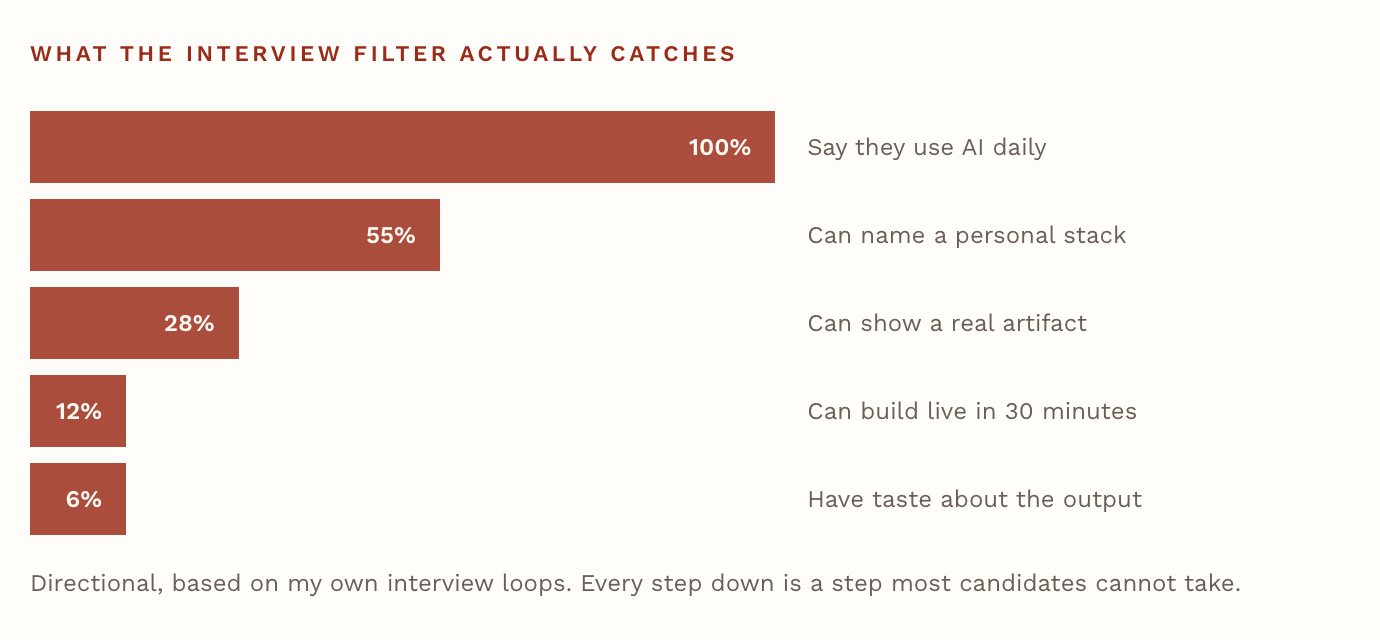
You need people in 2026 who are all about experimentation. They are not stuck in their ways. They are all for relearning how to work in this new age. That is what I am looking for. There are no playbooks right now. Marc Benioff’s school of SaaS looks like most other institutions of higher education. They do not translate to the real world. Or at least the world of the vertical AI hypergrowers.
Now think about what happens when the whole org looks like this.
Every function moves at the speed of the fastest AI native person you have ever worked with. Decisions that used to require three meetings happen in a Slack thread. Prototypes replace specs. Customer requests get answered the same day. Roadmaps get shorter because the cycle time is shorter.
David Senra just interviewed Luca Ferrari from Bending Spoons. Ferrari does not use job titles anymore. He runs one of the most efficient software companies in the world, roughly a fifty percent EBITDA margin on billions in revenue, and he has decided that traditional roles are a legacy artifact.
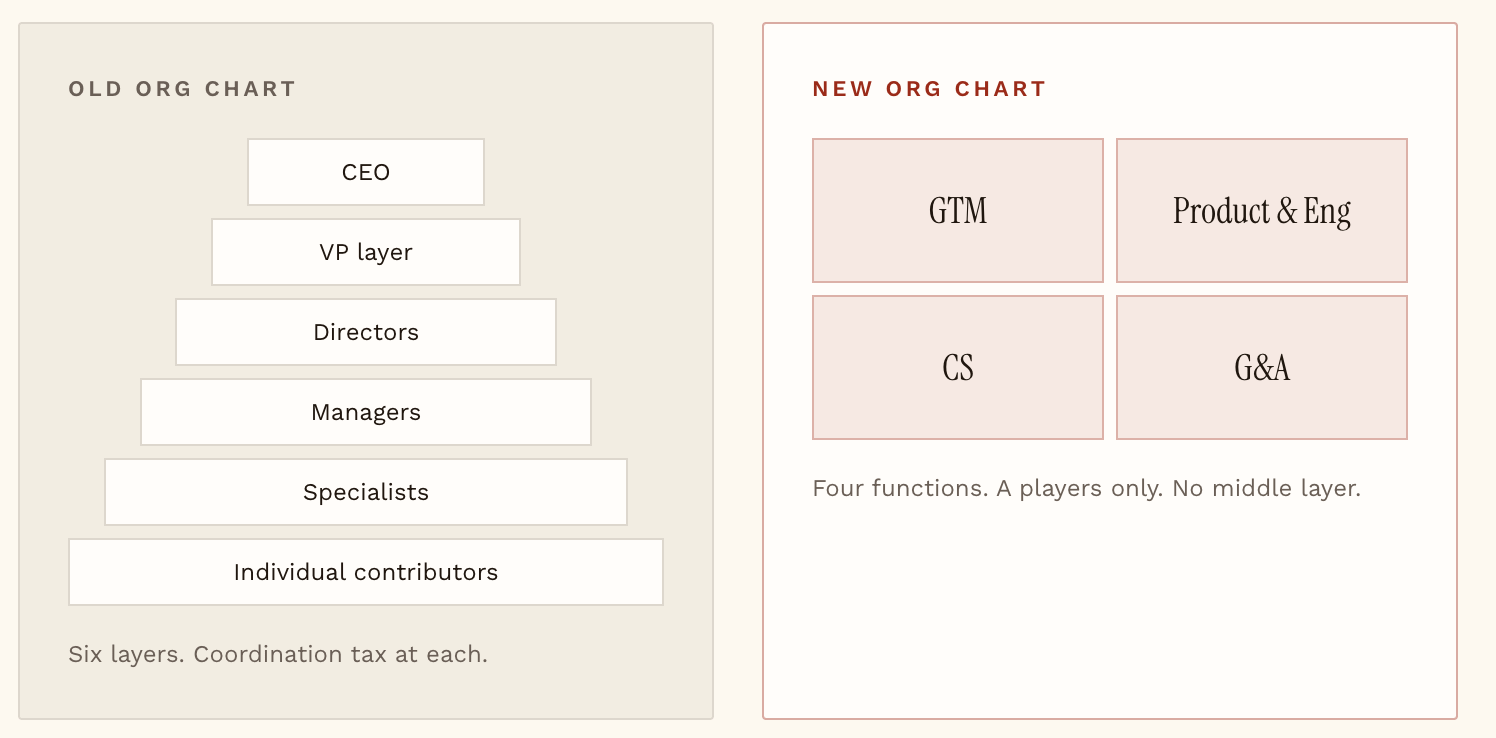
I think he is directionally right. The future org chart might just be four things. GTM, Product and Engineering, CS, G&A. That is it. A small number of extremely hardcore A players who build inside those four functions. No middle management layer. No coordination tax. No specialists for things that AI now does better than humans. They are running AOL and Evernote with like thirty people per. Even with products that have millions of users.
You do not get there by retrofitting your current team. You get there by hiring differently starting now.
If this newsletter resonates, the Vertical Software Summit is the room in person.
Every serious acquirer, founder, and investor in vSaaS is coming.
Register today and reserve your spot before it sells out!

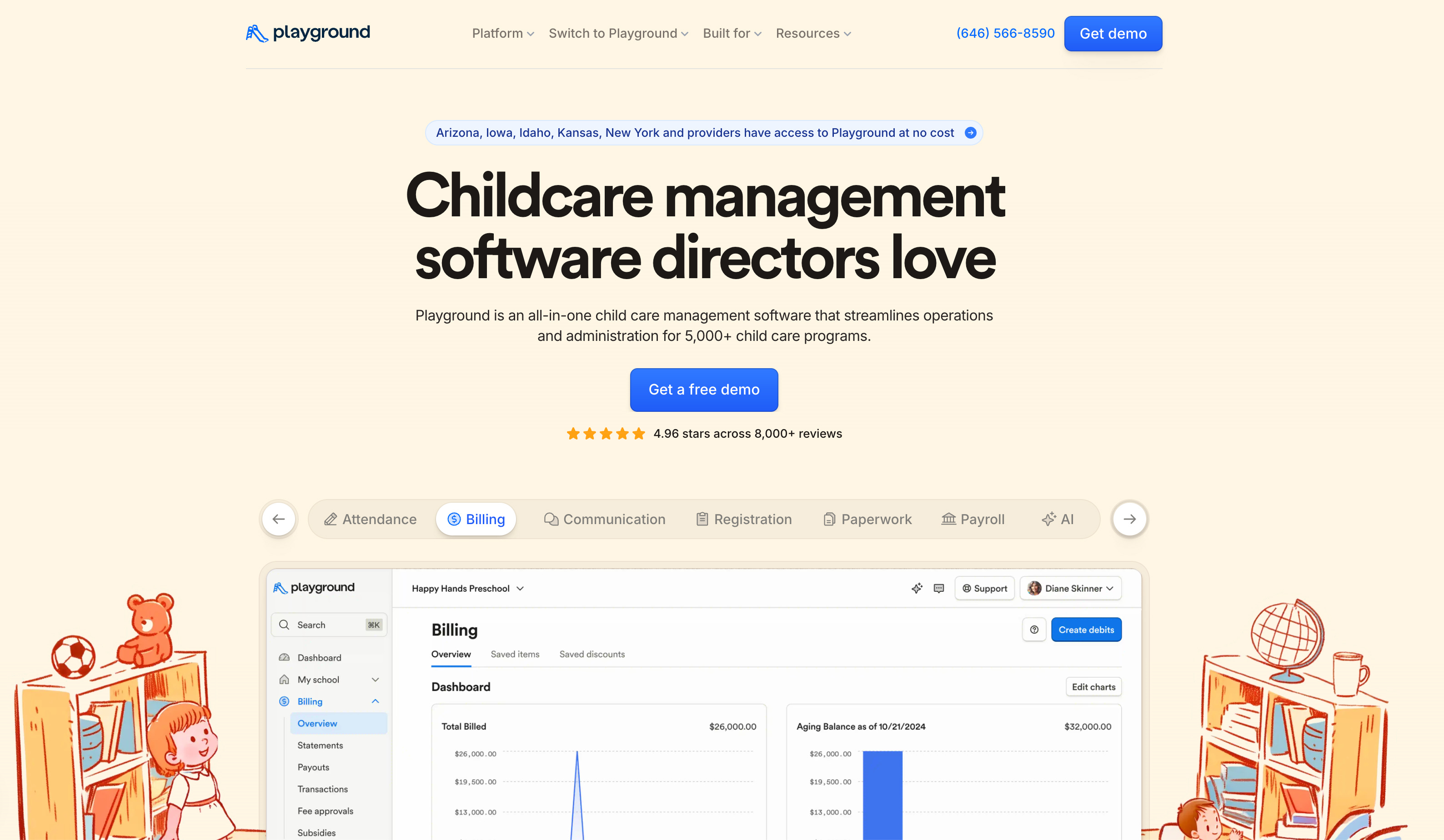
Playground got acquired by Procare Solutions last week.
That is the headline.
The story underneath it is why anyone building in a small vertical should be paying attention.
Rewind to 2020. Daniel Andrews is a software engineer with a Berkeley degree. His brother Josh and their longtime friend Sasha Reiss are figuring out what to build. The Andrews brothers grew up inside a preschool. Their mom ran one. They watched her drown in paperwork every night for twenty years. Billing spreadsheets. Attendance sheets. Enrollment forms. Subsidy paperwork. Parent updates. Payroll. All done by hand or on software that felt like it was built when Bush was president.
Their first customer was their mom’s school.
That is a wedge most founders miss. They chase venture scale problems and end up with venture scale competition. Playground started with one center, one operator, one deeply personal user. The product got shaped by the actual mess of running a preschool, not by a strategy deck.
They raised three million from Human Capital and Bedrock in 2021. And then they did the thing that most founders in vertical software cannot do. They stopped raising. Total capital raised across the life of the company: roughly three and a half million dollars. That is it.
Compare that to the typical vertical SaaS trajectory. Seed. A. B. C. Growth. A hundred plus million dollars burned before anyone knows if the model works. Playground grew to more than five thousand child care programs on less than one round.
The product itself is a study in workflow depth. Not a point solution. Not a bolted together stack. One platform that runs the operational spine of a center. Billing. Attendance. Enrollment. Payroll. Parent communication. Food programs. Learning. Subsidy management. Everything a director touches in a day.
That is what people miss about vertical SaaS. The category looks small from the outside. Child care software. Five thousand centers. A boring niche. But when you own that much of a customer’s daily workflow, the average revenue per account grows, the retention compounds, and the competitive angle becomes almost impossible to attack from the outside. Horizontal players cannot go deep enough. Legacy players cannot ship fast enough.
Then Camber happened. And this is the part that most operators reading this need to sit with.
A year ago, when every vSaaS company was rushing to slap a chatbot on a marketing page, Playground built a real workflow layer. Camber is not a writing assistant. It is a voice agent that answers inquiry calls from prospective families. It handles daily admin. It writes notes. It works around the clock. Playground called it an AI employee for child care, and that framing is exactly right.
Think about what that means for a preschool director. Enrollment calls used to eat two or three hours of the day. Now Camber picks them up, qualifies the family, and drops the lead into the CRM. Administrative work that used to require an office manager gets absorbed by the software. The center runs leaner without cutting people who touch kids.
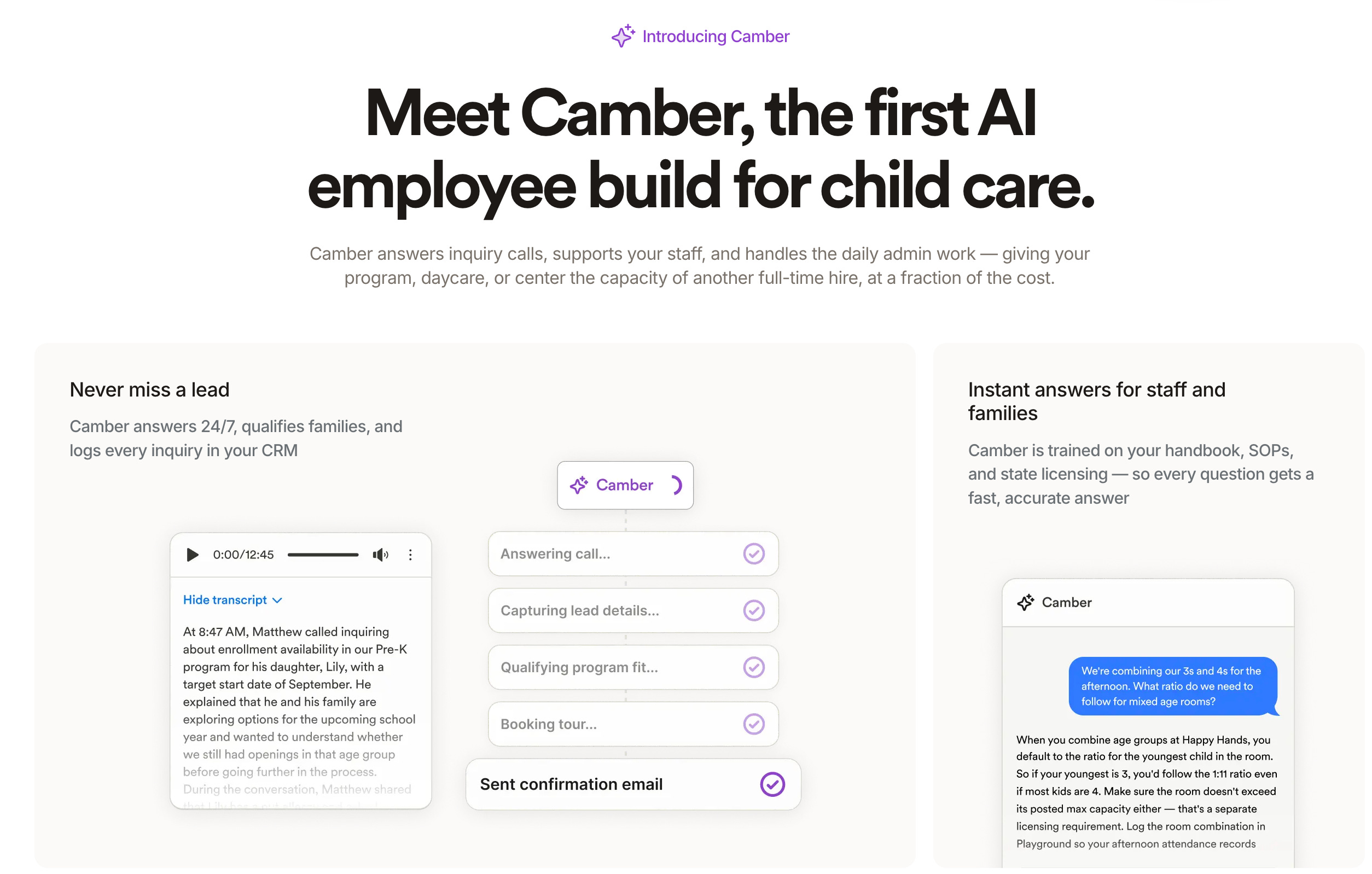
That is the vertical AI thesis in practice. Not AI features. AI labor. Priced against the cost of a headcount, not the cost of a software seat.
Now consider the acquirer. Procare Solutions has been in child care software for thirty years. Forty thousand centers on their platform. Roughly two hundred sixty million in revenue and ninety five million in EBITDA when Roper Technologies acquired them for one point seventy five billion in early twenty twenty four. That is six point seven times revenue and eighteen times EBITDA for a vertical software business in a market most investors have never heard of.
Roper is a Nasdaq 100, S&P 500, Fortune 500 serial acquirer of niche vertical software. They own dozens of these businesses. They do not buy for growth. They buy for durable cash flow inside markets nobody else wants to compete in. Procare fit the pattern perfectly. Sticky. Regulated. Mission critical. Fragmented customer base of small operators who never switch.
But even Roper and Procare have a problem. They are not going to build Camber. Thirty year old organizations with forty thousand customers do not ship AI voice agents. They cannot recruit the engineers. They cannot move at the cadence. The technical debt alone would kill it.
So they did the smart thing. They bought the company that already had.
This is the pattern to internalize. In almost every legacy vertical software category right now, there is the same setup. A thirty year incumbent with distribution and a boring balance sheet. A three to five year old challenger with the AI product the incumbent needed to ship two years ago. The incumbent cannot out ship the challenger. Consolidation is a natural ending in a lot of cases. It has already happened in child care. It is going to happen in dozens more categories over the next thirty six months.
Is an M&A tidal wave in the verticals finally incoming?
Three founders. Three and a half million dollars raised. One mom’s preschool as customer zero. Five years to an exit into one of the most acquisitive software holding companies on public markets.
Boring vertical. Personal wedge. Capital efficient. AI native at exactly the moment the incumbent needed a partner. That is the whole playbook.
Stay sharp.
Do me a solid and forward to a friend :-)