

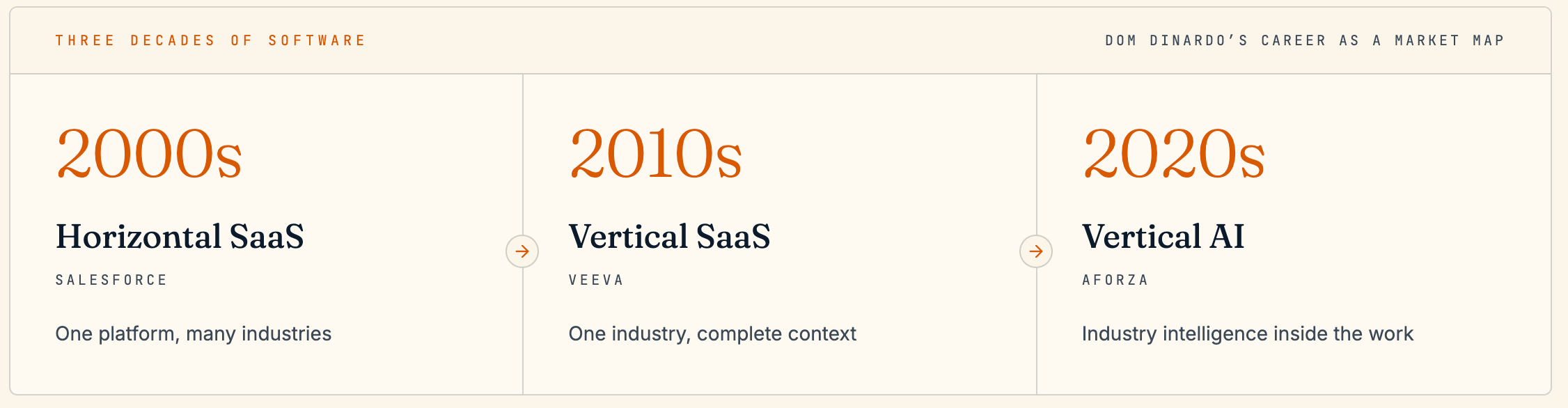
Horizontal SaaS organized the company.
Vertical SaaS learned the industry.
Vertical AI acts inside the work.
Dom Dinardo has had the unusual advantage of arriving early to three software eras. He joined Salesforce in the UK in 2002, before “cloud” was the category. He later went to Veeva and saw why a company built for one industry can be harder to dislodge than a horizontal giant. Then he founded Aforza around consumer goods, a vast industry whose frontline still runs through stores, bars, coolers, distributors, photographs, promotions, and unreliable connections.
That arc gives him a clean thesis for this decade: vertical AI will not win by putting a chat box beside vertical software. It will win by coupling intelligence to an industry’s data, process, interface, commercial model, and moment of decision.
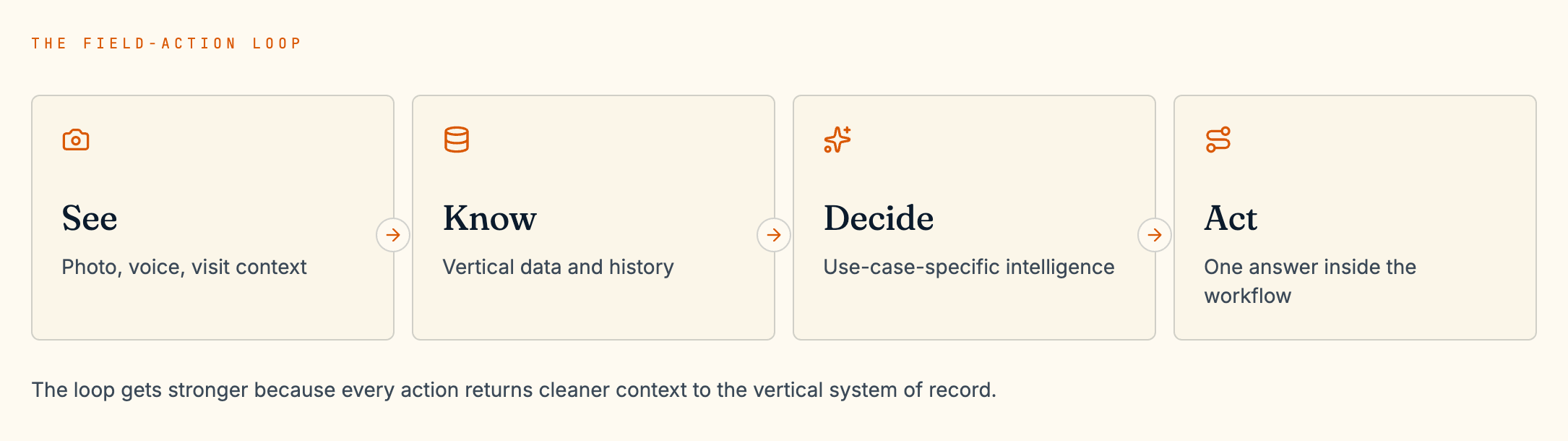
The distinction sounds small until you picture the user. A field representative doing 20 visits does not want to explain the store to ChatGPT. The useful product already knows the route, account, promotion, shelf, and history. It sees the new photograph, recommends the next action, and gets out of the way.
This is not a story about a better model. It is a story about where intelligence becomes valuable. The model is a component. The compounding advantage is everything wrapped around it: vertical intimacy.
Vertical Software Summit
We are already 80% sold out so if you’re considering coming to the Vertical
Software Summit this November, now is the time to grab your ticket.
All information at the link below.
It’s truly the best few days of the year in vertical software and vertical AI.
This Weeks Vertical Titan:
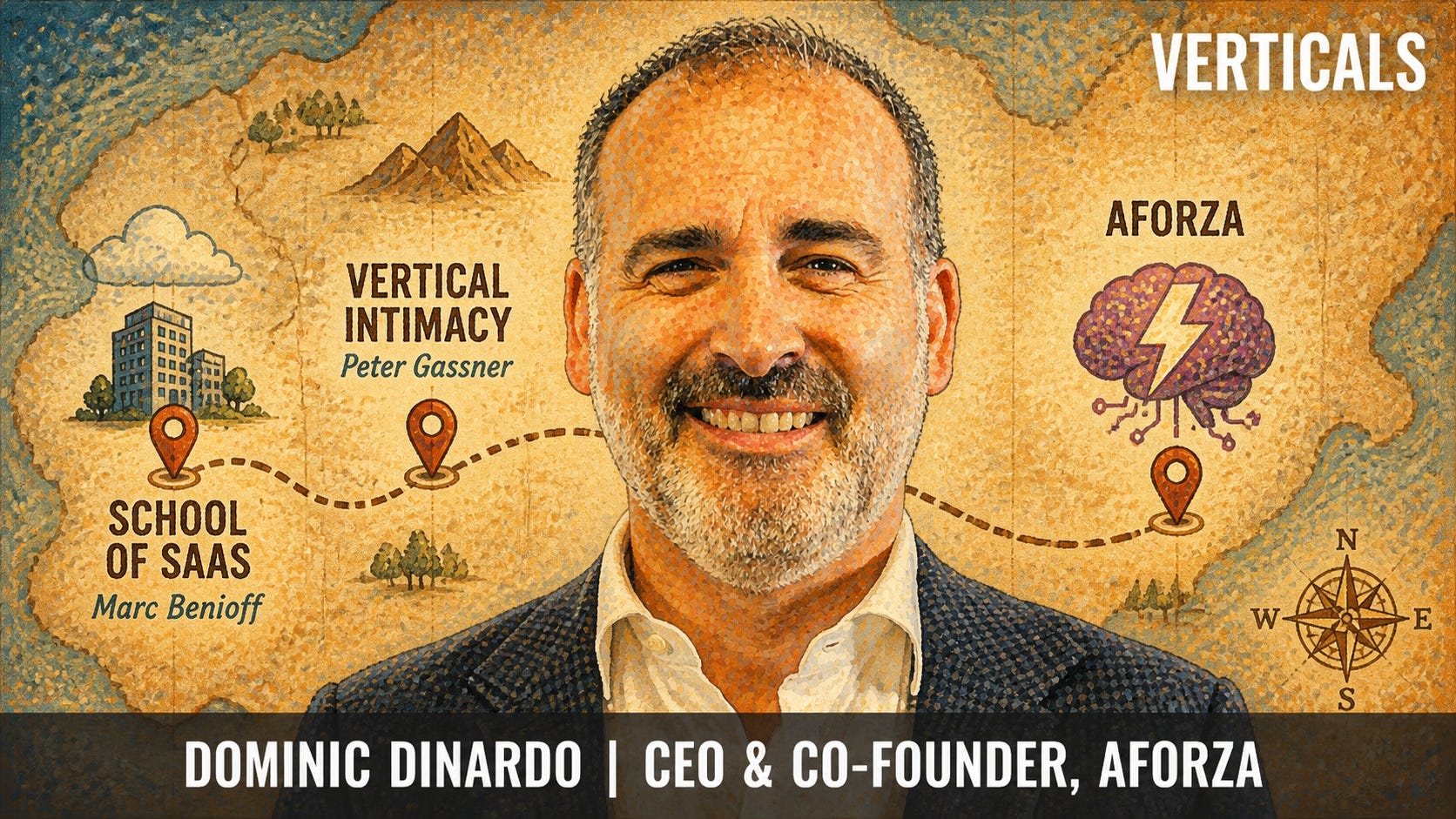
Dom Dinardo (Founder & CEO @ Aforza)
Dom’s career is almost a controlled experiment in software strategy. At Salesforce, he learned the horizontal playbook at Marc Benioff’s School of SaaS as employee 3 at Salesforce UK. At Veeva, working in a company engineered around life sciences, he learned what he calls vertical intimacy directly from Founder/CEO Peter Gassner. At Aforza, he is applying those lessons to the frontline of consumer goods in the new era of vertical ai.
Aforza began with complex offline order capture and retail execution. Today its vertical AI product, Ava, is embedded into that operating system. The company describes the product less like software bought and more like an employee hired—a framing that forces the ROI question into plain language.
The scale is already global: roughly 70 countries, with customers named in the conversation including L’Oréal, Lego, A.G. Barr, Asahi, and Edrington. The point is not the logo wall. It is that one vertical data model can travel widely when local process variation is designed into the system.
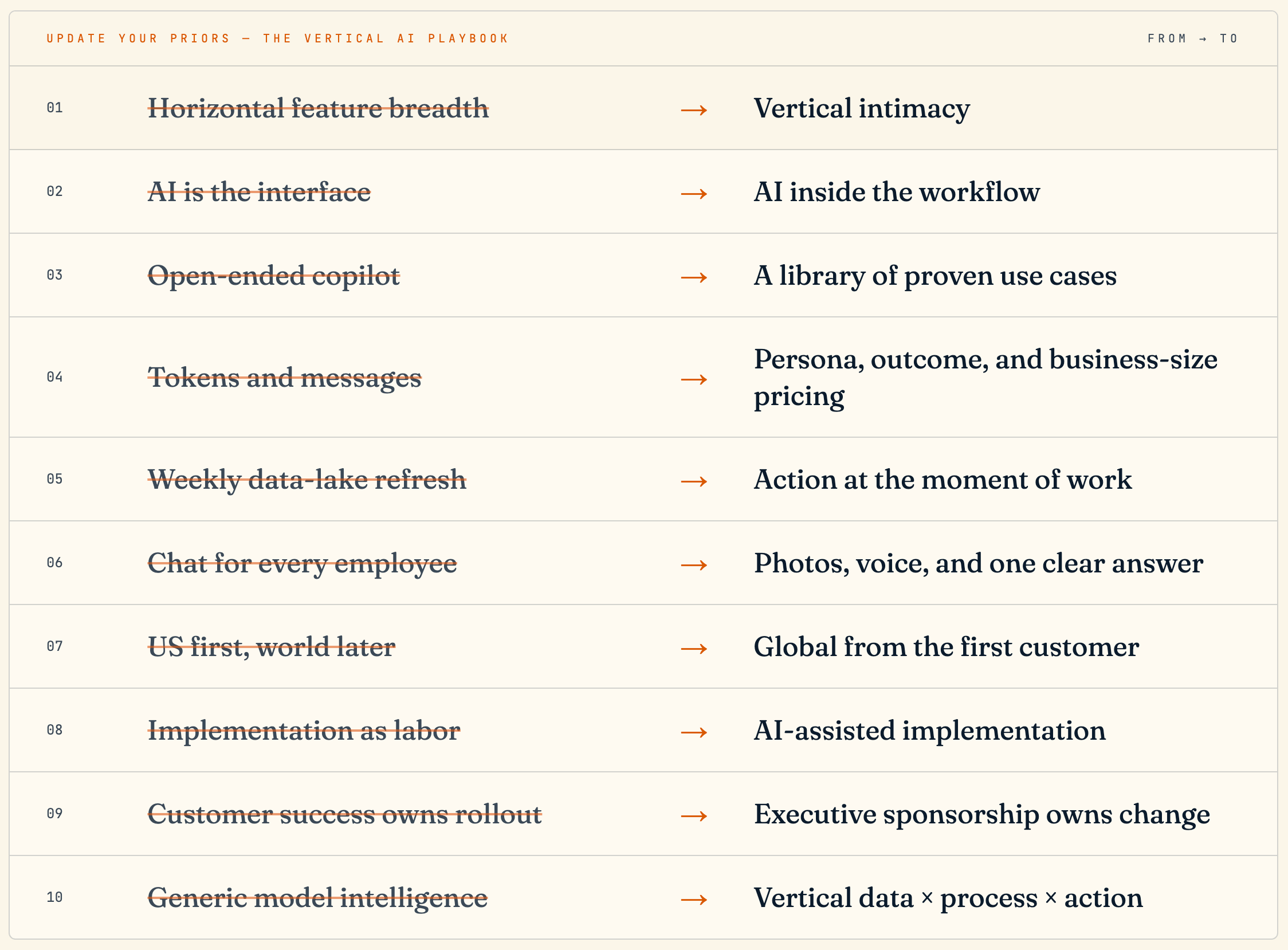
Ten moves for building vertical AI that matters.
The episode’s lessons extend well beyond consumer goods. They form a practical operating system for founders building intelligence into any industry where work, data, and context resist generic software.
01. Pick the vertical where the hard work still happens off-screen.
Aforza did not begin with a category everyone already understood. Dom saw a large CPG software market served mostly by broad horizontal vendors, but no obvious vertical winner. The opening was not glamorous: representatives taking orders in shops, bars, basements, and places where connectivity fails.
That difficulty was the attraction. Offline mobile sync, country-by-country operating differences, promotions, coolers, shelves, and local distributors create a market that looks inconvenient from the outside and inevitable once you know it from within.
Action item: list the workflows in your industry that break when the signal drops, the employee leaves the desk, or the standard data model runs out. Investors: ask whether the ugly implementation detail is temporary friction or a durable barrier to entry.
20. Build vertical intimacy before you build vertical intelligence.
Dom learned the contrast across two eras. Horizontal SaaS rewards breadth: one product, many industries, a repeatable sales motion. Veeva taught him the inverse. In a vertical company, the product, sales team, implementation, vocabulary, and customer relationships all deepen around one industry’s reality.
AI makes that intimacy more valuable, not less. A general model can know a lot about CPG. It cannot automatically own the customer’s data model, approvals, route plan, commercial rules, or the trust required to change how thousands of people work.
Action item: turn customer knowledge into product objects, workflow rules, and implementation methods—not just sales collateral. Investors: diligence whether vertical expertise lives in the system or only in the founders’ heads.
03. Put AI in the interface, not in place of the interface.
The dominant AI product pattern is still a blank box. That works for knowledge workers who can form the question and evaluate an open-ended answer. It is a poor fit for a field representative expected to make 20 visits, take photographs, check a cooler, place an order, and keep moving.
Dom’s phrase is the useful distinction: not AI is the UI, but AI in the UI. The intelligence should appear at a decision point with the right context already assembled. The user should not have to become a prompt engineer to receive the next best action.
Action item: identify the exact screen and exact second where a better decision changes the outcome, then put the intelligence there. Investors: ask to see AI complete a real job without a carefully staged prompt.
04. Sell a use-case library, not an empty copilot.
Aforza built a library of more than 100 CPG-specific AI use cases, each tied to a job and an expected source of value. That is the opposite of shipping a general assistant and waiting for customers to discover ROI themselves.
The library changes the enterprise conversation. A buyer can choose a known problem, understand the workflow it changes, and measure whether the intervention worked. Product discovery becomes a catalog of outcomes rather than a tour of model capabilities.
Action item: create a written inventory of narrow, repeatable decisions your product can improve and attach a measurable value hypothesis to each. Investors: ask how many use cases have moved from demo to repeatable deployment.
05. Price against the customer’s unit of value.
Tokens are a cost input. They are not a buying language. Dom is blunt about this: customers do not want messages, tokens, or fairy dust. They want a commercial model they can budget, defend, and compare with the economic result.
That is why one pricing model is not enough. A field-sales workflow can price per user. Promotion matching can price per claim. Trade-promotion planning can scale with the size of the business. The metric follows the value architecture of the job.
Action item: map every product line to the unit the buyer already uses to describe value. Investors: test whether gross margin improves with model efficiency while customer pricing remains stable and legible.
We’re doing an initmate webinar on ‘How To Sell Your Vertical Software Company’ on September 29th from 1-2pm MST. Only allowing 15 founders in. Reply to this email and we will get you registered.
06. Make real-time context the product advantage.
One prospect described a next-best-action workflow built from data that was already a week old. For a field team, that is not intelligence; it is a postmortem. The store, shelf, price, stock position, and conversation have already changed.
The better pattern closes the distance between observation and action. A photograph of a shelf becomes a recommendation while the representative is still standing there. That speed is not merely a nicer experience—it changes whether the insight can affect the visit at all.
Action item: measure the age of the context behind every recommendation. Investors: ask what decision becomes possible only because the product acts now rather than in the next dashboard refresh.
07. Design for the worker’s environment, not the demo room.
Frontline software lives under different constraints than white-collar software. Hands are occupied. Connections disappear. Lighting is bad. The employee may have seconds, not minutes. The right input might be a photograph or voice; the right output might be one sentence.
This creates a real vertical advantage. The model may be horizontal, but the interaction design, process timing, and exception handling are not. The product that respects the environment can outperform a more powerful model wrapped in the wrong experience.
Action item: shadow users where the work occurs and remove every tap, field, and prompt that does not survive that environment. Investors: insist on seeing the product used in the field, not only in a conference-room demo.
08. Use AI to compress implementation, not just the product experience.
Vertical software companies often lose time after the contract is signed. Discovery notes become requirements, requirements become user stories, and local exceptions multiply. Aforza is using AI inside that implementation work, including turning discovery conversations into structured user stories.
This matters because implementation speed is part of the product. If intelligence can shorten the path from agreement to adoption, the company improves time to value, deployment capacity, and the economics of serving complex customers at once.
Action item: map the manual translation steps between signed deal and live workflow, then automate the highest-volume handoffs first. Investors: treat implementation throughput as a core product metric, not a services footnote.
09. Go global by designing for variation from day one.
Aforza’s first customers were in Portugal and Kenya; the product is now used across roughly 70 countries. Edrington reportedly reached 40 markets in under 18 months. That path is possible because country and operating-company variation was treated as a product requirement, not a later localization project.
Vertical does not have to mean geographically narrow. A strong industry data model can provide the common spine while configurable processes absorb local routes, distributors, languages, and commercial rules.
Action item: separate the industry’s universal objects from each market’s configurable rules before international expansion forces the distinction. Investors: ask whether every new country creates reusable product capability or another custom branch.
10. Keep executive sponsorship inside the operating system.
The last mile of vertical AI is organizational. New intelligence changes decisions, responsibilities, and the way managers coach teams. It can disappear into corporate bureaucracy even when the software works exactly as promised.
Dom stays close to steering calls on important rollouts because change management cannot be delegated to a login screen. The best vertical founders do not only understand the workflow; they understand who must sponsor it, who must trust it, and how proof travels through the organization.
Action item: require an executive owner, a quantitative North Star, and a recurring impact review for every major deployment. Investors: ask who inside the customer will still defend the rollout when adoption gets politically difficult.
The moat gets deeper as intelligence moves from answer to action.
This map is qualitative, not a performance score. It translates Dom’s framework across four layers: interface, workflow, data, and commercial model. Move right by becoming more specific to the industry. Move down by owning more of how work is done and value is captured.
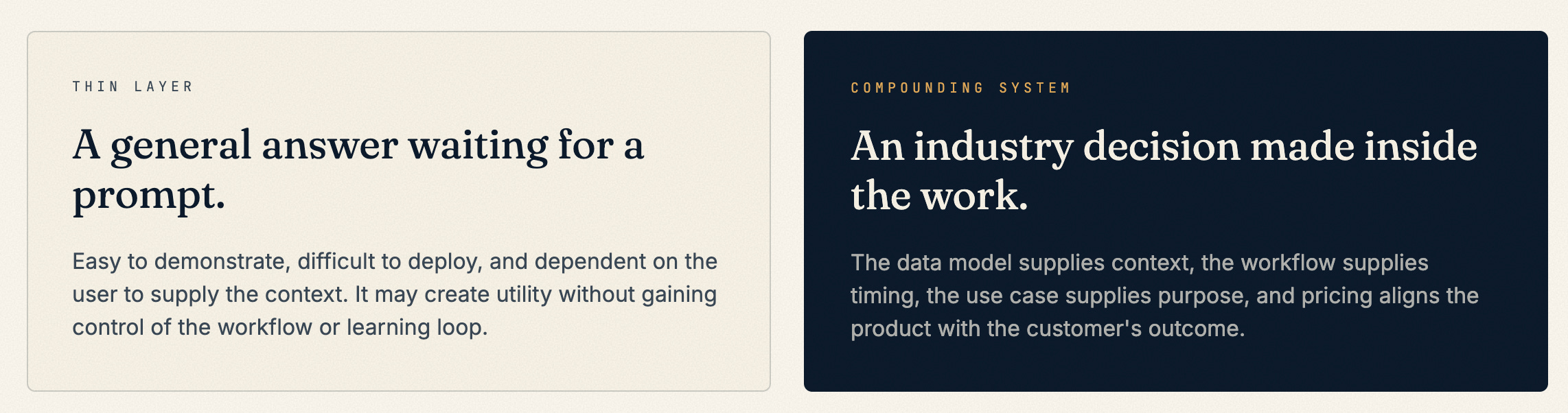
The model companies will keep making intelligence cheaper. That does not erase the vertical company. It raises the value of knowing exactly where intelligence belongs.
See you next Sunday.
— Luke Sophinos
Thanks for reading LINEAR. I reply to every email…
Have any questions, feedback, comments? Let us know, we work for you!