

The Dawn of the AI Marketplace with the Marketplace Philosopher Mike Duboe of Greylock
There’s a reason the Sriracha shortage became a national crisis. David Tran built Huy Fong Foods on a handshake — 28 years, tens of millions of dollars in pepper procurement, and no contract. When that relationship broke, the supply chain broke with it, and we all felt it on our grocery shelves. The uncomfortable truth Nic Poulos opened this week’s episode with: most B2B commerce still runs closer to Sriracha than to Amazon. It isn’t frictionless. It’s fundamentally constrained by human relationships.
That’s about to change. AI commerce is coming; not as a slightly nicer shopping cart, but as something that rewires how transactions get brokered, matched, and monetized. That makes it the perfect moment to put Mike Duboe on the show.
Mike is a rare animal in venture: a marketplace philosopher who came up as an operator. He was the first growth hire at Stitch Fix, where he built the growth team from zero all the way through the IPO. Today he’s a general partner at Greylock, investing in network businesses, marketplaces, and consumer — and, in his words, “accidentally” became a vertical software and application investor along the way.
In this week’s episode we covered what an “AI marketplace” actually means, why the take rate is exposed, where the value is moving after the match, and why embedded ads might be the most underrated monetization story in vertical AI. Here’s what I took from the conversation.
Vertical Software Summit
We are already 80% sold out so if you’re considering coming to the Vertical
Software Summit this November, now is the time to grab your ticket.
All information at the link below.
It’s truly the best few days of the year in vertical software and vertical AI.

This Weeks Vertical Titan:
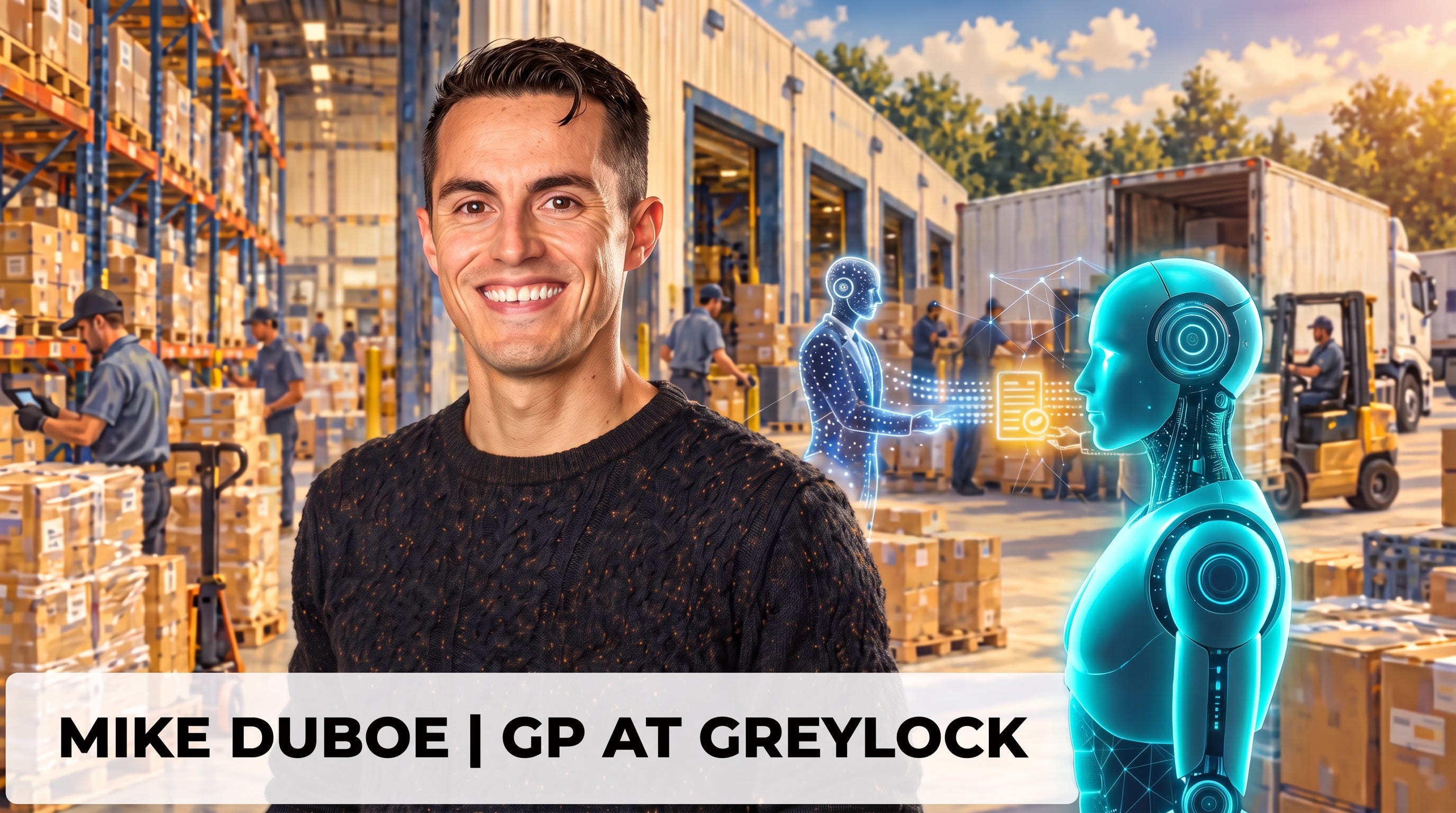
Mike Duboe (GP @ Greylock)
Mike Duboe is the kind of investor you want when the model itself is in flux, because he’s not a thesis guy, he’s a mechanics guy. He doesn’t defend marketplaces on faith; he can take one apart and tell you which gears still turn.
That operator pedigree matters. Mike ran growth at Stitch Fix from pre-scale all the way through its public debut, meaning he lived the two hardest problems in network businesses at ground level: manufacturing liquidity when no one knows you exist, and turning that liquidity into a compounding machine rather than a series of one-off campaigns. He left about a year after the IPO and joined Greylock, where he focused on “network businesses — so marketplaces and consumer networks,” which he says “led me to accidentally becoming more of a vertical software and application investor.”
That accident is our gain. People who think seriously about market structure are rare. People who have actually operated one are rarer. Mike is both, and it shows every time the conversation drifts toward the parts of the model everyone else takes for granted.
His core view on what’s happening right now: AI isn’t creating “AI-native marketplaces.” It’s making more markets addressable to the marketplace model than ever before. Transactions that were previously human-to-human, high-complexity negotiations — the kind that lended themselves to brokerages rather than streamlined marketplaces — are now things agents can handle. And in verticals where no online catalog has ever existed, AI creates the ability to build one that didn’t exist before. That reframe — addressability expansion, not marketplace replacement — is the most useful lens I’ve heard on this topic in a while.
He’s also refreshingly honest about where the model is exposed. His take: “Nowadays, it’s going to be insufficient to just charge for the match.” That line drives the whole playbook section below.

1. The match fee is exposed — move downstream of the transaction
For decades, the core value of a marketplace was the match, and the match is what you got paid for. Mike’s argument is that agents quietly threaten that: if agents can match supply and demand on both sides without a marketplace interface, then charging for the match itself gets compressed. Expect take-rate compression in some categories.
But this is an opening, not a death spiral. The monetization moves downstream of the transaction — credit guarantees, exception handling, verification, traceability. Those are areas where agents are actually smart, and where the marketplace can own something agents can’t easily replicate.
The takeaway: If you’re building a marketplace or a vertical platform that touches commerce, stop building your P&L around match fees. Build it around what happens after two parties find each other — because that’s where durable value (and defensible revenue) is heading.
2. The proprietary catalog is the new system of record
Mike’s most specific investment insight came from High Stock, a liquidation marketplace for excess inventory. The unlock wasn’t the technology — it was the discovery that a whole “dark market” of cross-border distributors quietly buy near-expiration US beauty products and move them overseas. These buyers have no websites, no online catalogs — they exist entirely offline, found through conferences and phone calls. By onboarding them, High Stock ended up with proprietary SKUs in a market that had no legible catalog.
That’s the pattern Mike looks for in B2B: “How are you actually going and creating the catalog versus just piggybacking one that exists?” If the catalog is already legible to agents, agents can bypass you. If you built the catalog nobody had, you’re the system of record. As I put it in the conversation, that’s a proprietary data moat in the agentic era.
The takeaway: Pick verticals where the supply side has never been digitized. The messy, offline, relationship-based parts of a market aren’t a problem to route around — they’re the wedge. If agents can already see the catalog, you don’t have a business; you have a UI.
3. Differentiated logistics beats liquidity when you’re the challenger
Palm Street built a consumer marketplace in categories Whatnot overlooked — plants first, then reptiles. On paper, Whatnot had the liquidity lead. What pulled sellers over? Fulfillment. Shipping a live plant — let alone a reptile — is genuinely non-trivial, and Palm Street’s specialized logistics expertise was enough incentive for sellers to move despite the liquidity gap.
Mike’s framework: what comes downstream of the transaction ends up being a reason to use a marketplace instead of going direct through agents. Liquidity gets you in the door; operational specialization keeps you in the building.
The takeaway: If you’re going second into a marketplace where the winner has liquidity, don’t fight the match — fight the fulfillment, the exception handling, the compliance, the physical weirdness the winner doesn’t want to deal with. Those are moats agents can’t talk their way around.
4. Start with vertical SaaS on one side, add the marketplace later
The classic marketplace-to-vertical-SaaS pivot is well-trodden. Mike lived the data point: Faire, Pepper, Bori, Resnovie — most of the B2B marketplace theses from his early investing days ended up eschewing the marketplace model entirely, building vertical software first, and monetizing on SaaS and payments rather than the match. Pepper eventually layered on an ad network at real scale. But the core model is SaaS, not match fees.
The interesting question the three of us landed on: does AI change the odds? My answer in the episode was that the two models start to blend into one. You get one side of the ecosystem with classic vertical AI tooling, and then over time you spin up the other side — the way a law-firm tool could eventually push clients to lawyers and take a commission on top of SaaS fees. The line between “vertical AI product” and “vertical marketplace product” is going to dissolve, because at some point you’re both the workflow and the transaction.
The takeaway: Don’t feel obligated to solve two-sided liquidity on day one. Enter with the easier side and a valuable tool, build trust and data, and treat the marketplace as an expansion product — not the founding premise. The cold start problem isn’t gone; AI just made it optional to confront immediately.
5. Consumers won’t hand over the transactions that feel good
Here’s the counterweight to all the agentic-commerce hype. Mike thought about this deeply during his Stitch Fix years, and his conclusion: a lot of consumers don’t actually want frictionless shopping. The instinct to automate everything misses that shopping itself is the product for a meaningful slice of purchases.
His split: where the objective is clear, where search and matching is easy, and where shopping feels like work — agents should and will take it. Think replenishment, commodities, the stuff you automate on Amazon anyway. But where the process of shopping is expressive and fun — fashion, discovery, surprise — AI’s role is to make the experience better, not to remove it. That’s why Whatnot became the outlier marketplace of the past decade: it was fun.
The takeaway: When you design for agentic buying, sort your catalog into “chore” and “joy.” Automate the first. For the second, build AI that delights rather than transacts — because the moment you turn a joy purchase into a utility purchase, you’ve destroyed the value you were supposed to capture.

A quick word from our sponsor on the Verticals podcast, Parafin. Fresh off the 2026 Forbes Fintech 50 and a new credit facility led by Goldman Sachs, they’ve now extended over $35B in offers to small businesses through platforms like DoorDash, Gusto, and TikTok Shop.
Purpose-built embedded capital for vertical platforms.
6. Trust systems were built for humans. Rebuild them for agents.
One of the sharpest one-liners in the conversation: “Most marketplace trust systems — I think about eBay stars — were built for humans. What’s the equivalent built for agents?” The answer is probably verified outcome data — not star ratings, but auditable performance: did the thing arrive, did it match spec, did the counterparty perform? That’s the currency agents will trust.
This has a practical implication for the “dark marketplace” dream — agents transacting with agents while you sleep. The real constraint isn’t technology; it’s that the agent needs to think like you’d think. Abstraction of buyer judgment is the hardest and most valuable asset in the whole system, and you can only build it with deep engagement over time.
The takeaway: If your marketplace or vertical platform has a reputation layer, start asking what the agent-native version of it looks like. Verified outcome data, performance guarantees, and exception-handling records will matter more than human star ratings in an agent-mediated world.
7. Embeds ads are the vertical AI monetization story
This was the section of the conversation where everyone leaned in. Mike’s example: Open Evidence, the clinical AI company, which converted point-of-time physician usage into massive ad revenue essentially overnight — because pharma has huge ad budgets and there has never been a better moment to reach a doctor than while they’re actively reasoning through a case at the keyboard.
I’ve been sold on this since Uber turned on embedded ads and added roughly a billion to the bottom line. And generative AI is the perfect vehicle for it. You’re serving one industry. There are a finite number of companies desperate to reach those users. The user is mid-workflow, talking to an expert (the AI), with intent visible in every token. An ad served there isn’t a banner — it’s contextually relevant information, delivered at exactly the right moment, tied to what the user is already asking about. It’s a no-brainer.
8. Clear ad labeling is a trust feature, not a betrayal
There’s a reflexive worry that ads inside AI products will break user trust. Mike takes the opposite view, and I think he’s right: when it’s clear what is and isn’t an ad, it builds confidence that the default responses are unbiased. Transparency becomes a feature.
The open question, as he framed it, is whether anyone has built the right native ad unit — the one that enhances engagement rather than trading it away. He points out that Instagram ads arguably make Instagram more engaging, which is an absurdly high bar. Right now, most AI ads are effectively search ads (which is why Open Evidence works). The unlock is a native unit nobody has invented yet — creative, bespoke, per-publisher. My favorite idea from this stretch was Luke floating an API key anyone could drop into a vertical AI app to turn on embedded ads in ten seconds flat. The SSP layer for consumer AI apps is probably early. The B2B version is lower volume and higher value — and, for now, inherently consultative.
The takeaway: Vertical AI founders should treat embedded ads as a first-class revenue line, not a sellout. Ship contextually relevant, clearly labeled placements; watch the engagement data; and expect that the first five ad formats you try aren’t the right ones.
9. Growth talent is the scarcest resource in the AI era
Mike grew up in the early-2010s school of systematic growth thinkers — people who engineered compounding loops instead of running tactics. His observation: in the AI era, basic products are trivial to ship, so what differentiates winners is structural distribution, network effects, and durable brand. That makes systematic growth talent more valuable than ever — and there’s a shortage, because technical founders historically under-valued distribution, so the incentive to train the next generation of growth thinkers collapsed.
The current wave of AI-native marketers are scrappy and fast, but “lean more tacticians versus systematic growth thinkers.” And since the tactics are changing faster than ever, being a tactician without principles atrophies quickly.
The takeaway: If you're a vertical AI founder, the best headcount decision you'll make this year is hiring someone who thinks in systems about distribution — not someone who can spin up channels fast. And if you're a growth person: the window for tacticians is closing. The people who can abstract the principles will own this era.
10. The marketplace underwriting checklist, rewritten for agents
Mike ended with the most useful segment of the whole episode: the Bill Gurley / Jeff Jordan evergreen marketplace attributes — and what needs rewriting for the agent era.
Still evergreen:
High fragmentation on both sides
High-frequency transactions (or a credible path to frequency)
Getting into the payment flow
A founder with an edge on aggregating demand — typically spiking on industry know-how or growth
A point of view on disintermediation — which in this era means “going to agents”
Getting rewritten:
Take rate assumptions — the match fee is exposed (playbook #1)
Reputation systems as lock-in — less confident; agent-native trust isn’t proven yet
The 10x interface experience — matters less; he’d rather underwrite a founder’s understanding of market structure and their ability to spin up liquidity fast
That last shift is worth sitting with. For a decade, the marketplace bar was product magic. Mike is saying the new bar is market-structure literacy: do you understand the shape of the market, where the supply hides, who holds the inventory, why they’ll move? Can you generate liquidity faster than anyone else? Because interfaces are replaceable now. Market understanding is not.
That’s the episode. As always, the whole conversation is worth your time — Mike learns in public, which is the best kind of guest. If you’re building in vertical AI, vertical SaaS, or anything touching B2B commerce, this one has quite a few frameworks to steal!
See you next Wednesday.
— Luke Sophinos
Thanks for reading LINEAR. I reply to every email…
Have any questions, feedback, comments? Let us know, we work for you!
AI compresses matchmaking and inflates everything that happens after the date