

The Vertical Software Summit is ~60 days out...

If you’ve been waiting to grab a ticket, now is the time
(and if you need a free one reply to this and we will get you one).
It took Procore 14 years to reach $100M in ARR. It took Harvey three.
Legora went from zero to $100M in ARR in eighteen months. OpenEvidence hit $150M in five. MagicSchool put up $10M in its first year of monetization. GC AI went from $1M to $10M in under twelve months.
Meanwhile, the last generation of vertical winners, the ones we all study, needed a decade on average to do what this generation is doing in thirty-six months…
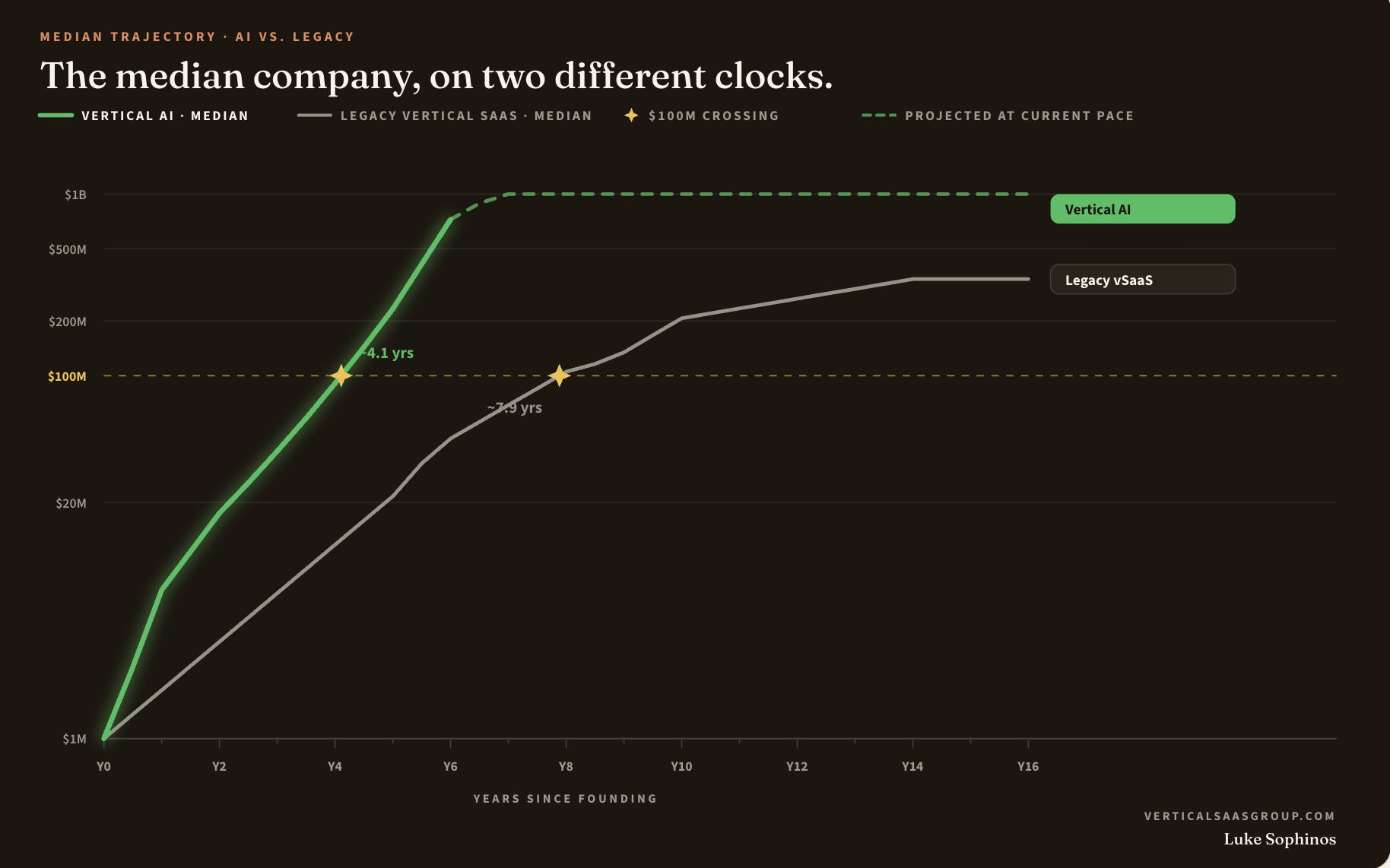
This is not a rounding error. It is a structural change in how fast vertical software businesses can compound, and it changes how you should think about every vertical market on earth…

The Two Clocks: Legacy Vertical SaaS vs Vertical AI
Twenty years of vertical software history produced a clear tempo. Build the system of record, grind through multi-year implementations, expand seat by seat, attach payments, cross $100M sometime around year ten, go public a few years after that.
Here is what that clock actually looked like:
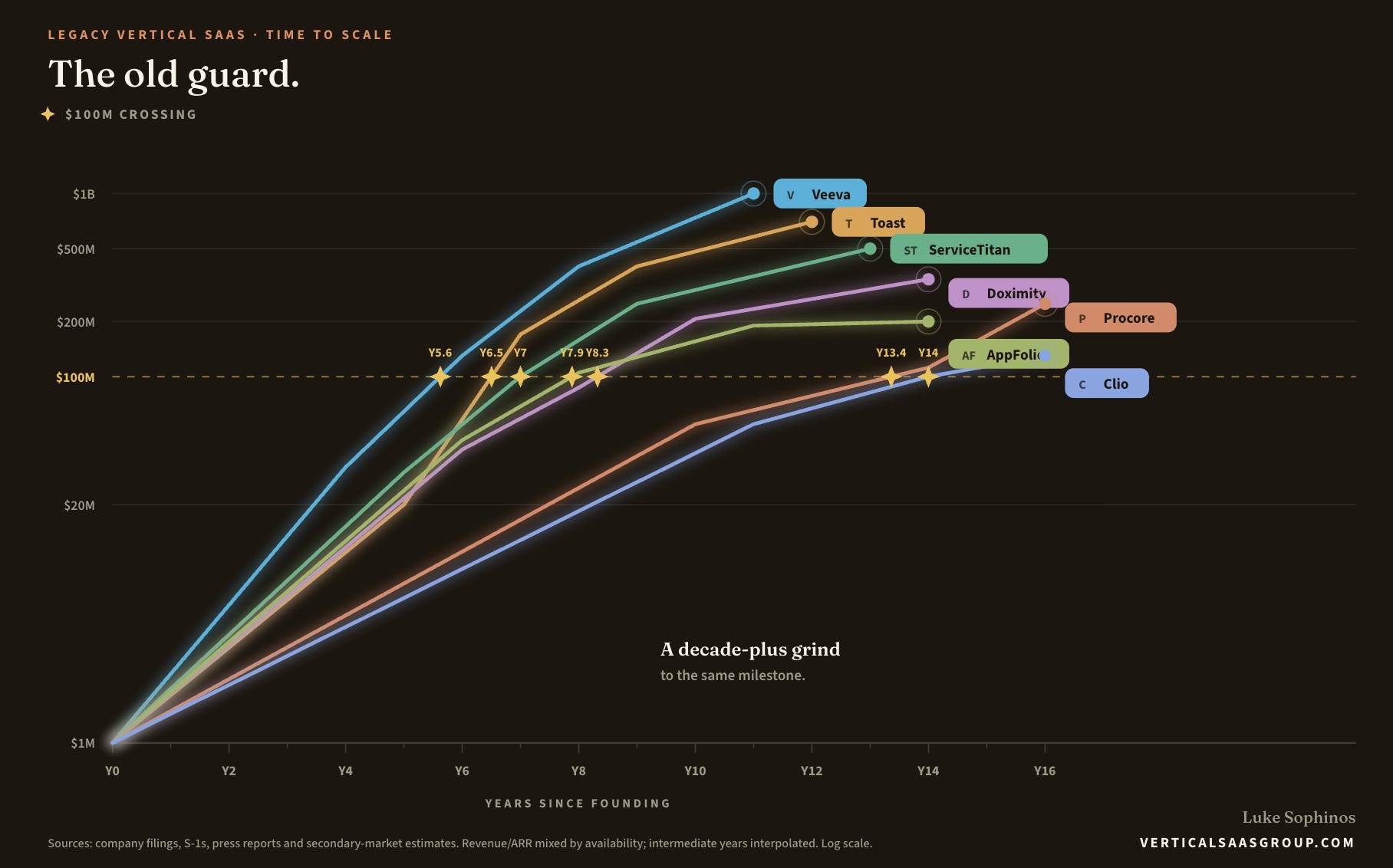
Veeva was the sprinter of its generation: seven years to $100M with fewer than 200 customers and only $12M raised. That was considered one of the greatest executions in software history.
Procore was the grinder: a decade to reach $5M, fourteen years to $100M, twenty-two to a billion. Clio needed 14 years to hit $100M and crossed $500M in May of this year, eighteen years after founding. Doximity, a genuinely elite business, took ten years to cross $100M.
Median time to $100M ARR for the vertical software greats: roughly a decade.
Median time to $500M for the ones that got there: well into the teens.
Now look at the clock the vertical AI generation is running…

Harvey crossed $100M in ARR in August 2025, three years after founding. By this summer it was at $350M. If the line holds, Harvey gets to $500M in under five years. Clio just did it in eighteen.
And then Legora broke the clock entirely: $100M of ARR in eighteen months from founding, in the same vertical as Harvey, with half the ramp. Eighteen months is faster than Wiz, faster than Deel, faster than nearly any software company ever measured — and it happened in law, a category the last generation needed a decade and a half to crack.
OpenEvidence is the outer edge: $50M to $150M in ARR in five months, faster than three quarters of every SaaS company ever measured. It reached 300,000 doctors in about a year. Doximity needed a decade to assemble that same audience.
That is the part worth internalizing. The audience was compounding for years while the revenue line sat flat at zero, and monetization was not a build — it was a switch. When a vertical AI product owns the daily habit of a licensed, high-value professional, the revenue ramp is not a function of go-to-market. It is a function of the day someone decides to charge.
Distribution is pre-built.
The wallet got bigger.
Adoption friction collapsed.
The three mechanisms
Distribution is pre-built. The vertical SaaS generation spent twenty years dragging laggard industries onto cloud and mobile. The AI generation inherits buyers who already purchase software, already hold budget, and already know their workflows are broken. Harvey never had to convince a law firm that technology matters. A decade of legal tech did that for them.
The wallet got bigger. Vertical SaaS sold seats, and seat budgets are small. Vertical AI sells completed work: a drafted motion, a resolved claim, a documented encounter. That spend comes out of labor and outsourced services budgets, which dwarf software budgets in every vertical. The AI company is not competing for the incumbent’s line item. It is eating the line item above it.
Adoption friction collapsed. The legacy winners fought implementations measured in years. The AI winners ride an interface that feels like a conversation and returns value in the first session. MagicSchool signed up six million educators without a sales force worth mentioning. That motion did not exist in 2011.
Two honest caveats, because they matter.
Speed is not margin. Harvey’s revenue carries real model costs underneath it in a way Veeva’s never did. A $100M AI ARR and a $100M SaaS ARR are not the same business, and the market will eventually price the difference.
And the vertical still sets the floor. GC AI compounds 23% a month because in-house legal budgets are centralized and decisions are fast. The model does not override the market’s metabolism. It removes the excuses.
That is not a faster horse. It is a different race.
The best vertical software businesses of the last cycle were decade-long builds, and the very best of them, Clio included, needed the better part of two decades to reach $500M. The best vertical AI businesses of this cycle are compressing that into three to five years.
Let’s look at the chart in aggregate…

This may be my favorite chart in newsletter history.
What a time to be alive…

The Map Was Already Drawn
In 2007, Peter Gassner left Salesforce to build software for one industry: pharmaceuticals. Everyone told him the market was too small. Veeva now does $3.4B in revenue and trades around $33B.
In 2011, Aman Narang and his co-founders started building point of sale for restaurants, a category investors had written off as a services-heavy graveyard. Toast now runs at roughly $5B in annual revenue.
In 2012, Ara Mahdessian and Vahe Kuzoyan started building software for plumbers and HVAC shops out of a garage, because their parents ran trades businesses. ServiceTitan crossed $1B in revenue this year.
Each of these stories has the same shape. A founder picked a market that looked boring or broken from the outside, spent a decade proving the wallet existed, educating the buyer, and wiring up the workflow. Then the business compounded for another decade.
Here is the part nobody is pricing in: every one of those stories is also a prospectus for the next one.
Every public vertical software company above a billion in revenue is a proof statement. It proves the demand exists. It proves the buyer can be trained. It proves the workflow is budgeted. Those are the three hardest things to establish in any vertical, and the incumbent already paid for all of them.
Which means the correct way to map vertical AI opportunity is not to chase what is trending. It is to look at where vertical software already produced massive winners and ask: who is the AI-native successor here, and does one exist yet?
Run the scoreboard:
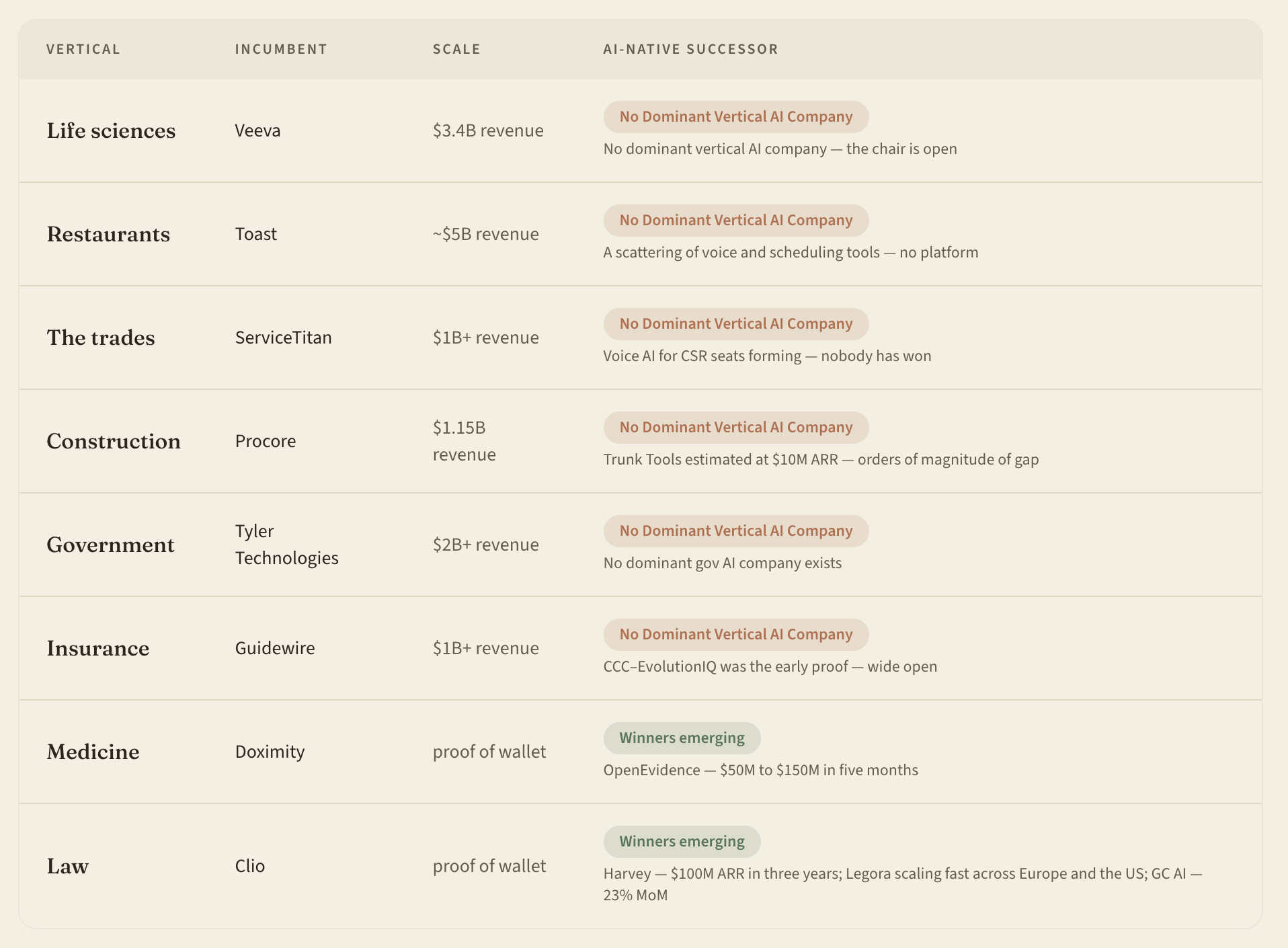
Now notice where the vertical AI winners showed up first: medicine and law.
Doctors got OpenEvidence. Lawyers got Harvey, Legora, and GC AI. Why those two? Because Doximity spent a decade assembling the physician graph and proving doctors monetize, and Clio spent eighteen years proving legal budgets are real, real enough to build a $500M ARR business on top of them. When the AI products arrived, those markets were pre-sold.
The software winner is not the competition.
It is the proof of wallet.
And the successor’s ceiling is higher than the incumbent’s. Veeva sold software, a tool budget. Whoever builds the Veeva of AI sells labor and outcomes, an operating expense budget. The second wallet is five to ten times the size of the first.
Gassner proved pharma pays. Narang proved restaurants pay. Mahdessian proved the trades pay. Twenty years of vertical software history drew the map, marked the wallets, and trained the buyers.
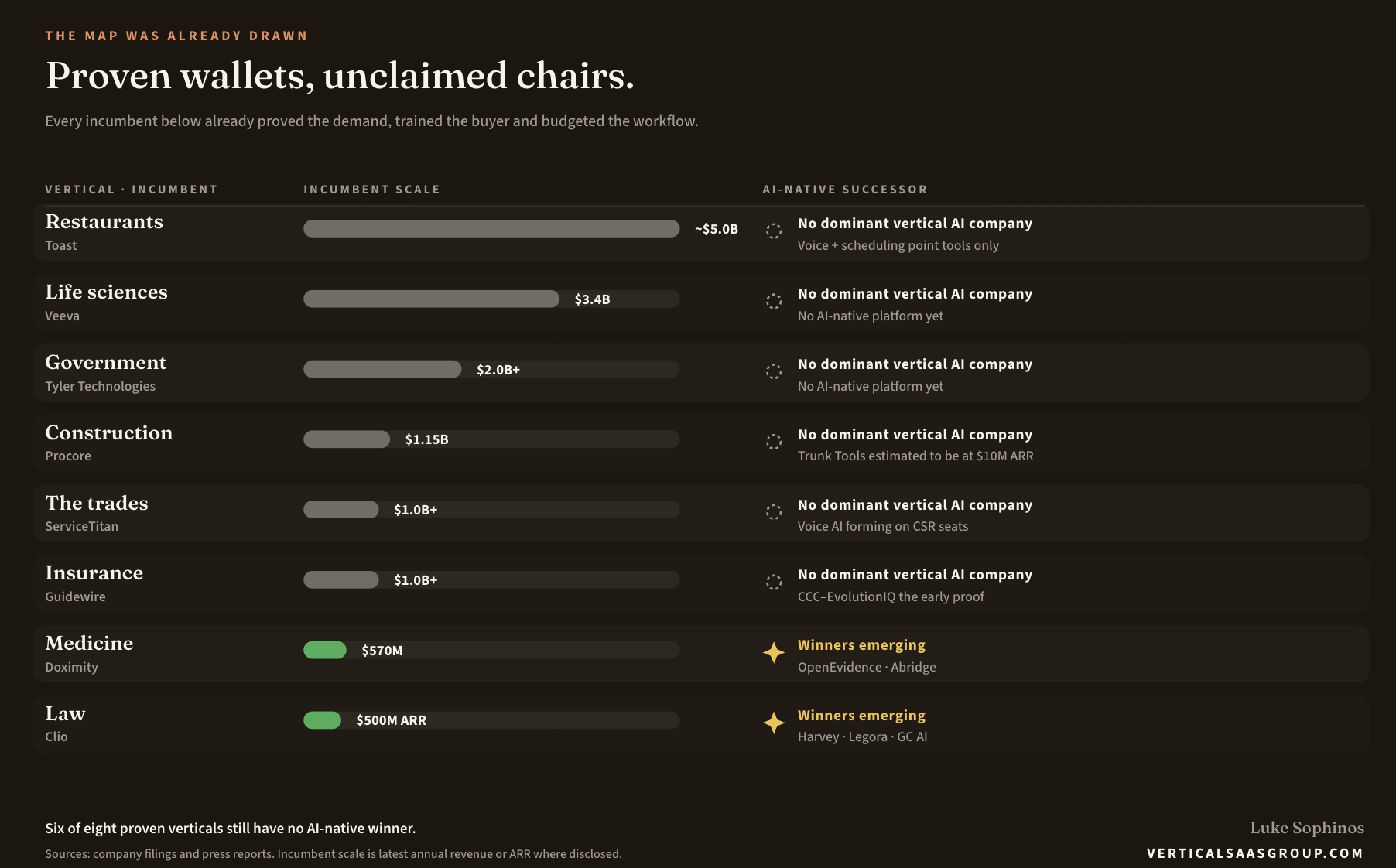
The vertical AI generation does not need a better map. It needs to move faster on the one it was handed. And as this week’s numbers show, it already is…

The Best Value Creation Levers Don’t Stand Alone
The best Vertical SaaS companies I’ve worked with all have one thing in common: they don’t try to do everything.
Instead, they’re remarkably disciplined about where they invest. They evaluate every product decision, strategic initiative, and investment not only by its immediate return, but by what it makes possible next.
That’s a different way of thinking about strategy. If you spend enough time talking with software founders and private equity investors, you’ll notice a common pattern. Nearly every strategic conversation eventually turns into the same question:
Where should we invest next?
The answers are familiar. AI. Embedded payments. Pricing optimization. International expansion. New financial products. Services. Each has a compelling business case, and each has the potential to create meaningful enterprise value.
But I think we’re starting to ask the wrong question. Instead of asking which initiative will deliver the biggest return, leaders should ask:
Which investment will make every future investment more valuable?
Every Vertical SaaS company has more opportunities than it has engineering resources, investment capital, or organizational capacity. The challenge isn’t identifying good ideas. It’s deciding which investments create the greatest strategic optionality over the next five years.
One thing I’ve noticed is that the strongest SaaS companies rarely chase trends. They make a handful of strategic investments that continue paying dividends as the business evolves. Looking back, those decisions often seem obvious. At the time, they usually required saying no to a dozen other attractive opportunities.
Some initiatives create value. Others strengthen the platform in ways that make future initiatives more valuable. The best ones do both. Those are the investments that compound over time.
Take AI as an example. AI can automate workflows, improve customer support, and increase productivity. But its impact changes dramatically when it’s built on top of rich operational data, well-defined workflows, and years of customer context.
The technology matters. The foundation matters even more.
The same principle applies across many of the strategic decisions software companies are making today. Better operational data improves AI outcomes. Deeper workflow ownership strengthens customer retention. Financial infrastructure creates opportunities for embedded finance. Transaction data unlocks new insights.
Viewed independently, these look like separate initiatives competing for budget. Viewed strategically, they’re connected capabilities that reinforce one another.
Embedded payments is one example. For years, we’ve talked about payments as a value creation lever, and I think that’s still true. It can generate new revenue, strengthen customer relationships, and contribute to enterprise value.
But perhaps the bigger opportunity isn’t payments alone.
It’s what becomes possible once payments become part of the platform. Transaction data becomes more accessible. Financial workflows become more connected. Future financial products become easier to introduce. Each new capability increases the value of the next.
That’s why I believe the most successful vertical SaaS companies will increasingly think less about individual initiatives and more about building platforms that create future opportunities.
These are exactly the kinds of conversations I’ll be having with Mark Passifione and Daniel Burton of Xplor Pay during our executive discussion, Building More Valuable Vertical SaaS Companies, on September 10. If these questions are on your mind too, I hope you’ll join us.
The best value creation levers don’t stand alone. Neither do the conversations that shape them.
The next generation of Vertical SaaS leaders won’t win because they identified more value creation levers than everyone else.
They’ll win because they invested in capabilities that made every future lever more powerful.
Do me a solid and forward to a friend :-)