

Great in the right hands, a disaster in the wrong ones. Quinn Litherland on Forward Deployed — who to hire, how to pay them, and how to templatize it.
Every vertical AI company with a seed round is suddenly “forward deployed.” Palantir’s own executives made fun of the copycats on an earnings call: sales engineers in costume. And there is a reason everyone claims it — the model works. But it works like a chainsaw. Great in the right hands, a disaster in the wrong ones.
This week Nick and I sat down with Quinn Litherland, founder and CEO of Revin. They build verticalized automation for home services: HVAC, plumbing, roofing, remodeling, pool services. Think AI Native Services for Mid-Market/Enterprise Field Services. Three years old, just over $10M raised, out of New York. Their agents answer calls at 9pm, qualify homeowners, run a $30,000 roof sale across a four-week omnichannel campaign, and book the job back into ServiceTitan. Their FDEs sit in a random state in the U.S. every week running $250M remodeling businesses. And Quinn has thought harder about how to make forward-deployed actually scale — and how to avoid the two traps that kill companies that try it — than almost anyone we have had on the show.
This episode is a masterclass in the FDE motion: who you hire, how you pay them, where they sit, how you templatize the role, and how you keep from becoming a services shop with venture funding and a prayer.
Vertical Software Summit
Last chance before ticket prices go up September 1st!
We are already 80% sold out so if you’re considering coming to the Vertical
Software Summit this November, now is the time to grab your ticket.
All information at the link below.
It’s truly the best few days of the year in vertical software and vertical AI.
This Weeks Vertical Titan:
Quinn Litherland
(Founder/CEO @ Revin)

Quinn walked into one of the most fragmented markets in software: home services, a $650B-plus industry with 2.5 million providers running systems older than the startups selling to them.
Revin targets mid-market to enterprise: $25–30M family businesses that scaled regionally, plus PE platforms like Vertex doing $600M+ across 25–26 brands. ACVs run $70K to $250K. A roofing company pays that because a single new job is worth $50,000, and Revin can close five new customers in month one that would have leaked through the funnel.
The strategic insight worth studying is the reframe. Revin is not selling software. They are selling labor. Their workflows and agents are employees to these businesses. And that changes everything downstream — because a remote employee who is onboarded badly and doesn’t understand the business will never run operations effectively. You cannot just ship a dashboard and wait.
Revin is not selling software. We are selling labor.
Quinn Litherland, Revin
So Revin embeds. Deep, fast, from day one of a customer going live. At some point they are essentially running your business, and ripping them out becomes nearly impossible. The product’s atomic unit isn’t the UI. It is the agents, learning directly from every conversation, improving constantly. Quinn calls the endgame “headless companies”: a $500M roofing business run by five people and a stack of agents.
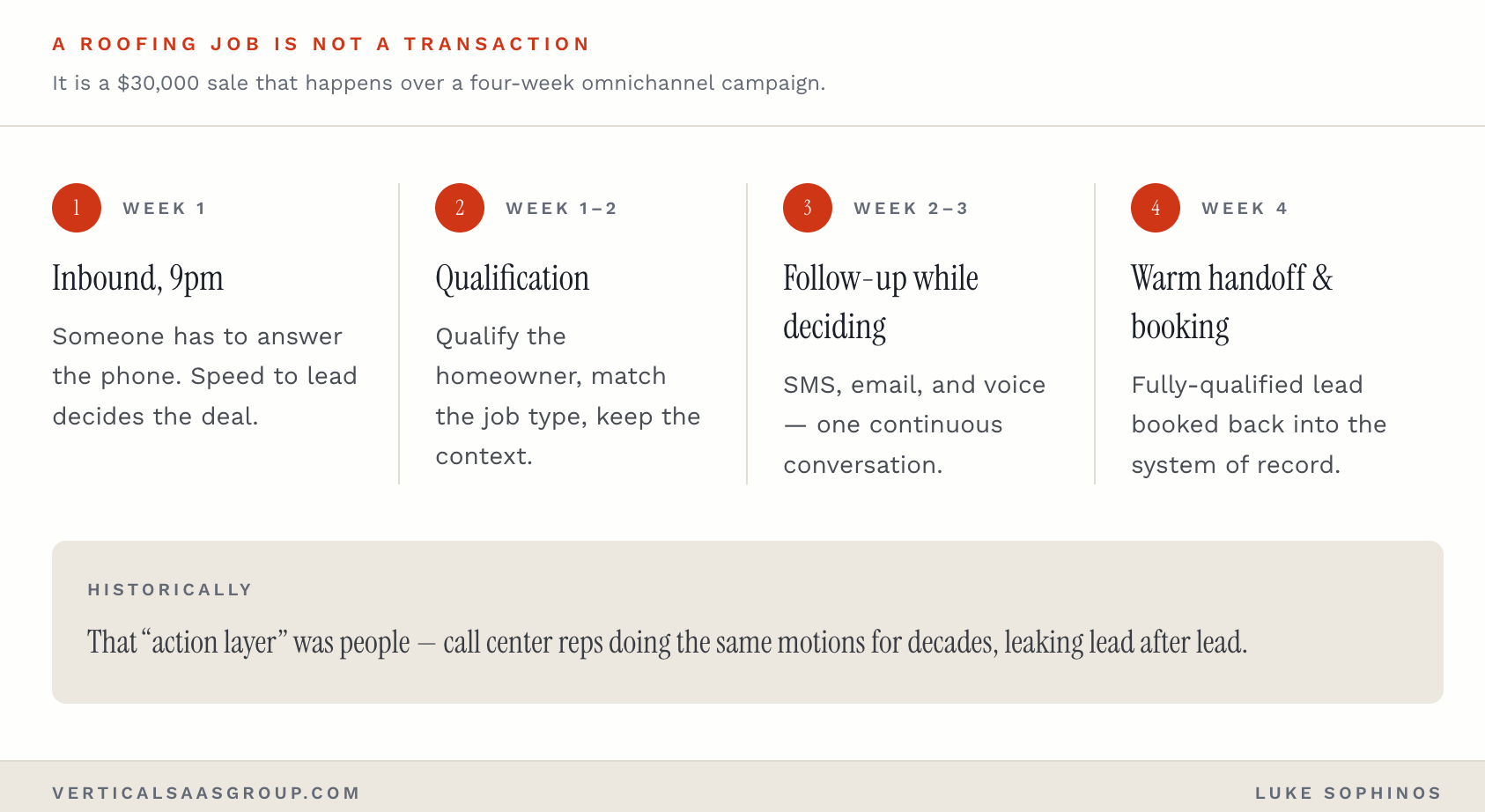
The core product insight is more interesting than the product itself. A roofing job isn’t a transaction; it’s a $30,000 sale that happens over a four-week omnichannel campaign. Someone has to answer the phone at 9pm, qualify the homeowner, follow up while they’re deciding, maintain context across SMS, email, and voice, and then hand off a warm, fully-qualified lead. Historically that “action layer” was people — call center reps doing the same motions for decades, leaking lead after lead. Revvin replaced that with agents that own the workflow end to end: inbound speed to lead, qualification, job-type matching, booking back into ServiceTitan or whatever the system of record is.
That is the vision. The engine that makes it real — and the reason this episode matters — is the forward-deployed motion. That is what this newsletter is about.
01. The Forward-Deployed Motion
Deploy, maintain, expand — in that order.
Renewals are the scoreboard.
That is the Revin mantra. And I love it.
Deploy: go live as fast as possible with the highest quality outcomes.
Maintain: don’t vanish at month three, which is where most FDE-heavy deals die.
Expand: if a customer is buying more workflows, they are happy, and “you crush these three workflows, now do these six” becomes the natural motion. When LTV goes from $70K to $250K to $1M, the renewal stops being a negotiation and becomes a planning session.
Hire founder-shaped operators, not sales engineers.
The profile is the story. Paul, one of Revin’s best FDEs, ran a bootstrapped car detailing business in Austin doing about $500K a month, built his own tools, exited, and joined. Today he manages a couple billion dollars of enterprise value in roofing and works with the C-suites of these businesses. Quinn’s line: Paul could leave tomorrow and run a roofing roll-up better than 95% of the private equity folks he meets. Implementation skills, expansion instincts, industry fluency, and deep empathy for operators because he was one. This is not a sales engineer. This is a founder who chose your company instead of starting his own.
Pay that person like an owner — because they are one.
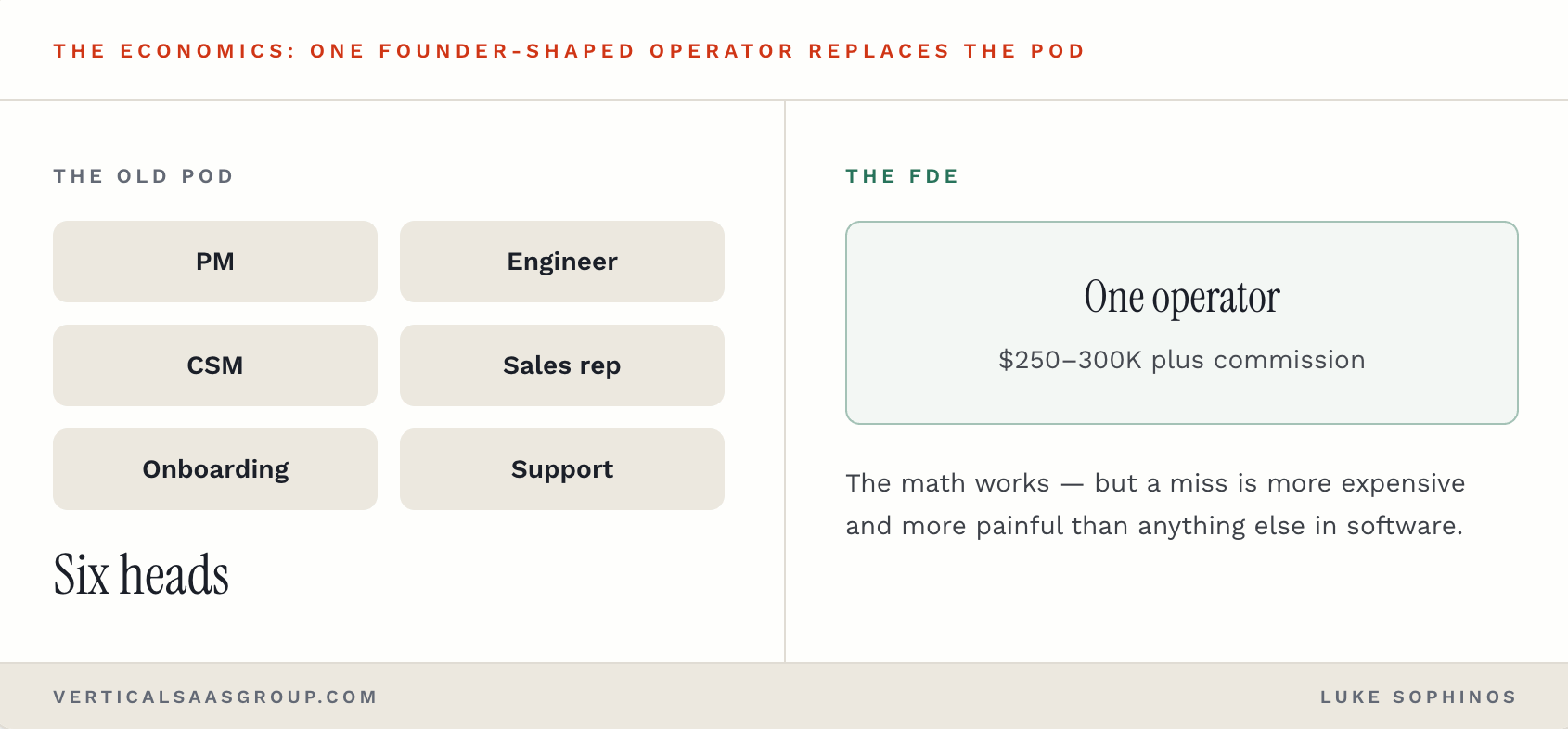
Quinn points to Decagon as the model. An FDE who can make a million dollars this year if every account renews, plus a cut of expansion, will act like the CEO of their book of business. Renewal-based commission turns your most expensive cost center into a revenue engine. And the economics work: hire one of these people instead of the old pod of PM, engineer, CSM, and sales rep. Pay $250–300K plus commission and you replaced six heads with one. But you have to get the hire right, because a miss is more expensive and more painful than anything we have seen in software.
Put forward-deployed under product, not engineering.
The field is where the signal lives. Your FDE should be able to say, “I have seen this five times today, we need to solve it.” Under engineering, you build what you think is right instead of what the trenches are telling you. Revin’s FDEs are the product org’s nervous system. They are in middle-of-nowhere Ohio every week, understanding these operators in a way a PM staring at a dashboard never will. Handled well, the FDE motion forces you to actually understand the businesses you serve — stickier product, more durable value. Handled wrong, you are screwed.
Watch for the two traps, because both will get you.
This is the most important part of the conversation. Trap one: you become a services factory — running a services playbook on VC money, praying you will eventually automate the humans. Trap two: everyone is “forward deployed” and nobody is building repeatable systems — chickens with their heads cut off. Quinn’s hard truth: forward-deployed is often an excuse not to build great product, and a lot of teams will be screwed because no one is coming to save them.
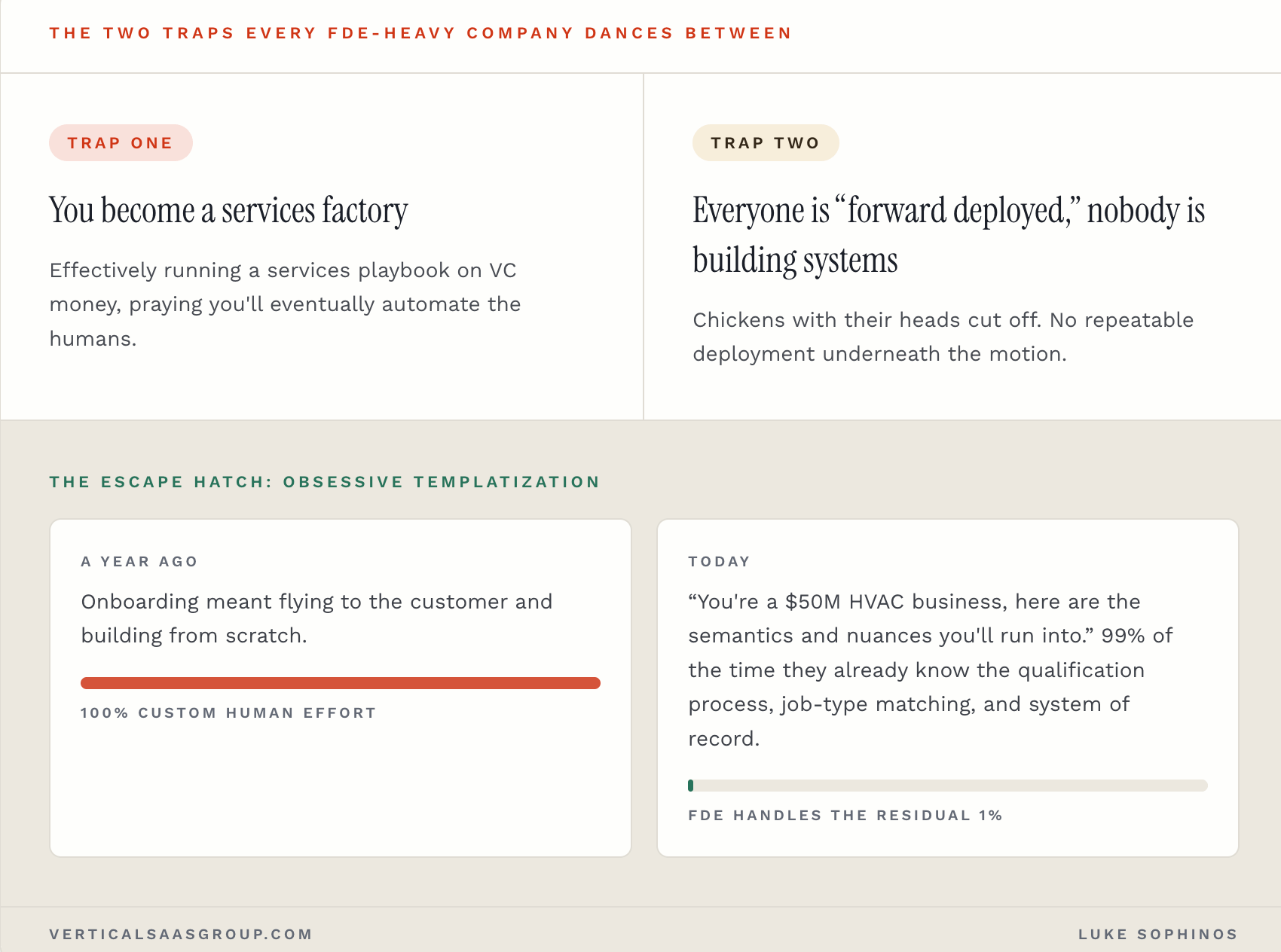
The escape hatch is obsessive templatization. A year ago, onboarding meant flying to the customer and building from scratch. Today it is: “You are a $50M HVAC business, here are the semantics you will run into. 99% of the time we already know your qualification process, your job-type matching, your system of record.” The FDE handles the residual 1%. Every new customer must take measurably less human effort than the last. Otherwise you are not building a company. You are building a nonprofit consulting firm with venture backing.
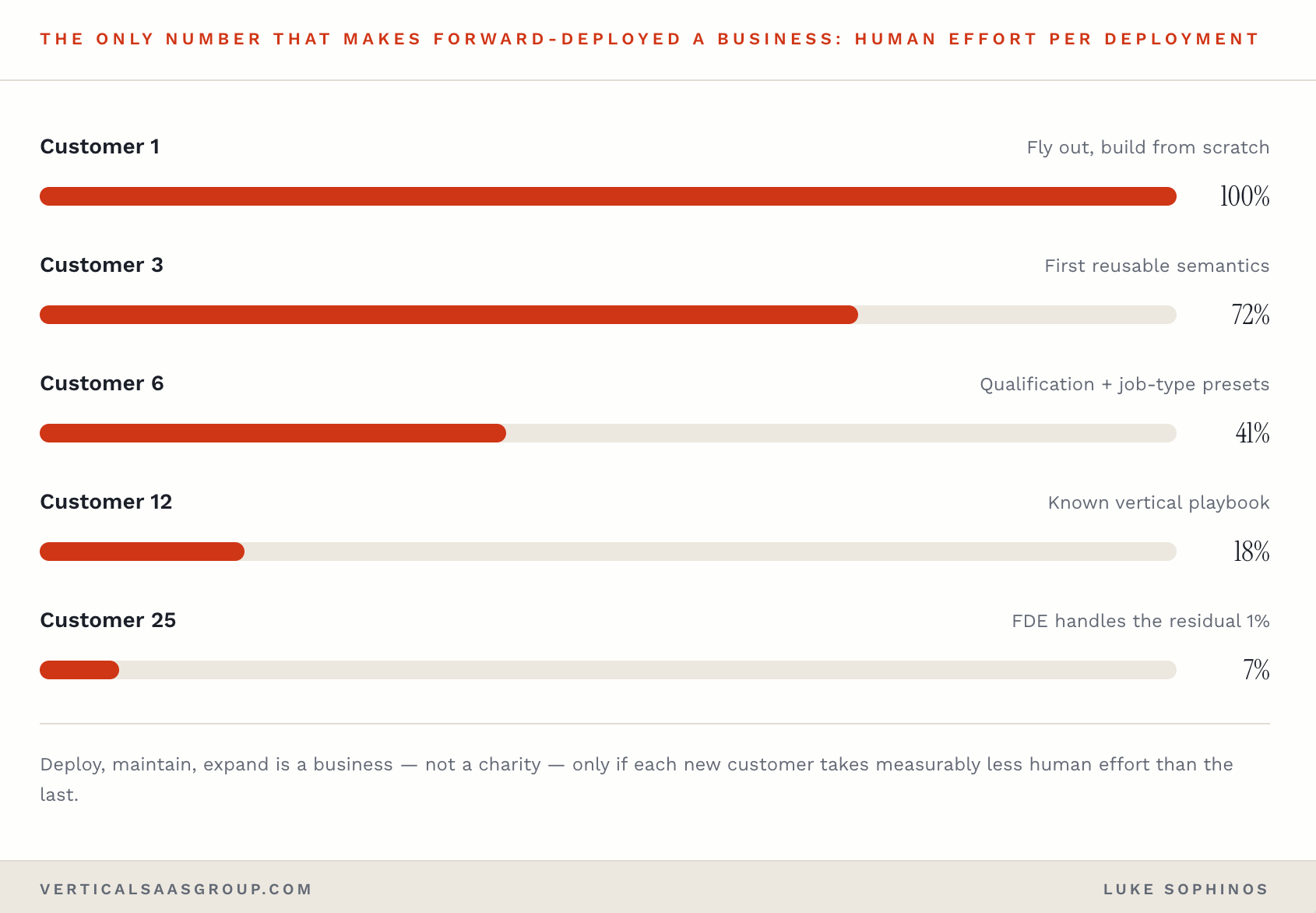
The FDE role is getting less technical — and that is fine.
Teams are already using the term “AI deployment strategist,” and Revin’s newest FDEs are less and less technical. The core requirements: really smart product thinkers who can talk hand in hand with a customer, because they are embedded in the trenches. Quinn expects a wave of startups building internal tooling for this motion, which eventually lets the role migrate toward a CSM shell. The jobs-to-be-done don’t change — deployment, trust-building, feeding signal back to product — but the profile is shifting from engineer to operator.
Sell the person, not just the product.
Buyers of vertical AI are starting to demand it: “I don’t want to be your guinea pig. Who am I working with day to day?” Operators want to meet their deployment counterpart before signing, because they will change and improve these workflows together. Your FDE is now a sales asset. Show the operator the exact person who will sit in their trenches and perfect their workflows. If the motion is good, it sells itself. If it isn’t, your sales cycle will find out.
Stake out the action layer, and don’t stab the system of record bear.
For 20 years in home services, humans were the action layer. They interacted with a system of record, performed a task, and either automation pumped the data back or they copy-pasted it themselves. In the agentic era, the agent is the system of action. Quinn’s read: own the workflow and you win. It is the lifeblood of the business, and it matters relatively less where the data lives. And critically: do not announce you are now a field service management tool. The Podium/ServiceTitan blowup is the cautionary tale — Podium spent 18 months building a competitive FSM product, refused marketplace terms, and got shut off. Revin’s stance: be a great integration partner, pipe data back into the system of record, stay clear of the bear. If you own the action, you own the monetizable moment.

A quick word from our sponsor on the Verticals podcast, Parafin. Fresh off the 2026 Forbes Fintech 50 and a new credit facility led by Goldman Sachs, they’ve now extended over $35B in offers to small businesses through platforms like DoorDash, Gusto, and TikTok Shop.
Purpose-built embedded capital for vertical platforms.
In low-ACV markets, the product has to be the answer — not more FDEs.
The uncomfortable question for anyone with a $5K ACV product: why does this need humans to embed it into companies that won’t pay enough to make the math work? If the buyer can’t pay for the deployment, the product has to get to a place where it doesn’t need one. Quinn’s first question to low-ACV teams is always, “Why is it so low, and what else could you provide that increases their outcomes?” And Nick’s corollary: the gap between “handles 90% of the workflow but you still log in” and “handles it soup to nuts” is enormous — $10–20K versus $100K, because offloading an entire process carries a major premium. If software ACV can’t grow, count the payments and transactional revenue attached to actions. The revenue is there; it’s just not in the SaaS line item.
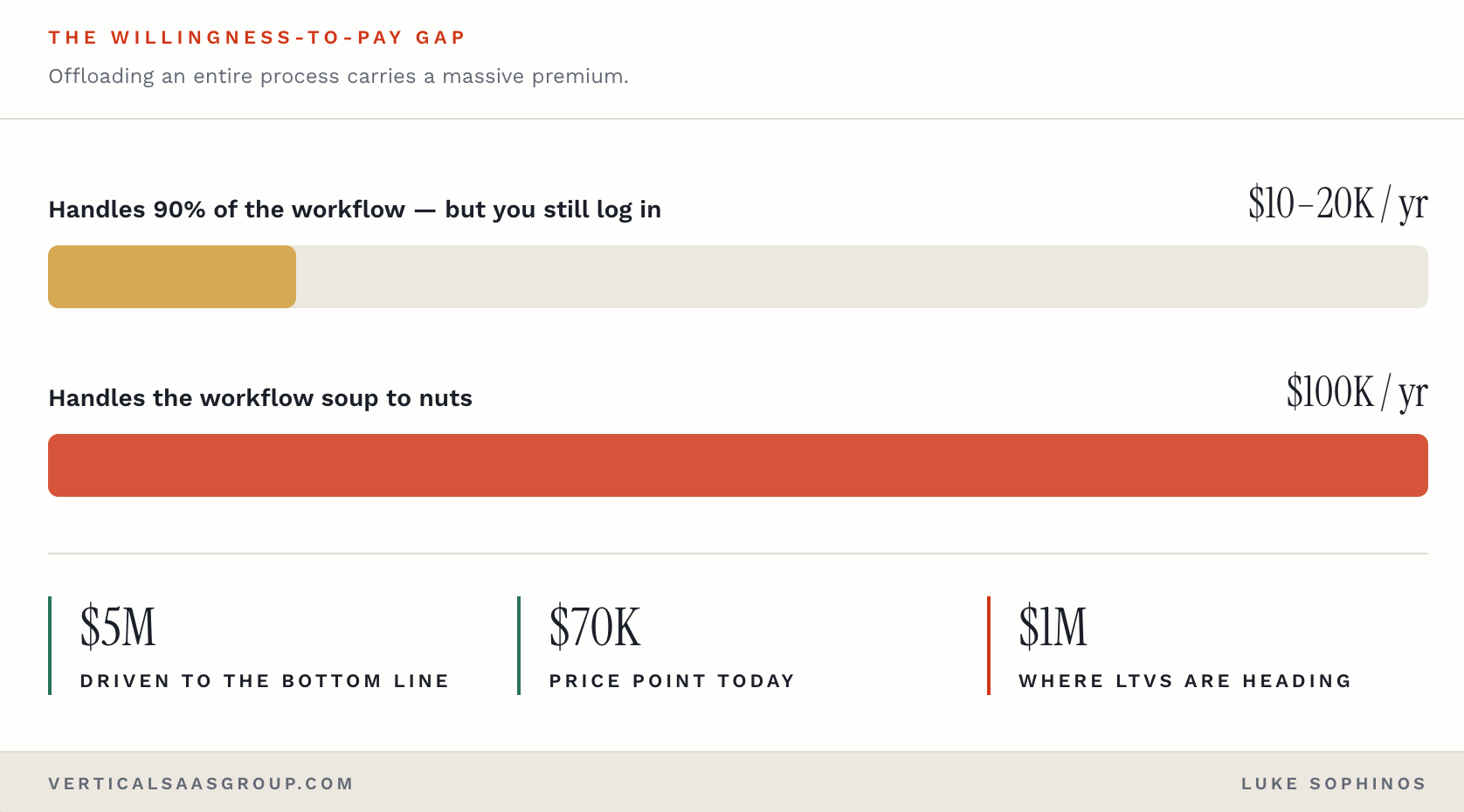
The throughline of this conversation is that the hard part of vertical AI was never the model. It’s the trust, the buy-in, and the dirty work of embedding your people into businesses that have run the same way for 30 years — and then converting all of that into repeatable product before the services trap swallows you.
Quinn’s bet is that the teams who do that painful work properly are the ones who win the next decade of vertical software. I think he is right for AI Native Services Companies. Handled well, the FDE motion isn’t a cost of doing business. It’s the moat.
If you are building anywhere the action layer is still run by humans, this episode is required listening. Watch it on The Verticals YouTube channel, and subscribe to the newsletter right here.
See you next Wednesday.
— Luke Sophinos
Thanks for reading LINEAR. I reply to every email…
Have any questions, feedback, comments? Let us know, we work for you!