

You’re running out of time!
Ticket prices go up September 1st, and may even run out by then. We are already 75% sold out so if you’re considering coming to the Vertical Software Summit this November, now is the time to grab your ticket!
All information at the link below.
It’s truly the best few days of the year in vertical software and vertical AI.
Underwrite the platform.
Own what nobody wrote down.
Most VCs in the country have a thesis on vertical software and vertical AI. Which translates to them essentially making educated bets. Sahil Poddar isn’t. As the co-founder and CEO of Parafin, he powers embedded capital inside some of the largest platforms on earth — DoorDash, Worldpay, Mindbody, Amazon, Gusto, and dozens more. That gives him one of the rarest seats in tech: he’s underwriting vertical software companies from the inside. He sees which platforms compound, which stall, which have real merchant lock-in, and which are one AI cycle away from being replaced.
This week’s conversation is the closest thing you’ll get to a live scan of the vertical SaaS ecosystem — what separates the great platforms from the median ones, why sequencing into financial services matters more than ambition, how AI is quietly rewriting underwriting and moats, and why “blue-collar” vertical software might be the most defensible category left standing. If you build, invest in, or sell into vertical software, this one’s essential reading.
Three things in this conversation should change how founders and investors work:
First, distribution — the thing that decides whether a vertical fintech line ever pencils: direct-to-SMB is a graveyard and embedded is the unlock. Marketing a loan selects for the borrowers you least want. Pushing a pre-approved offer through the platform a merchant already opens every morning selects for the ones you do — and hands you granular transaction data to underwrite with instead of a personal credit score.
Second, the separator between best-in-class vertical SaaS and the median: the great platforms act as collective bargaining agents for their merchants. They negotiate payments and capital on behalf of thousands of small businesses and repackage the result as a core service. The merchant data shows the payoff — a hard split between the one-to-two feature cohort and the six-plus feature cohort, with financing very often the stepping stone across.
Third, the moat question every vertical software board is asking wrong. If everything worth knowing about your industry is written in a document an AI can read, AI is coming for it. Legal, finance, accounting — exposed. Pizza shops, home services, anything running on knowledge that only exists in practice — defensible, and even more so once you move past pure software into capital, supply and physical goods.
This Weeks Vertical Titan:
Sahil Poddar (Co-Founder & CEO @ Parafin)
Sahil’s path is not the standard fintech founder arc. He grew up in a small-business family in India, then went deep on the sciences — bachelor’s, master’s, and eventually a PhD in particle physics. That work pulled him into data science, which pulled him into Meta, and then — somewhat serendipitously — into Robinhood, where he built and led major pieces of the growth, revenue, payments, and risk infrastructure. It’s also where he met the co-founders he’d eventually start Parafin with.
What Sahil saw at Robinhood was a renaissance in consumer finance. You could download five or six apps from the App Store, move money instantly, and get a best-in-class experience. But he noticed the sector driving ~40% of the U.S. economy — small and medium businesses — was quietly being left behind. Payments had been digitized by Square and Stripe. Credit had not. SMBs had exactly two ways to fund growth: retained earnings or the debt markets. Equity wasn’t a realistic option. And the debt markets, in Sahil’s words, were unfair.
That’s the wedge Parafin was built on. But Sahil’s insight wasn’t just “lend to SMBs.” It was the opposite of the conventional playbook. He looked at the graveyard of direct-to-SMB lenders — Kabbage, BlueVine, OnDeck — and concluded the whole model was structurally broken: marketing-led acquisition attracts adverse selection, you end up competing on ad creative, you have zero proprietary data to underwrite on, and you lead with none of the trust that lending requires.
So Parafin flipped it. Instead of going direct, they went through the platforms — embedding capital inside the software that SMBs already trust, already live inside, and that already has asymmetric transaction data on them. DoorDash knows exactly how much Nic’s restaurant sold last quarter. Mindbody knows exactly how a yoga studio is trending. That data becomes the underwriting engine, and the platform becomes the distribution engine. The result: zero CAC, higher conversion, lower loss rates, and enterprise churn that has stayed at effectively zero since day one.
Today Parafin runs three products — working capital, BNPL, and platform-embedded financing — has built its own transformer model (Paraformer) for time-series credit analysis, and just shipped a bank-transaction AI system that can produce a credit limit from a single Plaid token. Their BNPL line — starting with Gusto for payroll deferral — is growing 3x faster than anything they’ve ever launched. He’s building the underwriting layer for the entire vertical software economy. And because of the seat he sits in, he can see the pattern behind every great vertical SaaS company operating today.
Live Workshop Tomorrow @ 4pm EST.
How to Build An Epic Customer Conference
If you aren’t yet doing a customer conference you should. No matter your size.
I would add seven figures of ARR every time we did it and I’m bringing on the exact guy who organized mine to teach us all how to knock it out of the park. Hope you’ll join us!
01. Act as the collective bargaining agent for your customers.
Across Parafin’s entire portfolio of platform partners, the single strongest predictor of a great vertical software company is this: it aggressively negotiates with vendors on behalf of its customer base — payments, lending, insurance, supplies, marketing. The harder the platform bargains, the more valuable it becomes to the SMB.
This is what makes a vertical platform look and feel like a franchise. The median platform negotiates to maximize its own take rate. The best ones negotiate to maximize what their customers get, and take the compounding retention that follows. It is the Costco instinct applied to vertical software.
Action item: Founders: in your next vendor negotiation, write down what your customer gets before what you get. If that list is shorter, you’re monetizing your base instead of representing it. Investors: this instinct is the cleanest qualitative separator between best-in-class vertical software and the median.
#02. The wedge gets you in. The feature stack keeps you there.
Every great vertical software company gets its foot in the door with one aha moment — one workflow, one wedge, one feature. But durability comes from stacking features over time until you are the operating system for that business.
Sahil’s data shows two clusters of customers forming on every platform: those using one or two features, and those using six or more. The 6+ cluster is where nearly all the LTV lives, and churn there is a fraction of the rest of the base. Growth is not a funnel problem — it’s a feature-depth problem.
Action item: pull your own feature-count histogram this week and manage to the 6+ cluster, not to logo count. Investors: ask any vertical platform for that distribution. The shape of it is the growth model.
#03. Sequence financial services with discipline, not ambition.
Sahil is blunt: if a platform has less than roughly $1B in payments volume, layering in lending usually doesn’t make sense yet. Parafin routinely turns platforms down and tells them to go make the core product better first.
Payments, then lending, then deeper embedded services is a ladder, not a menu. Your platform has to be sticky and scaled before it can be a distribution channel for capital. Otherwise a financing line is a press release attached to a thin base — and one that consumes the team’s attention at exactly the wrong moment.
Action item: don’t bolt on financial products until your core has the volume and retention to make them a channel rather than a distraction. Investors: ask for the sequencing ladder, not the ambition slide.
#04. Financial products are the on-ramp to your highest-LTV cohort.
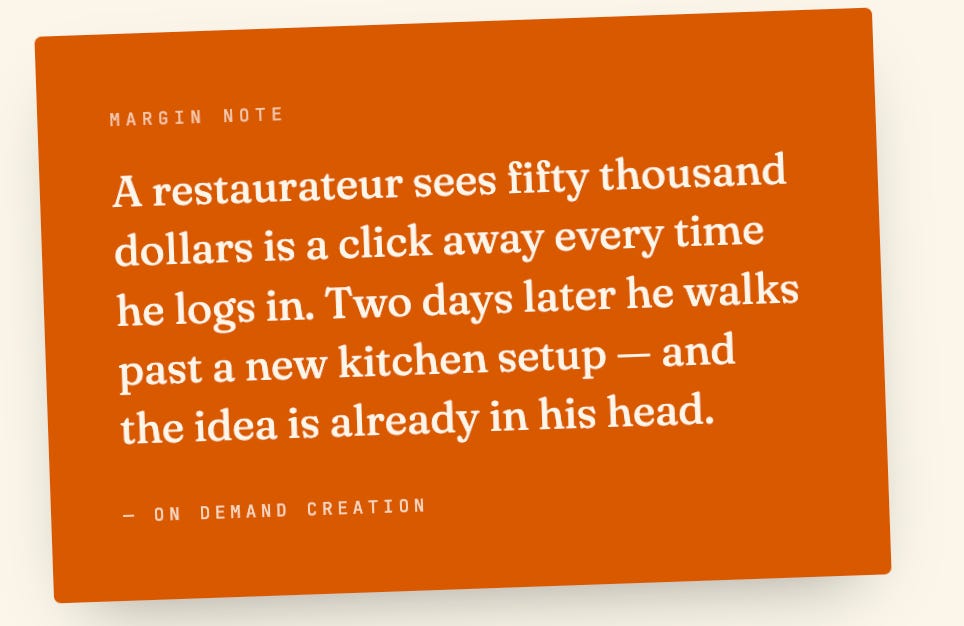
Once a customer takes capital through the platform, they adopt more products across the ecosystem — fast. Financing is one of the strongest gateway features in vertical software, not because of the spread, but because of what it does to the rest of the account.
The mental model shift is to stop treating embedded finance as a revenue line and start treating it as the fastest known path into the 6+ feature cluster. Priced that way, the decision changes: you optimize for adoption and trust, not take rate.
Action item: measure your financial products by downstream feature adoption and retention, not by their standalone margin. Investors: ask what happens to net revenue retention after a customer’s first capital event.

A quick word from our sponsor on the Verticals podcast, Parafin. Fresh off the 2026 Forbes Fintech 50 and a new credit facility led by Goldman Sachs, they’ve now extended over $35B in offers to small businesses through platforms like DoorDash, Gusto, and TikTok Shop.
Purpose-built embedded capital for vertical platforms.
#05. Sell the MVP. Then delight into the expansion.
One of the sharpest lessons from Parafin’s early enterprise wins: always sell the smallest version of the product that still delivers real value. If the buyer will pay for the MVP, everything you build on top becomes delight instead of obligation.
Luke shared the inverse — an early $1M ACV deal where he oversold, promised the world, and spent years rebuilding trust. Overselling a whale is a debt that compounds at a punishing rate, and you pay it back in the exact quarters you needed for building.
Action item: strike every unbuilt feature from the enterprise deck. If the deal dies without them, you have a hypothesis with a contract attached, not a wedge. Investors: ask what shipped on the day of signature, not what’s on the roadmap.
#06. Enterprise sales works best when it’s cerebral, not aggressive.
Parafin has won some of the biggest logos on earth with what Sahil calls a ‘very cerebral, non-salesy’ motion: lead with data, lead with analytics, and be willing to say ‘you might not be ready for this yet.’
That intellectual honesty compounds. In enterprise, being the party willing to walk away wins more deals than being the party willing to promise anything. In a market saturated with AI-generated outreach, the scarce asset is a human who will tell a buyer the truth about their own numbers.
Action item: put one honest disqualifying sentence in your next enterprise pitch — the deals you lose to it were never going to activate anyway. Investors: signed logos are not the milestone in vertical software. Activation is.
#07. When your first whale asks you to jump, jump — but never go single-threaded.
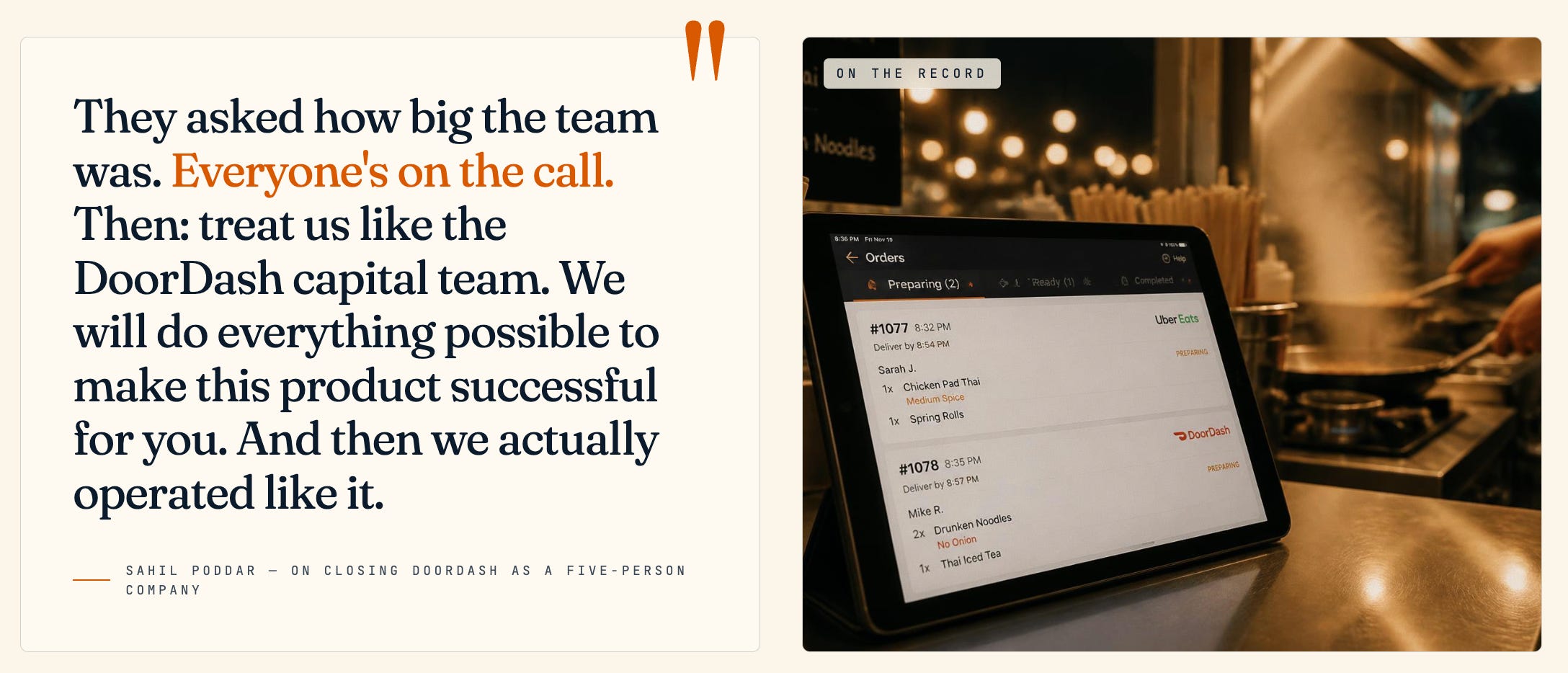
Parafin’s first partner was a public DoorDash. On the deciding call, DoorDash asked how big the team was. Sahil answered, ‘Everyone’s on the call.’ Five people. They won by moving faster than any incumbent could.
In parallel they landed partners across other verticals so they were never dependent on one relationship. Balance founder-mode intensity with the discipline of a second and third thread — big partners go quiet for reasons that have nothing to do with you: a reorg, a roadmap freeze, a new CFO.
Action item: pull out every stop for the whale, and keep two other flagship accounts in flight so no single partner’s pause becomes your pause. Investors: concentration isn’t automatically a red flag — an idle roadmap caused by concentration is.
#08. Increase your surface area for luck.
Every early-stage vertical business has a cold-start problem. Sahil’s solution was volume of exposure: talk to as many prospective partners as humanly possible, show up with the most compelling product flow in the room, and give them zero reasons to say no.
Not a deck — a working flow. Absorb the feedback, tighten it, and run it again. Luck in a vertical market is mostly a function of pipeline density and the quality of what you put in front of people.
Action item: count your live prospect conversations this quarter. Under twenty and your problem isn’t conversion, it’s exposure. Investors: at inception stage, surface area and follow-through are the two signals you can actually underwrite.
#09. Your moat is what AI can’t learn from a document.
Sahil’s test is the sharpest moat question in vertical software right now: is your industry’s knowledge written down? If the expertise lives in manuals, statutes, and documentation, a model can absorb it and the software layer gets commoditized. If it lives in practice, relationships, and undocumented judgment, you have time.
Screen time is the second axis. Verticals where the operator lives in software all day are the most exposed to a generalized interface; verticals where the work happens off-screen are harder to reach. Score yourself honestly on both.
Action item: ask whether your value is institutionalized in documents or embedded in practice — if it’s written down, you need a layer beyond software. Investors: this is the best one-question screen for a vertical portfolio today.
#10. Insights are cheap. Actions are the product.
Parafin explicitly declined to build an ‘AI financial insights’ product. Their view: an insight without an action isn’t enough. What changes with modern AI is that the model can now take the action — tool calling, agentic payments, computer use — and that’s the moment there’s a real product instead of a dashboard.
Their filter for every AI idea is two gates: does it save the customer time or money by completing a task, and does the company have a genuine right to win in that category? Most ideas fail one or both. Meanwhile the highest-return AI work has been pointed at the core — underwriting, fraud, reconciliation, projections.
Action item: run every AI roadmap item through both gates and kill anything that clears only one; build the action, not the dashboard. Investors: ‘right to win’ is the question most vertical AI decks never answer.
Underwrite the platform, not just the merchant.
Do the task, not the dashboard. Own what nobody wrote down.
Four things worth taping to the wall — whether you’re operating a vertical platform or underwriting one:
1. Distribution through the workflow owner changes the business. Founders get a better borrower pool, better conversion, better loss rates and data no direct competitor can see. Investors should treat that as a different business model, not a cheaper CAC line.
2. Embedding means data flows in. If the user has to leave, apply cold and maybe get rejected, you built a worse version of direct inside someone else’s product. It’s the fastest way to tell a real integration from a partnership press release.
3. AI has to complete the task, and you need a right to win it. Insight is table stakes and worth nothing on its own. Most vertical AI roadmaps clear the first gate and quietly fail the second.
4. The moat test is whether the knowledge is written down. Documented industries are exposed. Practice-based, physical, off-screen industries are defensible — and get more defensible the further past pure software you go. Score every vertical in your portfolio or your roadmap on that single axis.
If there’s a single through-line to steal from Sahil this week, it’s this: the best vertical software companies act like franchises, negotiate like collectives, sequence financial services with discipline, and build moats in the parts of the business AI can’t read from a document. That’s the compounding formula.
Big thanks to Sahil for opening up the Parafin learnings to the rest of us. If you’re building or backing the workflow layer, the capital layer, or the AI layer of a vertical, this episode is required listening. Forward it to a founder or an investor in vertical software — and if you’re building something interesting in the space, my inbox is open.
See you next Wednesday.
— Luke Sophinos
Thanks for reading LINEAR. I reply to every email…
Have any questions, feedback, comments? Let us know, we work for you!