

Today’s newsletter is sponsored by Xplor Pay.
Artificial intelligence is changing how software is built, customer expectations are evolving, and investors are rethinking what creates long-term enterprise value.

Join Xplor Pay and Luke Sophinos, Founder of Vertical SaaS Group, for an executive discussion exploring how AI, workflow ownership, platform strategy, and financial capabilities are reshaping the future of vertical SaaS. Register today and reserve your spot.
Business-in-a-box / digital franchise
A fast primer on the model that makes the branding move possible.
Business-in-a-box vertical software is what happens when a founder stops asking “what workflow can I digitize” and starts asking “what does this operator actually need to run their entire business.” The answer is almost never just software. It is software plus services plus supplies plus payments plus marketing, delivered as one relationship.
Think of it as a digital franchise. All the operational infrastructure and scale advantages of a franchise, without the royalties, the brand handover, or the loss of independence. The operator keeps their name, their storefront, and their profits. The platform provides everything else.
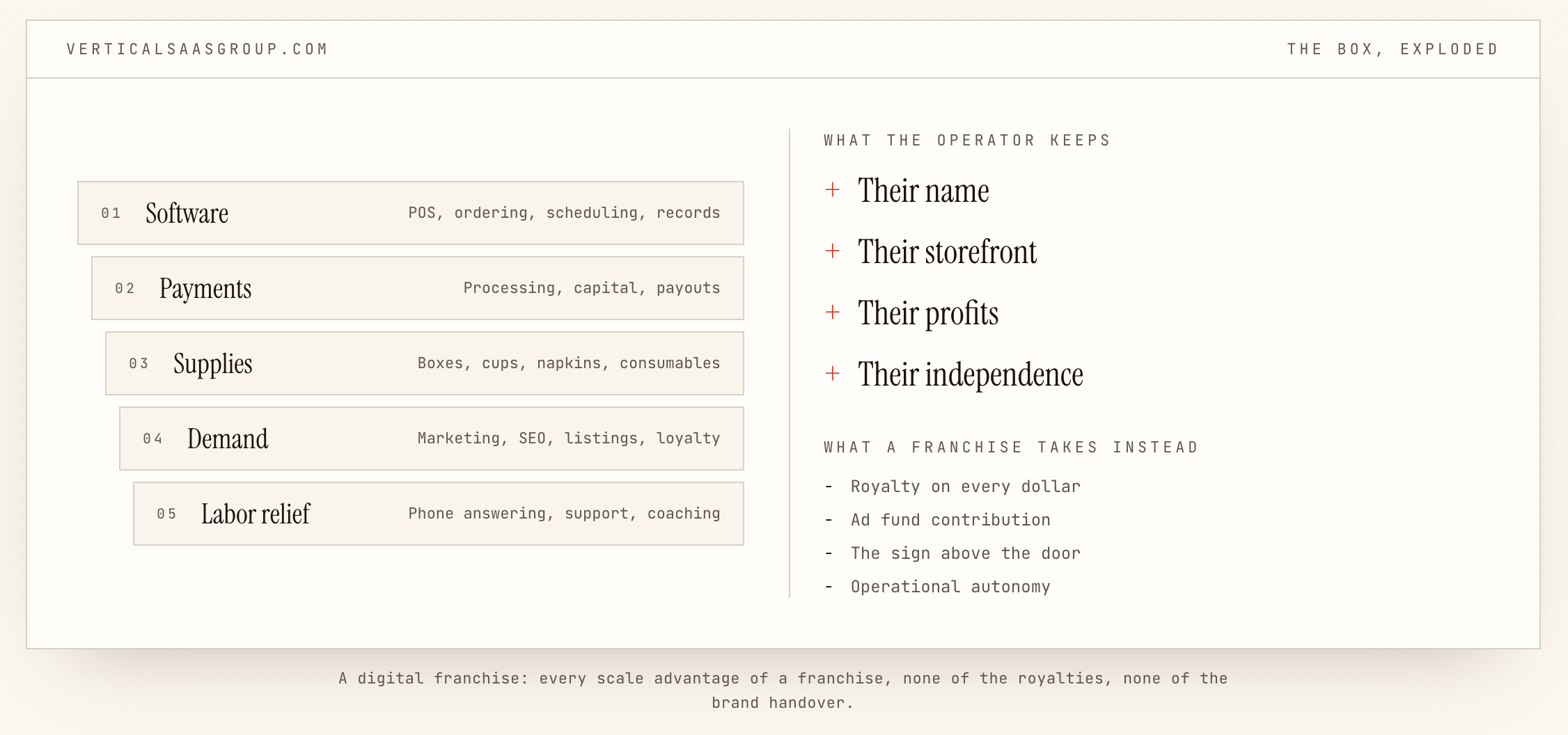
Slice does this for independent pizzerias. Moxie does this for solo medspas. Odeko does this for coffee shops. Cents does this for laundromats. Each one earned the account with software, then followed the operator’s real spend into every non-software line they could serve.
That is the model.
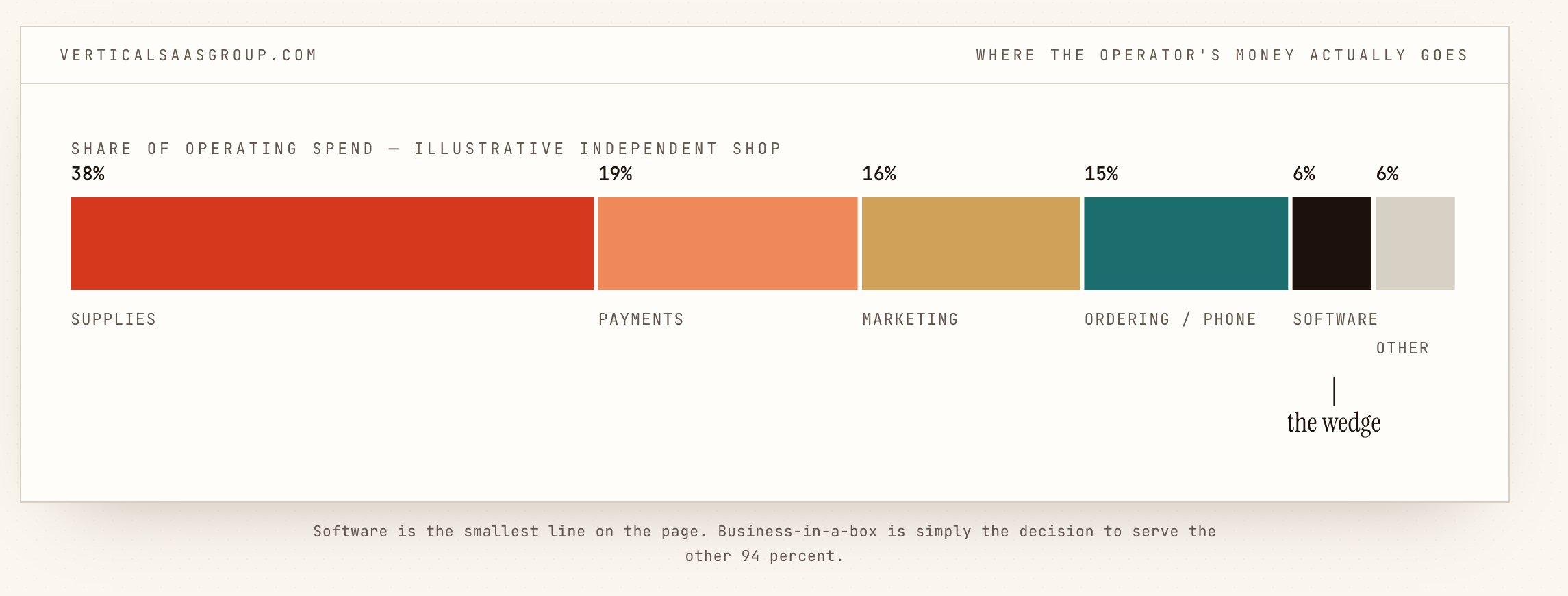
Now here is the part almost nobody talks about…
You’re running out of time for the 2026 Vertical Software Summit. Tickets are close to 80% sold out! We’ll have 350+ vertical founders/operators/investors in Miami in November. If you need a free ticket let us know and we will get you one!
6+ billion dollar Vertical Founders/CEOs.
The Vertical AI event of the year.
Once you own the whole stack, you get to change who you compete against.
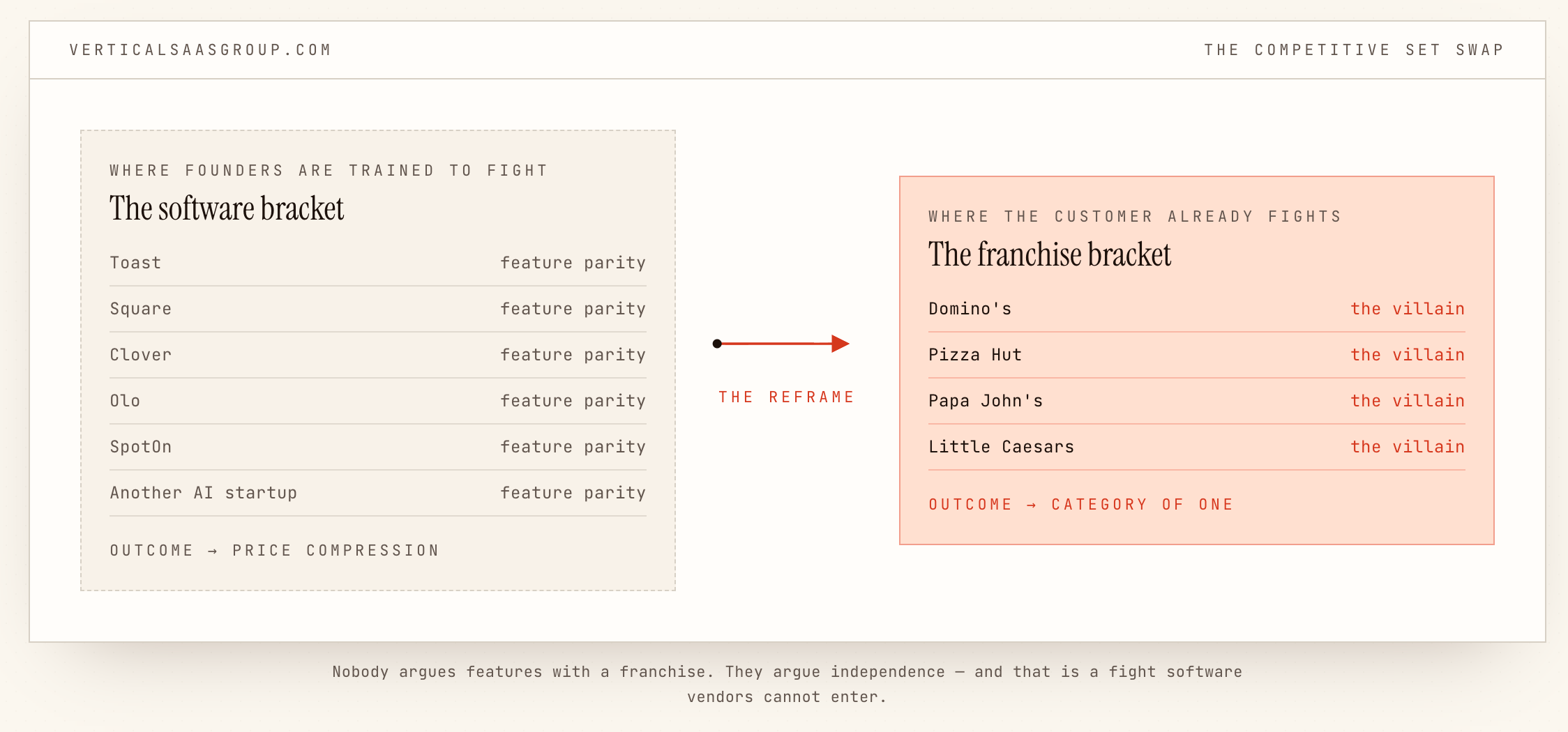
Slice is the clearest example in vertical software history, and almost no one credits them for it. They do not position against Toast. They do not position against Square. They do not position against Silicon Valley AI. They position against Domino’s and Pizza Hut.
Read that again.
Their entire market story is “we give independent pizzerias everything the chains have, without making you sell your soul, your brand, your storefront, or half your profits to a franchisor.” That single framing does more work than any feature list ever could.
Look at what that positioning unlocks:
I. It reframes the buyer’s mental model
An independent pizza shop owner does not wake up shopping for POS software. They wake up watching a Domino’s open two blocks away and wondering how to survive. Slice walks in and says we are your answer to that, not another vendor.
II. It reframes the competitive set
When you compete against a franchise, features stop mattering. What matters is independence, brand ownership, margin retention, and dignity. Those are not things a POS competitor can counter-position against. They are structural.
III. It reframes pricing
If the alternative is handing over royalties plus marketing fees plus giving up your name, a monthly software fee plus supply attachment looks like a gift. You are no longer priced against SaaS. You are priced against franchise economics.
IV. It reframes retention
Customers do not churn from the thing keeping them independent. They churn from vendors. Slice is not a vendor. Slice is the reason they still own their business.
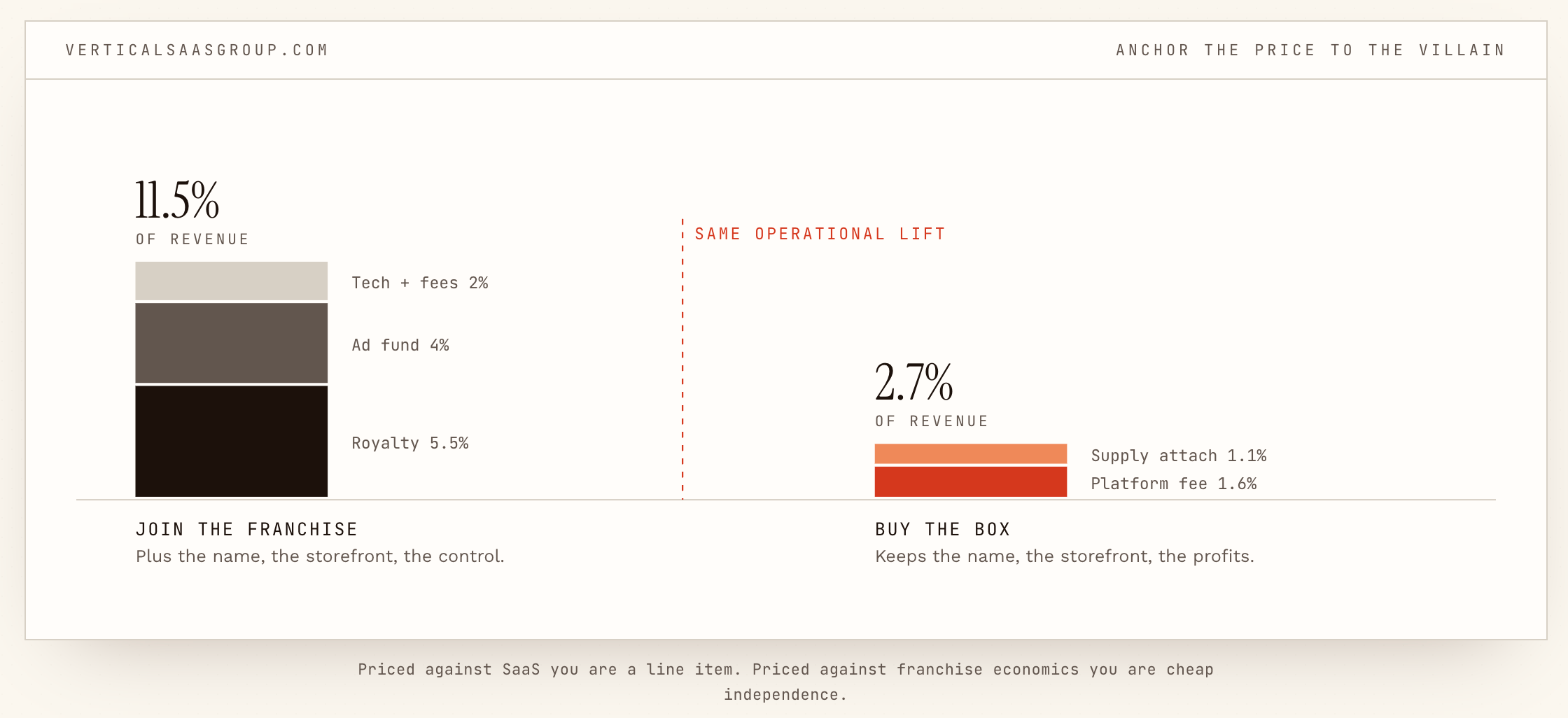
This is the branding move that turns a vertical SaaS company into a movement. And it only works because they own the full stack. If Slice were just software, the Domino’s comparison would sound absurd. Because they own software, supplies, ordering, marketing, and phone, the comparison is real.
Build the box, then use the box to move yourself into a category of one.

How to pull off the branding move in your own vertical
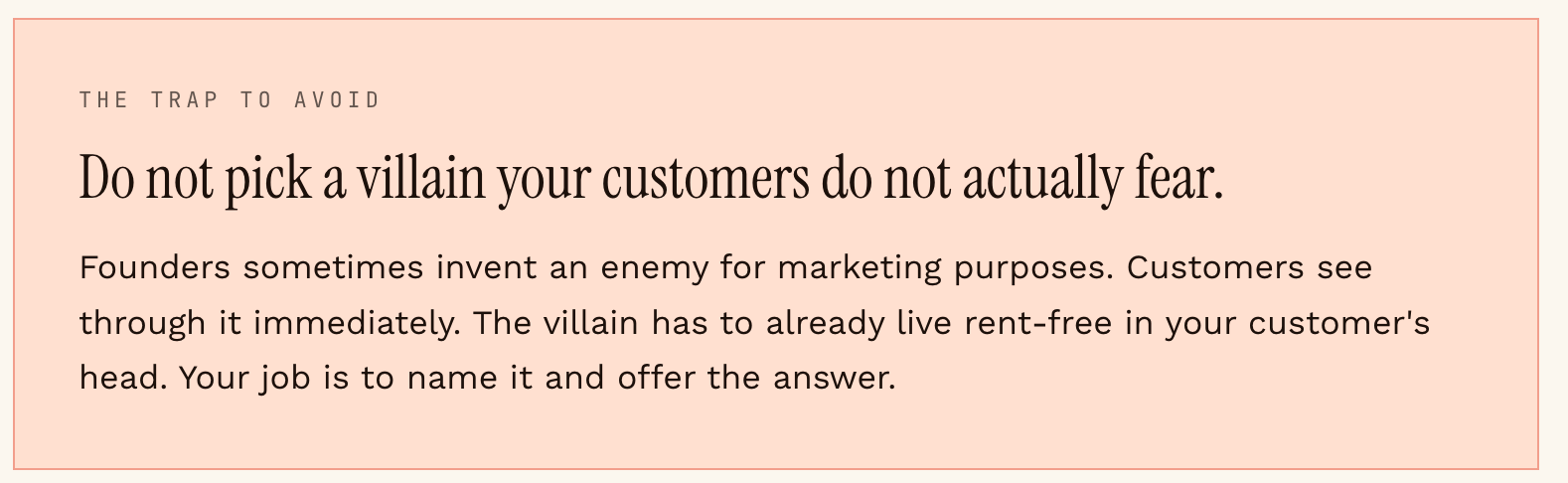
Most founders never attempt it because they were trained to position against other software. Wrong instinct.
Step one — find the villain your customers already fear
Not the software competitor. The real-world threat. For pizzerias it was Domino’s. For solo medspas it is corporate chains and franchise aesthetics groups. For independent coffee shops it is Starbucks. For laundromats it is national laundry brands and gig-delivery platforms. Ask ten customers what keeps them up at night. The villain is in that answer, not in your competitive matrix.
Step two — earn the right to make the comparison
You cannot say “we are your answer to Domino’s” if all you sell is a scheduling app. The claim has to be backed by the stack. Supplies, marketing, ordering, payments, phone. The more of the operating surface you own, the more credible the comparison becomes. This is why the branding move requires the business-in-a-box underneath it. One without the other collapses.
Step three — write the story in franchise terms, not software terms
Do not talk about features. Talk about what a franchise gives an operator and how you deliver the same thing without the handover. Scale. Brand support. Marketing power. Operational leverage. Then close with what you do not take. Their name. Their profits. Their independence.
Step four — price against the villain, not against SaaS
The moment you anchor pricing to franchise economics instead of software economics, your ACV ceiling changes. A pizza shop paying 8 percent of revenue to a franchisor will happily pay you a fraction of that for the same operational lift. You are not expensive software. You are cheap independence.
Step five — make the story public
The branding move is not an internal deck. It is the homepage. It is the sales pitch. It is the founder’s every podcast appearance. Slice does not hide the Domino’s framing. They lead with it. That repetition compounds into category ownership.

The shortlist, and how each one is approaching the move
The best way to see how this move works in practice is to look at operators who are already inside the businesses they serve. Not all of them have completed the branding move. Some are still building the box. Others have the box but have not yet named the villain with conviction. That gap is what creates the opportunity.
Each company below earned its first customer with software. Then it followed the money. Supplies, payments, marketing, ordering, logistics — whatever the operator was already spending on and doing badly. The question now is whether they complete the final step and tell the market, clearly, who they are really against.
The scorecard tracks two things. Stack depth: how much of the operating surface the company owns. Branding move: how explicitly they have named the villain and reframed the competitive set. The first gets you to scale. The second gets you to a category of one.
Slice
The reference case for the entire category. Software for independent pizzerias, plus boxes, cups, napkins, ordering, marketing, and phone answering. Positions explicitly against Domino’s and Pizza Hut. The message is not “better POS.” The message is “keep your shop, beat the chains.” No other vertical SaaS company has executed the branding move this cleanly.
We’re running a 60 minute webinar this Thursday at 4pm EST on…
How to Plan/Run an Epic Customer Conference
If you haven’t done one yet, they are a HUGE revenue unlock, no matter your stage…
Moxie
Medspa in a box. EHR, POS, scheduling, compliance tracking, discounted supplies, and business coaching. The branding move is emerging. They position against the loss of independence that comes with joining a corporate medspa group or franchise. The message is “own your practice, not someone else’s brand.”
Odeko
Coffee shop software plus supply delivery. The natural villain is Starbucks. The branding move is still underdeveloped here, and it is the single biggest storytelling opportunity left on the table for them.
Cents
Laundromat software running front-of-house, POS, pickup and delivery, and the operational layer for independent operators. The villain set is national laundry chains and gig-delivery platforms eating into local demand. The branding move is quietly forming.
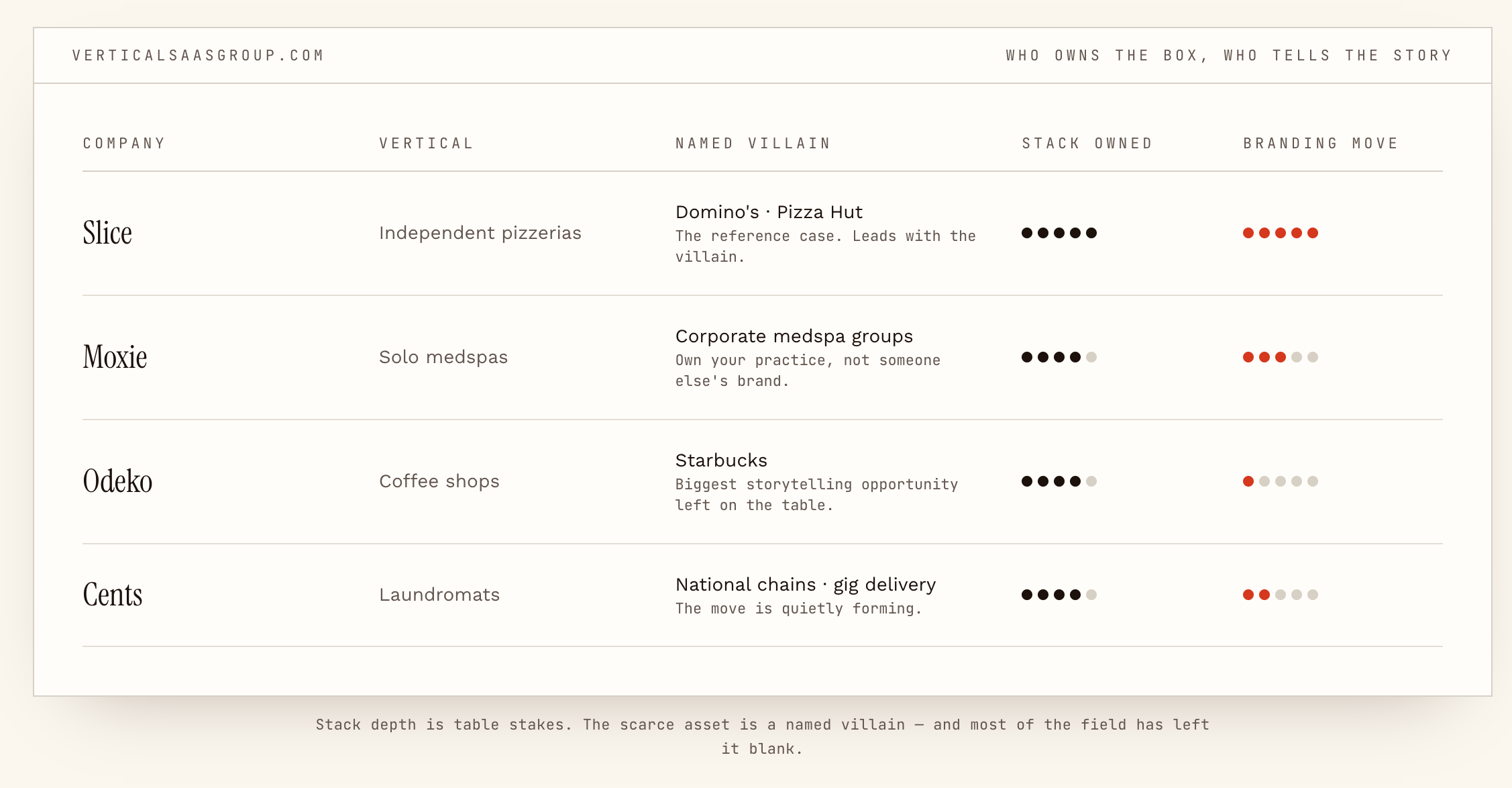
The pattern across every one of these companies is the same.
They earned the account with software, then followed the operator’s real spend into every non-software line they could serve. The ones that will compound the most from here are the ones that also name the villain and take the branding move seriously.
Slice figured out that the software was never the product. The product was independence. Everything else — boxes, ordering, marketing, phone — was just the delivery mechanism for that promise.
That is the lesson worth stealing.
The takeaway
The wedge. In an AI age, the software is the wedge. It gets you in the door and earns the trust that everything else is built on.
The company. The business around the software is the company. Supplies, payments, marketing, ordering, and services are the real operating surface that creates the relationship.
The moat. The villain you name is the moat. When you change who you compete against, you move outside the feature-versus-feature death spiral and into a category of one.
Build the whole box. Then tell your customers exactly who it is really for, and exactly who it is really against.
Do me a solid and forward to a friend :-)
Fantastic. So aligned with how I am thinking about the same in the vertical accounting space. The villian is an established and respected franchiser. My launch client, a legacy practice, is fully onboard with this and we are building it out step by step - marketing website, lead gen, CRM, proposals, engagement letters, billing, job management, filing/regulatory integrations, ledger, agents... the list goes on. Then when its proven (getting close) we setup an AI native accounting practice as a client owning the outcome. Tackling it from both angles. Honestly your direction on all of this over the past few months has been a game changer as I build out the strategy and platform.