

Today’s newsletter is sponsored by Xplor Pay.
Artificial intelligence is changing how software is built, customer expectations are evolving, and investors are rethinking what creates long-term enterprise value.

Join Xplor Pay and Luke Sophinos, Founder of Vertical SaaS Group, for an executive discussion exploring how AI, workflow ownership, platform strategy, and financial capabilities are reshaping the future of vertical SaaS. Register today and reserve your spot.
AI Roll Up Market Map: From Twitter to $4B & The Money Behind It
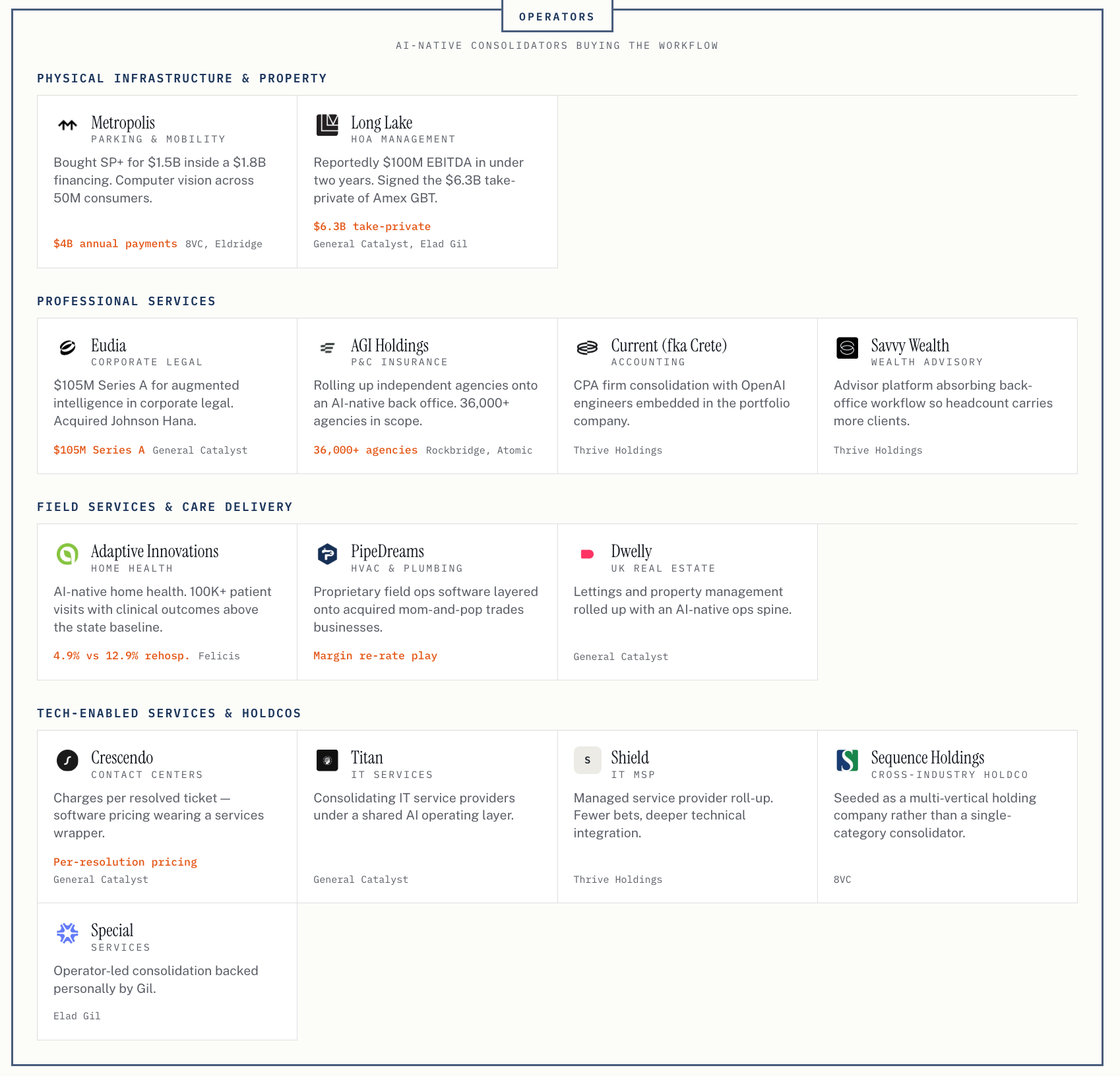
Twenty-four months ago the category did not have a name. Slow Ventures called them GBOs. A few operators were quietly rolling up service businesses and layering software on top. Matt Brown had a taxonomy. I was writing about M&A+SaaS and then Venture Buy Outs. Nobody agreed on anything. It was a Twitter thread and a Substack post.
A few of the operators worth knowing:
Then the platform funds moved.
General Catalyst built Creation, a $1.5B strategy dedicated to AI-enabled roll-ups. Ten publicly disclosed portfolio companies. Long Lake in HOA management. Eudia in legal. Titan in IT services. Crescendo in contact centers. Dwelly in UK real estate. The most systematic version of the play by a mile.
Thrive Holdings launched a $1B vehicle in April 2025 and by December had convinced OpenAI to take equity and embed engineers inside portfolio companies. Current (formerly Crete) in accounting. Savvy Wealth in advisory. Shield in IT MSP. Fewer bets, deeper integration.
8VC and Slow Ventures run leaner. 8VC backed Metropolis, seeded Sequence Holdings as a cross-industry holdco, and moved into stealth healthcare. Slow pioneered the low-upfront GBO model years before the category had a name.
a16z, Khosla, Bessemer, GV, Elad Gil, Felicis, Rockbridge, Bain all layered in over the last twelve months. Gil personally backed Long Lake and Special. Felicis led Adaptive Innovations in home health. Rockbridge co-backed AGI with Atomic. Bain is running a payer-focused merger in healthcare AI.
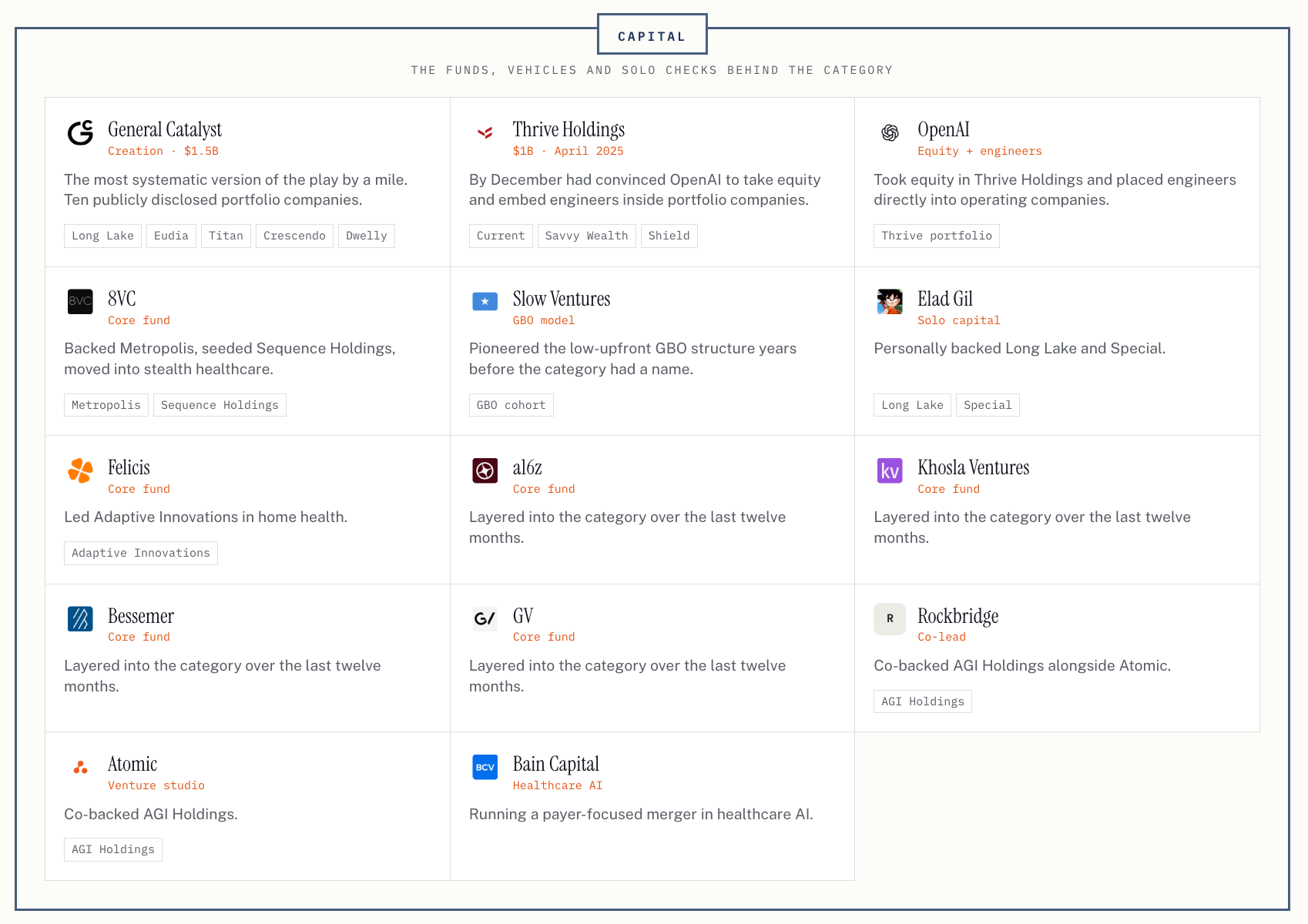
The pattern is simple. Twenty-four months ago this was six firms and a Substack. Today it is every top-tier venture firm plus most of the mid-market PE world plus a growing set of family offices and sovereigns.
The traditional PE-vs-VC boundary stopped mattering in this category. Both sides see the same thesis: labor-heavy services businesses, mispriced by traditional PE, unreachable by traditional SaaS, and transformable by AI-native operators willing to own the workflow instead of selling to it.
Two years ago this was a tweet.
Crazy how fast all of this moved…
If you’ve been reading the newsletter for a while and getting value out of it,
will you do me a really quick favor? A <5 minute favor to be exact…
I’m launching The State of Vertical AI: 2026 H2 Benchmark Survey.
It will be the definitive guide on how vertical software and vertical AI companies are actually building, monetizing, and scaling AI -- specifically the pre/post AI performance cuts nobody else is publishing.
Survey is 100% anonymous, takes <5 minutes, and every founder who fills it out gets the
full report back and a free ticket to the Vertical Software Summit in November!
Click the image below to access it :-)

A sincere thank you in advance!

How an AI Roll-Up Actually Pencils as a Venture Investment
The instinct most VCs have when they hear “buy a services business” is to reach for the PE calculator. Buy at 4x EBITDA. Improve operations. Sell at 8x. Fine returns. Not venture returns.
That is not the underwrite. Here is the underwrite.
Start with the acquisition math. A $10M revenue services business at 15% EBITDA margins throws off $1.5M in cash. In accounting, pest control, or HVAC, that business trades at 3-4x EBITDA in the middle market. Call it $5M enterprise value.
Now layer the AI operating platform. Real deployments in accounting and IT services are absorbing 30-70% of labor tasks. Labor is 55-65% of the cost structure. If you compress even half of that headcount cost into automation, EBITDA moves from 15% to 35-40%. That $10M in revenue is now throwing off $3.5M-$4M, not $1.5M.
You did not fire the humans. You let each of them carry 2-3x the client load, which solves the chronic labor shortage that was capping revenue growth in the first place. Revenue grows into the capacity. Now you have $15M in revenue at 40% margins. $6M in EBITDA on a business you bought for $5M.
Then repeat. Tuck in five more platforms of the same size at the same multiples. You now own a $60M revenue, $24M EBITDA operating business. Total equity deployed: roughly $30M plus some acquisition debt.
Now the part everyone misses.
Once you have run the AI platform across six acquired businesses, you no longer just have a services operator. You have a productized system. The workflows are standardized. The models are trained on real proprietary data. The compliance posture is defensible because you actually operate inside the regulated category.
That is when you launch the lightweight B2B product.
Take legal as the cleanest example. You roll up six mid-market law firms. You massively improve their throughput with an internal AI platform. Then you launch a B2B legal AI assistant to every business in America, priced at SaaS-like ACV, backed by the fact that your own licensed attorneys sit behind it for anything that requires actual practice of law.
Every horizontal legal AI startup gets stuck at the same wall: they cannot practice law, so they cannot close the loop. You can. Because you own the firms. The moat is not the model. The moat is the license, the data, and the operational spine underneath the software.
Now your $60M services business has a second revenue line: a $10M ARR B2B product growing at 200% a year, sold into a market ten times larger than the acquired firms could ever serve directly.
Do the same in accounting. Roll up CPAs, then launch an embedded AI accounting product for every SMB in America, backstopped by your own licensed accountants. Same play in insurance: roll up brokers, launch an AI insurance advisor with a real E&O policy and real licenses behind it. Same in home services: consolidate HVAC operators, then license the dispatch and diagnostics platform to independent shops nationwide.
The services business funds itself. The productized SaaS layer is the venture outcome.
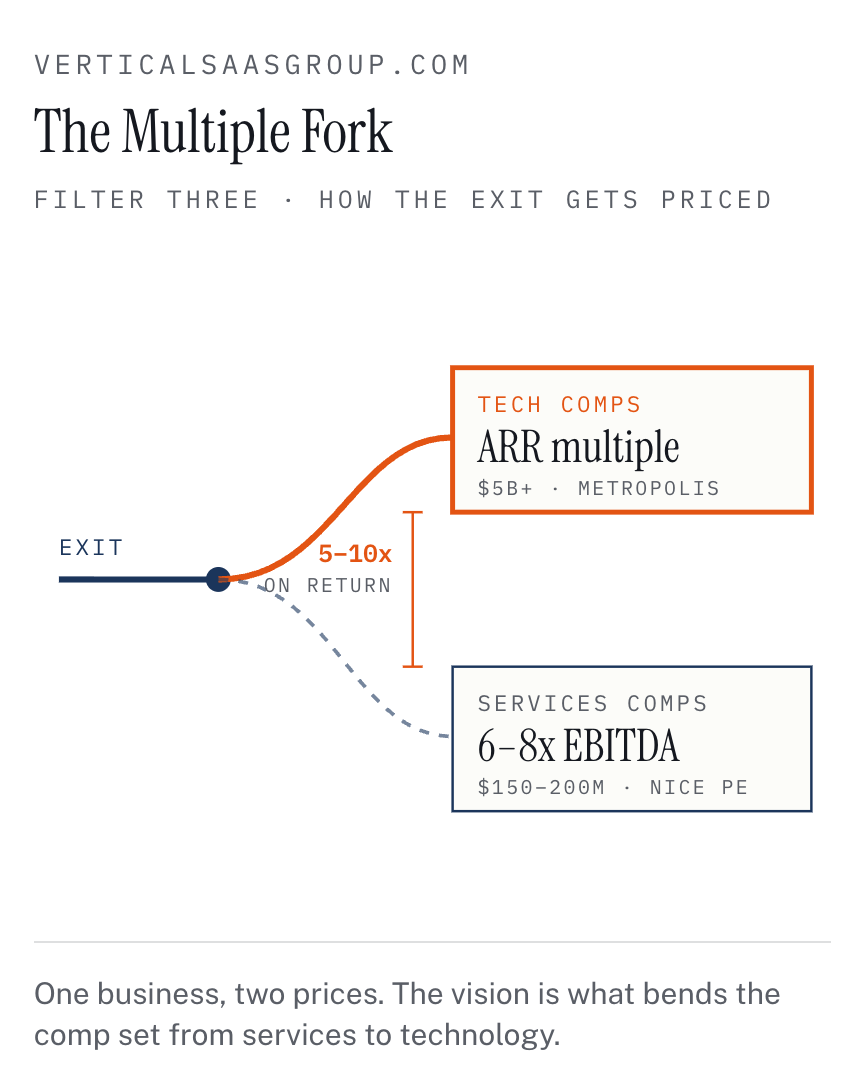
The re-rate is where venture math actually shows up. Traditional services businesses trade at 6-8x EBITDA at exit. That gets you a $150M-$200M outcome. Fine. Not venture.
But AI-native operators that have crossed into productized software are being valued on a blended framework. The services revenue at services multiples. The B2B product at ARR multiples. Metropolis was valued at $5B+ before the SP+ deal closed. Long Lake reportedly cleared $100M in EBITDA and is being marked at software-like multiples. Crescendo is charging per resolved ticket, which is functionally software pricing dressed in a services wrapper.
Uber is a decent analogy. Uber was not valued like a taxi medallion company. It was valued as a technology platform that happened to own the workflow of moving humans through cities. The medallion comps said $2B. The tech comps said $60B.
Same trick. Different decade.
An AI roll-up hits venture math when three things converge: proprietary technology deep enough to defend the margin gains, a productized second act that reaches beyond the acquired footprint, and a narrative arc credible enough that the exit market prices the business as tech instead of services.
Miss any of the three and you have PE. Get all three and you have Metropolis.

How to Spot the AI Roll-Ups Destined for Greatness
Three filters. In this order.
One. The team is a triangle, not a solo act.
Every AI roll up worth backing has three roles staffed on day one. Miss any leg of the triangle and the company dies in a specific, predictable way.
The Forward Deployed Engineer builds the AI operating layer. Not fine tunes prompts. Not integrates SaaS. Actually builds proprietary systems that absorb workflow. This is the Palantir DNA the category runs on.
The PE/M&A operator underwrites deals, structures debt, and integrates acquisitions without blowing up culture. Nine out of ten founder led roll ups die here. They can build the tech and cannot close a deal, or they close deals and cannot integrate. Renovo Home Partners went bankrupt on exactly this failure mode.
The industry expert is the operator who ran a business in this vertical for 15 years and knows why the ugly workflow is actually ugly. Without this leg, the AI you build solves the wrong problem beautifully.
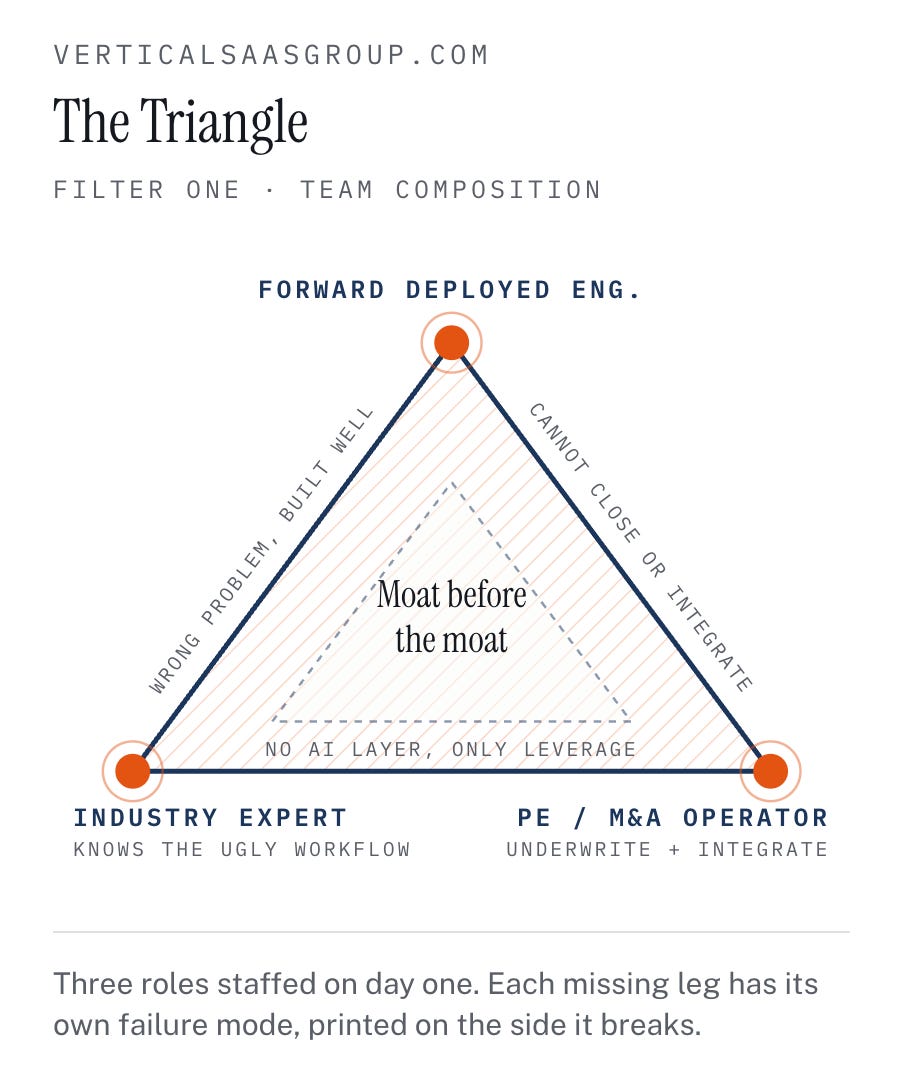
If the team is two engineers and a banker, pass. If the team is three operators without a builder, pass. The triangle is the moat before the moat.
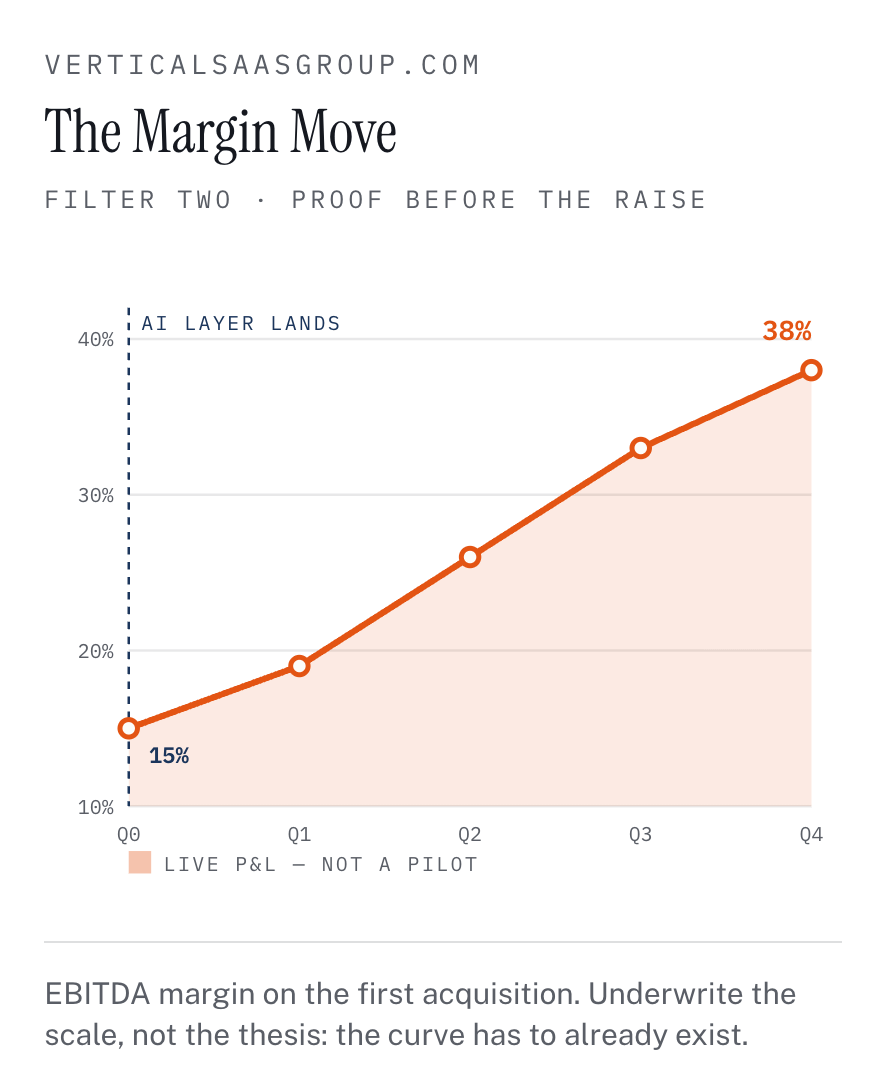
Two. The margin move already happened. On real customers. Before the raise.
The signal that separates real from theater is whether the AI platform has actually moved EBITDA in a live business.
Not a pilot. Not a case study. Live P&L, live customers, and a margin curve you can point to on a chart.
Long Lake did this. Adaptive is doing it in home health. Metropolis proved it at SP+ within four quarters. The founders who cannot show the margin move on their own first acquisition are asking you to underwrite the thesis. The founders who can are asking you to underwrite the scale.
Those are radically different risks. Only fund the second one.
If you made it thus far, go check out the 2026 Vertical Software Summit. We’ll have 350+ vertical founders/operators/investors in Miami in November. Two days,
6+ billion dollar vertical Founders/CEOs.
The Vertical AI event of the year.
Three. The vision is big enough to flip the multiple.
This is the least obvious filter and the most important.
Every AI roll up eventually faces one question at exit: does this get priced as a services business or as a technology platform? A 6x EBITDA multiple or a 10x revenue multiple? The gap between those two outcomes is 5 to 10x on your return.
The vision has to be big enough to bend the multiple. That means a category large enough that the endgame is category ownership, not category consolidation. A productized second act that reaches beyond the acquired footprint. A founder who talks about the business the way Kalanick talked about Uber, not the way a PE operator talks about a portco.
Ask the founder what the business looks like in ten years. If the answer sounds like “we will be the biggest player in dental billing,” that is a nice PE outcome. If the answer sounds like “we will roll up the firms, productize the platform, and sell the AI layer to every business in America,” you might have a re rate on your hands.
Both can make money. Only one makes venture money.
Two years ago this was a tweet. Today it is a category. Two years from now half the entrants will be gone and the survivors will be very large businesses.
Pick carefully.
Until next Sunday.
Luke
Do me a solid and forward to a friend :-)
well done Luke - great analysis and insight.