

Before we dive in today, we have a quick ask!
Fill out our 100% anonymous annual benchmark survey and get a FREE ticket to the Vertical Software Summit this November AND access to the report when it drops.
It will help all of us understand what is working in verticals, specifically around AI.
A quiet, structural rot….
Something is off in venture capital right now, and most people don’t want to say it out loud. Not in an obvious “bubble about to pop” way. More like a quiet structural rot; revenue multiples being applied to services businesses, GMV being called ARR, $100M valuations for companies that could be disrupted by two tokens from Anthropic, and a whole lot of capital looking for a home in anything that feels like a moat.
Meanwhile, at the early stage, according to Rick Zullo, there’s arguably more real opportunity than there’s ever been. Capital-efficient vertical companies are compounding quietly while the zeitgeist chases trillion-dollar outcomes.
This week, Nic sits down for a conversation with Rick Zullo, founder of Equal Ventures, that gets at this disconnect better than anything I’ve heard in a while. Rick runs a seed fund focused on four unsexy-but-enormous markets — insurance, supply chain, retail, and energy — and last year, somewhere between a third and half of his Fund 1 portfolio was free cash flow positive while still growing 100%+. Nobody’s putting that on a billboard. They should be.
This Weeks Vertical Titan:
Rick Zullo, Founder/GP of Equal Ventures
Rick’s path into venture is a classic operator-of-the-craft story. Consulting and private equity first, then an MBA at Columbia, where one of his early internships was at Bowery Capital — working for Nic Poulos, who interviewed him on this episode. Fourteen years later, he’s spent his entire career investing across vertical software, vertical marketplaces, and vertical services.
Eight years ago he started Equal Ventures. Today it’s a couple hundred million in committed capital, a few funds in, laser-focused on seed-stage investing in four markets: energy, insurance, retail, and supply chain.
What makes Rick interesting isn’t the fund. It’s more of his lens.
He describes himself as a value investor in a growth asset class — but he’s quick to clarify he’s not a Ben Graham “cigar butt” guy. He’s a Charlie Munger and Michael Mauboussin disciple. The translation: he’ll happily ride the J-curve and hemorrhage cash with a company for years, but only if the market structure and competitive dynamics suggest it can eventually build a durable moat and become a free cash flow monster. He spends more time thinking about moats before a company has shipped a line of code than most investors spend thinking about them at the Series B.
And that lens is exactly why he’s uncomfortable right now. Software used to have built-in defensibility — expensive to build, slow to ship, hard to distribute. Today, product has no moat, and a huge chunk of the market is investing in services businesses using software-era math. Rick thinks that ends badly for a lot of people. He’s not vague about it, and he’s usually armed with specifics.
He also has the receipts to back up the contrarian stance: a portfolio of “quiet compounders” throwing off real cash while growing triple digits, in a market that has decided those companies don’t matter because they can’t absorb a billion dollars.
Quick PSA:
~90 Days Until The Vertical Software Summit
DON’T WAIT. We are already 75% sold out.
If you want to be at the Vertical AI Event of the year where ~400 vertical software founders, operators, and investors come to gather, snag your ticket now.
The speaker line-up is a 10/10 and the entire investment community shows up.
We had to turn away 100+ folks last year who waited until the last few weeks to grab their ticket.
Don’t be that person who misses out!
01. Underwrite to monopolization potential, not product pull
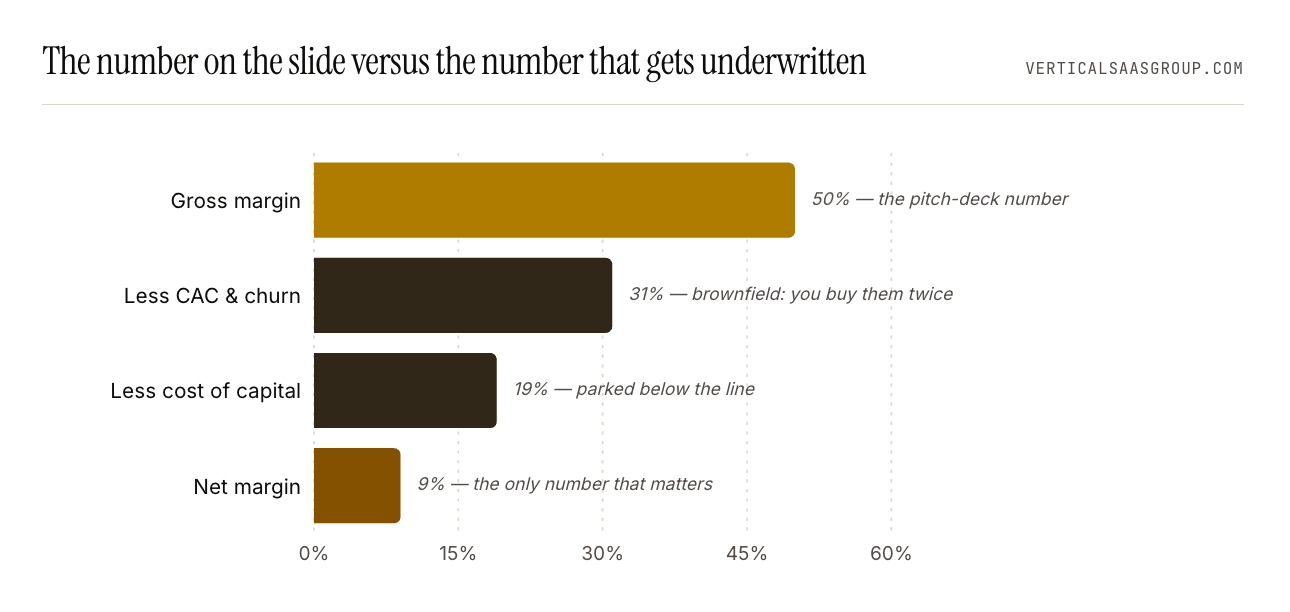
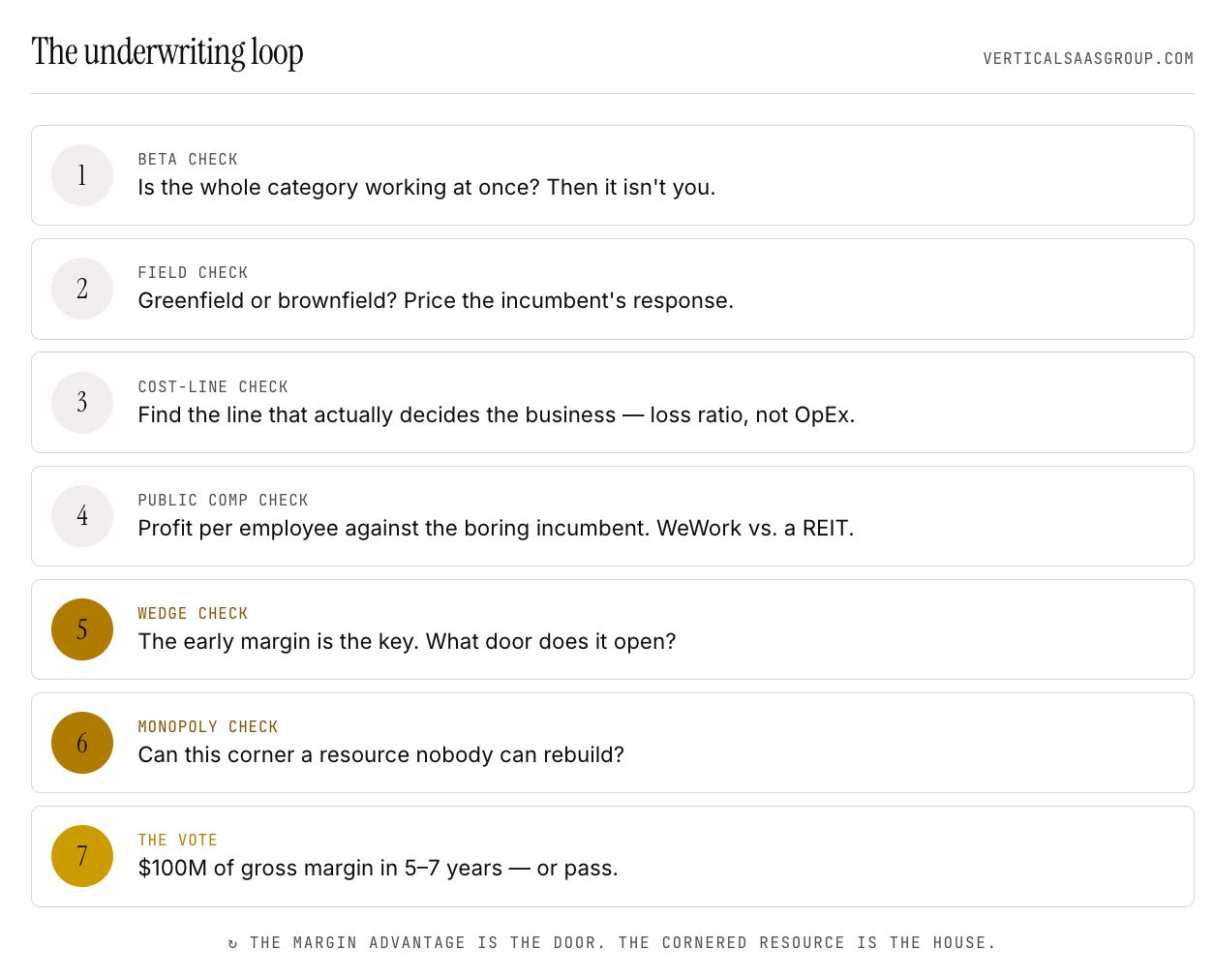
Revenue multiple investing in services has never worked. Services companies have cost structures, and even if you automate everything away, the long-term question isn’t gross margin — it’s net margin. And you can’t know net margin unless you understand the moat structure of the industry.
The Thiel test still applies: can you monopolize this sector? Rick’s blunt take — most service opportunities have zero chance of monopolizing their sector. Early product pull and temporary margins are not a business. If you’re at $10M of services revenue with great gross margins, that doesn’t matter candidly. What matters is whether the position becomes defensible at scale.
#02. Know whether you’re playing a greenfield or brownfield game
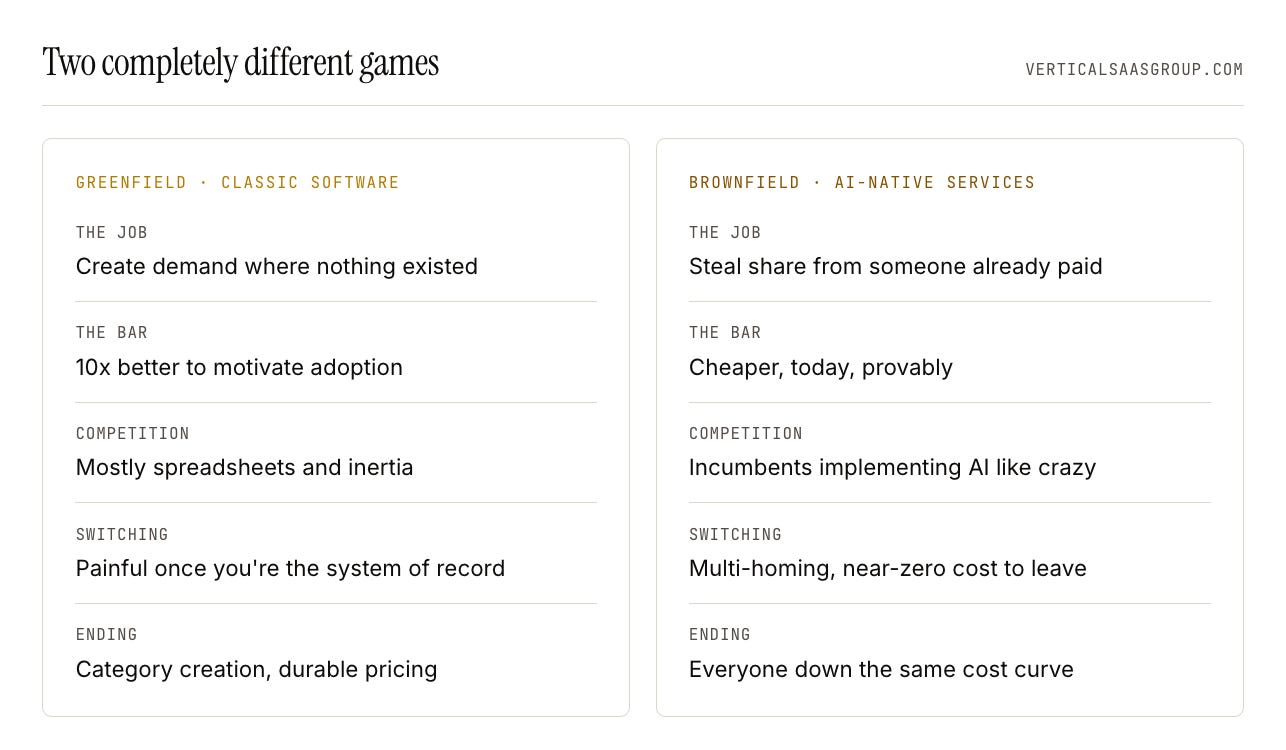
Software investing was largely greenfield — the 10x rule applied because you had to motivate a customer to adopt something de novo. Services investing is brownfield: you’re stealing share from incumbents, not creating a category. Brownfield means multi-homing customers, low switching costs, everyone driving down the same cost curve — and incumbents who are implementing AI like crazy too. Don’t underwrite a world where competitors don’t respond.
#03. Watch for “beta-driven product-market fit”
This was my favorite concept from the episode. When every company in a category starts working at the same time because of a technology or market catalyst — that’s not PMF, that’s beta. We saw it in supply chain in 2021. We’re seeing it in AI-native services now.
Corollary: if it feels too easy, it’s probably not valuable. And there’s a real case for being the fast follower, not the pioneer, in categories where everyone is subsidizing the customer at once.
#04. Treat early margin advantage as a wedge, not the business
Rick has a portfolio company that went 0 → $10M with 50% EBITDA margins in year one. His reaction? Great — now everything we talk about is how to convert that position into critical mass for the next stage of the business. The margin is the key to the door, not the house.
The Amazon lesson: Amazon wasn’t a bookseller. The wedge became a marketplace, then a platform, then a thousand other things. Right now, too many AI services and physical AI companies have the wedge but no second act — and that needs to be the plan from day one, not a bank shot later.

A quick word from our sponsor on the Verticals podcast, Parafin. Fresh off the 2026 Forbes Fintech 50 and a new credit facility led by Goldman Sachs, they’ve now extended over $35B in offers to small businesses through platforms like DoorDash, Gusto, and TikTok Shop.
Purpose-built embedded capital for vertical platforms.
#05. Underwrite to the cost line that actually matters
In insurance, OpEx barely matters. The loss ratio is the business. Most AI-carrier startups have no clue what their loss ratio is until the book matures — and many are trying to outrun their book with growth. We watched this movie in 2021. Everyone got washed out.
Same pattern in mining: everyone wants to use AI to drill more surgically, but the core competencies that win are distribution and cost of capital — which the incumbents already own. And watch the accounting games: companies loading up on assets and putting the cost of capital below the line so gross margin looks pretty. That cost is real whether you report it or not.
#06. Reconcile every private company against public comps
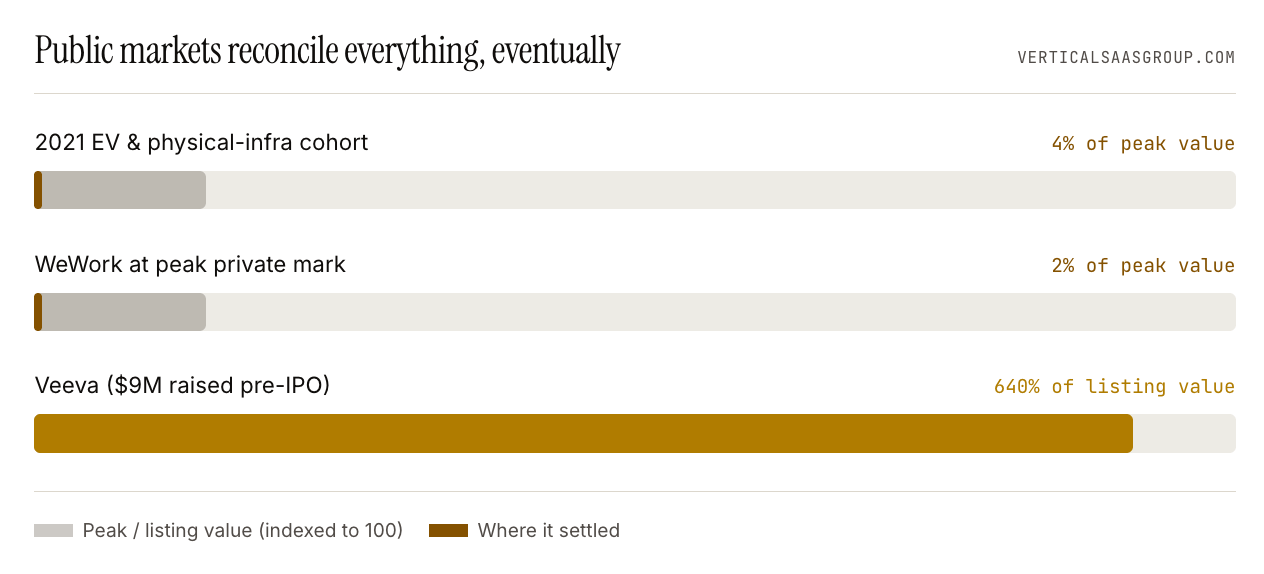
WeWork had great revenue growth and positive margins — and horrific unit economics versus any legacy REIT. Rick applies the same test everywhere: profit per employee, revenue per employee, the specific ratios of the industry, against the incumbents. The 2021 EV and physical infrastructure cohort now trades at 2–5% of their IPO values. Public markets don’t care about your revenue multiple. They eventually reconcile everything.
#07. Physical AI moats are real — but only for cornered resources
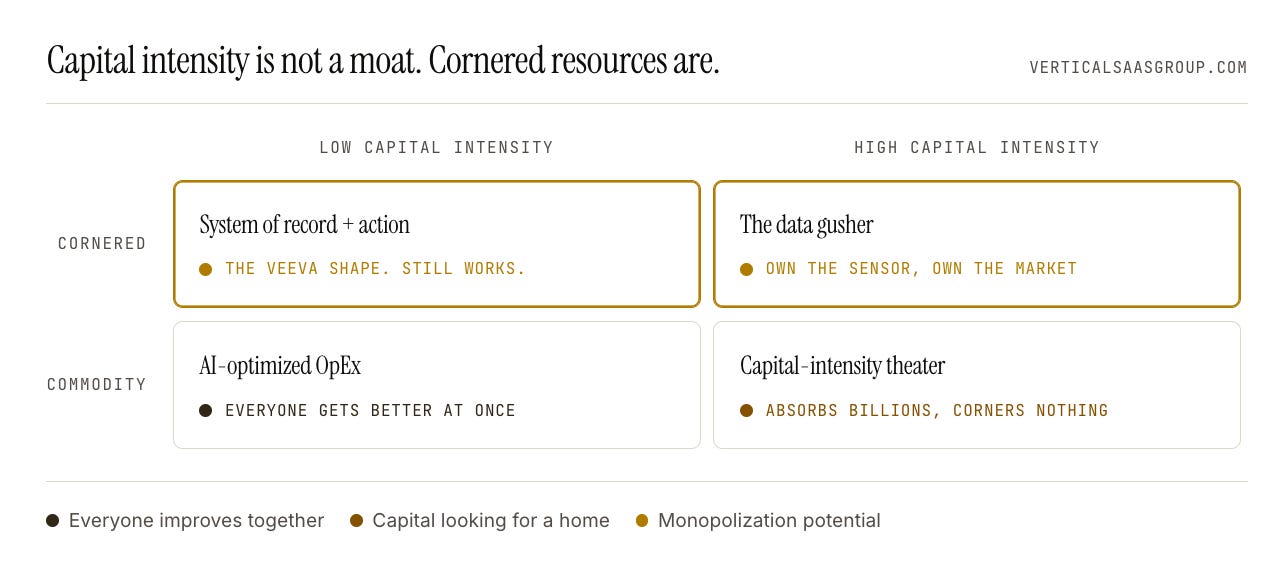
The “data gusher” thesis works: if you own the cameras in the warehouse, the hardware on the ships, the sensors on the grid — those are scarce, cornered resources. How many ocean carriers are there? How many will work with multiple providers? Own the physical layer and competition gets structurally hard.
But recognize why the market loves these deals right now: they’re massively capital intensive, and the market is flooded with capital that needs a home. Capital intensity is a feature for mega-funds, not necessarily a moat for the company.
#08. Veeva couldn’t get funded today — and that’s the problem
Veeva raised $9M before going public and has been printing cash ever since. In today’s market, nobody wants that company because you can’t deploy billions into it.
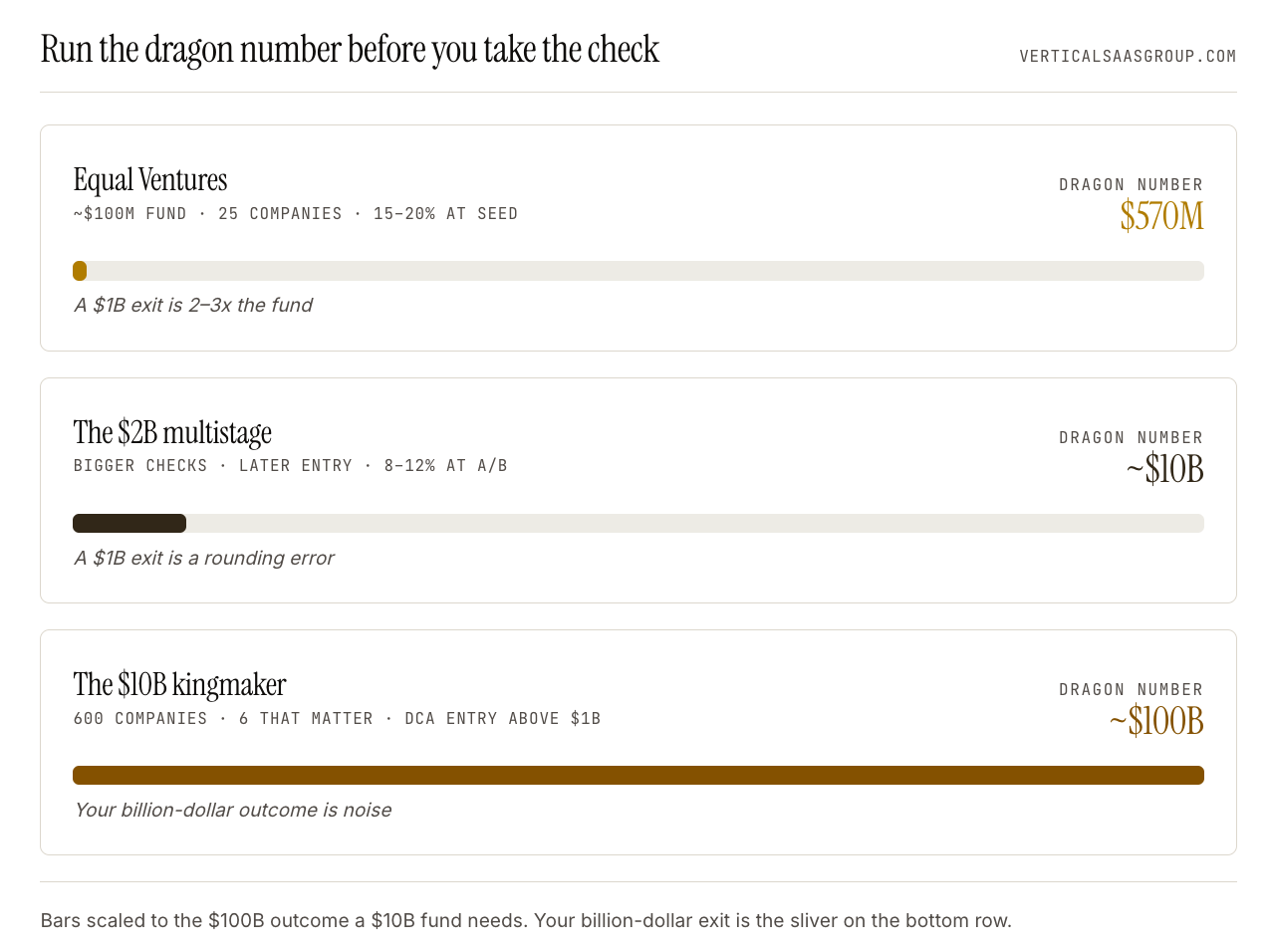
The kingmaking era is real: run the math on 3-and-30 on a $10B fund and you understand why every good idea suddenly “requires” a billion dollars to pursue. The biggest funds look more like Blackstone than Benchmark — Rick’s comparison, and it’s accurate. Founders Fund has backed 600 companies where 6 really matter, with an average dollar-cost-averaged entry well above $1B. That’s a crossover/public-investor playbook (the Sands Capital model from the Amazon/Salesforce era), not seed venture. Neither is wrong. But they are not the same game.
#09. Founders: pick your investor by the outcome math, not the brand
One of Equal’s LPs uses a “dragon number” — take your average ownership and calculate the exit size needed to return the fund. Equal’s target: roughly a $570M outcome. A billion-dollar exit 2–3x’s their fund.
A mega-fund needs a $100B outcome. A billion-dollar exit doesn’t move their needle — which means your billion-dollar outcome doesn’t matter to them. If you want to build a capital-efficient company, investor alignment is existential. The wrong cap table closes doors.
#10. The quiet-compounder playbook still works
Equal is content to do a seed, maybe a small Series A, own 15–20%, and never have the company raise again. Invest at a $7M pre, wake up to $150M of top line and $20–30M of free cash flow. Their LPs — endowments, foundations, fund of funds who’ve seen the game — know compounding eventually wins.
In a market where hope is being passed off as strategy (”this could be a trillion-dollar outcome!”), picking your playbook and living and dying by it is the actual edge.
Hope is not a strategy.
The close
Here is what I keep coming back to. Everything working at once is not proof that the model is sound. It is the condition under which nobody has to check. Beta is generous, capital is cheap, gross margin is flattering, and the marks are all unrealized. In that environment discipline looks like underperformance, right up until the tide goes out and it looks like the only thing that mattered.
You do not need to call the top. You need to know which game you are playing and then actually play it. If you are underwriting to monopolization potential, say so, and eat the volatility. If you are building a quiet compounder, stop apologizing for the size of your market and go own it. The failure mode is not picking the wrong playbook — it is running one playbook and grading yourself on the other one’s scoreboard.
Beta lifts everyone. Structure decides who is still standing when it stops.
So pick your playbook, and live and die by it. Do the homework nobody wants to do. Be the nerd reading the book instead of sitting on the panel. In vertical software and vertical AI, the boring question is almost always the right one, and right now it is the only question with an edge left in it.
See you next Wednesday. If this one landed, forward it to a friend!
— Luke Sophinos
Thanks for reading LINEAR. I reply to every email…
Have any questions, feedback, comments? Let us know, we work for you!