

Today’s newsletter is sponsored by Xplor Pay.
Artificial intelligence is changing how software is built, customer expectations are evolving, and investors are rethinking what creates long-term enterprise value.

Join Xplor Pay and Luke Sophinos, Founder of Vertical SaaS Group, for an executive discussion exploring how AI, workflow ownership, platform strategy, and financial capabilities are reshaping the future of vertical SaaS. Register today and reserve your spot.
Alright, let’s get to it…
I think most vertical founders are thinking about open source incorrectly.
They treat it as an identity, a movement, or a marketing narrative. It is none of those things. It is a build lever. And the founders I love are the ones who know when to lean on open weights, open frameworks, and open cores, and when to quietly route the hard parts through closed models they pay real money for.
The interesting question is not open versus closed.
It is how you compose them.
And if you’re using one or two closed source models for EVERY ITEM, you’re probably renting a ferrari for some trips to the grocery store…
How to think about deploying open source as a vSaaS founder without losing the plot.
Route cheap jobs to cheap models, hard jobs to frontier models
Start with a simple map. Draw every AI call in your product. For each one, write down three numbers. Cost per call. Volume per month. Consequence of a wrong answer.
That table tells you a lot about where open source might belong.
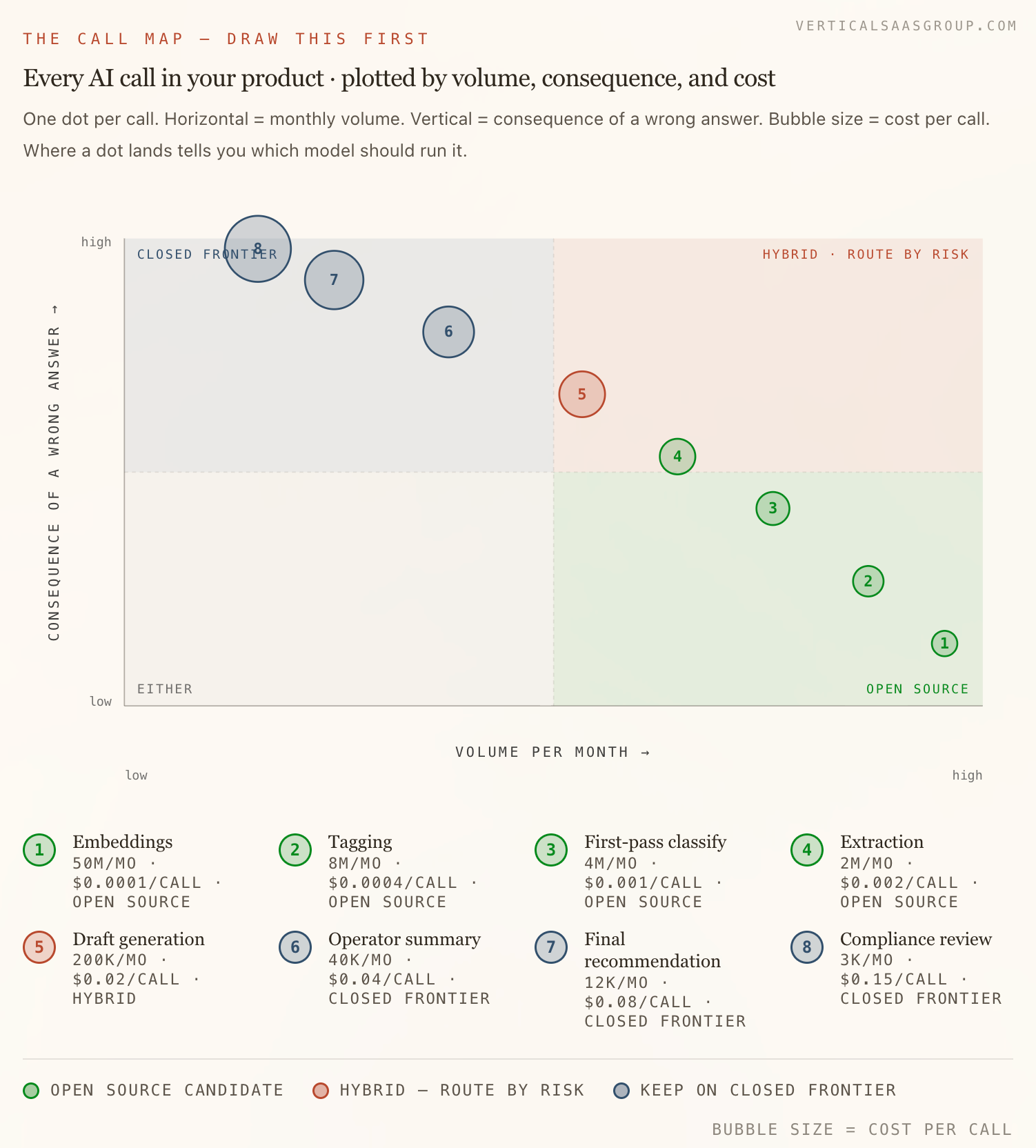
High volume, low consequence calls are usually open source candidates. These are the calls that quietly eat gross margin if you leave them on frontier APIs.
To simplify it, with these types of calls, you’re renting a Ferarri for a trip to the grocery store…
Moving them to open weights, hosted somewhere you control and possibly fine tuned on your vertical data, tends to pay for itself quickly at scale.
Low volume, high consequence calls are usually worth keeping closed. The final draft. The summary the user actually reads. The recommendation the operator acts on. The frontier tax feels worth paying here, because the quality delta is real and the volume is small.
Now the part I think most founders miss. Tie the two together with a routing layer you own.
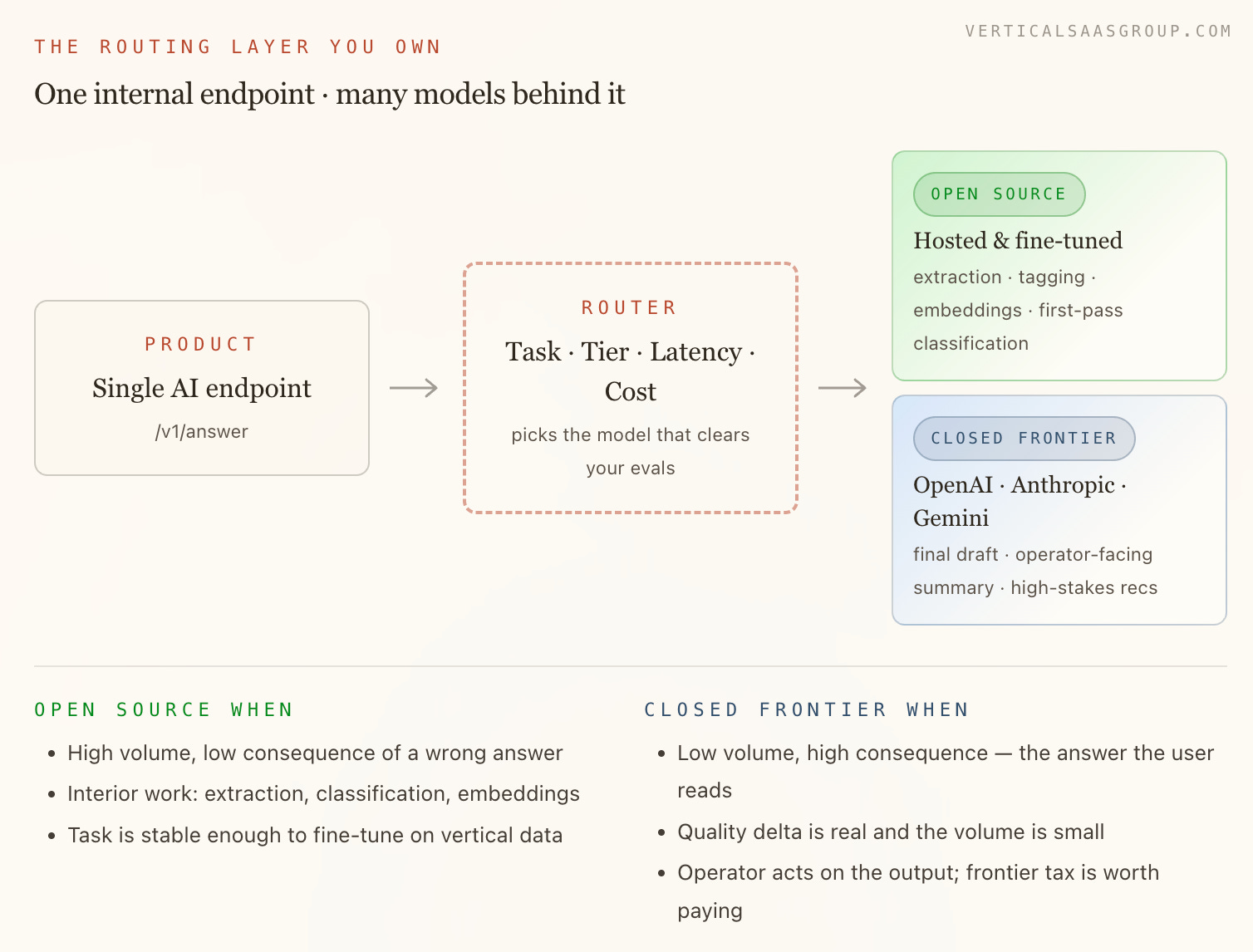
Do not let the model choice leak into your product code. Every AI call in your app should ideally hit an internal endpoint, not OpenAI or Anthropic directly. That endpoint decides which model runs, based on the task, the customer tier, the latency budget, and the current cost profile. When a new open model ships that beats your current one on your evals, you swap it behind the endpoint and your product does not change.
This might be the highest leverage architectural decision in a vertical AI company right now. Founders who build it early tend to migrate work from closed to open as open catches up, and they compound margin every quarter. Founders who hardcode a single provider are usually one price hike or deprecation away from a bad quarter.
A few operator notes worth considering…
Build your own evals before you optimize your stack. You probably cannot decide what to route where if you do not know what good looks like on your workflow. Vertical evals may be more of a moat than the models themselves.
Consider open sourcing your commodity layer. The vertical data model, the workflow logic, and the customer specific fine tunes usually belong closed. Giving away the schema rarely pays off.
Do not fine tune too early. Prompting plus retrieval tends to beat a bad fine tune. Fine tuning makes more sense once you have volume, stable evals, and a clear cost or quality reason.
And in most verticals, your customers do not care which model you use. They care that it works, that it is fast, and that someone owns the outcome when it does not.
If you’ve been reading the newsletter for a while and getting value out of it,
will you do me a really quick favor? A <5 minute favor to be exact…
I’m launching The State of Vertical AI: 2026 H2 Benchmark Survey.
It will be the definitive guide on how vertical software and vertical AI companies are actually building, monetizing, and scaling AI -- specifically the pre/post AI performance cuts nobody else is publishing.
Survey is 100% anonymous, takes <5 minutes, and every founder who fills it out gets the
full report back and a free ticket to the Vertical Software Summit in November!
Click the image below to access it :-)

A sincere thank you in advance!

OpenSource: A Real Look At What It Can Do To Your Margin
Let me start with an observation.
Most of you are using 100% closed source models today. Gemini, OpenAI, Anthropic. You are wrapping their APIs, charging 10 to 20% on top of whatever they charge you, and calling it a vertical AI product. That is not a business. That is a passthrough with a login screen.
The uplift math is worth walking through, because I do not think most founders have actually done it.
Assume open source models can serve a meaningful chunk of your workload at roughly 10% of the cost of frontier closed models. That number moves around depending on the task, but for high volume interior work like extraction, classification, embeddings, and structured parsing, 10% is a reasonable directional number. Your customers are already paying you a price they are comfortable with. You do not have to lower it. You just have to change what sits underneath.
Now scale it across a real vSaaS.
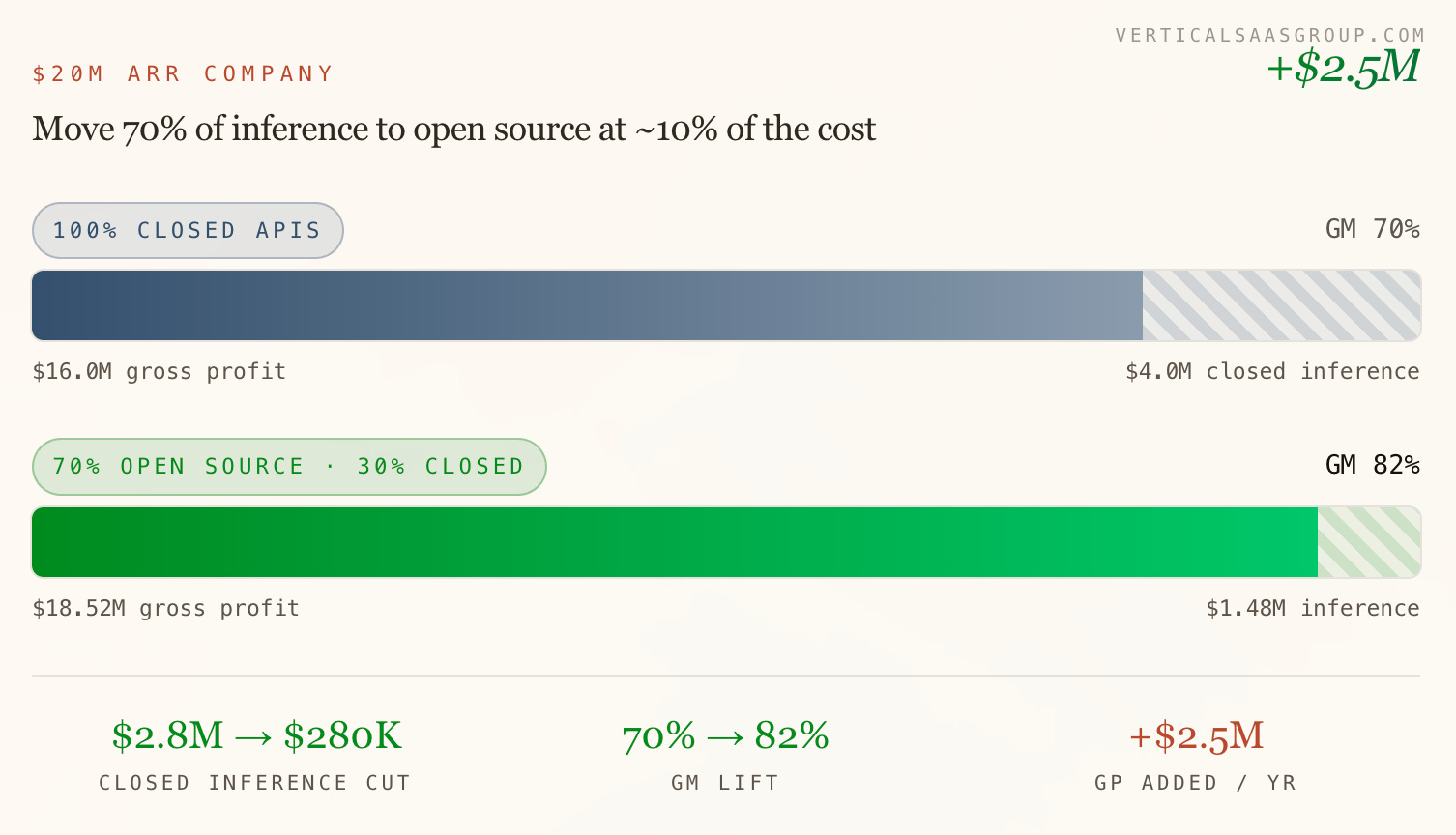
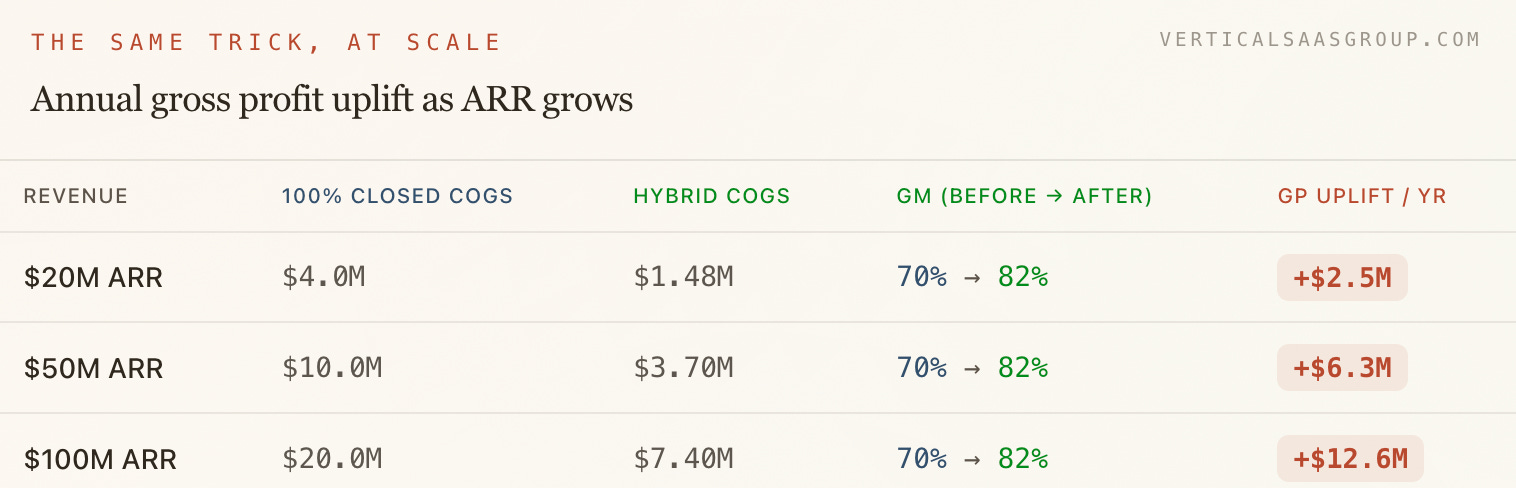
Say you are a $20M ARR vertical AI company. You are running maybe $6M a year in COGS, and $4M of that is model inference on closed APIs. Gross margin sits around 70%. Not great for software, but typical for the current wave of AI native vSaaS companies.
Move 70% of your inference workload to open source at roughly 10% of the closed cost. That $2.8M of closed inference collapses to about $280K. You just added roughly $2.5M in gross profit without touching pricing, headcount, or product surface area. Gross margin moves from 70% to about 82%. On a software multiple, that swing alone is worth tens of millions of enterprise value.
Now run it forward. At $50M ARR with the same mix, you are looking at $6M plus in annual gross profit uplift. At $100M ARR, north of $12M. That is real money. That is the difference between a company that has to raise again and a company that compounds cash.
And the customer never notices.
The frame most founders miss is that AI COGS is not a cost of goods problem, it is a strategy problem. Every dollar of closed inference you leave on a workload that could run open is a dollar you are handing to OpenAI or Anthropic that should be sitting on your balance sheet. Multiply that across a portfolio of vSaaS companies and you are talking about hundreds of millions of misallocated margin across the category.
The founders who understand this are quietly rebuilding their stacks right now. The ones who do not are going to look up in 24 months and wonder why their gross margins never expanded and their competitors got acquired at 10x while they sat at 5x.

Real companies already doing this — and what they are saving
A caveat before I get into this. Most vertical software and vertical AI companies have not publicly disclosed their model stack. It is one of the more guarded operational details in the category right now, probably because it is a real source of margin advantage and nobody wants to hand competitors the map.
So I had to pull in a few horizontal companies alongside the vertical ones to get the pattern across. The principle travels. The vertical operators I have talked to privately are doing versions of the same thing. They just have not blogged about it.
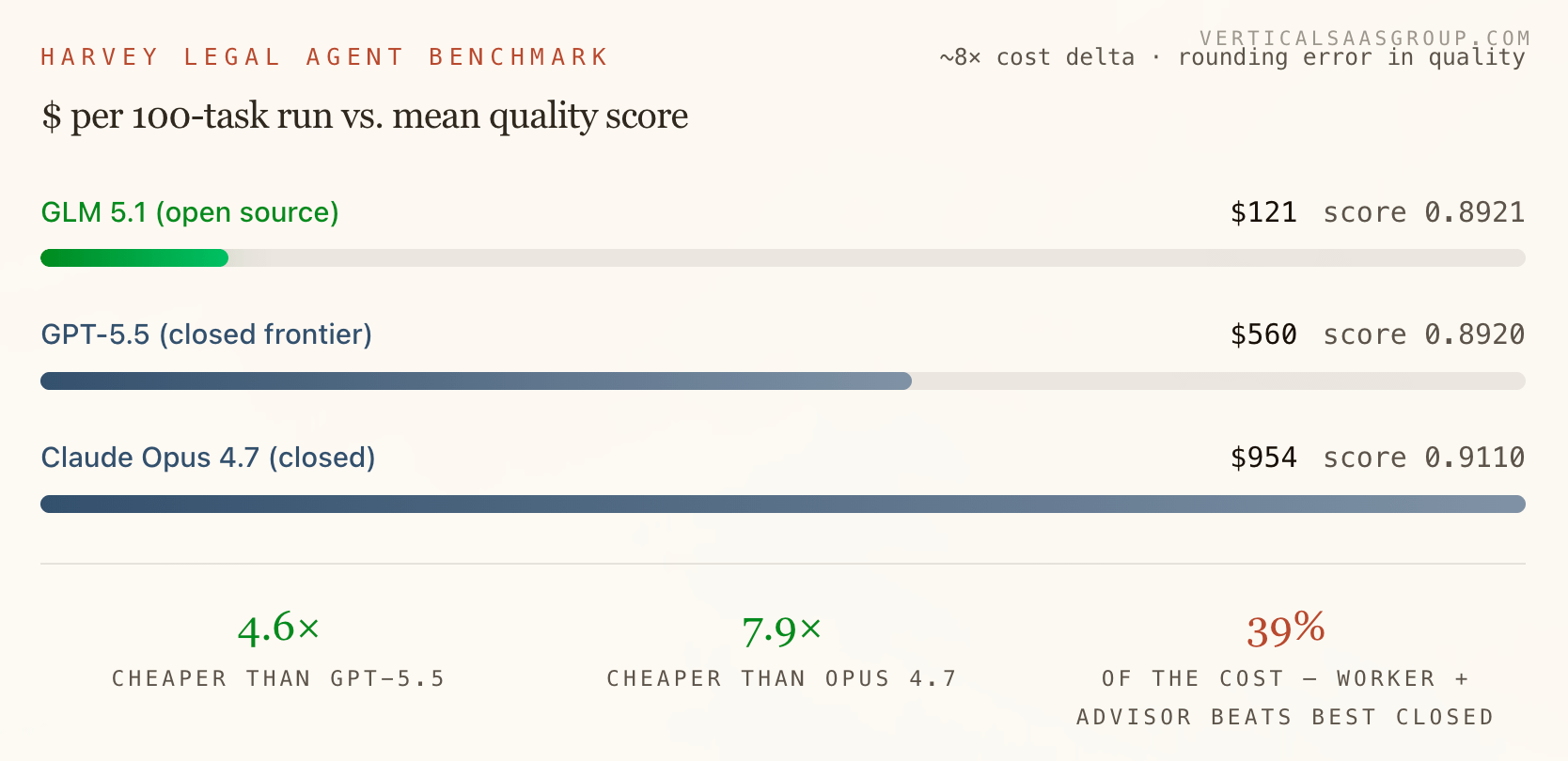
Harvey (vertical AI, legal). Harvey confirmed they are training open source LLMs to encode law firm workflows, in partnership with the firms themselves. Co-founder Gabe Pereyra was explicit about the two goals: serve frontier intelligence across their product at an affordable price with a strong security posture, and give law firms the foundation to own their own intelligence. Then Fireworks and Harvey published the math. On the Harvey Legal Agent Benchmark, GLM 5.1 hit a mean score of 0.8921 for $121 across a 100 task run. GPT-5.5 hit a nearly identical 0.892 for $560. Claude Opus 4.7 hit 0.911 for $954. Roughly 8x cost delta for a rounding error in quality. When they wrapped an open source worker model around a closed frontier advisor, they beat the best closed model on the all-pass metric at 39% of the cost. This is the cleanest published example we have of a vertical AI company composing open and closed.
If you made it thus far, go check out the 2026 Vertical Software Summit. We’ll have 350+ vertical founders/operators/investors in Miami in November. Two days,
6+ billion dollar vertical Founders/CEOs.
The Vertical AI event of the year.
OpenEvidence (vertical AI, healthcare). The most used medical search engine in the US, trusted by 40%+ of American physicians, publicly stated their reasoning for owning the stack: “closed-source models offer strong general capabilities, but they impose constraints like non-secure data, high cost per token, reliability and latency issues, and the inability to optimize for domain-specific performance.” They now train custom, domain-specific open source models on peer-reviewed medical literature. Baseten disclosed they projected $1.9M in savings just on training infrastructure, before you even get to inference. This is the company that first scored 100% on the USMLE. It is not running on someone else’s API.
Now the horizontal companies, included because they have published architecture details that most verticals have not, and the composition logic is the same.
Sierra (horizontal agent platform). Bret Taylor has been openly telling anyone who will listen that Sierra runs a “constellation of 15+ frontier and open source models.” Not one model. Fifteen. Open source models handle low latency tool calling and precision classification. Frontier models handle long context reasoning and empathy. He is on record saying there will not be one model to rule them all, and that any serious agent company will end up composing this way. Not a vertical company, but the pattern is exactly what a serious vertical AI stack should look like.
Pinterest (horizontal consumer). Their CTO went on record saying they are using open source AI at “less than 10% of the cost of leading, proprietary AI models,” with an order of magnitude reduction in inference costs on visual workloads. Their internal PinCLIP model outperforms state of the art open source multimodal embeddings by 30% on retrieval. Not a vertical company. But the shape of the argument travels directly. Fine tune open source on your proprietary data, beat the frontier on your specific task, save 90% on cost.
DoorDash and Instacart (horizontal marketplaces). Both use LLMs offline to enrich internal knowledge graphs and catalog data, while keeping runtime retrieval on classical, cheap infrastructure. The expensive intelligence runs once, batch, on their terms. The cheap runtime serves the customer. Same composition principle, just applied at horizontal scale.
The pattern is consistent across every company that has actually published its architecture, vertical or horizontal. The ones building enduring AI businesses are not picking sides. They are composing. Open source for volume, control, and margin. Closed models for frontier tasks where quality is non negotiable. A routing layer they own between the two.
I assume the vertical operators quietly doing this look exactly like Harvey and OpenEvidence.
They just have not written the blog post yet.
Always prioritize winning your vertical.
Optimizing the stack is not as important…
Model composition is a second-order problem.
Becoming the default choice in your industry is the first-order problem.
Everything above is real. The margin math is real. The routing layer is real. The Harvey and Sierra and OpenEvidence examples are real. And none of it will save you if you lose sight of the actual game.
The founders who lose in every scenario are the ones who spend more time composing models and less time building THE solution for their vertical.
Model strategy is a second order problem. Owning your industry is the first order problem. If you are not the default answer when someone in your vertical thinks about the workflow you serve, no amount of clever inference routing is going to fix that.
Open source is a lever.
Closed models are a lever.
Fine tuning is a lever.
Evals are a lever.
Levers are useful if you have already picked up something heavy.
They do nothing if you are still trying to figure out what to lift.
So use this piece the way it is meant to be used. When you have real volume, real workflows, and real customers who cannot imagine running their business without you, come back and optimize the stack.
That is when the 82% gross margin conversation actually pays off. Until then, every hour you spend on model composition is an hour you are not spending owning your vertical.
Own the industry. Own the workflow. Own the data. Own the customer. The model layer will still be there when you get to it, and by then it will matter more than it does today because you will actually have something worth optimizing.
Do me a solid and forward to a friend :-)