

Before we dive in today, we have a quick ask!
Fill out our 100% anonymous annual benchmark survey and get a FREE ticket to the Vertical Software Summit this November AND access to the report when it drops.
It will help all of us understand what is working in verticals, specifically around AI.
Survive to iterate.
Think in curves.
I’ve cancelled four software subscriptions this year and rebuilt them myself. My friend the barber is doing the same thing in ChatGPT between haircuts. And Alex Oppenheimer of Verissimo Ventures, NEA before that, Morgan Stanley tech banking before that, spent an hour with us walking through which VC priors actually survive when the median person walking into your shop is now, at least casually, a software developer. The answer is more nuanced than either the doom
take or the everything-is-fine take.
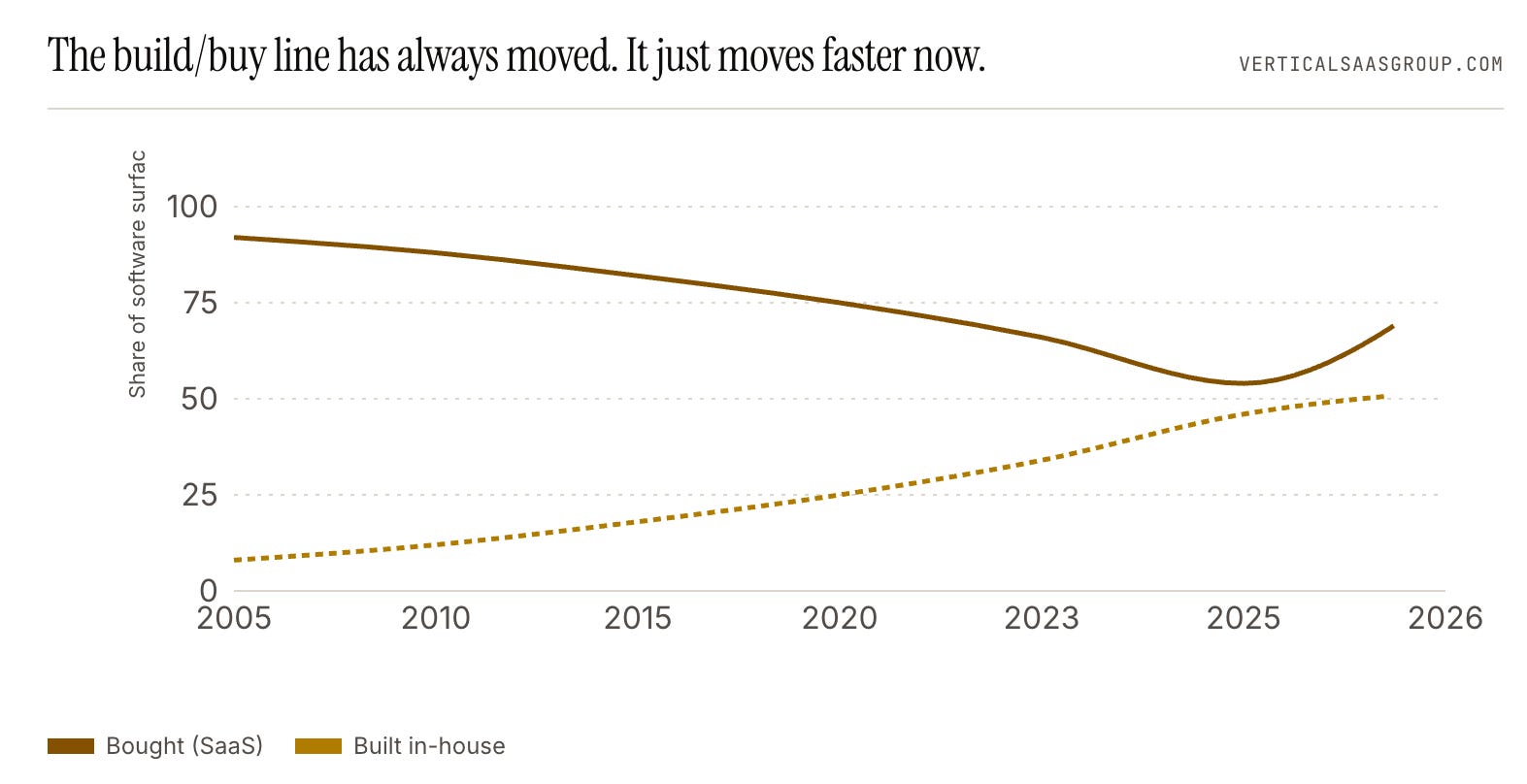
The macro update: the build-vs-buy line moves, but it never goes away. Small, tangible tools are on the cancellation list. Anything complex, cross-team, or regulated is more firmly in the buy column than it was a year ago, and the vendors on the right side of that line just got wider moats — not narrower ones. Specialization of labor is a hell of a thing. The HVAC owner should not spend half his week debugging his own dispatch tool. That’s still true. It might even be more true now.
The second shift is a founder one: the real debate is big vs. small, not vertical vs. horizontal. The vertical software cohort of the last decade quietly proved that the markets everyone thought were too small never were. AI is that same story again, at higher amplitude, because it’s now eating services budgets — 80% of GDP — instead of just software budgets. Retrospective pattern-matching is the tax you pay for not being early.
And the capital one: think in S-curves, not lines. The current fundraising market is bimodal — Notion memos priced at $80M, revenue rockets priced at $10B, everything in the middle is stuck in Death Valley. The pre-seed founder’s real job in four words is survive to iterate. The pre-seed investor’s job is to right-size the fund so a $500M outcome still works, because IPO nostalgia is a bad way to plan a decade.
This Weeks Vertical Titan:
Alex Oppenheimer and the case against the wrong argument
Alex ran early-stage at NEA for the better part of a decade before spinning up Verissimo. He is a mechanical engineer who wandered through Morgan Stanley, sat on eighty-plus cap tables, and now writes small checks with the specific contrarianism of someone who has watched three cycles in a row. His pattern recognition on cycle-vs-permanent is unusually calibrated, which is why the first thing he told me was that we’re all asking the wrong question. It is not vertical versus horizontal. It is not AI-native versus AI-later. The real axis is big versus small, and it is quietly doing all the sorting.
The build/buy line has moved before. It moved when Salesforce was born. It moved again when Airtable and Notion made every ops manager briefly believe they were a software company. It is moving now, further and faster, because you no longer need to know how to code to ship. But, and this is the part everyone selling the “software is dead” thesis quietly leaves out, the total surface area of things that could plausibly become software is expanding at the same time. The line drifts up. The chart underneath it gets taller.
Quick PSA -
90 Days Until The Vertical Software Summit
DON’T WAIT. We are already 75% sold out.
If you want to be at the Vertical AI Event of the year where ~400 vertical software founders, operators, and investors come to gather, snag your ticket now.
The speaker line-up is a 10/10 and the entire investment community shows up.
We had to turn away 100+ folks last year who waited until the last few weeks to grab their ticket.
Don’t be that person who misses out!
Alex tells the story on himself. He churned his Salesforce subscription. It was $25K a year. He decided he could do better. He hired three developers to keep the replacement alive. The bill now runs closer to $80K a year, and he is on the hook for the roadmap. This is not an anti-vibe-code polemic. It is the oldest lesson in software procurement, dressed up in 2026 clothes.
Anything you build for yourself, you also own. The invoice moves from a vendor line to a headcount line, and the headcount line grows.
“I churned Salesforce. It now costs me eighty thousand a year to support what I replaced it with. That is the whole build-versus-buy debate in one anecdote.”
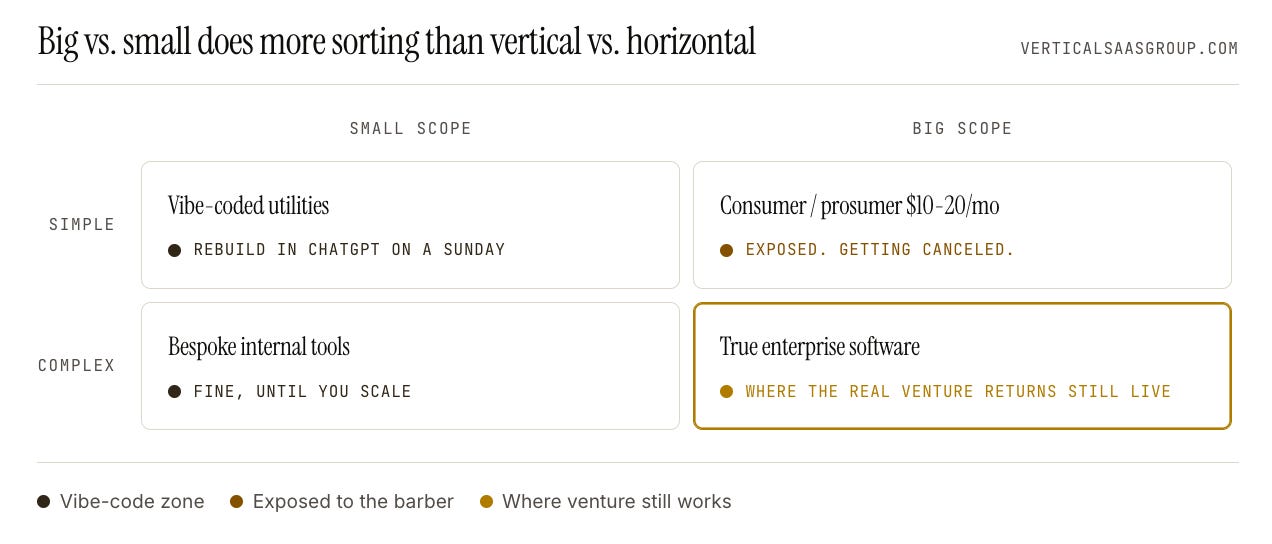
The frame Alex kept coming back to, and the one I have been thinking about since, is that vertical versus horizontal is not the interesting cut anymore.
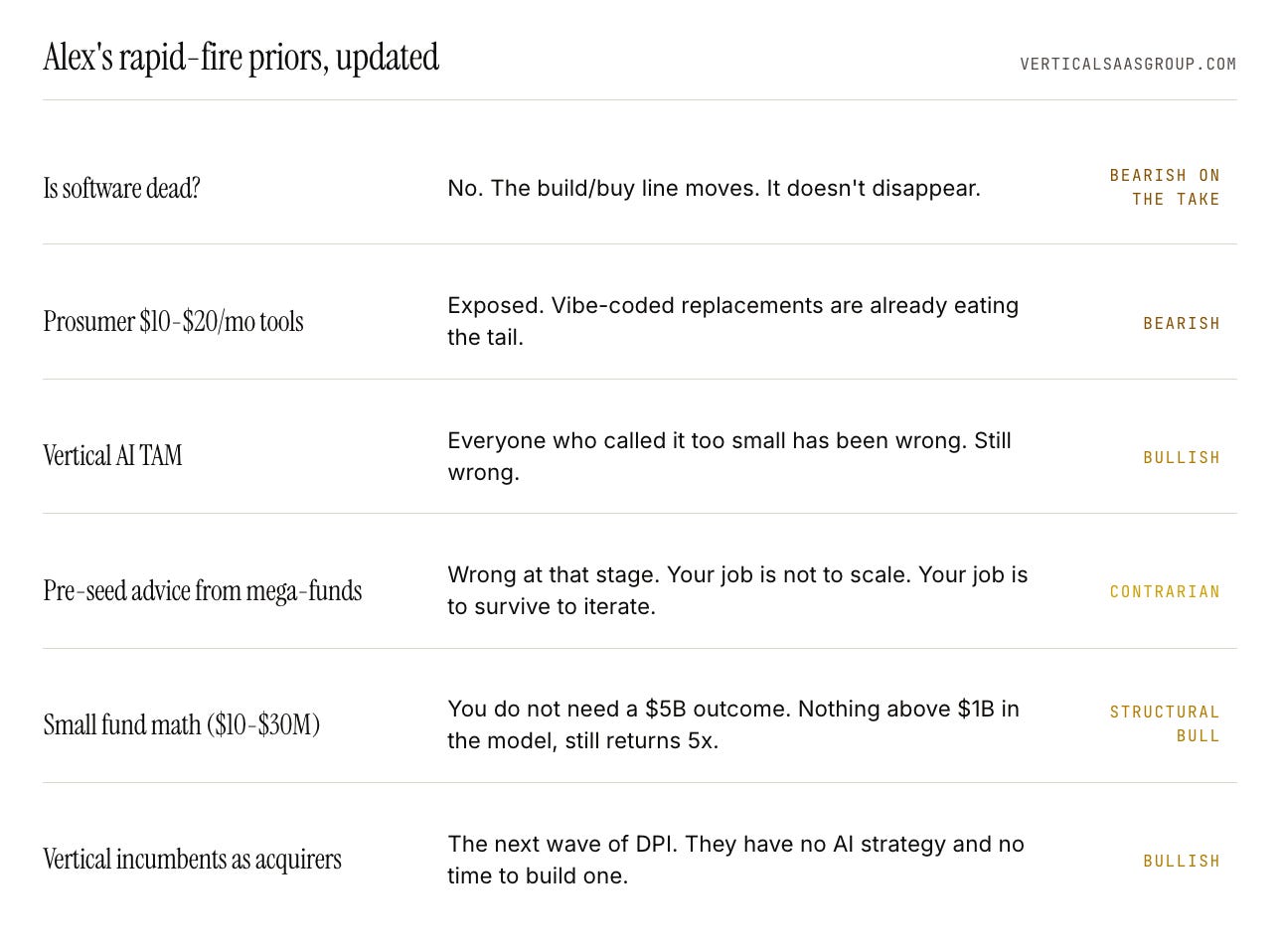
Big versus small is. The prosumer app charging $12 a month for a lightly styled form builder is exposed. The complex, mission-critical, boring, un-sexy enterprise system that runs a manufacturer’s floor is not.
Both can be “vertical.” Only one survives the barber.
This maps neatly onto a shift Alex has been calling for years: the rise of the millennial decision-maker. Someone in their late thirties inherits, buys, or simply gets promoted into a traditional business.
They walk in, look at the tools, and ask why any of it looks like 1985. Ten years ago they had to wait for a vendor to build them something. Today they can vibe-code a passable v1 in a weekend. The incumbency you thought you had — because “these people don’t adopt technology” — is gone. And that is a demand-side story, not a supply-side one. It is not about the tools. It is about who is running the SMB.
Which brings us to the other Oppenheimer axiom, the one I’ve quoted in three conversations since we hung up: survive to iterate. Four words. He tells it to every pre-seed founder he backs.
The big funds, he argues — and I agree — give the opposite advice at that stage. They talk about scaling GTM, hiring aggressively, running the sales playbook. But at pre-seed the product isn’t baked, the market often isn’t ready, and the founder’s real job is to still be in the game when timing finally arrives. Timing is the single largest ingredient in startup outcome. You cannot control it. You can only outlast it.
“Your job at pre-seed is to survive to iterate. Not to scale. The big funds tell you the opposite, and at that stage they’re wrong.”
What to steal from Alex’s field notes:
#01. Bet on the sleepy strategic, not the loud one.
IPO windows will reopen — Alex is convinced the bar has been raised absurdly and will come back down — but the underrated wave of liquidity in vertical AI is the non-tech strategic acquirer. Devcon can’t build an AI construction platform. EvolutionIQ getting acquired in insurance is a preview, not an anomaly. The vertical incumbents without an AI strategy have three options: build (they can’t move fast enough), cannibalize (they won’t), or buy. Multiples will not stay low for long. If you are running an AI-native business inside a vertical whose largest player currently has no AI leader on their org chart, you are the acquisition they are quietly modeling.
#02. Survive to iterate — the pre-seed founder’s real job in four words
Alex has a line he gives every pre-seed founder he backs, and it is the exact opposite of what a $2B platform fund will tell you the day after they wire your seed check. Your job is not to grow. Your job is to survive to iterate. Because at genuinely early stages the product isn’t baked and the market probably isn’t ready either — and by the time it is, you need to still be alive. Big funds arrive with scaling advice, which means hiring advice, which means burn advice. That advice is a fine way to run out of runway before the market shows up.
This is the founder version of the S-curve. You’re investing pre-inflection. You don’t know exactly when the inflection lands. You just need to be there when it does, which means being there before it does, which means today it looks less interesting than it will in eighteen months. If your capital plan cannot tolerate that gap, you’re playing a different game than the one that actually pays out.
#03. Big vs. small is the real debate — vertical vs. horizontal is the distraction
One of the sharpest reframes in the conversation: for a decade every panel argued vertical vs. horizontal SaaS. Alex thinks the argument the AI era actually cares about is big vs. small. If your product is a small, tangible solution you could describe on a one-pager, you should assume a competent operator will vibe-code it for themselves this year. If it’s a complex, cross-team, non-core system that no single buyer wants to own in-house, you have a real business — vertical or horizontal makes very little difference.
This is why the cheap prosumer end of the market is bleeding first. Nobody is going to rebuild a full enterprise-grade platform in Claude Code on a weekend, and even if a few try, they will not scale it to a thousand users. But the $10–$20/month prosumer subscription with three features? That’s now on the cancellation list of every operator who owns a ChatGPT account.
#04. The line moves — but build vs. buy never goes away
Every company that employs software engineers has always been running the build-vs-buy calculation. AI has not killed the question. AI has moved the line — a barber can now ship his own booking system, a founder can cancel four subscriptions and rebuild them — but the question survives untouched. And the moment you actually try to run the DIY thing at any scale, the specialization-of-labor argument kicks in fast. Alex’s own example: churning a $25K/year Salesforce subscription and immediately paying $80K/year for three developers to hold up what he built himself.
The correct read isn’t that software is dead. It’s that the wrong software is dead. Anything a smart operator can hold in their head and reproduce in an afternoon of vibe coding is exposed. Anything that touches multiple teams, multiple regulators, real economies of scale, or real edge cases stays firmly in the buy column — and the vendor who owns it just got a wider moat, not a narrower one.

A quick word from our sponsor on the Verticals podcast, Parafin. Fresh off the 2026 Forbes Fintech 50 and a new credit facility led by Goldman Sachs, they’ve now extended over $35B in offers to small businesses through platforms like DoorDash, Gusto, and TikTok Shop.
Purpose-built embedded capital for vertical platforms.
#05. Earned insight beats a Stanford resume — go do the job first
Alex tells college kids the same thing he was told about finance: you don’t want to study finance, you want to study the finance of something. Same rule for founders. If you want to build AI revenue cycle for hospitals, spend real time in a hospital before you spend anyone’s capital. The single quickest way to lose Alex on a first meeting is to pitch an idea you could have Google-searched into an existing public company.
This is where the from-industry founder still crushes the Bain-trained user-interviewer. Not because pedigree is bad — Alex ran mechanical engineering at Stanford, did Morgan Stanley, spent years at NEA — but because empathy for the problem is a load-bearing part of the product. Founders who wake up every morning going “why does this thing still not exist” build differently than founders who woke up going “what’s hot right now.”
#06. The barber is shipping software — respect it, but don’t confuse it with a business
The moment in the interview that stopped me: Alex pulls up a photo of his French barber, mid-cut, inside ChatGPT vibe-coding a full booking and scheduling system for the shop. That is the new normal. Every hands-on operator with a laptop and a curiosity can now materialize working software for their own workflow. This is unambiguously good — more people building, more real problems getting real solutions.
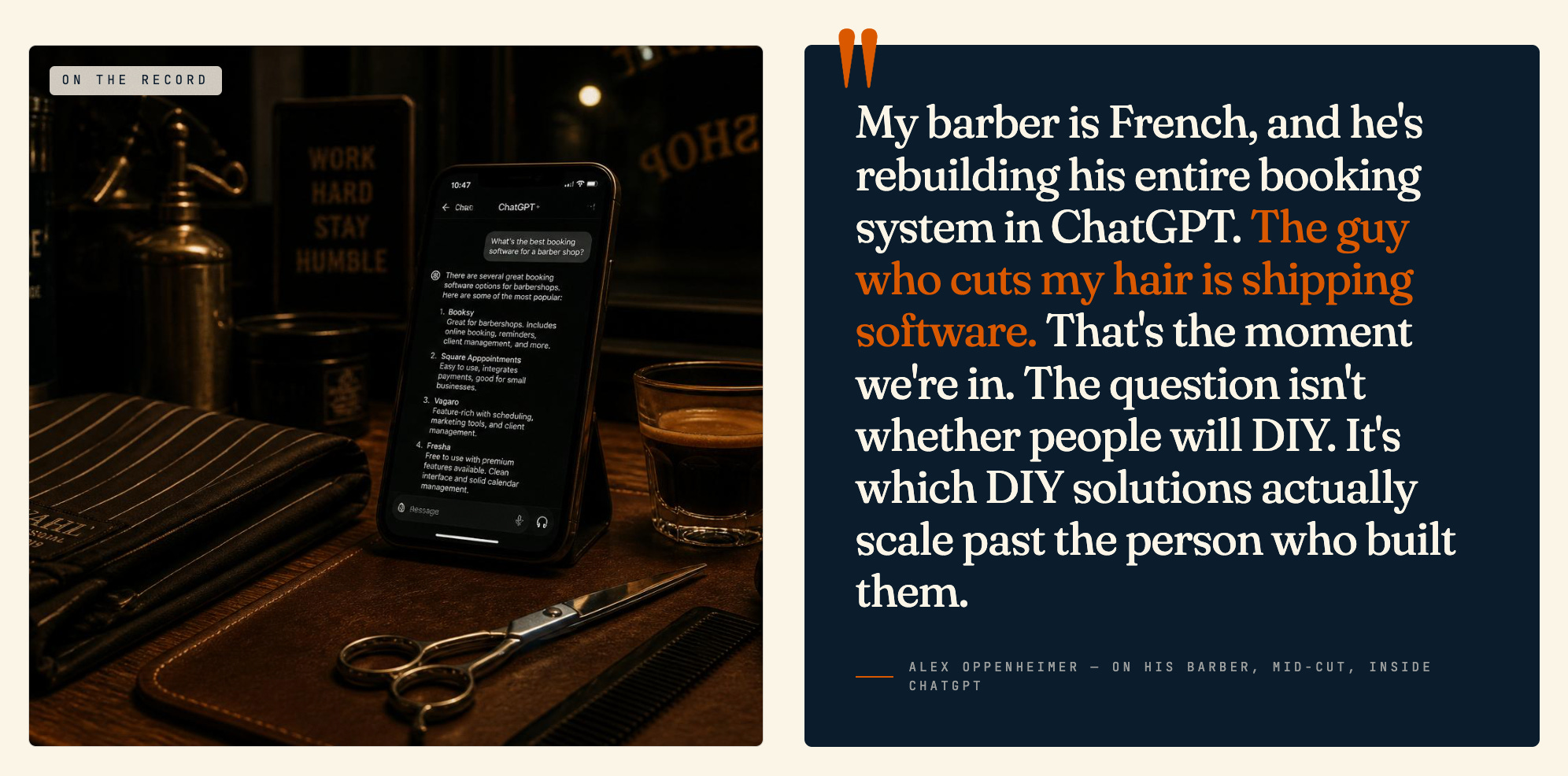
It is also not, by itself, a company. The barber loves cutting hair. The HVAC owner should not be spending half his week debugging his own dispatch tool. Specialization of labor exists for a reason: one team, focused on one problem for one hundred businesses, will always beat one hundred businesses each solving their own version of it at midnight. The question for founders is not whether people can DIY — it’s which DIY solutions collapse under the weight of the second, tenth, and thousandth user.
#06. Retrospective pattern matching — vertical markets are always bigger than they look
This is the sentence that reframes an entire decade of VC pushback: every generation of VCs is anchored about five years behind on which markets are big enough. The first cohort of vertical SaaS businesses were told their TAMs were too small. Software’s share of GDP kept marching up and the TAMs turned out fine. Supply chain? Too niche, too analog. Then a trillion dollars of freight went digital. AI is that story again, at higher amplitude — because it is now eating services budgets, not just software budgets, and services is 80% of GDP.
The operator implication is simple: if the loudest room-tone response to your market is “that seems small,” that is a leading indicator you’re early, not wrong. If the loudest response is “seven companies just raised in that space,” you are almost certainly late.
We’re doing a workshop tomorrow with a killer AI Product Expert who is going to talk about what it actually entails to build an AI Native Product.
The texture under the software nobody is going to vibe-code away.
From-industry founder + earned insight
The trucker who founded a freight platform. The millennial running a family business who demanded software that looked like Snapchat. The empathy shows up in the roadmap.
Complex, cross-team, workflow-deep
The kind of product you cannot describe on a one-pager. Multiple stakeholders, real edge cases, real economies of scale. The buy side of the frontier keeps expanding.
AI-native services in regulated niches
Fund admin, customs brokerage, licensed healthcare — the vendor gets paid for outcomes, owns the eval loop, and inherits a data moat the labs will never see.
Small-fund math that actually returns capital
$26M funds, 5% ownership, no billion-dollar fantasy required. Right-sized to the DPI the current exit environment can actually generate.
The common thread: earned insight into a job complex enough that a smart operator with a laptop cannot displace you in a weekend; priced and funded like a business that does not depend on an IPO that isn’t coming.
See you next Wednesday. If this one landed, forward it to a friend!
— Luke Sophinos
Thanks for reading LINEAR. I reply to every email…
Have any questions, feedback, comments? Let us know, we work for you!
Some of the best content on Verticals out there 👍
Very insightful analysis - and it deeply resonates as ground truth for me as a founder - well done Euclid.
Timing, on multiple intersecting demand vectors has been a critical deciding factor for us and also a company force multiplier for growth and adoption. Yeah we’re smart, we’re right, we’re first and being aggressively adopted into a massive surface but it sure level sets the ego to know timing is the decider and our goal is to survive to execute the opportunity that Timing has brought so we can thrive - excellent insights from the Linear letter.