

Today’s newsletter is sponsored by Xplor Pay. Launching embedded payments is a major milestone, but it’s only the beginning of the opportunity. Many software companies see merchant adoption plateau after launch, not because of their technology, but because they stop investing in their payments business.

Built from firsthand experience growing and scaling more than 20 vertical SaaS platforms, this article explores what high-performing software companies do differently to increase merchant adoption, convert existing customers, and create long-term enterprise value. Read the article here.
Alright, let’s get to it…
The market is not paying for AI features. It is paying for AI re-architecture.
Every pre-AI vertical SaaS company is running the same experiment right now. Some are launching a separate AI product on top of their legacy data. Some are rebuilding the UI inside the core app. Some are adding a chat panel. Some are trying to sell an AI Agent marketplace. Some are buying their way in through M&A.
A few are already getting rewarded. A few are getting punished. Some strategies are too early to tell if they will work out or not, but we can all agree the ceiling is enormous…
Pre-AI Incumbents Have Five Paths Forward. Here Is What Is Working, What Is Not, and What Is Just Early.
Path #1: Build a net new AI platform on top of your legacy data, separated from the legacy product
This is the most interesting path in the market today and it is not close.
The move is simple to describe and hard to execute. You take a pre-AI incumbent with a real data spine and you spin the AI product out as its own brand, SKU, pricing model, and often its own GTM. The legacy product still runs. The legacy customers still pay. But the AI platform sits alongside it, feeds off proprietary workflow data, and gets sold with an AI-native pricing model.
You keep the moat. You escape the multiple.
Intercom is the reference case. They renamed the entire company Fin. Fin surpassed $100M in ARR growing 350% YoY, resolving nearly 2M queries per week across 7,000+ customers. NRR moved from 112% to 146% after outcome-based pricing. Salesforce agreed to acquire Fin in June 2026 for ~$3.6B, roughly 9x ARR. Same company. Different re-architecture.

The critical unlock was that Fin became sellable outside Intercom. Fin for Platforms runs on top of Zendesk or Salesforce. The AI product does not just defend the installed base, it expands TAM to everyone using a competitor’s SoR.
In vertical software, the pure Fin move is rarer but starting to happen. RealPage launched Lumina AI Workforce with OpenAI as multifamily’s first agentic AI platform. AppFolio launched Realm-X Performers as a distinct product line and reported nearly 500% QoQ Performer adoption growth, with Leasing Performer customers seeing 35%+ more showings booked.
The reason this path is winning is structural. Markets know how to price AI-native usage growth. They do not know how to price a legacy per-seat business with an AI chatbot glued on. Architect the AI platform as its own product with outcome-based pricing and you tell two stories at once: durable legacy ARR underneath, AI-native growth on top.
Pros:
No cannibalization of legacy SaaS revenue. Outcome-based pricing creates a net new revenue line on top of the SoR.
AI-native multiple stacked on legacy substrate. Dual narrative: durable ARR underneath, AI-native growth on top.
Upsell into the SoR without a rip and replace. Land with AI on a competitor’s stack, expand into your own SoR.
New buyer, new budget. You are not fighting for share of the same line item.
Fresh pricing model. Per-outcome pricing is nearly impossible inside a mature per-seat contract.
Cleaner category story. “Fin,” not “Intercom with AI.”
Dramatically better NRR mechanics.
Optional standalone exit path.
Cons: if the new product is a wrapper without deep hooks into proprietary workflow data, it collapses into a thin skin. Requires a second product team and a second GTM motion.
Path #2: Make AI the UI, not a feature inside the old UI
The most ambitious path. Not autofill. Not a copilot popover. Not AI-flavored buttons inside a legacy grid view. The actual bet is that the primary way customers interact with your product stops being forms, tabs, and menus, and starts being a generative surface driven by intent.
The 1,000-button screen is dying whether SaaS vendors like it or not. The question is whether the incumbent leads that transition or gets replaced.
The path plays out in three phases:
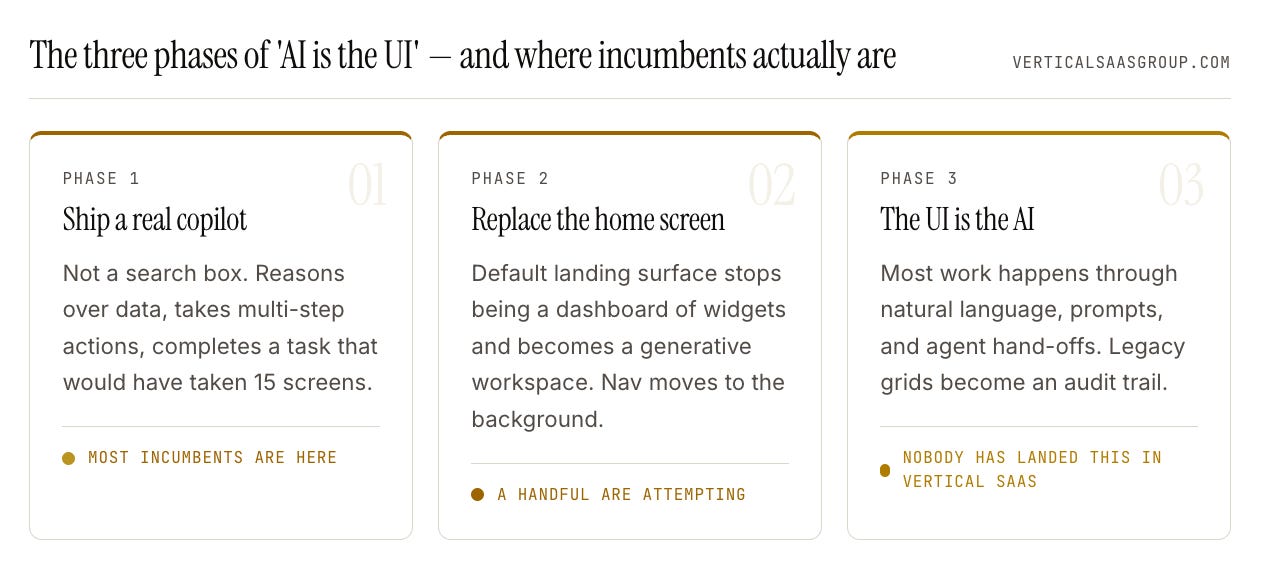
Procore is directionally trying this with Procore AI. Whether they re-architect the primary UI or just add smart panels around existing screens is the open question. Q1 2026 was 16% revenue growth with 95% GRR. That is not proof of a UI transformation. That is proof they still have time to run the play.
The candid read is that no pre-AI vertical incumbent has convincingly landed Phase 3 yet. Toast IQ is smart but SMB restaurant operators run a shift, not a chat surface. The winners will be incumbents who recognize the old UI is a liability and cannibalize their own screens before someone else does.
Pros: if you execute Phase 3, you become the AI-native version of yourself and neutralize the entire class of AI-native attackers. Highest defensive value of any path. Cons: massive product risk. Requires deprecating UX that customers are trained on and CS teams are certified on. Nobody has fully pulled it off yet.
Path #3: Side chatbot / copilot as a permanent bolt-on
Different from a copilot as Phase 1 of Path #2. Path #3 is when the chatbot is the entire strategy and just lives forever on the side of the screen.
Fast to ship. Easy to demo. Rarely rewarded.
Clio Manage AI is the honest example. Summarizes matters, creates tasks, drafts messages. Useful. But structurally an assistant. The reason Clio got a $500M Series G at a $5B valuation was not the sidecar. It was the $1B vLex acquisition happening in the same breath. The sidecar was table stakes. The re-rating came from the platform move.
AppFolio’s own 2026 benchmark: 78% of surveyed property managers say they cannot rely on AI features in their legacy PMS.
Pros: low risk, useful transition state. Cons: rarely changes budget, market does not re-rate you for it. Stop here permanently and an AI-native competitor eats your lunch.
Path #4: Build an AI agent platform (sell agents individually, be the toll road)
Highest conviction longer term. Least public proof today. Nobody has evolved this into a full ecosystem yet, but the mechanics are unusually attractive.
You sell agent by agent, priced per outcome, outside the cost band of the underlying SoR. Receptionist agent, leasing agent, AP agent, claims agent. Each on its own budget line. Each measured against a KPI. Over time, third-party developers build on your rails and you take a rev share. That last part is what nobody has cracked.
ServiceTitan is the best directional proof point. AI Voice Agent and Contact Center Pro book jobs and handle capacity. Bonney Plumbing saw 11% more bookings and 60% fewer missed calls with Contact Center Pro. ServiceTitan crossed $1B ARR with 31% growth to $614.3M in a recent quarter. The agents work. The ecosystem is not there yet.
The pricing structure is why I like this path. Agent-by-agent sales bypass the pain of expanding an MSA. You are selling into a labor line, not a software line. That budget is 5 to 10x the size.
Pros: highest ceiling. Sells into labor budget, not software budget. Sits outside the SoR cost band. Optionality to become a real vertical agent marketplace. Cons: no proven ecosystem yet. Vertical buyers usually want painful jobs automated, not a platform. Winners probably look like Path #1 first.
Path #5: M&A
Not an AI strategy. An accelerant. Only works if you know which path you are accelerating.
Clio buying vLex for $1B is Path #1 wearing Path #5 clothing. Schneider buying Cognite for $3.1B is Path #1 for Schneider, buying a pre-built industrial data foundation for its AVEVA unit.
Pros: compresses time, buys missing workflow, data, or distribution. Cons: M&A without a chosen path is balance sheet gymnastics.
What is actually happening in the market
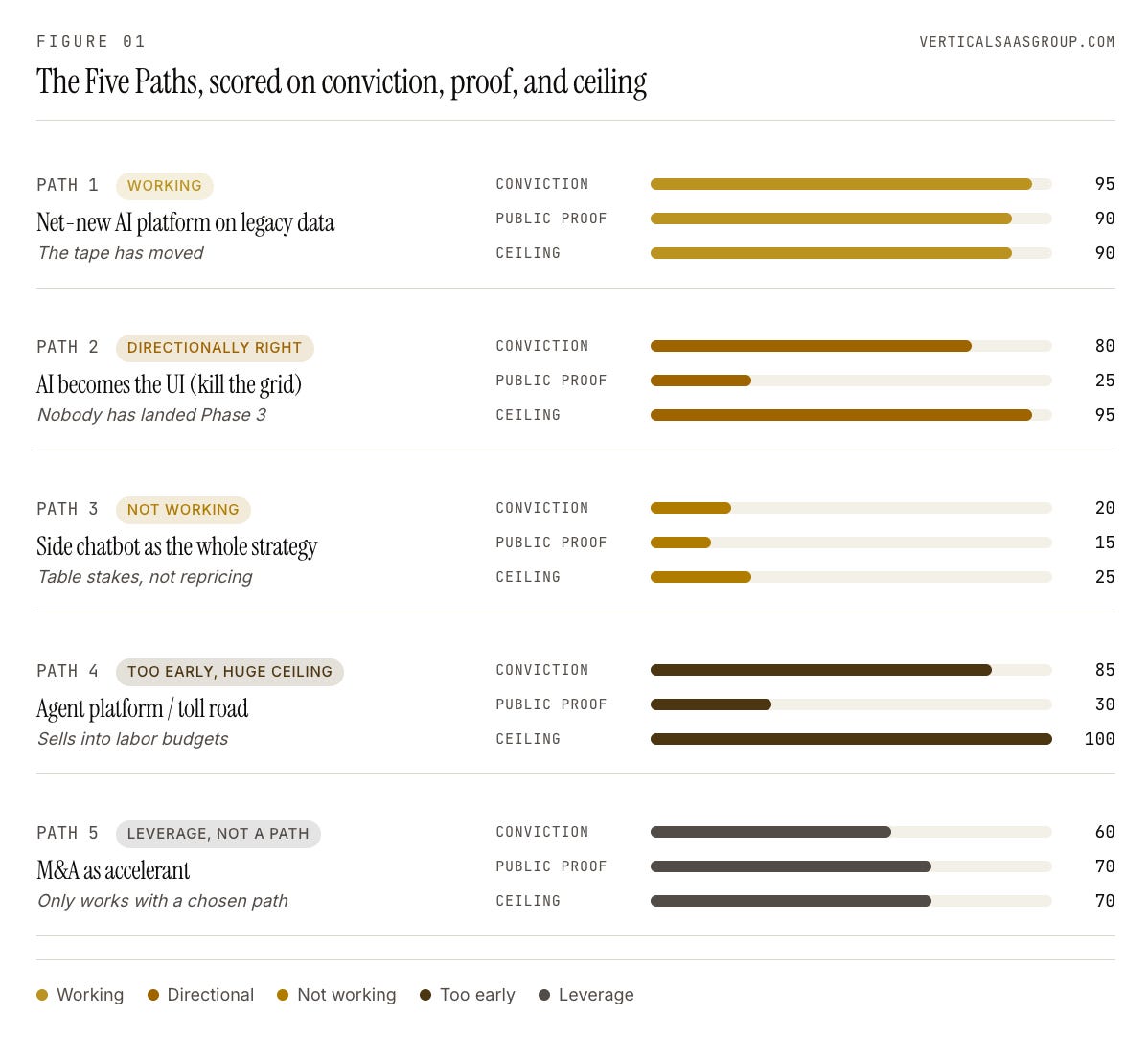
Working today: Path #1. Fin, Realm-X, Lumina, Clio, Cognite. This is where the tape has moved.
Directionally right, nobody has landed it yet: Path #2. Most incumbents ship copilots and call it transformation. Whoever gets to Phase 3 first defends against AI-native attackers.
Not working today: Path #3 as a standalone strategy. If your entire AI strategy is a chat panel, the market has already told you what it thinks.
Too early, high conviction on the ceiling: Path #4. ServiceTitan is proving the agents work. Nobody has proven the platform-of-agents thesis. Next cycle, not this one.
Leverage, not a path: Path #5.
The market is paying for AI that captures work while getting priced like it was built yesterday. It is not paying for chat panels. And it is waiting to see who has the courage to blow up their own UI before someone else does it for them.

How to decide which path and why. Six questions.
1. Is your data actually proprietary and asymmetric? The gate for Path #1. If your data is generic, you will build a wrapper and the market will price it as one.
2. Can your current pricing model absorb outcome-based AI monetization? If per-seat SaaS pricing cannot flex to per-outcome economics, that is your Path #1 signal. Fin at $0.99 per outcome could not have existed inside Intercom’s per-seat structure.
3. Are you willing to blow up your own UI? The Path #2 gate, and a leadership question, not a product question. If you cannot commit to killing the 1,000-button grid view, you are doing Path #3, not Path #2.
4. Who is the new buyer? Same MSA signer → Path #2. New operational buyer (COO, VP Ops, RevOps) → Path #1. Labor line owner → Path #4.
5. What can your customer actually absorb? Regulated or fragile customers do not want a UI rewrite next quarter. Give them a Path #1 product they can pilot without touching the SoR.
6. One budget line or trying to be a platform? Path #4 only works if you have real evidence customers want multiple agents. Otherwise land one outcome, then expand. Earn the right to be a platform before you claim it.
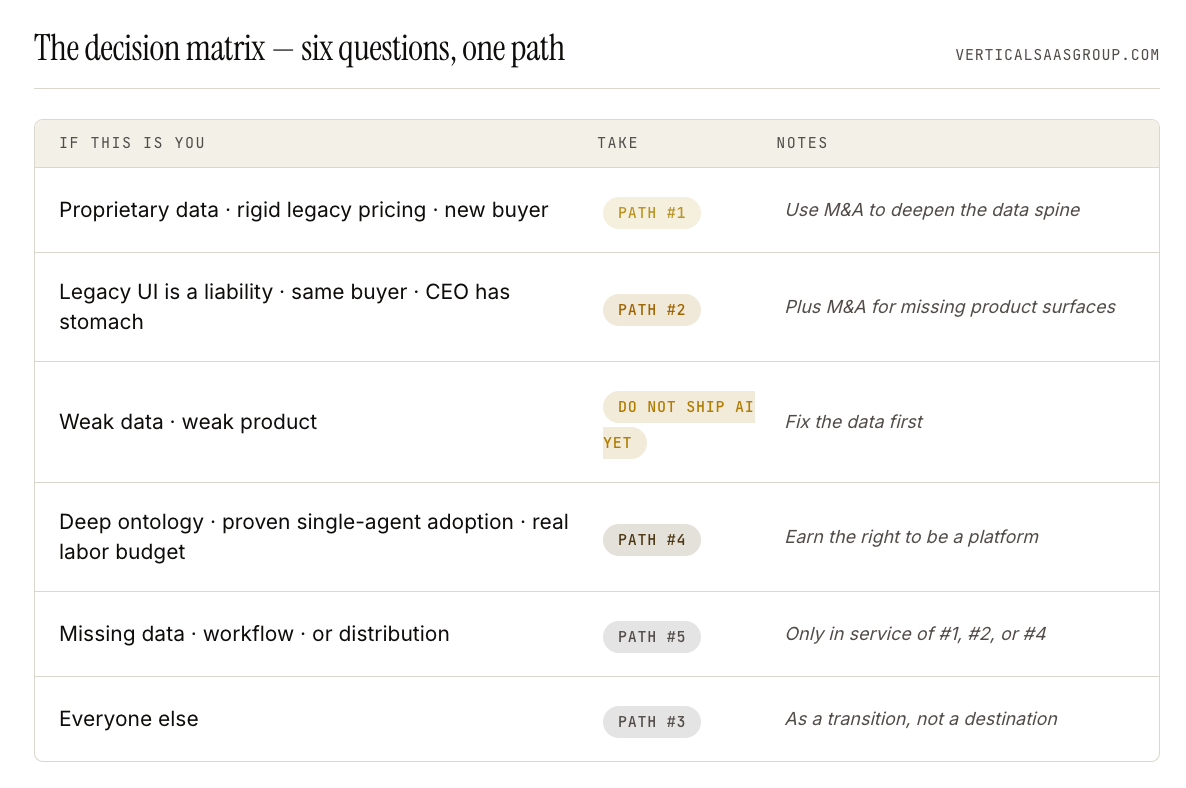
Honest cross-tabulation:
Proprietary data, rigid legacy pricing, new buyer → Path #1
Legacy UI is a liability, buyer lives inside the software, CEO has the stomach → Path #2
Weak data → do not ship AI yet
Multiple workflows, proven single-agent adoption, labor budget → Path #4
Missing workflow, data, or distribution → Path #5 in service of #1, #2, or #4
Everyone else → Path #3 as a transition, not a destination
If your first instinct is a chatbot, wrong path. If your first instinct is to figure out what asymmetric data you own, or what your product looks like when the grid view is gone, right path.

Cognite (Vertical AI For Manufacturing): How a Norwegian oil company accidentally built one of the best AI platforms in the world
Most people first heard of Cognite in June 2026 when Schneider agreed to buy it for $3.1B.
Almost nobody knows how it got built…
The problem that could not be bought (2014-2016). In 2014, Karl Johnny Hersvik became CEO of what would become Aker BP. Mathematician. Software background. He mapped every piece of software the company used and found the same ugly answer everyone in industry finds: less than 1% of sensor and operational data was actually being touched by a decision-maker. He scanned the market for a solution. There wasn’t one. Every vendor solved a slice. Nobody solved the substrate.
Meanwhile, Aker ASA (Aker BP’s parent conglomerate) approached John Markus Lervik. Lervik had co-founded FAST Search & Transfer in 1997, sold it to Microsoft in 2008, then founded Cxense and taken it public. Two software companies, two exits, deep in enterprise search and data infrastructure.
If you made it thus far, go check out the 2026 Vertical Software Summit. We’ll have 400+ vertical founders/operators/investors in Miami in November. Two days,
6+ billion dollar vertical Founders/CEOs.
The Vertical AI event of the year.
Aker asked Lervik to help with their strategy for the “fourth industrial revolution.” He sat down with the CEO of every Aker portfolio company plus 50 other industrial CEOs and came back with a blunt answer: this is not an application problem, not an AI problem, a data problem. IT and OT are behind a wall. Fix the wall, everything else becomes possible.
Aker didn’t take the memo. They asked him to run it. Cognite was incorporated December 7, 2016, with Lervik as CEO, alongside co-founders Geir Engdahl and Stein Kristian Foss. Aker BP was customer zero before there was really a product.
The pre-AI product (2017-2020). Cognite Data Fusion was ugly, boring, and important. Industrial DataOps. Connecting OT and IT data. Contextualizing sensor streams, engineering docs, and time-series data into a unified model. Building a living industrial knowledge graph. Then digital twins on top.
Lervik was blunt about what it required: if you took the 1,000 best engineers in Silicon Valley and dropped them on this problem without industrial domain expertise, they would fail. The team pulled from 61 nationalities, splitting roughly between software engineers and industrial domain experts hired directly out of operations.
The GTM most people missed. No SDR army. No outbound sequences. No PLG hooks. Captive-anchor land-and-expand.
Aker BP customer zero. Then Equinor, Statoil, Statnett, Aker Solutions across the Norwegian industrial ecosystem. Then bp, OMV, Aramco. Then Mitsubishi and Idemitsu. Every deployment co-designed against real assets. Aker ownership gave Cognite standing invitations into customer conversations across an entire ecosystem.
The CS motion was Palantir-style. Forward deployed engineers, not classic CSMs. Cognite still hires Senior Field Engineers with 3+ years hands-on in oil, gas, or process manufacturing. Not a call center. A services team disguised as engineering.
The capital story before anyone cared about AI. Accel came in early. TCV led a $150M round at a $1.6B valuation in May 2021, one of the largest SaaS rounds in Europe. Read that 2021 press release carefully. The word “AI” barely appears. The pitch is “modern industrial data management.” Cognite was raising unicorn money for infrastructure work most people found deeply uninteresting.
The Robot Dog moment tells you where the product was really pointed. November 2020: Aker BP and Cognite deployed Boston Dynamics’ Spot on the Skarv installation in the North Sea. Cognite Data Fusion made the images, scans, and sensor data actionable in real time. Public reaction: “cool robot.” Real signal: Cognite was quietly building the operating layer for autonomous industrial work.
The CEO handoff (2022). In April 2022, Lervik stepped aside. This is where founder-led companies can break. Cognite handled it well.
Girish Rishi came in from JDA Software, which he had spent five years converting from a legacy on-prem supply chain vendor into Blue Yonder, later sold to Panasonic for ~$7.1B. Rishi’s specialty: taking a deeply technical industrial software company and turning it into a commercial machine. Lervik stayed on as Chief Strategy & Development Officer. Founder didn’t leave. Founder made room.
Seven months later, ChatGPT dropped.
The cutover (2023-2025): the Path #1 move. Most industrial software companies froze. Some bolted on RAG chatbots (Path #3). Cognite did neither. They ran Path #1.
June 15, 2023: Cognite launched Cognite AI inside Cognite Data Fusion. A generative AI accelerator layered on top of six years of industrial data infrastructure. RAG over private industrial data. Copilots inside Industrial Canvas. Low-code app creation from natural language. The launch explicitly named the problems most AI vendors were failing on: hallucinations, data leakage, access control. The substrate was reframed as the reason the AI actually worked.
Then came the real Path #1 move. Cognite Atlas AI launched as a separately branded, low-code industrial agent workbench. New name. New product surface. New pricing narrative. Own landing page. Own positioning as “the only low-code industrial AI agent workbench.” All of it sitting on top of Cognite Data Fusion, which stayed the durable legacy substrate.
Just like Fin sits on top of Intercom’s data. Just like Realm-X sits on top of AppFolio’s. Just like Lumina sits on top of RealPage’s. The pattern is exact.
By September 2025, Cognite disclosed production usage of Atlas AI across Aker BP, ADNOC Offshore, Celanese, Hess, HMH, Idemitsu, and Tokuyama, with SLB and Radix building on top. Aker BP publicly reported Atlas AI agents reducing engineer time on root cause analysis by over 70%. Real operating outcome on real North Sea assets. That is the Path #4 flavor showing up inside a Path #1 architecture, which is the exact evolutionary arc I described earlier.
The payoff (2024-2026). 2024: nearly $100M ARR, up 38% YoY. 29 new logos. $23M in expansion, 41% outside oil and gas. MAU up 98%. HQ moved to Phoenix, domicile to the Netherlands.
2025: revenue crossed $170M with 36% ARR bookings growth.
June 30, 2026: Schneider Electric announced it would acquire Cognite for $3.1B in cash, folding it into AVEVA. Schneider’s CEO Olivier Blum said it directly: they were buying a “truly industrial-grade AI platform” built on “a unified industrial data model.” Aker shares jumped nearly 7%.
$1.6B in May 2021. $3.1B in June 2026. Roughly a doubling through a period where most late-stage software valuations were cut in half. That is the Path #1 re-rating in numbers.
Let’s assume they were at ~$200M of ARR today, they got bought for 15X revenue when only growing ~30%. If if they would have not embraced AI they’d probably be worth 2-3x ARR. Think about that for a second…
What Cognite teaches the framework.
Cognite is the cleanest end-to-end proof of the whole newsletter.
One, they had asymmetric proprietary data before they had “AI.” Six years of OT/IT contextualization, knowledge graph, and digital twin work. That is a strong foundation for Path #1, and Cognite is the industrial answer to what “asymmetric data” actually looks like in practice.
Two, when the moment came, they did not bolt AI onto Cognite Data Fusion and call it done. They spun up Atlas AI as its own product with its own brand and its own pricing narrative. Textbook Path #1.
Three, they used Path #4 mechanics inside Path #1 architecture. Preconfigured agent templates. Third-party partners building on top. The earliest hint of a real vertical agent ecosystem, but hosted inside a coherent AI platform.
Four, they exited via Path #5. Schneider bought Path #1 because they could not have built the substrate in time. Every serious industrial software vendor now has to react to that transaction.
AI does not rescue weak substrates.
It amplifies whoever already did the boring, hard work.
Cognite did the hard work first.
Then they ran the exact play the market is now paying for.
The market caught up second.
Do me a solid and forward to a friend :-)