

Today’s newsletter is sponsored by Xplor Pay. Launching embedded payments is a major milestone, but it’s only the beginning of the opportunity. Many software companies see merchant adoption plateau after launch, not because of their technology, but because they stop investing in their payments business.

Built from firsthand experience growing and scaling more than 20 vertical SaaS platforms, this article explores what high-performing software companies do differently to increase merchant adoption, convert existing customers, and create long-term enterprise value. Read the article here.
AI Roll Ups, Two Years Later
Two years ago, this model didn’t have a name.
I wrote about it as “venture buyouts.” Slow Ventures called them “GBOs.” Matt Brown had a taxonomy. Nobody knew what to call the thing.
Now the market has settled the naming question. They’re called AI Roll-Ups. And in the last twelve months they’ve gone from a fringe experiment to arguably the most-funded NEW category in venture (outside of pure AI plays of course).
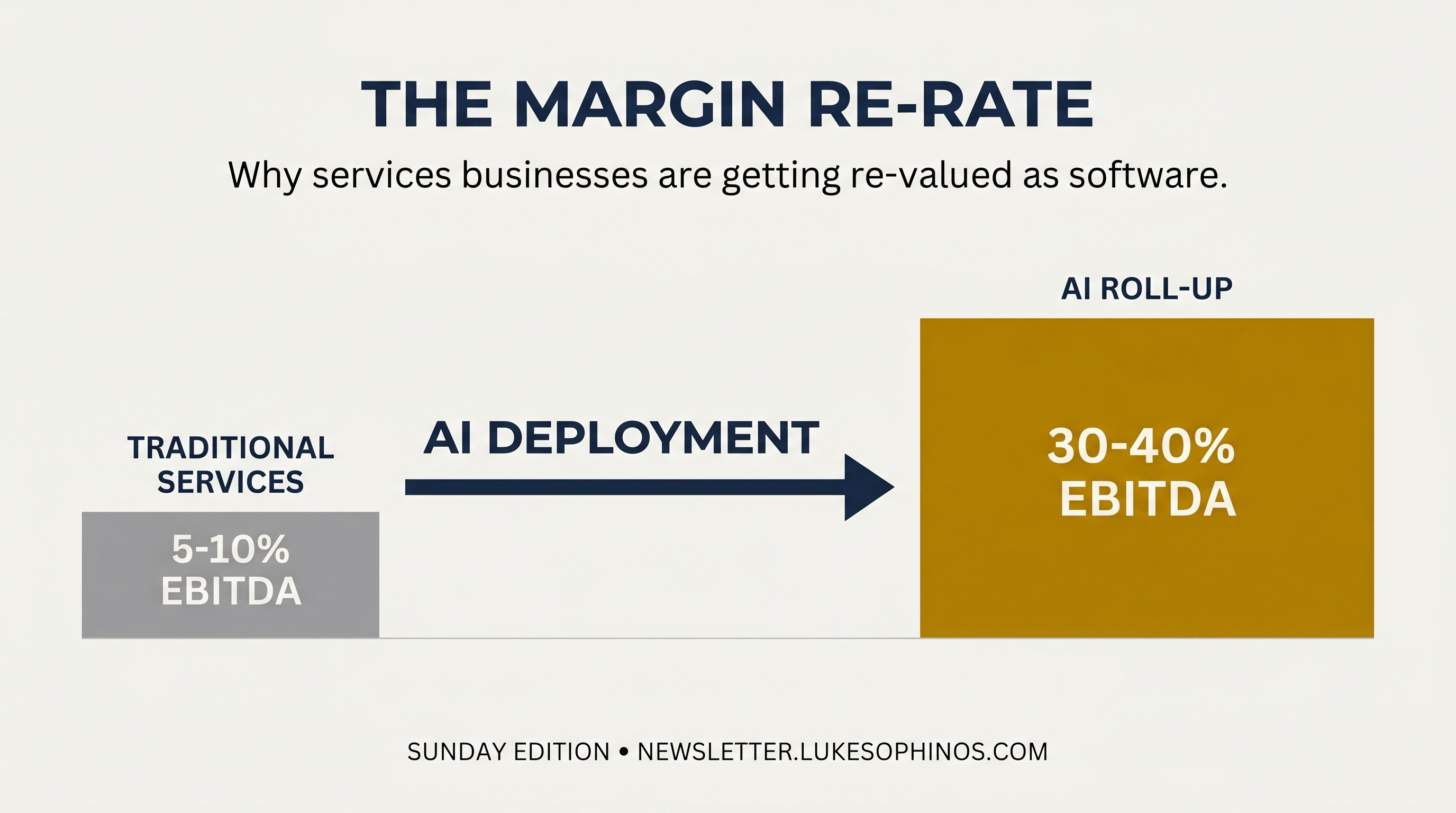
The original thesis was simple: buy operating businesses in fragmented, labor-heavy industries, layer proprietary AI on top, re-rate the margin profile from services (5-10% EBITDA) to software (30-40% EBITDA), and compound at venture scale.
That’s still the thesis.
What’s changed is that it’s now real.
The names on the board are no longer hypothetical.
The current landscape:
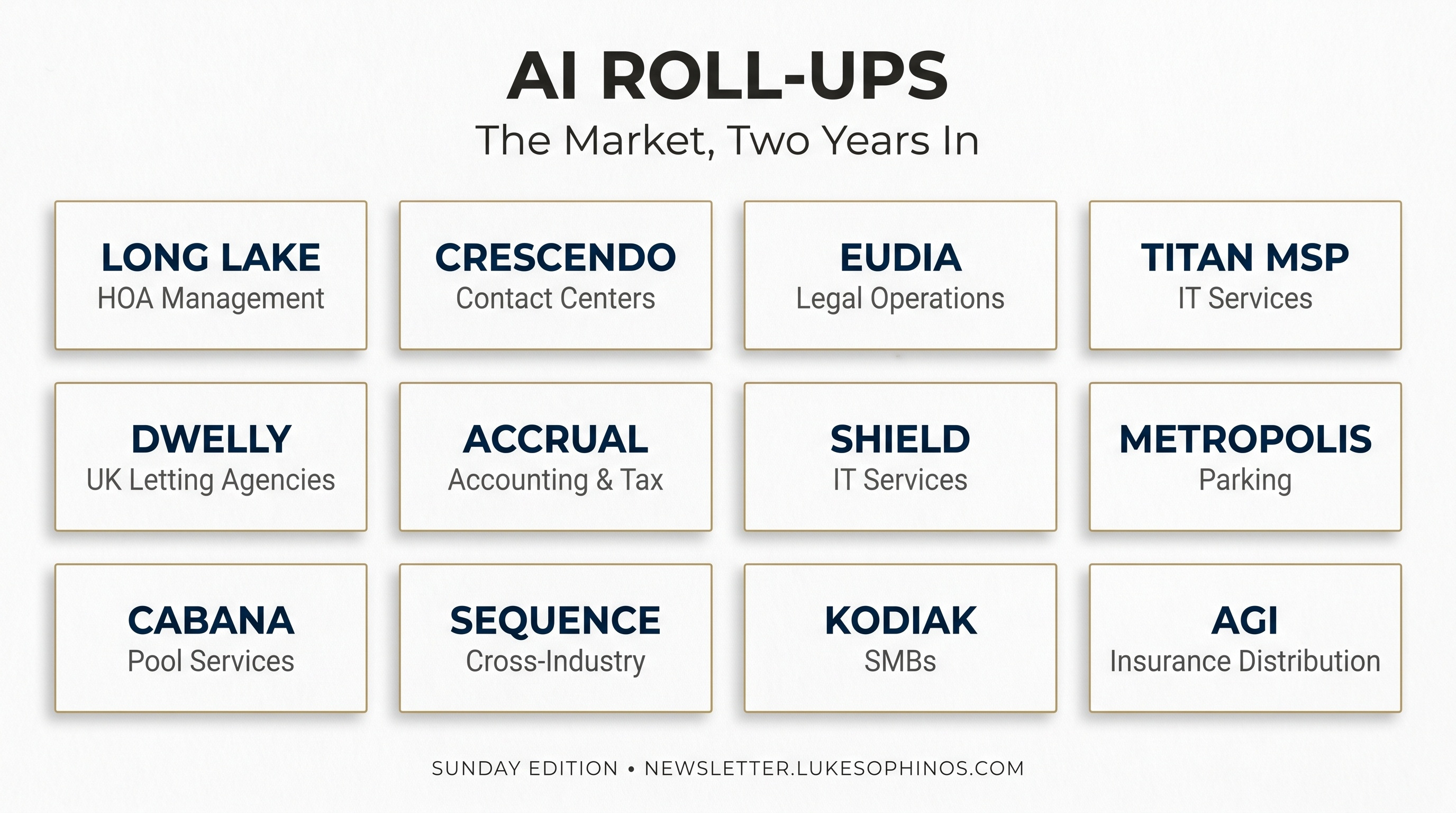
Long Lake (HOA management, General Catalyst): $670M raised, 18 acquisitions, reportedly ~$100M EBITDA in under two years.
Crescendo (contact centers, General Catalyst): $500M valuation after acquiring PartnerHero. Charging per resolved ticket, not per hour. 4x margin advantage over traditional BPO.
Titan MSP (IT services, General Catalyst): $74M and the acquisition of RFA, an MSP with 400+ financial services clients.
Dwelly (UK letting agencies, General Catalyst): $93M. Maintenance resolution times cut from 50 days to 20. EBITDA margins doubled where fully deployed.
Accrual (accounting, General Catalyst): $75M to automate tax prep.
Shield (IT services, Thrive Holdings): $100M from Thrive, led by ex-Palantir CIO Jim Siders.
Metropolis (parking, Slow / 3L / Eldridge): $1.7B Series D, $1.5B acquisition of SP+. The original proof point.
Cabana (pool services, Asymmetric): The capital-efficient model. ~$10M raised, $12-15M revenue, $4M+ EBITDA. Buy first, build second.
Sequence Holdings (cross-industry, 8VC): Stealth. Scale, Cognition, and Lone Pine alumni.
And more!
And now AGI in insurance distribution. More on that below.
What the last twelve months actually taught us:
1. The math is not universal. Long Lake and Crescendo are the poster children. But you don’t get to reference-check a category on its two best names. Renovo Home Partners collapsed. Multiple other bets are quietly stalling. The winners are winning very publicly. The losers are being repackaged as “portfolio adjustments.”
2. Distribution is the moat, not the model. Anyone with capital can copy the playbook. What they can’t copy is a founder who spent 15 years in pool services, an operator who scaled Keystone to $5B, or a client roster that took decades to build. The AI isn’t the moat. The base is.
3. Speed is the killer. Every single failure mode I’ve seen in this category traces back to acquisition pace outrunning integration capacity. Buying is easy. Integrating six businesses in twelve months while also building an AI platform while also running an OpCo is where companies die.
4. The PE-VC handshake is happening. This is the most underrated shift. Two years ago, PE and VC firms only interfaced when one was selling to the other. Now Atomic is co-investing with Rockbridge on AGI. General Catalyst is running a private equity motion inside a venture fund. The wall is coming down.
5. Not every “AI roll-up” is one. A lot of what gets labeled AI roll-up today is a traditional PE roll-up with a ChatGPT wrapper on the pitch deck. The real ones share three traits: proprietary AI built before/during the first acquisition, a services vertical where AI can do 30-70% of the work, and an operator who has actually run something in the industry.
The uncomfortable observation:
The category is now crowded enough that pattern-matching alone won’t work. General Catalyst’s $1.5B allocation, Thrive’s $1B vehicle, Khosla, Lightspeed, 8VC, Slow, Atomic, and a dozen more are all deploying against variations of the same idea. The alpha is no longer in seeing the model. It’s in picking the right vertical, the right operator, and the right structural setup.
The best of these will look like software companies in a decade. Most will look like PE-owned services businesses with better dashboards.
The interesting question is not whether AI roll-ups work. They clearly do. The question is whether they can become venture-scale. A lot of them will end up as PE exits. But a few will compound into public company machines.
That’s the actual bet.

Excited to unveil AGI today…
American Growth Insurance that is 😃

After stepping away from Portico (FKA known as CourseKey) after our sale to Private Equity, I became obsessed with AI-Powered Roll Ups.
Jack Abraham, Chester Ng, Michael Stenlick, and Brandon Zhang of Atomic all shared the excitement and we began a journey of analyzing industries where we felt AI could transform the underlying business and create the opportunity for a venture-scale outcome.
We spent nearly a year analyzing 1,000+ industries and settled on one…
Insurance Distribution.
The surprising thing about insurance brokerages was that, unlike other industries, for every single front-office person (the ones actually interfacing with the customers) there was an army of back-office individuals doing the dirty work to support them. I had never seen the level of ratios we saw here. We asked the question, “What if AI could do the dirty work? What if AI could move the back office headcount into the front office so that nearly EVERY employee was spending time with customers?” That seemed like an important and exciting opportunity.
We rolled up our sleeves and built an AI platform to prove the thesis. We studied every workflow, we automated as much as we could, and we launched tooling at ~10 different agencies across the United States. The results were incredible. Folks were spending SO MUCH more time with the customer and all the fundamental business metrics were substantially improving as a result.
We did not know insurance and we did not know M&A. We knew technology. So we had to go out and find the perfect partners to pull this off.
I feel so fortunate to say that we did that.
After talking to hundreds of prospective Founder/CEO’s we met Brian Morgan. Brian has spent his entire career building and scaling companies in the insurance distribution space. Most recently, he saw an incredible ramp up at Keystone Agency Partners as the Chief Revenue Officer. This business went from $0 to $5B in enterprise value in <5 years. It’s a beautiful case study in the classic roll-up playbook in the insurance market. Brian saw the opportunity for a new type of Roll Up. One powered by AI.
Brian connected us with Rockbridge Growth Equity, a Private Equity firm founded by Dan Gilbert of Rocket Mortgage. Tony Pulice, Partner at RGE, blew us away. His humility, his acumen, his maniacal focus on strong values, and to boot he had already scaled and exited an incredible insurance brokerage, HighStreet, and was the key board and investment partner there as it got off the ground and scaled. Tony was focused on finding a company that met the same thesis, something that was different from the typical insurance agency roll-up. It was a match made in heaven!
So today, we’re so excited to come out of stealth, after ~2 years of hard work, with a $70M round backed by Rockbridge Growth Equity and Atomic. I believe this is a first-of-its-kind partnership between leading Private Equity and Venture Capital firms. These two groups typically don’t interface unless they are selling a company to one other. But combining PE’s M&A acumen with VC’s AI focus, and most importantly, a dream team of operators and executives, is so damn exciting…
AGI is acquiring agencies across the country and deploying incredible AI technology to substantially improve the customer experience, which in turn greatly improves the underlying business. We’re hiring across a multitude of roles.
I’m honored to serve as a Co-Founder, Advisor, and Board Member of AGI and look forward to supporting the team build the future of this industry.
Thanks to Axios for dropping the news.
Can read the full announcement at the link here.
Onwards!

How To Found an AI Roll-Up
A ton of folks want to run this playbook right now. Most people are going to run it wrong. Here’s the actual sequence, based on two years of doing it.
1. Find the right industry.
This is 80% of the early work. Get it wrong and nothing downstream matters.
You are looking for the intersection of three things:
AI can significantly move the needle across the entire business, not one or two functions. If AI only helps the sales team, that’s a feature, not a company. You need a vertical where automation can compress cost structure across the whole P&L. Front office, back office, ops, finance, everywhere.
Classic PE roll-ups already work here. If PE has been quietly making money in the space for a decade, the fragmentation is real, the acquisition math is proven, and the debt markets understand the assets. If PE hasn’t touched it, ask yourself why.
No venture-backed AI roll-up exists in the vertical yet. You want to be early. There are so many of these in IT. Tough to raise capital when so many are going after the same treasure.
Also test for venture scale. Can this actually get to $1B+ in enterprise value in a reasonable timeframe? A lot of these industries can produce beautiful PE-style outcomes but not venture outcomes. Be honest with yourself about the ceiling before you start.
We looked at 1,000+ industries before we picked insurance distribution. That was not a marketing number. That was the work. And it took a year.
If you made it thus far, go check out the 2026 Vertical Software Summit. We’ll have 400+ vertical founders/operators/investors in Miami in November. Two days,
6+ billion dollar vertical Founders/CEOs.
The Vertical AI event of the year.
2. Build the product first.
Slow Ventures has been the loudest on this, and they’re right. Prove the thesis with technology before you deploy a dollar into M&A.
This does two things. It forces you to actually understand the workflow, not just theorize about it. And it gives you something concrete to show investors, operators, and eventually acquisition targets.
The trap here is building the product in isolation. You need real operators giving you real feedback on real workflows. Find 3-5 friendly companies, cozy up to them, throw them some equity or free tooling, and embed. Watch the actual work. Do not build from a whiteboard.
3. Deploy it in the wild and prove it moves the numbers.
The product working in a demo means nothing. The product working inside 5-10 live operators with measurable improvements to fundamental business metrics is the entire ballgame.
We deployed at ~10 different agencies before we bought a single one. The results told us the thesis was real. If the results had been mediocre, we would have gone home. That’s the whole point of this step.
Pick 2-3 metrics that actually matter to the business (revenue per employee, time-with-customer, retention, close rate, whatever the vertical cares about). If AI doesn’t materially move those, you don’t have a roll-up. You have a services company waiting to happen.
4. Buy your first company and prove the thesis on your own P&L.
There’s an infinite difference between “the software works at a customer” and “we own the P&L and the numbers moved.” VCs know this. Operators know this. You need to know this.
The first acquisition is a proof point, not a scaling event. Pick something manageable. Deploy your tech. Show that on your own books, the thesis holds. This is the artifact you use to raise the real capital.
A few things I’d think about as well:
Get as much seller financing as humanly possible. Debt is dangerous. I’ve watched companies collapse on this exact model because they leveraged up too fast.
Structure the deal so the seller stays involved. Local relationships and institutional knowledge don’t transfer through a data room.
Don’t overpay. You are trying to prove the model, not win a bidding war.
5. Recruit team and investors from inside the industry.
This is what I’m seeing most tech founders ignore. You will not out-execute a category without operators who have already scaled in it.
For AGI, we knew tech but we did not know insurance and we did not know M&A. So we went and found Brian Morgan, who had scaled Keystone as CRO (They went from from $0 to $5B in enterprise value in ~5 years). We went and found Tony Pulice at Rockbridge, who had scaled and exited HighStreet.
Same rule applies to your investors. You need long-term patient capital. You need partners who have run M&A at velocity. You need people who understand both the venture side and the buyout side.
The magic in AGI was pairing Atomic (venture, AI expertise) with Rockbridge (PE, insurance M&A acumen). That combination is very hard to fake. It also barely existed as a structure two years ago. It’s a very unique model that was complex to put together.
6. Scale like crazy.
Now you run the playbook. This is where operational discipline separates the winners from the ones you’ll never hear about again.
Things to watch:
Integration capacity is the ceiling on acquisition pace. Every failure I’ve seen in this model comes back to this. Do not buy faster than you can integrate. If integration takes 6 months and you’re closing every 3, you’re building a landmine.
Standardize the operating system before you scale the M&A. Common playbook, common tech, common metrics across every acquisition. Otherwise you own a portfolio, not a platform.
Keep local brand equity where it matters. Especially in relationship-driven industries like insurance. The customer doesn’t want to know they got acquired.
Track the AI margin impact obsessively. Your entire venture investment thesis rests on the re-rate. If margins aren’t moving with deployment, something is broken and you need to know immediately.
Stay disciplined on debt. Just be careful with debt. It can take out your business. Don’t over-lever!
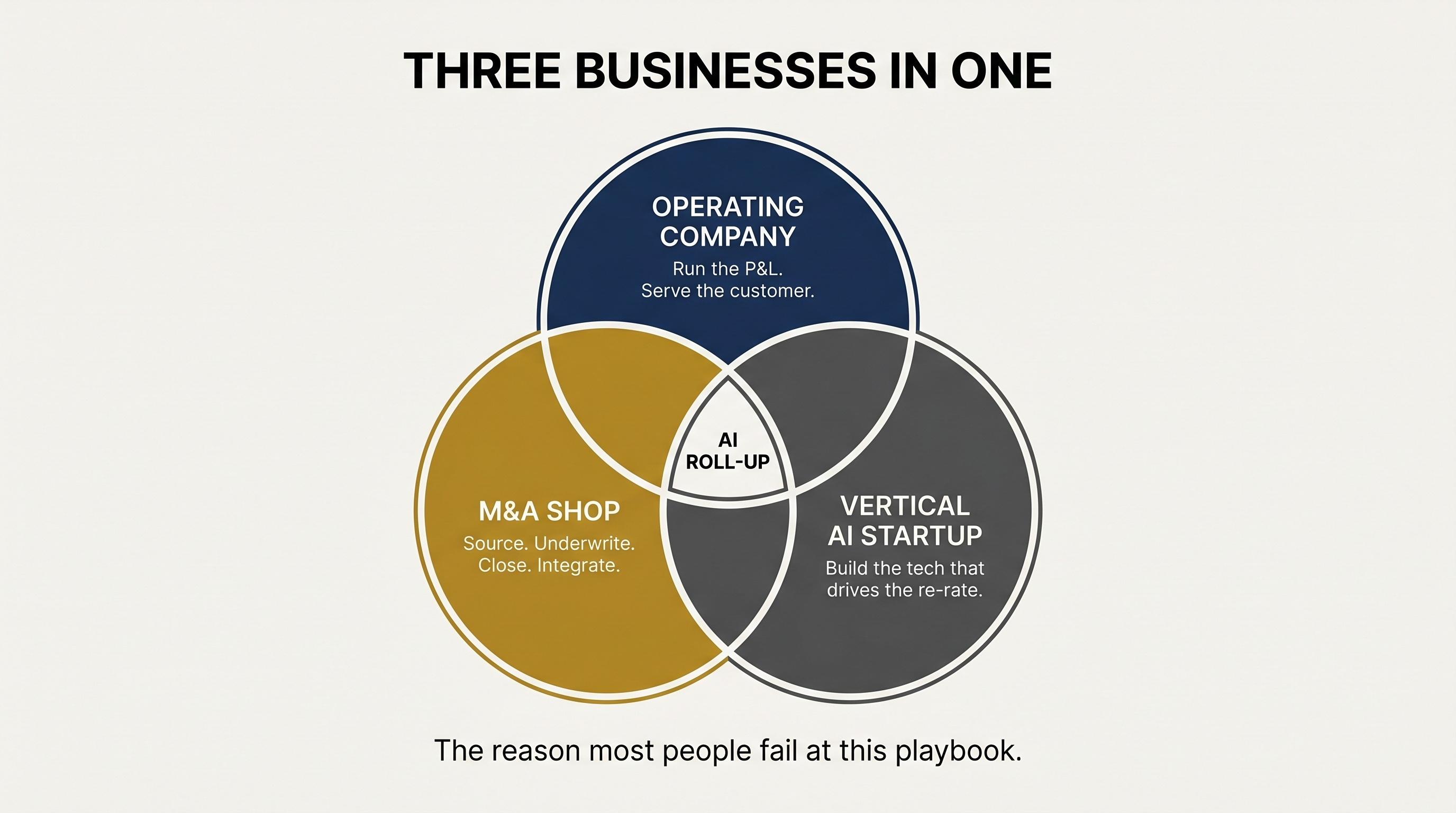
One more thing worth saying out loud. This is not a playbook for the faint of heart. You are running three companies at once: an operating business, an M&A shop, and a vertical AI startup. Each of those is a full-time job. Most people cannot do it. That’s exactly why the returns are available.
If you can do it, and you picked the right vertical, the outcome is enormous.
If you can’t, the wreckage is painful…
Tread wisely !
Do me a solid and forward to a friend :-)