

Sell the fish, not the pole.
SaaS has no inherent value in and of itself. It’s only valuable insofar as it helps a human get a job done. With AI, we now have technology that can do a lot of the job. So we’re moving to a world where the technology vendor isn’t selling a tool, they’re selling an outcome. Or as we say, you’re not selling the pole, you’re selling the fish.
Emergence’s Jake Saper on the token-maxing hangover, why AI-Native Services own the deepest data moat in the economy, and the uncomfortable question every SaaS founder should be asking this quarter…
The token-maxing hangover just kicked in.
Three months ago it was a badge of honor to brag about your monthly token bill. The bigger the number, the more “AI-native” you sounded on the earnings call. It turns out that token spend is a spectacularly bad proxy for value created. Boards figured that out roughly in unison, and the hangover is now shaping every meaningful vertical AI decision I’m watching this quarter: pricing, model choice, org design, even who you put on your board.
Sitting underneath the hangover are three forces colliding at the same time. Open source model quality has crept to within a handful of months of the frontier. Inference got so cheap that the same job now costs roughly a tenth of what it did a year ago. And services; 80% of GDP, the part of the economy the Valley loves to ignore, are quietly being rebuilt as software delivered by humans-in-the-loop. Any one of those would matter. Together they rearrange the vertical AI board.
To sort through it Nic spent an hour with Jake Saper, GP at Emergence Capital. Jake and the Emergence team called SaaS early, called vertical software early, bet on open source back in 2023 (Together AI, now at an $8.3B valuation), and coined the phrase “AI-Native Services.” He is the calmest voice I know on the topic and, refreshingly, the least invested in his own thesis being right in the shortest possible timeframe. What follows is his read on where value pools next, and the playbooks I’d steal as a founder, operator, and investor.

This Weeks Vertical Titan:
Jake Saper (Partner @ Emergence)
Jake has been at Emergence for twelve years. Board seats include Ironclad. Early checks into Zoom, Veeva, and a portfolio that reads like a decade of correct calls on business-model change. Emergence has a habit of naming the model before the market does — “SaaS” (originally “technology-enabled BPO,” which mercifully did not stick), then vertical software, and now AI-Native Services. When Jake tells you the frontier gap is closing and the money is moving downstream, it is worth pausing.
Start with the shape of the model layer, because everything else is downstream of it. In 2023 the closed labs looked untouchable. By mid-2026 the picture is very different — the most recent open-source releases are a handful of months behind the frontier, they are free to fork, and the weights are open, which means you can actually fine-tune them on your proprietary data. That last point is doing quiet violence to the moat story the frontier labs sold their investors.

The behavioral shift Jake keeps seeing inside enterprise buyers is a multi-model posture. Frontier labs get reserved for the highest-intensity, judgment-heavy calls. The majority of runs, the boring 80%, get routed to a fine-tuned open-source model at a fraction of the cost. Harvey, Legora, and the other well-funded agentic companies are pouring engineering into fine-tuning their own open-source weights precisely so they can separate their fate from any one lab’s pricing page.
“When intelligence gets this cheap, the model becomes less of a moat. The interesting question is where value actually goes.”
Which is where the model labs’ recent behavior starts to look revealing. Anthropic and OpenAI are hiring vertical leaders iw. Ironclad’s Jason Boehmig went to run legal at OpenAI and is quietly shipping vertical-flavored products. Some will land. Most, Jake suspects, will feel like straw-grasping. Building “Claude for Science” is not the same as spending five years learning why a pharma researcher won’t switch off her current workflow. The lab has near-infinite capital and can absolutely hire the specialists. But specialization is a different company, with a different cap table and a different product culture, and history has not been kind to the mothership that tries to run it in-house.
The more interesting move is DeployCo — OpenAI’s spinout that uses FTEs plus AI to help enterprises actually deploy the models. Emergence invested. The read is that deployment work is directly adjacent to selling tokens, so the strategic logic holds. On a meta level, DeployCo may itself become one of the largest AI-Native Services businesses in the world, using AI to deploy AI. There is a joke in there about recursion and a serious point about where the durable margin lives.
The reason enterprise buyers are wary of handing everything to the labs is not paranoia, it is math. If you’re Pfizer and you give OpenAI all your molecular data, you have handed the party that is now shipping vertical products your defensibility. Fine-tuning an open-source model on your own infrastructure looks a lot more sensible. The frontier labs, in trying to expand their surface area, are the reason their best customers now want an exit.
Agentic Software vs. AI-Native Services
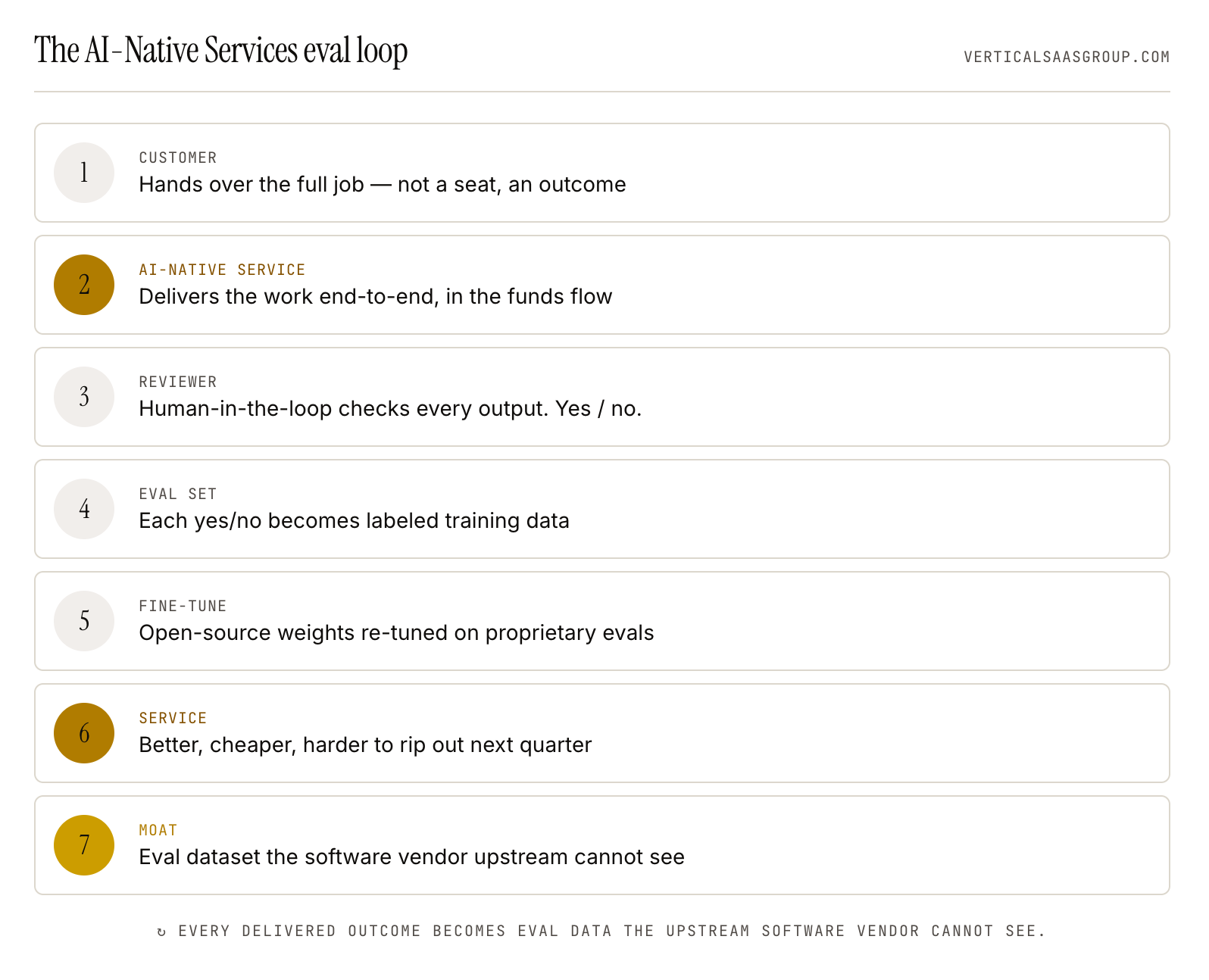
Jake thinks an AI-Native Services business (one that owns the full outcome end-to-end), has a better data moat than an equivalent agentic software company. The logic is if you sell software into a fund administrator, your view of the transaction is truncated. You see the piece your product touched. You do not see how it was reviewed, whether the customer accepted it, or what happened three months later in the audit. If you are the fund administrator, every delivered output generates an evaluation event, a human sign-off, and eventually a defended audit. That is a labeled dataset money cannot easily buy.
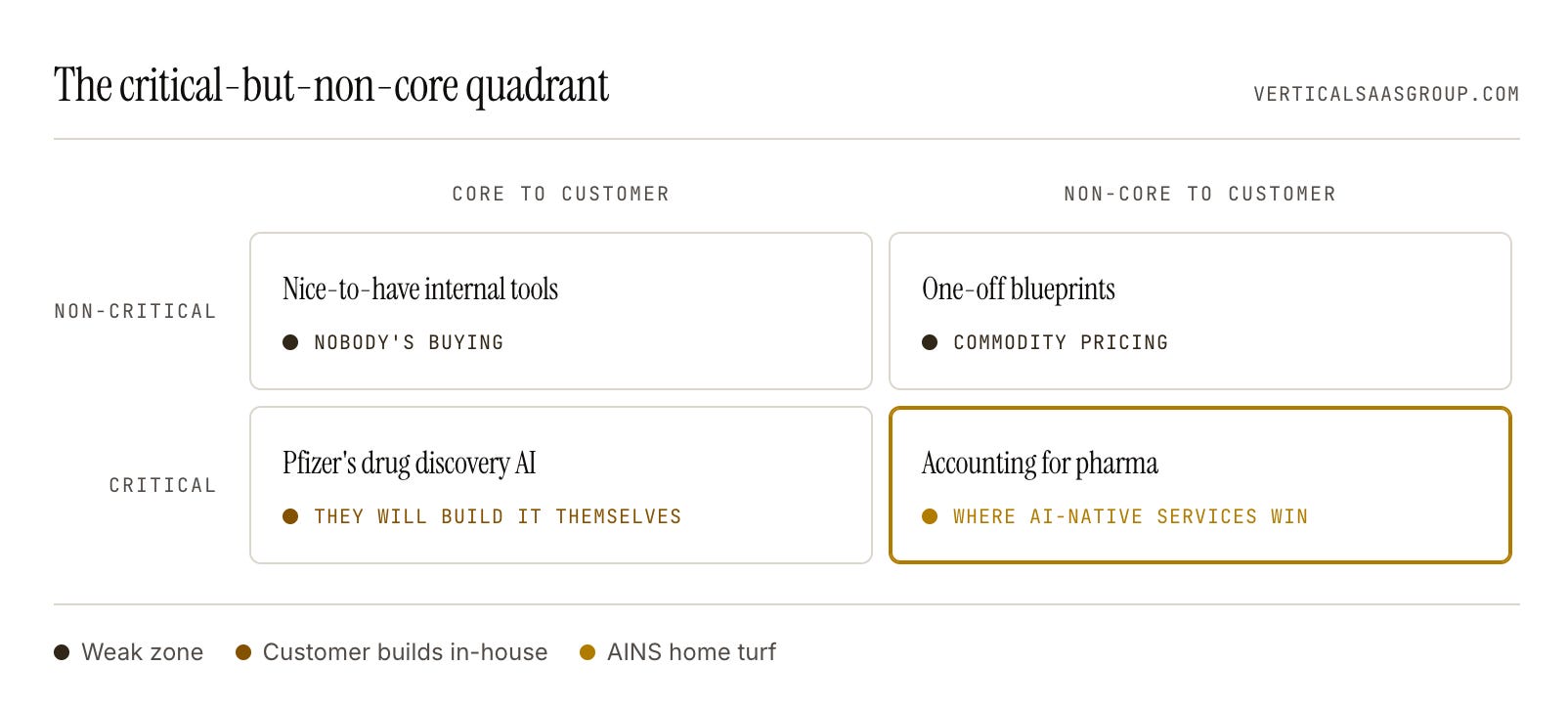
The framework Jake and his partners use inside Emergence to pick which services to chase is a simple two-by-two. Core versus non-core to the customer. Critical versus non-critical. Pfizer will never let you own drug discovery, it is both core and critical, and they will use open source to keep it in-house. Pfizer will absolutely let you own accounting, it is critical but not core, and nobody at Pfizer wakes up wanting to run an accounting department. That single lower-right box is where the most durable AI-Native Services businesses get built.
Quick PSA -
90 Days Until The Vertical Software Summit
DON’T WAIT. We are already 75% sold out.
If you want to be at the Vertical AI Event of the year where ~400 vertical software founders, operators, and investors come to gather, snag your ticket now.
The speaker line-up is a 10/10 and the entire investment community shows up.
We had to turn away 100+ folks last year who waited until the last few weeks to grab their ticket.
Don’t be that person who misses out!

Jake’s moves for building an AI-native business the labs can’t out-scale.
#01. Diversify the model spend — frontier for the 5%, open source for the rest
Every serious deployment Jake sees now — enterprise or AI-native startup — is running a multi-model architecture. The closed frontier labs handle the small share of jobs that genuinely require the top of the intelligence curve. The vast majority of runs go to cheaper, open-source models. The gap between the frontier and the leading open weights has collapsed from twelve-plus months to a handful of months, and it keeps shrinking. That changes the math on every token budget in the industry.
The infrastructure winners of this shift are already visible: Together AI, Base 10, the neoclouds serving fine-tuned open weights. The losers are anyone whose business model requires the frontier lead to stay wide. Enterprise buyers are also newly wary of pouring proprietary IP into a single lab — especially now that those labs are hiring vertical leads and launching competing apps.
#02. The frontier labs are moving into the app layer: plan for it, don’t pretend it away
Both OpenAI and Anthropic are hiring vertical leads. Jason Boehmig, Ironclad’s co-founder, just took over legal at OpenAI. Anthropic is shipping Claude for Science. The labs are also spinning up services arms — DeployCo at OpenAI, an Anthropic solutions group — to help enterprises adopt. Jake’s read: some of these vertical bets will land, most will feel like straw-grasping because the labs don’t have the workflow depth vertical incumbents spent a decade building. But you cannot assume they will fail.
#03. Beware mirage product-market fit: humans dressed up as AI is still a services shop
The single biggest risk Jake sees in the current AI-native services wave is what he calls mirage PMF. Revenue is growing fast, retention is great, customers love you — but the service is still being delivered primarily by humans. Congratulations: you built a services business and raised venture capital against it. The only real PMF signal for an AI-native services company is that the AI is performing an increasing share of the work over time, with margins to match.

A quick word from our sponsor on the Verticals podcast, Parafin. Fresh off the 2026 Forbes Fintech 50 and a new credit facility led by Goldman Sachs, they’ve now extended over $35B in offers to small businesses through platforms like DoorDash, Gusto, and TikTok Shop.
Purpose-built embedded capital for vertical platforms.
#04. Borrow credibility
Selling into a judgment-heavy service — legal, financial, medical — is a brand game as much as a product game. Nobody got fired for hiring Goldman. Nobody got fired for hiring McKinsey. The AI-native founder rarely walks in with that pedigree, which is why Jake talks about borrowing credibility. The cheapest form is hiring — put a grey-haired industry veteran in a customer-facing role, not on an advisory board where the customer knows they’re a logo. The most interesting form is frenemy partnerships with legacy vendors: they have brand and manpower, you have AI and speed, you rev-share until the relationship outgrows itself.
#05. Own the full lifecycle: the eval data is the moat
The reason Jake now argues an AI-native services company can out-moat a pure agentic software vendor: view of the transaction. A software vendor selling into a fund administrator sees a slice — the piece of the workflow their product touches. The services vendor owns the whole lifecycle. Every deliverable gets checked by a human, sent to the customer, defended in an audit. Every one of those checkpoints is eval data on the AI you built.
#06. Your competitive set is sleepier than you think
The best story from the interview was the founder who pivoted from selling agentic software into investment banks to becoming a mid-market investment bank. His two reflections were priceless. First, once he started using his own product to deliver real client work, his immediate emotion was embarrassment. You never understand a workflow until you’re the one being paid to run it
Software founders overweight the AI arms race and underweight how slowly the actual industries they’re attacking move.
Sell the fish.
Diversify the stack. Own the outcome nobody else will warranty.
If you’re building in the AI decade. and especially if you’ve raised venture capital against an AI-native services thesis — a few key areas separate the founders who compound from the ones who become case studies:
1. Sell the outcome, not the tool. Warranty the job end to end. The eval loop that comes back from owning delivery is the moat a pure software vendor never sees.
2. Run a multi-model stack from day one. Frontier for the small share of runs that require it. Fine-tuned open weights for the rest. Independence from any single lab is a feature you actively sell to enterprise buyers.
3. Hunt critical-but-non-core. Never the customer’s identity, always their cost center. Accounting at Pfizer, not the drug pipeline. MSPs, customs brokerage, paralegal work, licensed niches with real regulatory hurdles.
4. Refuse the mirage. Track percent of work performed by AI as a first-class metric. If the line isn’t trending up each quarter, you didn’t find PMF, you found a services shop with the wrong cap table.
The founders who quietly own the next decade won’t be the ones with the loudest frontier-lab partnership. They’ll be the ones who built McKinsey and Stripe out of the same team, warrantied the outcome, and turned every audit into a labeled data row on a model they own. Be that founder, and the frontier lead compressing works for you, not against you.
— Luke Sophinos
See you next Wednesday. If this one landed, forward it to someone still bragging about their token bill :-)
Thanks for reading LINEAR. I reply to every email…
Have any questions, feedback, comments? Let us know, we work for you!