

The moat is not the rule.
It is how the rule gets enforced.
Compliance has always been one of the most misunderstood wedges in vertical software. Everyone talks about it. Almost no one does it well. And in healthcare, the graveyard of AI point solutions that tried to bolt compliance onto a scribe or an RCM tool is already pretty crowded.
Which is why Zach Rosen and Brellium are worth paying close attention to.
Brellium sits in the exact middle of the healthcare revenue cycle — between the scribe and the biller — and quietly does something almost no one else is doing: turning payer compliance from a reactive, audit-driven fire drill into a real-time training loop that upgrades the entire clinical workforce. It’s a business built on a subtle but important insight: compliance in ambulatory healthcare isn’t a checklist. It’s a fractal. And the deeper you zoom in, the more non-deterministic it becomes — which is exactly where AI, network effects, and vertical depth start to compound into a real moat.
This week’s conversation with Zach is a masterclass in how to think about wedges, network effects, two-sided go-to-market, outcome-based pricing (and why it’s often a bad idea), and what it actually takes to build a category-defining vertical AI business inside one of the most closed ecosystems in tech.
Let’s get into it…
This Weeks Vertical Titan:
Zach Rosen (Co-Founder & CEO @ Brellium)
Zach Rosen is the co-founder and CEO of Brellium, an AI-powered clinical compliance platform serving ambulatory healthcare providers across all 50 states and multiple lines of care.
Zach didn’t grow up dreaming about compliance. He grew up dreaming about sports, and later, about investment banking — a career path he says he pursued “for reasons I’m not sure I fully understood at the time.” He figured out pretty quickly that finance wasn’t for him, and while at school in the Bay Area, he watched peers his age build wildly impactful companies. That environment reframed what was possible, and he took what he calls “an exact 50/50” — if finance was the wrong path, building a business was the opposite. That was the extent of the strategic reasoning at the time.
His first company was Sapient, which he built with a few classmates and ran for a little over two years. Sapient was, by his own account, a good business. But the real inflection point wasn’t professional — it was personal.
A routine primary care visit produced a core medical misdiagnosis. A few tests should have been run that weren’t. What followed were “a couple of really painful years.” The core thesis of Brellium was born directly out of that experience: build a safety net on patient care so what happened to Zach doesn’t happen to anyone else, ever again.
That’s founder-market fit you can’t fake.
Today, Brellium screens patient visits in real time against 1,000+ clinical, payer, and OIG standards — making sure care is rendered medically necessary and documented compliantly — across specialties ranging from ABA therapy to mental health to home health to hospice. They sit in the middle of the revenue cycle, integrated with scribes and intake tools on the front end and RCM/billing on the back end. They serve providers on one side and payers on the other. And they’ve built the business over the last five years, raising $16.7M to scale into what is quietly becoming one of the more strategically well-positioned vertical AI platforms in healthcare.
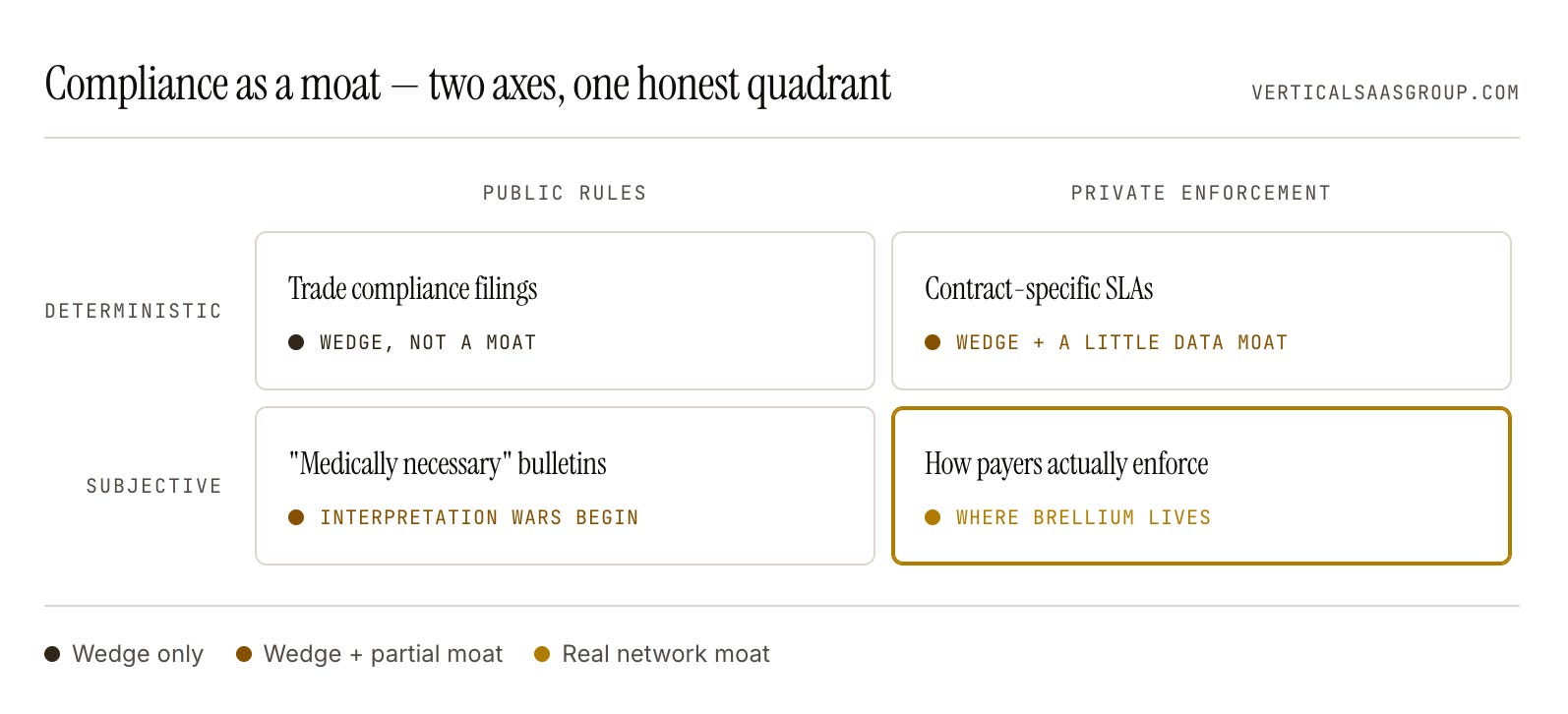
To see why the wedge lands where it does, start with the shape of the market. Ambulatory care is roughly half of US healthcare spend, which is itself roughly a fifth of GDP. Inside that, Brellium concentrated on the specialties where the rules are most subjective — mental health, ABA, home health, hospice. That is where words like “individualized” and “medically necessary” become matters of interpretation, and where payers spend the most energy building private enforcement patterns that public healthcare bulletins never mention.
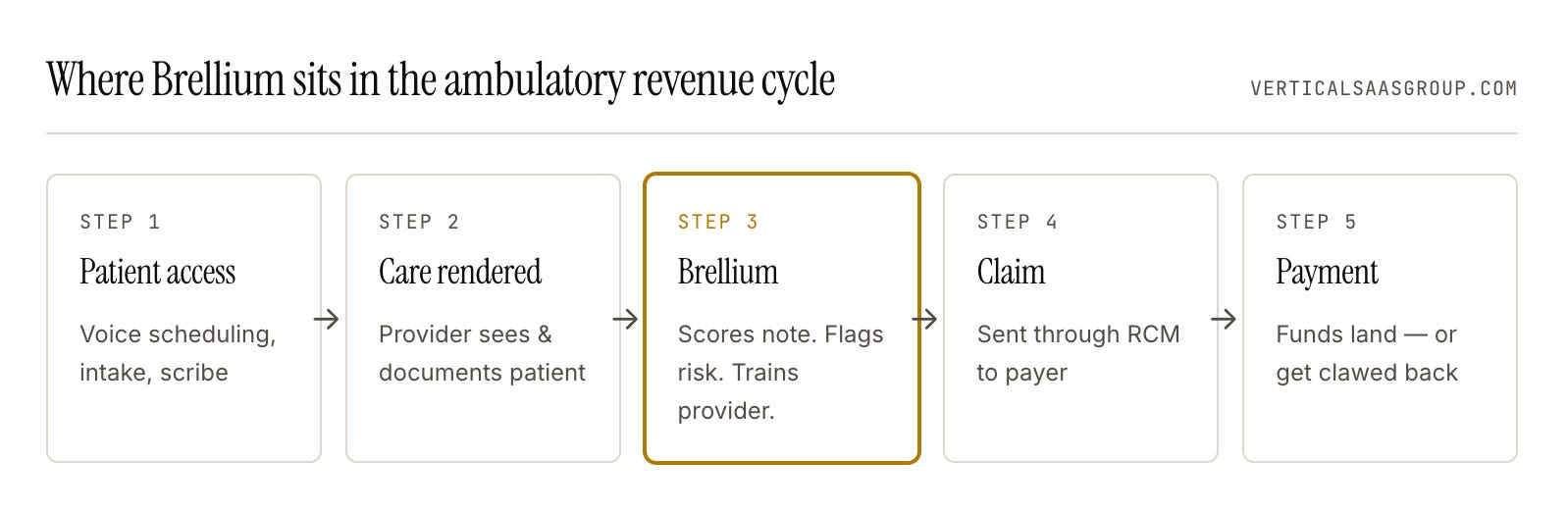
What Brellium sells is compliance. What Brellium does is training. A mental-health note has a laundry list of requirements — individualized language, history of present illness, medical necessity — and any miss can trigger a payer months later to pull the money back. Brellium catches those misses before the claim is filed, and that is the sale. But the reason customers renew is the Friday summary. It tells each clinician what they did well and where they need to improve, with trend lines that feed bonus tiers and promotion tracks. The product is a training system dressed as a compliance product, which is exactly why it sticks.
“At the surface we’re a compliance product. That is why customers buy. But the first-order value is that we’re a training product.”
Skeptics push back on compliance as a moat with one line — regulations are public. If the rule is a checklist of five things, a decent AI can score against it and so can everyone else.
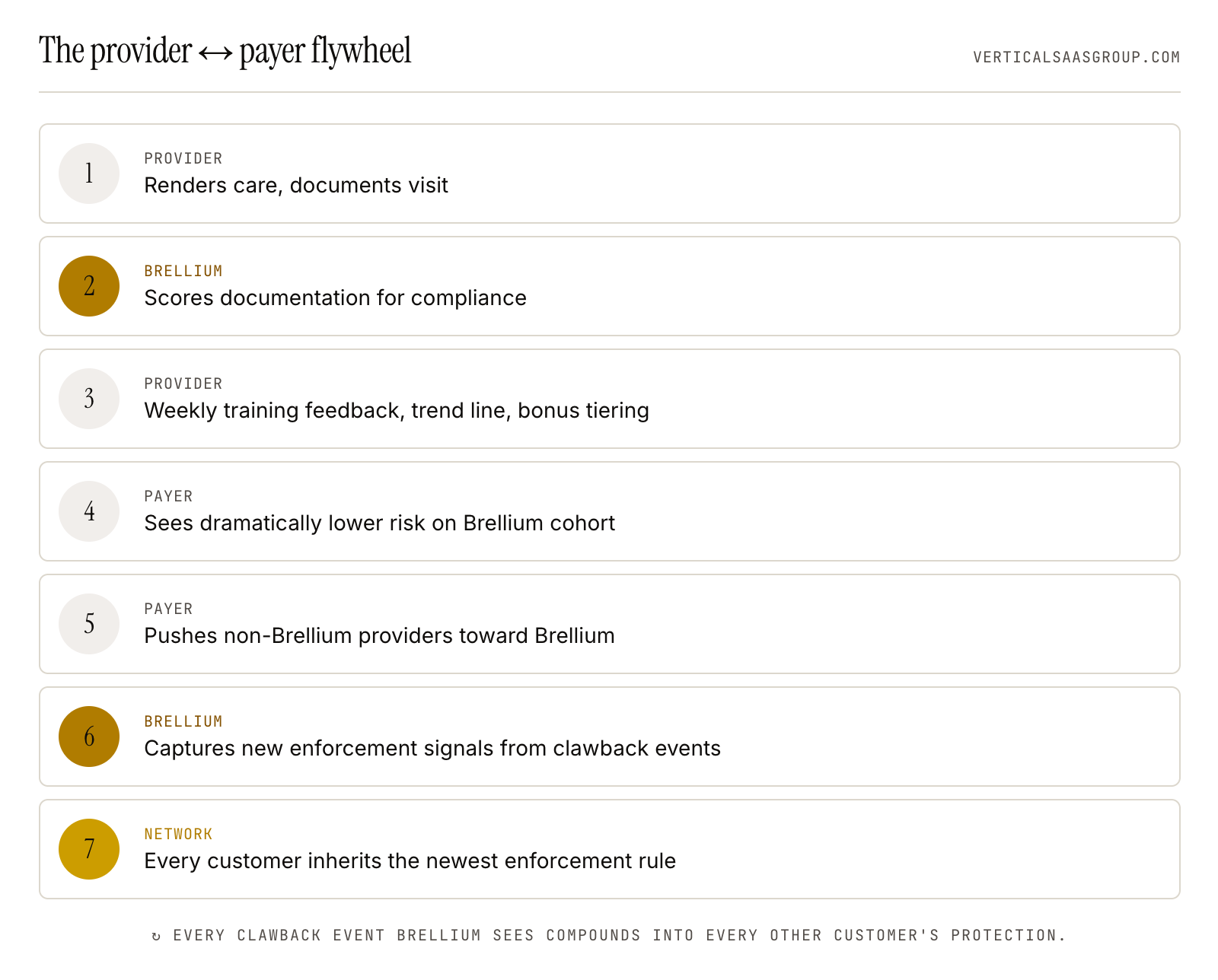
The market Brellium is walking toward is two-sided. Providers on one side, payers on the other, and the interesting question was always which side to start with.
They picked providers, because mid-market providers move faster and payers need proof points before they will engage.
Once a payer looked at its ABA book, saw dollars leaking, and then noticed a clean correlation between Brellium-covered providers and lower risk, the incentive to lean in became rational and immediate.
The loop now closes on itself ; every enforcement event Brellium sees on one side of the network compounds into every other customer’s protection.
None of this arrived on schedule. Brellium is five years old, and the first two and a half were pivots. A lot of smart people gave a lot of confident advice, and almost none of it moved the business.
What eventually moved it was a very specific loop; build, put in front of a customer, ask them to pay, iterate on their answer, ignore everyone else. That is a boring answer. It is also the answer.
What to steal from the Brellium story
The Brellium arc is specific to ambulatory healthcare, but the operating principles underneath it are not. Strip out the specialty codes and payer names and four transferable ideas sit there, ready for a founder in legal, construction, insurance, logistics, manufacturing, or any other vertical to pick up.
#01. Pick the path before you pick the wedge
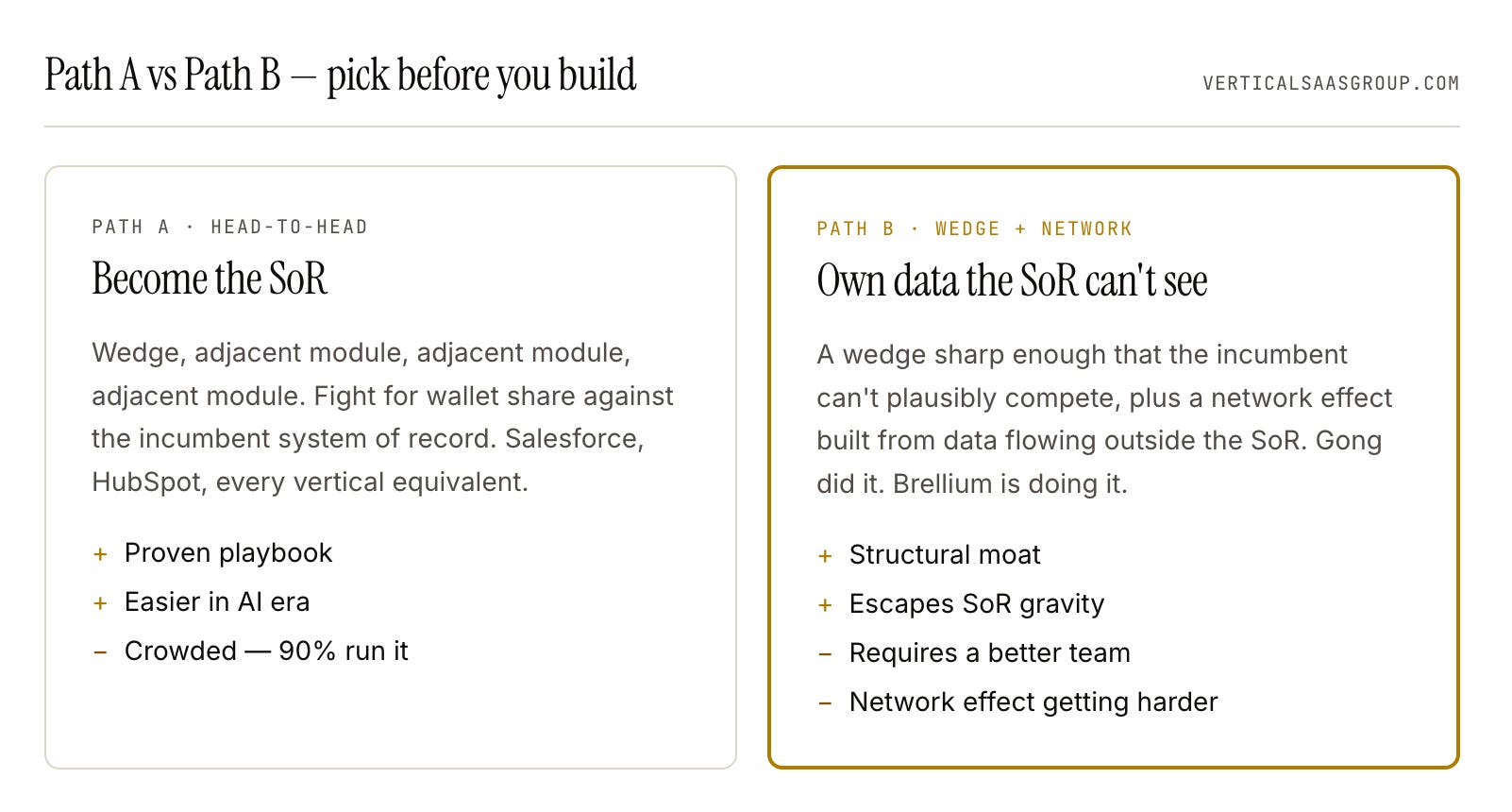
There are only two ways to build a durable vertical software company, and AI has not changed the fork. It has only sped up each side.
Path A is the classic — compete head-to-head with the system of record, ship a wedge, bolt on adjacent modules, race to become the SoR. Ninety percent of vertical SaaS runs it.
Path B is harder — build a wedge so sharp the incumbent SoR cannot plausibly compete, and pair it with a network built from data the SoR simply cannot see. Gong did it. Brellium is doing it. The honest note on Path B in 2026 is that the wedge is easier than ever, but the network effect is marginally harder — more competition for the same data-in-motion, more founders defaulting to the easier path.
If you sign up for B, you also sign up to be a better leadership team than the A operator down the street. The Path B playbook is not clear-cut.
#02. Run the wedge through the quadrant
Before committing a team to Path B, run the quadrant. Deterministic, public rules make a wedge, not a network. Subjective rules plus private enforcement produce the data asset the system of record cannot see.
If your category lands anywhere except the bottom-right corner, Path A is the honest choice and platform expansion — not moat construction — is the whole strategy. Founders lie to themselves about this constantly and it costs them two years.
#03. Sequence the flywheel from the shorter cycle
Two-sided networks fail when founders chase both sides in parallel. Start with the side that has a shorter cycle and lower burden of proof. Stack proof points there. Then walk into the other side’s boardroom with data, not a pitch.
The same logic applies to integrations — the 800-pound gorilla platform has no rational reason to partner, so spend integration energy on the long tail where the customers actually are. Brellium is integrated with essentially every EMR in ABA, including Central Reach, precisely because it did not wait for permission from the biggest one.

A quick word from our sponsor on the Verticals podcast, Parafin. Fresh off the 2026 Forbes Fintech 50 and a new credit facility led by Goldman Sachs, they’ve now extended over $35B in offers to small businesses through platforms like DoorDash, Gusto, and TikTok Shop.
Purpose-built embedded capital for vertical platforms.
#04. Price for what the customer actually feels
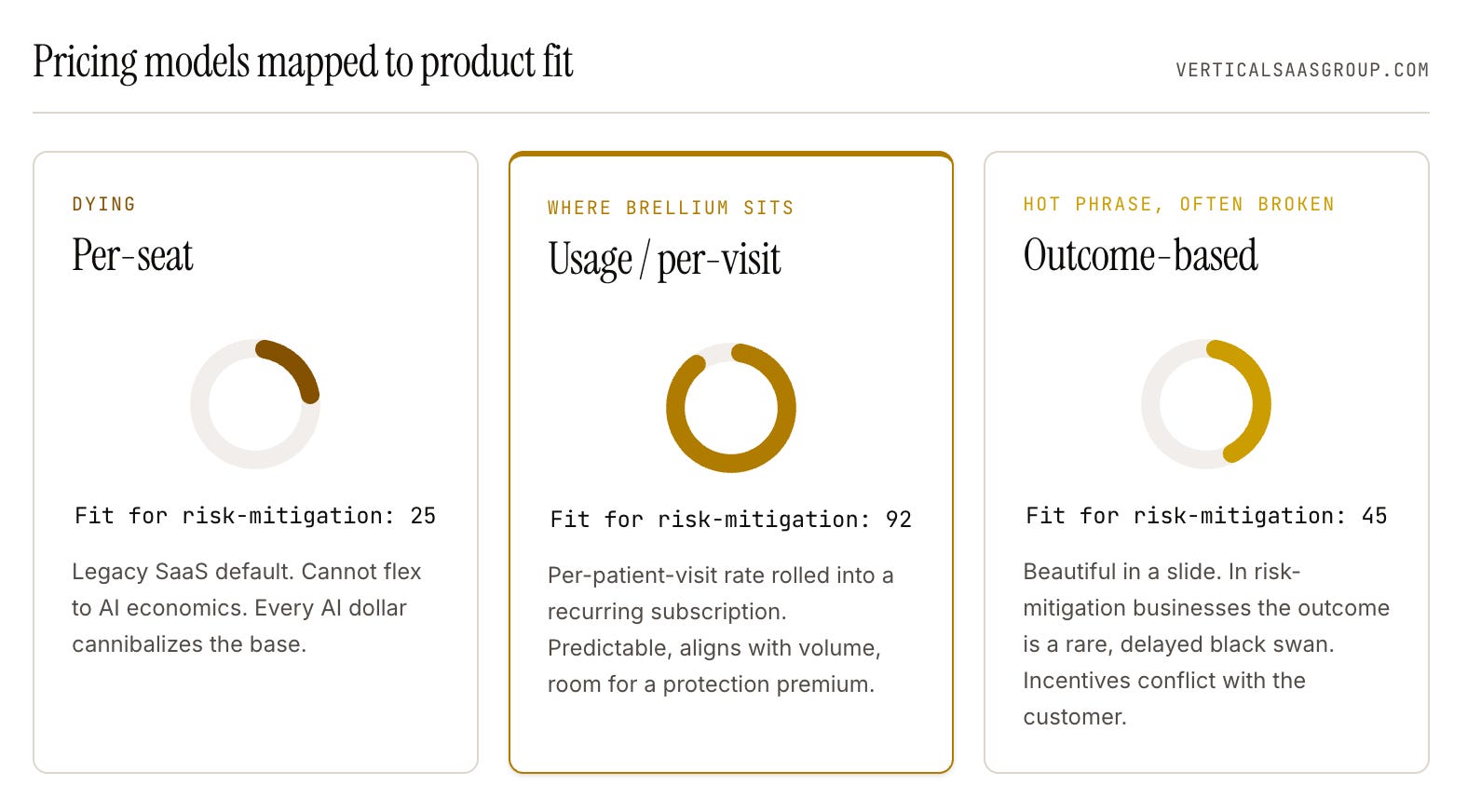
Outcome-based pricing is the phrase of the year. For risk-mitigation businesses it is usually the wrong hammer. The “outcome” is the absence of a rare, delayed black swan, which makes the incentives conflict with the customer’s interest.
Brellium sells usage instead — a per-patient-visit rate rolled into a recurring subscription, with a protection premium baked in.
Predictable for the buyer, aligned with the work, and honest about what the product does. A quiet contrarian take in a market that keeps repeating “outcome-based” as if it were always the answer.
One more thing —
Where Zach is bullish, bearish, and contrarian
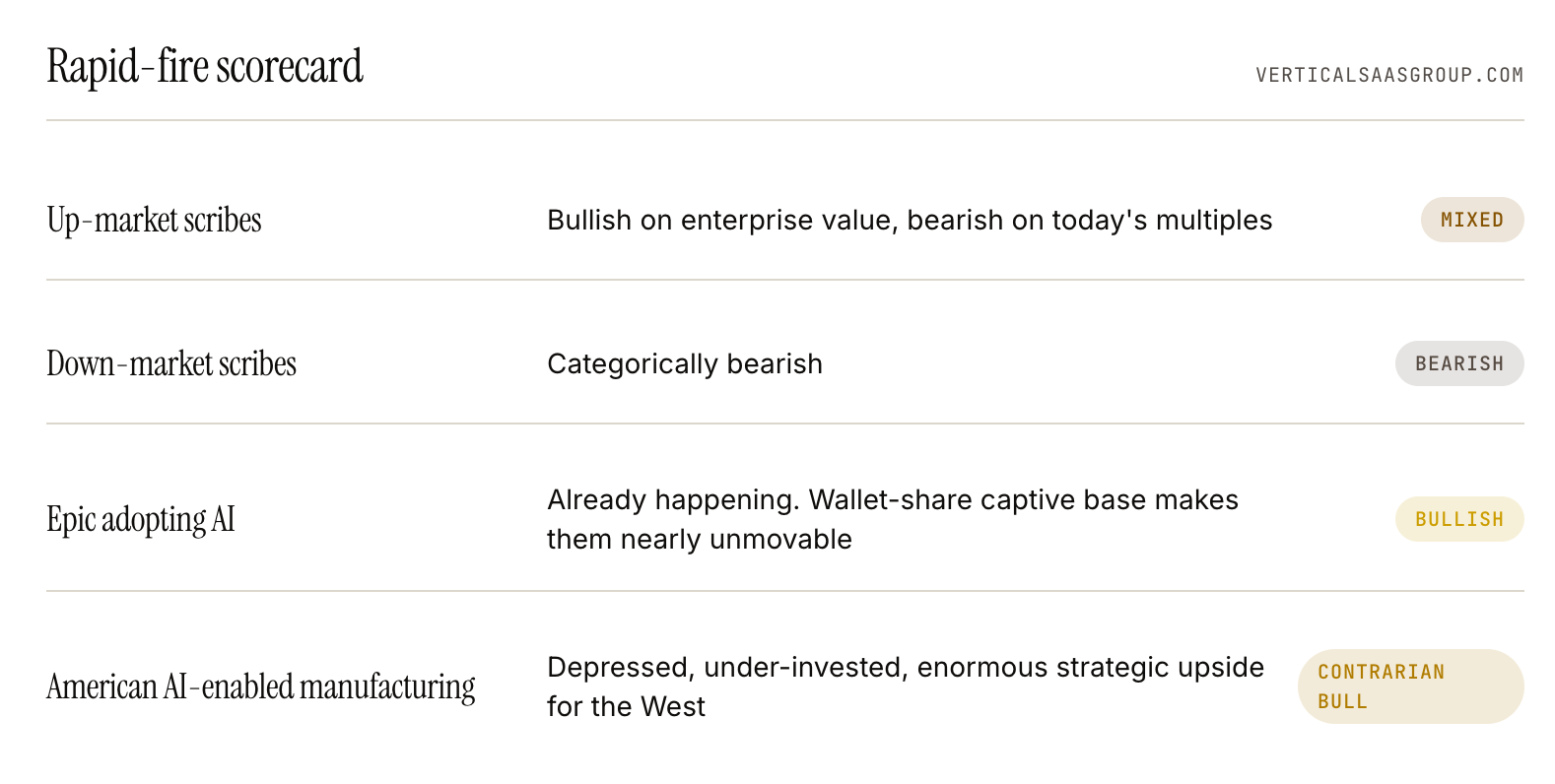
We closed the conversation with a rapid-fire scorecard. Most of it will not surprise you. The last row will.
AI-enabled American manufacturing was fashionable two years ago, then quietly went cold as capital rotated into humanoids.
Zach’s read is that this is precisely the moment to look at it — a large market, strategic importance to the West, and very few of the best builders paying attention.
If you have been reading vertical AI takes for the last six months and wondering where the uncrowded lane is, that is a serious pointer.
The wedge that becomes a network wins.
The chat panel bolted onto a legacy SoR does not. Everything else is variations on that theme.
Three lines to save before you close the tab.
Compliance is a moat only when it is blurry; deterministic, public rules produce a wedge, not a network.
Two-sided flywheels start on the side with the shorter sales cycle, then let the data pull the other side in.
Outcome-based pricing is the wrong instrument for risk-mitigation businesses; usage with a protection premium is more honest, more aligned, and more predictable than the phrase everyone is repeating on LinkedIn.
See you next week. If this one landed, forward it to the founder in your inbox who keeps calling their checklist a moat.
Thanks for reading LINEAR. I reply to every email…
Have any questions, feedback, comments? Let us know, we work for you!