

Bury and protect your data treasure.
Then, go all-in on action.
In 2011 Adam Harris and his co-founder Rich Castle looked at hospitality and saw nine fragmented systems where there should have been one. Fourteen years later, CloudBeds runs 20,000+ hotels in 157 markets, processes more than $20B a year, and will check in 57 million humans in the next six months. In an industry consumed by AI narrative, Adam has an unfashionable read on where the moat actually sits. “SaaS is not dead,” he says. “If anything our customers are spending more money on SaaS right now.”
The regime change he does see is system of record turning into system of action. Record-keeping was the price of admission; furnishing the next best decision — pricing, packaging, guest personalization — is the product. Studies show hoteliers know the rate change they should make 100% of the time and act on it too late 80% of the time. Awareness isn’t the bottleneck. Execution is. Software that only shows the data, is now, just a big dumb database.
The second shift is where defensibility actually lives. Frontier LLMs are giant custodial corpuses of the public internet, and Adam loves how practical they are — he built his own home-lab Jarvis on top of one. But they do not have his 4 billion data points of workflow-labeled hospitality behavior. That dataset, fine-tuned into a domain model and wrapped in a deterministic harness with confidence scores and source pointers, is the moat.
The third is pirate season. The seas are full of buccaneers — self-declared vertical AI experts who have never worked a night in hospitality, prompt-wrappers hallucinating cancellation policies into real legal exposure, cut-corner boarding parties flying a flag they haven’t earned…
This Weeks Vertical Titan:
Adam Harris (Founder & CEO @ CloudBeds)
Adam grew up in San Diego, studied economics at Berkeley, did a stint on Wall Street, and then left to build. Fourteen years ago he and his co-founder Rich started CloudBeds with a bet that a hotelier shouldn’t need nine disparate systems to run a property. Today it’s the category leader — 20,000+ hotels across 157 markets, 550,000 people logging in daily, 57 million check-ins expected in the next six months, and more than $20 billion in transactions running through the platform every year.
The current chapter is turning CloudBeds from a system of record into a system of action. Signals, the company’s AI forecasting and revenue engine, sits on 4 billion data points and runs millions of permutations every hour to produce deterministic, source-linked recommendations. They’ve also built three of their own foundation data models: 1) the guest, 2) rate and availability, and 3) everything else.
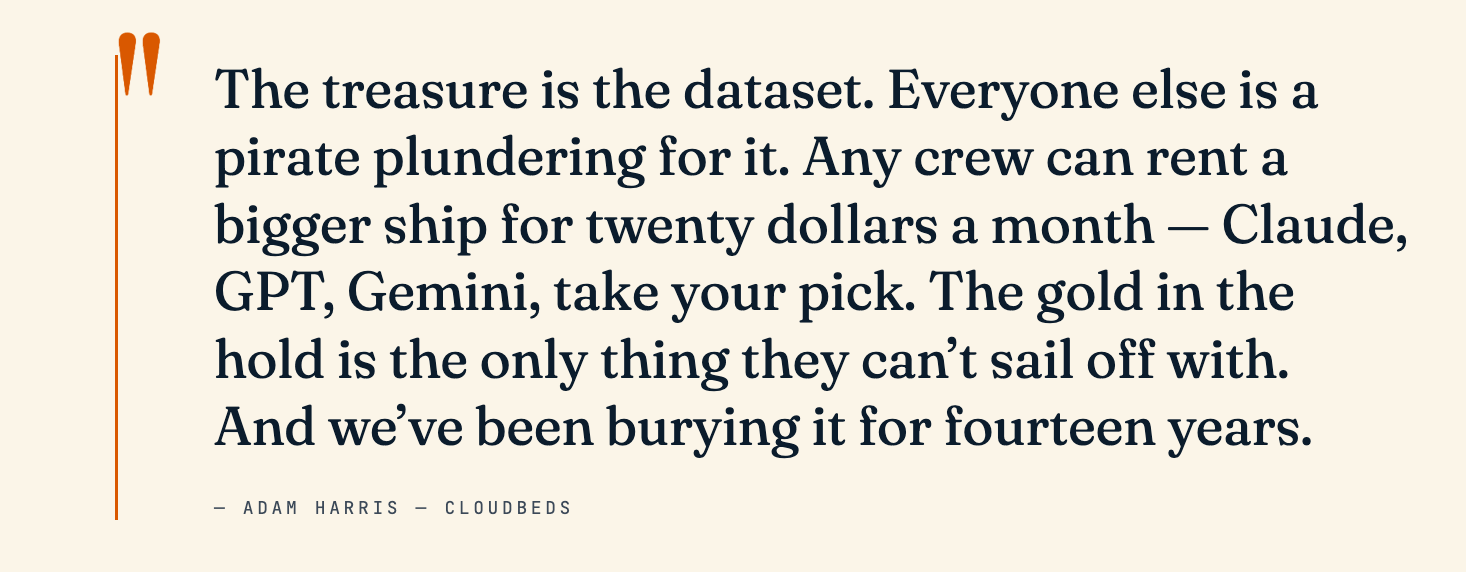
Adam’s frame: the corpus of proprietary, longitudinal, labeled hospitality data is the treasure. Frontier LLMs are extraordinary general brains but they can’t tell a boutique property in Lisbon why to raise a Thursday rate for a specific event window. Two years reinventing CloudBeds’ data architecture and DevSecOps was the price of admission for everything they are starting to ship.
The line every incumbent operator should write on a wall: hospitality is one of two industries where you can piss off a guest at 11pm and they’re still with you at breakfast.
The captain’s playbook — ten moves for guarding the gold in pirate season.
Operator-grade lessons from Adam Harris on why the dataset is the treasure, how to move from system of record to system of action, why deterministic harnesses beat probabilistic vibes when a boarding party is on the horizon.
#01. The treasure is the dataset, everyone else is a pirate plundering for it
Adam is blunt about the reason CloudBeds isn’t losing sleep over AI upstarts: he sits on 4 billion data points, runs millions of permutations on them every hour, will check in 57 million humans in the next six months and processes more than $20 billion in transactions a year across 157 markets. OpenAI and Anthropic have the world’s corpus of text. They do not have the corpus of what a hotelier actually did last Thursday at 6pm when a booking pattern shifted. That data — longitudinal, labeled by the workflow itself, jurisdictionally scoped — is not something a horizontal model can synthesize.
His framing of the current moment: pirate season. Everyone is racing to plunder the gold. LinkedIn is full of self-declared vertical AI experts who have never worked a night in the industry they claim to disrupt. That noise will burn itself out. The companies that emerge are the ones who spent the last decade quietly building a proprietary dataset — and the last two years re-architecting it for AI-era access patterns.
Action item: Audit your dataset the way an acquirer would. Is it longitudinal, labeled, jurisdiction-aware, and tied to real transactions? If not, that’s what you’re building for the next 24 months — before you touch a model.
#02. Stop being a system of record, become a system of action
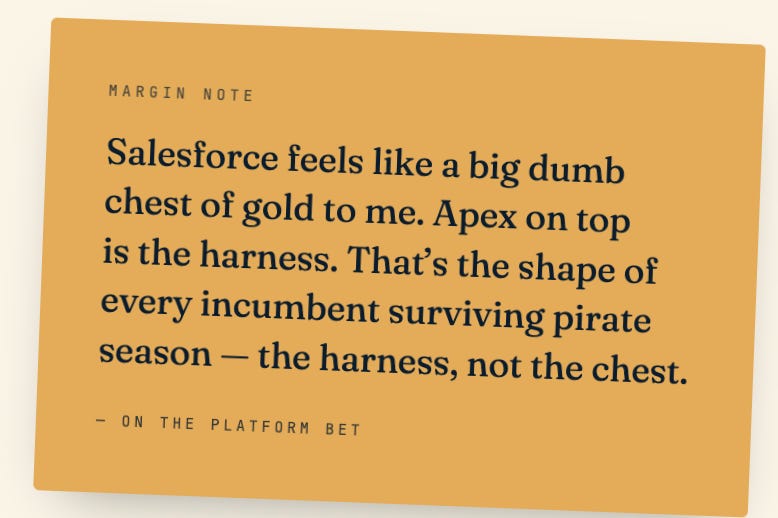
Adam keeps returning to the same phrase: record-keeping is not the value anymore, the work you should be doing with the record is. He calls Salesforce “a big dumb database” in its default shape, useful only once you strap Apex and harnesses on top. CloudBeds spent years consolidating nine hospitality systems into one system of record, and the entire product strategy now is to convert that record into action — Signals forecasts demand, prices rooms, packages offers, and furnishes the next best move before the hotelier is late to it.
The evidence he cites: studies show hoteliers are not dumb — they see the rate change they should make — but 80% of the time they act too late. Awareness is not the bottleneck. Execution is. So the software job description flips from show me my data to & do the work on my behalf, with a confidence score and a source I can audit.
Action item: For each dashboard in your product, ask: what is the one action this data implies, and could we take it on the customer’s behalf with their approval? That’s your Q1 roadmap.
#03. Deterministic harness beats probabilistic vibes, build the guardrails first
Hospitality is one of two industries where you can wrong a customer at 11pm and they are still with you the next morning (the other is medicine). Probabilistic outputs are not acceptable when the answer is this room $100 or not&; needs to be $100 every time, and “is availability real or not” needs to prevent an overbooking. CloudBeds wraps its agents in a deterministic harness — three data models (people, rate/availability, and everything else) exposed via MCP servers and APIs, with every answer carrying a confidence score and a pointer to the source row that produced it.
Adam’s LinkedIn here-say: connect your hotel to this Claude skill and it’ll write god-tier forecasts is a lie. Claude will be right 96 times out of 100, and the other four will lose real money. Context windows expose the drift; the industry ignores the disclosure. The unlock isn’t more agents — it’s the harness underneath them.
Action item: Ship a confidence score and a source-of-truth link with every AI-generated answer in your product. If a customer can’t audit the reasoning, they can’t trust the action.
#04. Own three data models, then let everything else be a marketplace
CloudBeds refuses to build everything. Adam draws the moat around three foundation data models — the guest (a human), rate and availability, and the operational data around both — and lets a massive partner marketplace fill in the long tail. That focus is why they can talk about being the orchestration layer with a straight face: the three models are theirs, the workflows on top can be anyone’s, and the partners are motivated because the data they get back is worth more than the fee they pay to plug in.
This is also why Adam picks his integrations from a paranoid place. A single AI upstart’s cancellation-policy chatbot has already generated real legal case law by hallucinating refunds. When you’re the system of record for 20,000+ hotels, one careless partner can drag your brand into a lawsuit. He says this isn’t protectionism?but instead adult supervision of a category that hasn’t grown into its power yet.
Action item: Draw a Venn diagram of what you must own, what you should partner on, and what you should refuse to do. If the first circle has more than three things in it, you are trying to build too much.
#05. Kill the seat license before somebody else does, price on the key, the token, or the lift
Adam is candid: nobody wants to log into Salesforce anymore, they want the data-and-action point. UI is dying. He watched customers cut Salesforce from 50 seats to one, piping the data into a vibe-coded internal tool that runs the actual playbook. Horizontal SaaS is going headless because it has to. CloudBeds got lucky here — they always charged by the key or the bed, not by the human, so the AI regime change doesn’t force them to unwind a per-seat contract.
The new pricing surface is a portfolio: transactional fees per token consumed when an LLM crawls their dataset, percentage-of-lift when their AI LLM demonstrably improves a property’s RevPAR, and traditional SaaS (but on a per room basis) for the system of record platform. His finding after running both experiments: the number came out roughly same. So the choice to his company has become what is cleanest to explain and easiest to sell.
Action item: Model the same customer-seat, per-transaction, and share-of-lift pricing this quarter. Pick the one that maps to how the buyer measures value, not the one your CFO’s spreadsheet is easiest to reforecast.
#06. Hybrid models: big model for language, your model for the specifics
Adam is emphatic: CloudBeds has no intention to reinvent math or visualization or general reasoning, those are commodity capabilities in the frontier models. What they provide is a vertical-specific model that knows why a rate goes up on a Thursday and not on a Friday for a boutique property in Lisbon during a specific event window. That is where CloudBeds spends its training budget: a fine-tuned corpus on very specific hospitality use cases and roles, orchestrated with other models that are best at the neighboring tasks.
He also believes the edge is coming, iterally. Phones will run trillion-parameter models. Nvidia’s roadmap makes it plausible. Cloud model choice will become a utility decision (Groq for sentiment because it’s on X, a Chinese or Japanese model for a specific reasoning benchmark, and so on). The architecture that survives is one where any model is swappable and the domain harness is yours.
Action item: Design your inference layer so the frontier model is a plug — swap Claude for Sonnet or an in-house fine-tune without touching the workflow. If you can’t do that today, that’s the refactor that saves you when the token bill flips.

A quick word from our incredible partner,
Parafin - the leading embedded capital partner for vertical software.
4.8 star rating on Trustpilot, with over 500 reviews [source]
71% CSAT rating across all partners
84 NPS
Serving top Fortune 500 companies, including Amazon, Walmart, and DoorDash
#07. Agents are only in phase one self-driving, swarm them, watch them, don’t trust them yet
The best analogy in the episode: self-driving cars are on phase four of five today— humans get into a Waymo without thinking about it. It’s been a bout a decade since they launched to get to this.
Agents are on phase one. They are cool, they daisy-chain, they fail often, they produce false flags and silent errors, and they burn tokens in loops nobody notices. Adam confesses he burned $3,200 in a month on a research harness he left running by accident. He tells that story publicly so smaller operators don’t repeat it.
The right posture is to swarm agents inside a governed sandbox — persona agents, department plus-ones, coding agents running 24/7 against the codebase — while your security and eval teams pressure-test what they leak. His EA has calendar access, so his EA-shaped agent does too.
Action item: Set a per-agent token budget and a red-team cadence this month. If neither exists, you are one accidental research loop away from a five-figure invoice.
#08. Over-index on planning, permitting takes longer than construction
Adam’s favorite operator metaphor: building AI features is like building a home. Permitting and planning eats 80% of the timelien. Foundation and walls go up fast once you have the right permits. Most companies invert this — they start construction, then have to tear it down when GDPR or California privacy law or brand-safety guardrails catch up. CloudBeds runs every AI initiative through a permit stage: what are the governing laws, are we tolerant of any AI slop in this output, where are the brand guardrails, etc.
The counterintuitive result: many initiatives never leave the permitting phase — because the honest answer is “we can’t make lemonade out of this one.” That’s not failure; that’s the discipline that keeps CloudBeds shipping products that actually move the needle. There is no silver bullet, and the humility to say so publicly is a real competitive advantage in a category that is currently drunk on hype.
Action item: For every AI feature request, run a two-page permitting doc — jurisdictions, guardrails, tolerance for weird output, failure playbook, before a single line of code is written. Kill the ones where the answer is “we don’t have the ingredients.”
#09. Direct booking wins — LLMs are the new discovery layer, and the inventory owner is king
Adam’s rapid-fire answer to whether AI benefits OTAs or hotels long-term: direct booking, one hundred percent. The reason is simple. Consumers already ask ChatGPT, Anthropic and Perplexity to plan trips to Montana. The current OTA advantage — being one of the sources of record the LLMs cite — is a rented advantage that expires the moment LLMs learn to talk directly to inventory owners. CloudBeds already does that distribution on behalf of its hotels, and sees those same LLM-originated requests hitting the platform.
The person who is king and queen in the long story is the inventory owner. LLMs collapse the layers of discovery and reservation. Anyone whose entire business model is being a middleman in that collapsed chain is watching their moat drain in public.
Action Item: If your customer sits on unique inventory or a unique dataset, expose it directly to LLMs via MCP or a well-documented API this quarter. Do not wait for an OTA-style intermediary to broker the relationship.
#10. AI can help A LOT with the little things
I asked Adam for the coolest vertical AI use case he’s seen, the answer is disarmingly small…
A high-touch luxury property programmatically prints a personalized welcome note at check-in and a personalized thank-you at checkout — remembers your favorite cocktail from three years ago at a sibling property in the chain — and the guest feels seen. That is the whole game. Not a robotic vacuum. Not a chatbot. A machine-generated moment of loyalty that a human team would have a hard time scaling to every guest.
The lesson generalizes: AI in a vertical wins when it lets the operator do something they always wanted to do for every customer, but couldn’t afford to do at scale. Not when it removes humans. Not when it slaps a chat window on the login screen. When it hyper-personalizes what used to be generic. that’s the compounding moat, because it’s the reason the guest comes back.
Action item: Pick one moment in your customer’s journey that used to require a human to remember them. Make your product do it automatically, at 100% coverage, this quarter. That is the AI feature that earns loyalty.
The operator takeaway from a 14-year incumbent still at the wheel: the treasure you spent a decade quietly burying is the only reason the pirates can’t catch you.
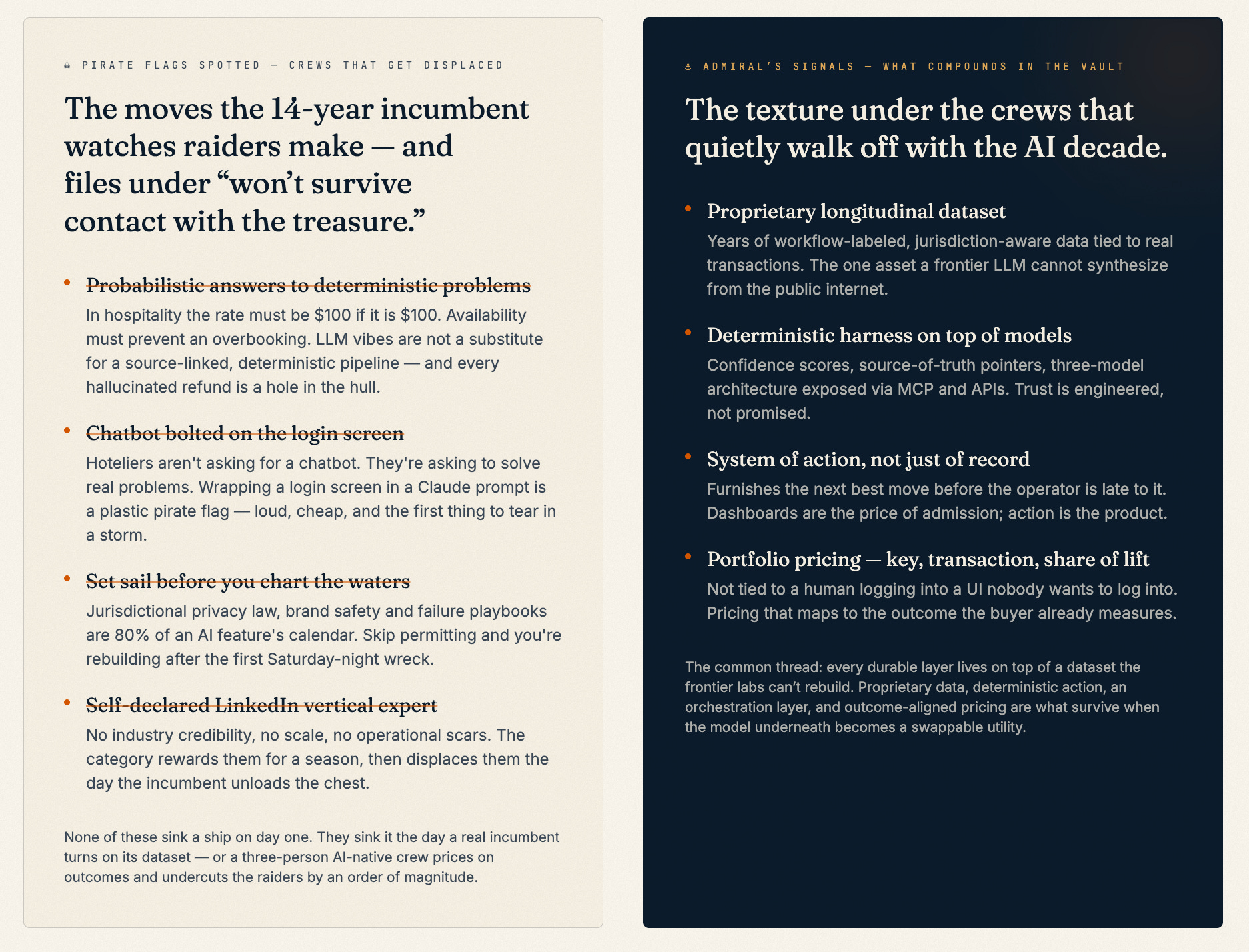
So guard the treasure…
Then sail the action no other crew can.
If you’re running a vertical software business in 2026 — especially one with a decade of customer workflow buried in the hold — four moves separate the captains that compound from the crews the pirates eventually catch:
1. Fortify the vault before you touch a model. Two years of DevSecOps and data-model work isn’t overhead; it’s the vault. Longitudinal, labeled, jurisdiction-aware transaction data is the gold a frontier LLM cannot mint on its own.
2. Forge the harness before you let the crew swing. Confidence score. Source-of-truth link. MCP-exposed data models. Trust is engineered, not promised and probabilistic answers to deterministic problems can show up as lawsuits, not blog posts.
3. Turn the system of record into a fleet. Dashboards were the price of admission at the port. The product is the next best decision, taken on the customer’s behalf, before they’re late to it.
4. Split the booty on the outcome, not the seat. Per key, per transaction, per share of lift. When SaaS and outcome-based experiments produce the same revenue, pick the one that matches how the buyer measures the plunder.
The crews that win this decade won’t be the loudest ships on the sea. They’ll be the ones who spent a decade quietly burying a dataset nobody else could copy, and had the discipline to lock it in a harness before anyone let the guns loose on a customer. Be that captain, and pirate season becomes free R&D…
Thanks for reading LINEAR. I reply to every email…
Have any questions, feedback, comments? Let us know, we work for you!