

Burn the instincts.
Own the distribution.
Build the hard thing.
In 2014, Zain Jaffer was running Vungle from a London bedroom on a few thousand dollars. By 2019 it had sold to Blackstone for $780M. By 2021 it was public at $4B.
The playbook that got him there — managerial layers, seat-based pricing, predictable MRR, hire fast, scale the org chart — is the same playbook he now walks into Blazel’s all-hands meetings to systematically unlearn. “My brain was wired still for a very SaaS-based world,” he says. “What worked previously does not work anymore.”
The first thing he had to unlearn was the org shape…
Look at Anthropic — founders and CTOs joining as individual contributors on a deliberately flat technical bench. Three-person companies running real revenue. The instinct to add headcount, layer in middle management and create org charts that look like a public company is a 2018 reflex that now actively suffocates the speed AI-native execution requires.
The second was where defensibility actually lives. The product is the easy part. The token bill, the latency stack, the frontier-lab dependency, the seat-based price floor — all of that gets compressed in public over the next 24 months. What doesn’t compress: owned audience, owned distribution, a dataset of human-labeled edits you can fine-tune into a model the labs can’t replicate without your customer relationships. Brand, voice and proprietary data are the moats. The model is rented from whoever is cheapest this quarter.
The third was the trap of easy revenue. Zain ran Blazel as an AI-native marketing agency for long enough to know how seductive it is — replacing existing budgets, no procurement friction, no UI required, a clean shot to $10M ARR in a year. And how it kills you. Every AI feature cannibalizes your own team. Every new entrant races you to the bottom on price. Your board freaks out the moment you propose taking revenue down to switch to outcome-based pricing. He pivoted Blazel into a platform before the trap closed — and the rest of this issue is the operating system underneath the move.
This Weeks Vertical Titan:
Zain Jaffer
Zain has started multiple companies. The most successful was Vungle — the mobile video advertising business he scaled from a London bedroom into one of the defining ad-tech outcomes of the last decade, acquired by Blackstone for $780M in 2019 and taken public at a $4B valuation. After Vungle he moved to the other side of the table for several years as an active operator, investor and board director across venture-backed companies.
Now he’s running Blazel, an AI-native marketing platform that helps founders and executives publish high-signal content on LinkedIn and convert it into pipeline. Blazel started life as an AI-native agency, harvested the workflow data from a team of human content operators, fine-tuned its own model on the labeled edits, and pivoted into a self-serve platform priced from hundreds of dollars a month — replacing what used to cost enterprises millions in in-house production.
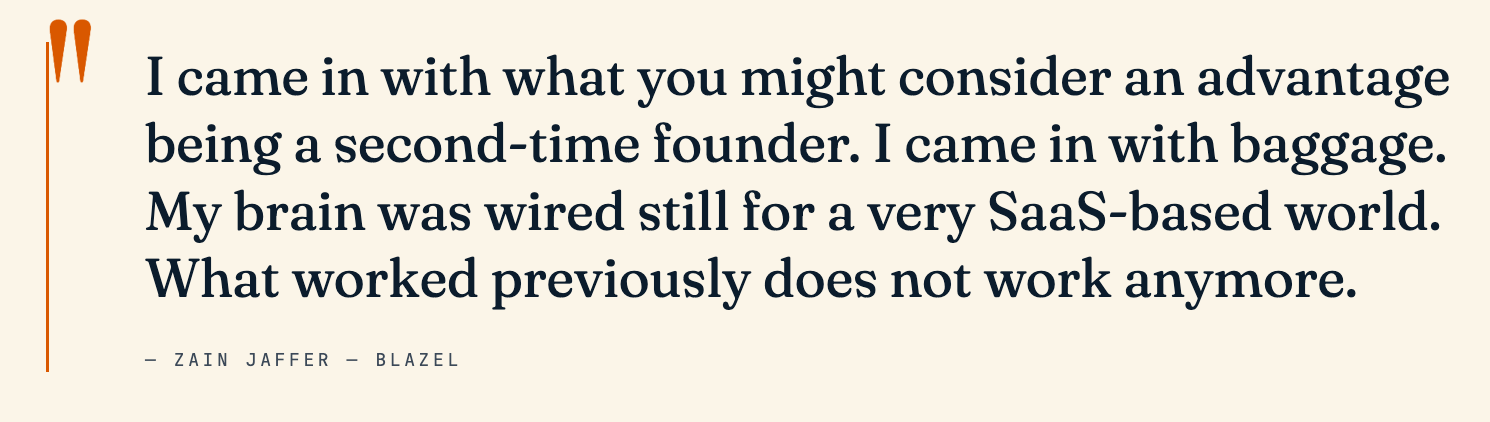
The frame Zain keeps returning to: a second-time founder’s playbook is baggage, not an asset, in an AI-native company. The reflexes that made Vungle scale — bigger orgs, MRR forecasting, seat-based pricing, agency cost structures — actively slow down the kind of company Blazel needs to be. The hard work isn’t building the product; it’s unlearning the playbook that built the last one.
The line every AI-native founder should write on a wall: history is buried with the corpses of great products that lacked distribution. In a world where 99.6% of LinkedIn is AI-generated, owned audience and authentic voice are the only moats the model companies can’t ship.
The post-SaaS founder playbook — ten moves from a $780M operator starting over.
Operator-grade lessons from Zain Jaffer on what to unlearn after a $780M exit — the AI-native agency trap, outcome pricing, building distribution before product, and why every SaaS reflex from 2018 is now a liability.
#01. Burn the SaaS instincts — your last playbook is now your biggest tax
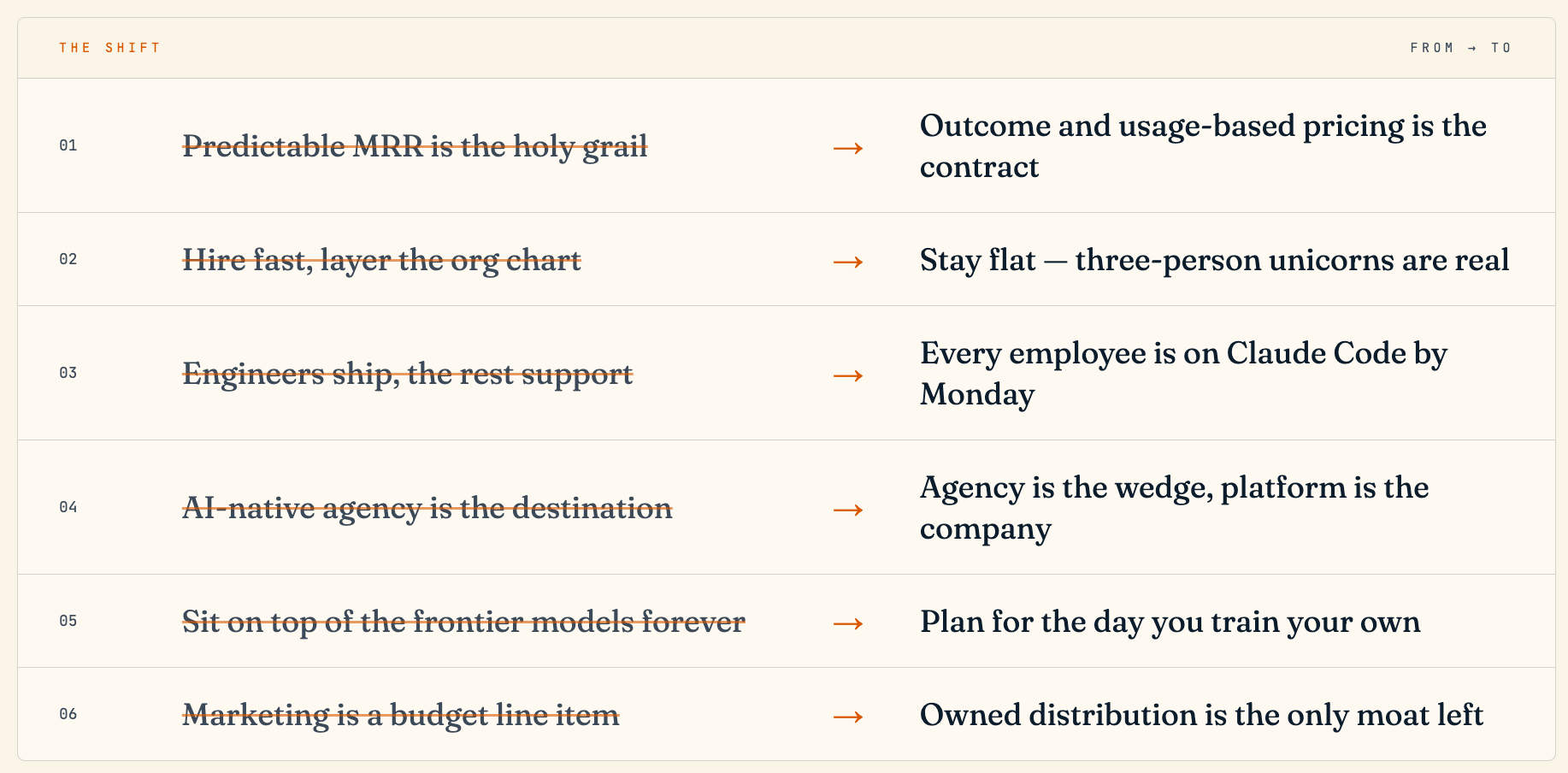
Zain came back into the game with what looked like an unfair advantage — a second-time founder who’d built Vungle from a London bedroom to a $780M sale to Blackstone and a $4B public listing. Instead he calls it baggage. “My brain was wired still for a very SaaS-based world. What worked previously does not work anymore.” The reflex to add managerial layers, the obsession with predictable MRR, the discipline of seat-based pricing — every instinct that made Vungle scale is now actively slowing Blazel down.
The Anthropic shape is the new template: leading founders and CTOs joining as individual contributors on a deliberately flat technical org. Three-person companies running real revenue. The founders who refuse to let go of 2018 SaaS muscle memory are the ones writing severance checks in 2026.
Action item: List the five operating habits you copy-pasted from your last company. Pick the most expensive one — managerial layer, MRR forecast, seat-based pricing — and kill it this quarter before AI does it for you.
#02. The AI-native agency is a trap dressed up as a wedge
Blazel started as an AI-native marketing agency. It worked. Zain says you can get to $10M ARR almost casually right now — you’re replacing budgets that already exist, there’s no procurement, no vendor approvals, no UI required. Then the trap closes. Every AI feature you ship cannibalizes your own headcount. Every new AI-native competitor races you to the bottom. And when you finally tell your board the right move is to take revenue down and shift to outcome-based pricing — they freak out.
His call: agency is a brilliant bootstrap and a phenomenal cash-flow business, but it is not a venture-scale company. Use it as a wedge to learn the workflow, harvest the labeling data, and earn the right to build the platform. Set a clear date by which the human-in-the-loop becomes a product feature, not the product. Zain pivoted Blazel before the agency hit critical mass on purpose — because at $10M ARR you can’t.
Action item: If you’re running an AI-native services business, write down today the platform you’re earning the right to build — and the revenue level at which you’ll force the pivot. Above that line the cultural switching cost is fatal.
#03. Distribution is the moat — own your audience before you need it
Zain’s hardest-earned lesson from two decades of building: history is buried with the corpses of great products that lacked distribution. The companies winning right now — Lovable, Cursor, the vibe-coding wave — aren’t winning on engineering. They’re winning on owned channels. Their CEO posts. Their COO posts. Their account executives post. Their AEs post. Press releases are rented megaphones. A newsletter, a podcast, a substack, an active personal brand on every executive — those are owned assets that compound for years.
There’s a downstream play, too: every piece of high-quality content you publish gets indexed by search engines and AI search agents. When a buyer asks ChatGPT or Perplexity for the best tool in your category, the answer is partly downstream of what you’ve been saying in public for the last two years. Most companies treat content as a marketing line item. Zain treats it as the most underrated permanent capital expenditure a startup can make.
Action item: Get your CEO, COO, and CTO posting two to three times a week on the channel where your buyers actually live. If you can’t sustain it manually, that’s exactly why platforms like Blazel exist — but the worst answer is doing nothing.
#04. Burn the MRR religion — outcome and usage pricing is the new contract
Zain calls predictable monthly recurring revenue “a staple of vertical SaaS” — and then names it as one of the instincts he had to unlearn. In an AI-native world the customer is paying for outcomes (leads generated, posts published, tickets resolved) and the cost structure is variable (tokens, GPU time, model calls). Forcing a flat per-seat license over that reality is a SaaS-era abstraction that’s about to crack in public.
It is uncomfortable. Boards hate it, finance hates it, and your sales team hates it because comp plans don’t work the old way. But this is exactly the discomfort that’s creating the opening. The companies that survive cannibalize their own MRR before someone else does. The ones that don’t are stuck protecting the seat license while a three-person AI-native team prices on outcomes and undercuts them by an order of magnitude.
Action item: Re-price your top-tier offering on the outcome that actually matters to the buyer this quarter. If finance pushes back, run it in parallel — but get the pricing surface that matches your economics into the market.
#05. Mandate AI fluency — every employee on Claude Code by Monday
At Blazel every employee — AE, intern, designer, marketer — has access to the codebase and is expected to ship. Zain mandates it. He’s seen the Anthropic blueprint from Thiel fellows working inside: same tools every public dev has, no proprietary harness, no review gauntlet, just ship-it culture. That’s why they outpace orgs ten times their size.
It comes with a cost. Vibe-coded passion projects pile up. People try to rebuild your CRM in a weekend. The discipline is to channel it: prototypes ship to staging, never to production, until they’ve been validated with a design partner. Done well, it functions like in-house forward-deployed engineering — your team builds for real customers, then your engineers harden what works into the core product. The cultural shift is the whole point: nobody hides behind a waterfall doc anymore.
Action item: Hand every non-engineer at your company a Claude Code seat and a staging branch this week. Set one rule: production code requires review, staging is fair game. Watch your roadmap accelerate.
#06. Pick one ICP, refuse the rest — Vungle’s $4B vs AppLovin’s $250B
The most expensive mistake of Zain’s career: at Vungle they served two markets — brand advertising and app installs — at the same time. AppLovin picked one. Today Vungle is worth $4B and AppLovin trades between $150–250B depending on the day. Same era, same TAM, same technology stack. The difference was a single product decision about who they refused to serve.
He’s applying the lesson to Blazel: head of marketing at a Series B company, post-PMC, with marketing collateral to train on, a stable website to anchor in, and a dream of activating the entire employee base on content. Yes, SMBs and creators self-serve the product — Zain treats that as a subset of the ICP feature set, never as the ICP itself. The hard thing is building for the demanding customer; the SMB market falls out of it for free.
Action item: Write your ICP in one sentence: role, company stage, and the specific outcome they’re judged on. If you can’t, you’re running two companies. Pick one and shut the other.

A quick word from our incredible partner,
Parafin - the leading embedded capital partner.
4.8 star rating on Trustpilot, with over 500 reviews [source]
71% CSAT rating across all partners
84 NPS
Serving top Fortune 500 companies, including Amazon, Walmart, and DoorDash
#07. Build your own model before token spend builds it for you
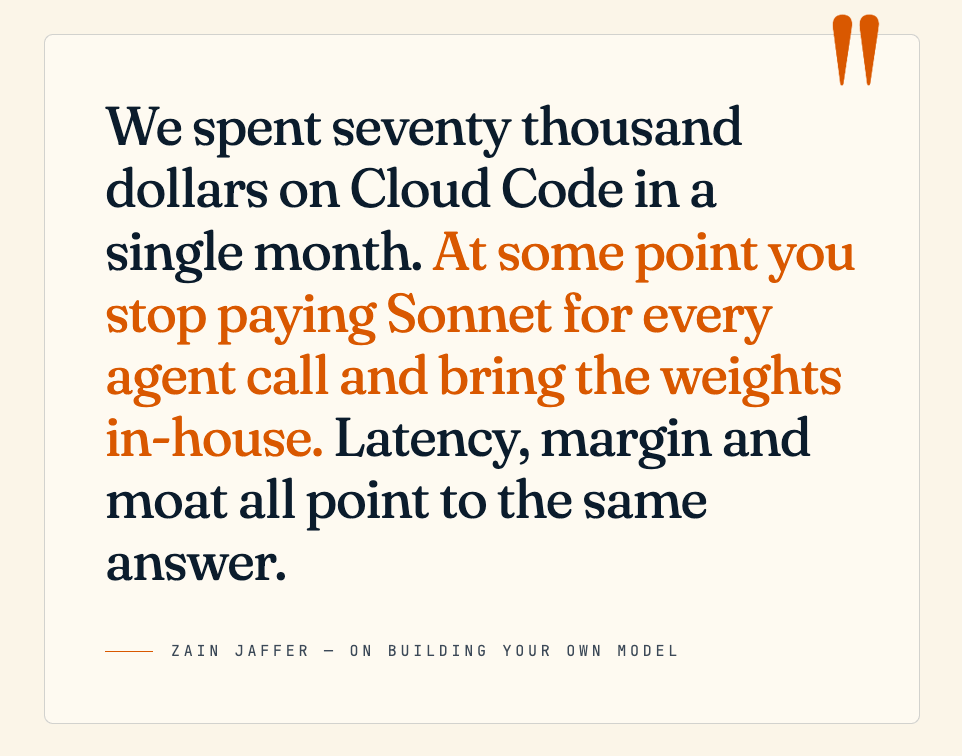
Sounds insane when OpenAI and Anthropic are trillion-dollar companies. But Zain watched Blazel’s token bill blow past $70K in a single month — Cloud Code spend, API calls, agent-on-agent orchestration trying to scrub AI slop out of generated content. At some point the math flips. Latency stacks up across agent chains. Margin compresses. The fix isn’t more agents on top of Sonnet — it’s collapsing the workflow into a fine-tuned model whose weights already know what “good” looks like for your vertical.
He’s not telling founders to train from scratch — that’s still insane. He’s telling them to assume that within a few years, a trillion-parameter model will run under their desk thanks to Nvidia, and to design the company so that bringing the model in-house is a Tuesday, not a re-platforming. Until then, harvest labeled data from every human-in-the-loop edit. That dataset is the moat.
Action item: Instrument every human edit your product touches as labeled training data. The day your token bill exceeds two engineers’ salaries, you have the data to fine-tune your way out of it.
#08. Where humans belong: labeling, evals, and forward-deployed engineers
Zain is bullish that fully-automated platforms beat human-heavy agencies — and equally clear about where humans are non-negotiable. Three places. First, data labeling: OpenAI, Anthropic, xAI and Google all quietly pay surgeons, lawyers and PhDs real money to label outputs. The dirty secret of the frontier labs is that they’re services businesses on the back end. Second, evals: an LLM-as-judge only works if its intuition was bootstrapped from world-class humans. Third, forward-deployed engineers — the Palantir move — sitting inside enterprise accounts to integrate, customize and drive adoption. For larger ticket sizes, FDEs are now table stakes.
What that means for the org chart: you don’t need a 200-person services arm. You need a small bench of the best domain experts in the world labeling the edge cases, and FDEs embedded in your top accounts. Everything in the middle — the content team, the QA team, the implementation consultants — collapses into the model over time.
Action item: Map your roles into three buckets: replaced by AI, augmented by AI, and a permanent moat for humans. If anyone is in bucket one without a transition plan, you have six months.
#09. Audience is the only counter-move to AI slop
Zain’s company analyzed LinkedIn at scale: 99.6% of posts are AI-generated, and only 0.4% qualify as acceptable training material. We are watching model collapse in real time on the world’s largest professional network. The reflex is to add more AI to the feed. The actual move is the opposite — authentic, edited, voice-driven content is now arbitrage, because everyone else is producing slop at infinite scale.
His prescription is unromantic: write your unique content into a projects folder, build a voice guide, record voice notes, use AI to draft and then spend real time editing. Or — if your time is too valuable to be on the content treadmill at 10pm on a Sunday — use a platform that does the orchestration for you. Either way, the bar for what stands out is going up, not down. Authentic voice beats infinite generation, forever.
Action item: Audit your last ten posts for AI tells — “not just X, but Y,” staccato bullets, the word “genuinely,” em dashes that don’t earn their keep. If more than half ring AI, you’re feeding the slop. Reset the voice guide.
#10. The new venture-class public stocks — and the bubble signal to watch
Zain has a sharper read on the public markets than most operators: SpaceX, Anthropic and OpenAI are functionally a new asset class — venture-shaped stocks trading on public exchanges, with ten-year hold periods baked into the price. Retail demand is so intense that SpaceX allocations are 6% of asks even for active investors with banking relationships. SPVs are layered, opaque, and in some cases illegal — people are getting wiped out.
The signal he’s tracking: when retail piles into pre-IPO vehicles at scale, that’s historically the most reliable leading indicator of a bubble cresting. Doesn’t mean the underlying companies are bad bets — Nvidia, Microsoft and Google at IPO would have made you rich. It means the next six to twelve months are going to be loud. The infrastructure providers, the GPU layer, and the application layer all look like winners in different scenarios. The model layer itself may be the most fragile of the three.
Action item: Stress-test your company against a 50% compute-cost collapse and a 50% model-pricing collapse. The strategy that survives both is the one worth executing.
The operator takeaway from a $780M founder doing it all again: your last playbook is the most expensive tax you’re paying.
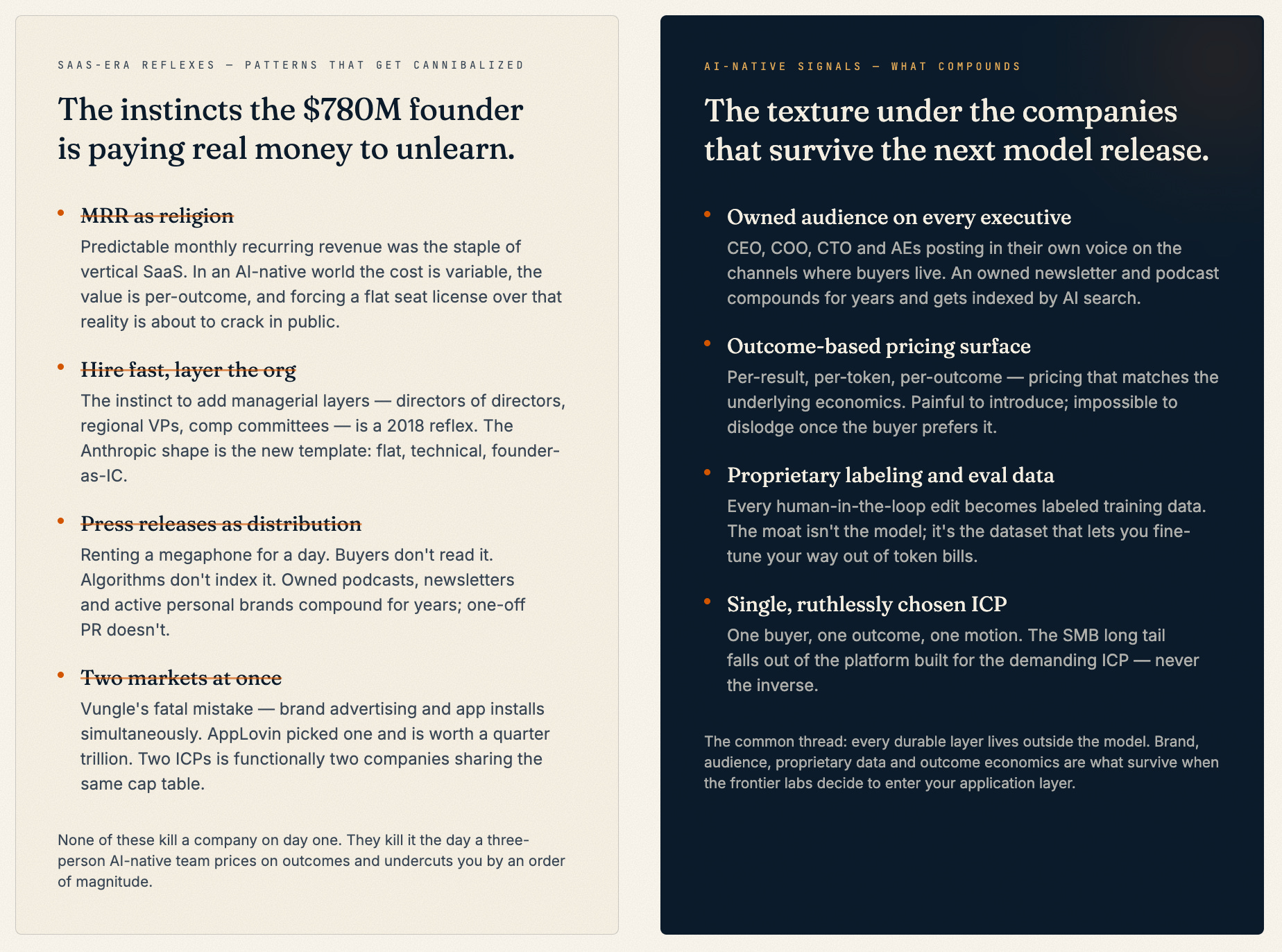
If you’re building an AI-native company in 2026 — and especially if you’re a second-time founder leaning on instincts from the last cycle — four moves separate the founders who compound from the ones who get cannibalized:
1. Flatten the org and put every employee in the codebase. Anthropic’s shape isn’t a quirk — it’s the new operating template. Mandate AI fluency across every function. Kill managerial layers before they kill your shipping speed.
2. Price on outcomes, not seats. Cannibalize your own MRR before a three-person AI-native team does it for you. The pricing surface that matches your variable cost is the one that survives the next 24 months.
3. Build owned distribution before you need it. A CEO podcast, a company newsletter, every executive posting in their own voice. The 0.4% of authentic content on LinkedIn is now the rarest asset in B2B marketing — and it compounds for years.
4. Refuse the easy $10M ARR. If you’re running an AI-native services company, set the date you pivot to platform — and set it before the cultural switching cost makes the pivot impossible.
The founders who win this decade won’t be the ones with the most impressive last playbook. They’ll be the ones with the discipline to burn it — to flatten the org, to price on outcomes, to own the distribution, and to refuse the easy revenue that traps everyone else. Be that founder, and you get to do it all again.
Thanks for reading LINEAR. I reply to every email…
Have any questions, feedback, comments? Let us know, we work for you!