

Live the user’s job.
Package the context.
Ship the easy button.
In late 2022 the consensus take on application-layer AI was that it was a death sentence. Every startup was a thin wrapper around ChatGPT. Every wrapper would be obfuscated the moment the underlying model got smart enough to read user intent. The narrative was so loud that VCs — already allergic to a vertical with few venture-scale exits — looked at Adeel Khan, a public-school principal with no software background, and said no roughly 98 times in a row. Three years later Magic School is leading the AI race with millions of teachers and 20% of children in America using his product….
The first thing the consensus investors got wrong was who the user is…
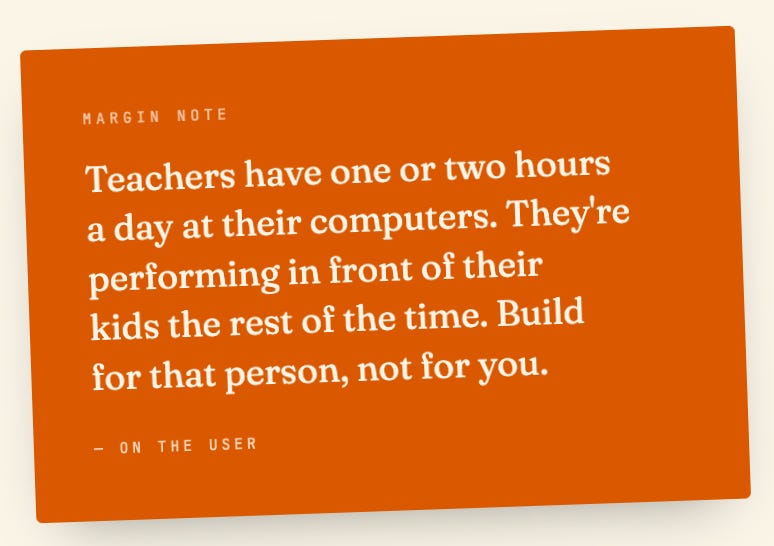
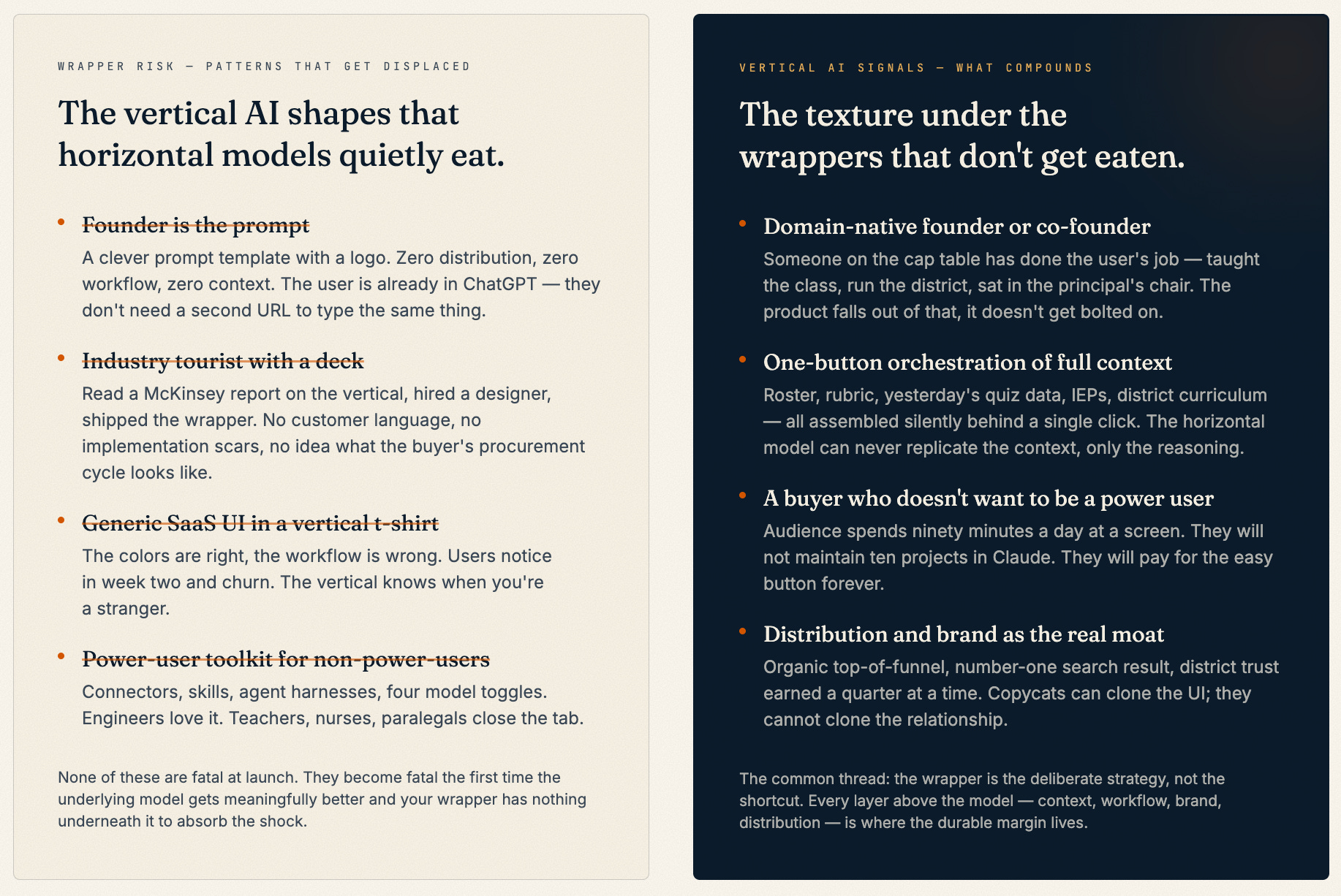
Teachers spend ninety minutes a day at a computer and the rest of it performing in front of children. They are not going to assemble a stack of Claude projects, MCP connectors and custom skills to extract bleeding-edge value out of a horizontal model. They want one button that already knows their roster, their rubric and yesterday’s quiz. The wrapper isn’t the liability — the wrapper is the entire product.
The second was what defensibility looks like. The gap between a stock Claude answer and a Magic School answer is everything Magic School knows that Claude can’t — the kid’s IEP, the district’s curriculum, the writing rubric, the implementation context. The vertical platform doesn’t compete with the model; it composes context on top of the model. Every copycat that’s shipped — PowerSchool, curriculum companies, a hundred lookalike UIs — almost never shows up in Magic School’s deals, because brand, distribution and context are the moats. The model is rented.
The third was what an organic PLG flywheel actually feels like. Five months from launch to a million teachers, zero paid acquisition. The number-one Google result for “AI for teachers.” Eighteen-hour days from a team of heroes keeping the lights on while the order-taking calendars filled themselves. The rest of this issue is the operating system underneath the three: how Adeel hired, how he priced the pilots that underwrote a Series A, when he flipped on monetization, and what he tells the board the next inflection looks like.
This Weeks Vertical Titan:
Adeel Khan, Founder & CEO
@ MagicSchool
Adeel grew up in a low-income household on free-and-reduced lunch and a Pell grant. He started his career as a public-school teacher in Atlanta, became an assistant principal at several schools across Denver, and eventually got to open his own public high school — Conservatory Green in Denver Public Schools — built on a simple promise: love the kids, hold them to high expectations, graduate 100% of seniors to four-year colleges. He did. After a year of principal coaching and a personal sabbatical, he came back from traveling in November 2022, the same month ChatGPT launched.
He had never built software. He didn’t know what a product manager was, what retention metrics were, what a Series A meant. A close friend who had just raised a seed told him: I’ve watched you do hard things, I bet you could do this. He hired a contractor, recruited a couple of engineer friends and a former student as an intern, and shipped the MVP of Magic School in May 2023. By October it had crossed a million teachers, all organic. Today it partners with districts representing roughly one in five U.S. children, has a teacher in nearly every American school building, and runs in 160 countries.
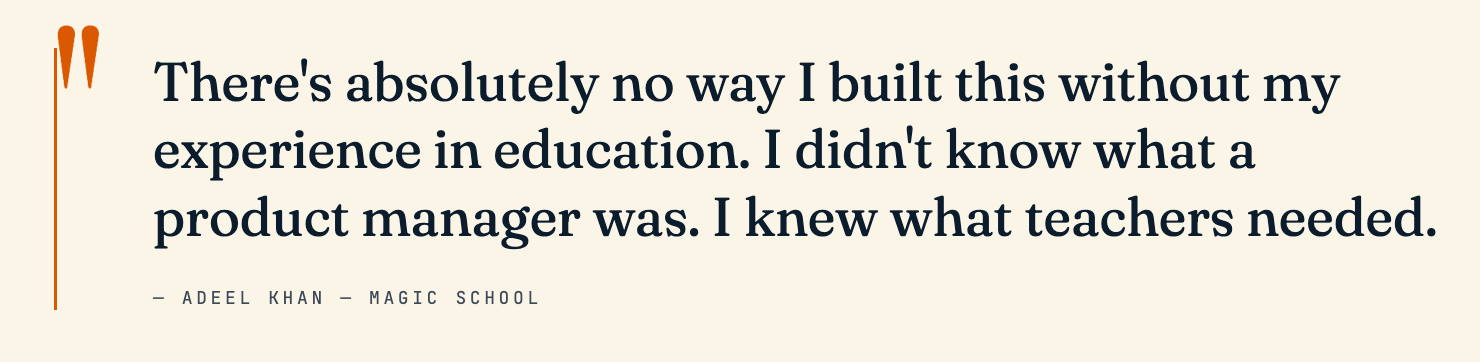
The frame Adeel keeps coming back to: his lived experience as a teacher and principal wasn’t a soft asset — it was the entire unfair advantage. He couldn’t have built this without it, and Magic School’s go-to-market team is now 85–90% former educators by design. The product is what falls out of user-empathy at scale, not what gets bolted on after.
The line every vertical AI founder should write on a wall: in education there is no greater opportunity to make impact at scale, and most of the work the consensus market won’t fund is exactly the work that needs doing.
The Magic School Vertical AI playbook — ten moves from a school principal who out-shipped the “tech people”
Operator-grade lessons from the most extreme vertical-AI PLG story to date — how Adeel hired for domain, priced pilots, built the easy button on top of horizontal models, and survived the shape change from order-taking to real enterprise sales.
#01: Domain expertise is the unfair advantage you can’t fake
Adeel had never seen a product manager, didn’t know what retention metrics were, had never heard the phrase Series A. He had run a public high school in Denver from scratch — graduated a class of first-generation college-bound seniors with 100% four-year acceptances — and he had taught English in Atlanta before that. When ChatGPT shipped in November 2022, he had a point of view on what generative AI could do for teachers that no Stanford CS grad in San Francisco could have, no matter how good the model got. The product fell out of that point of view.
His honest take: he absolutely could not have built this without the principal years. Someone who’s never taught could still win in vertical AI — but only if they treat domain depth as a constraint they actively recruit for, on the team or on the cap table. Today 85–90% of Magic School’s go-to-market team are former classroom teachers. Customers feel it in the first meeting, and they say so out loud.
Action item: Audit your team by classroom hours, not LinkedIn titles. If your AE, your CS lead and your solutions architect have never lived your customer’s job, hire one who has — even if it costs you a quarter of velocity.
#02. If your user has 90 minutes a day at a computer, build them the easy button
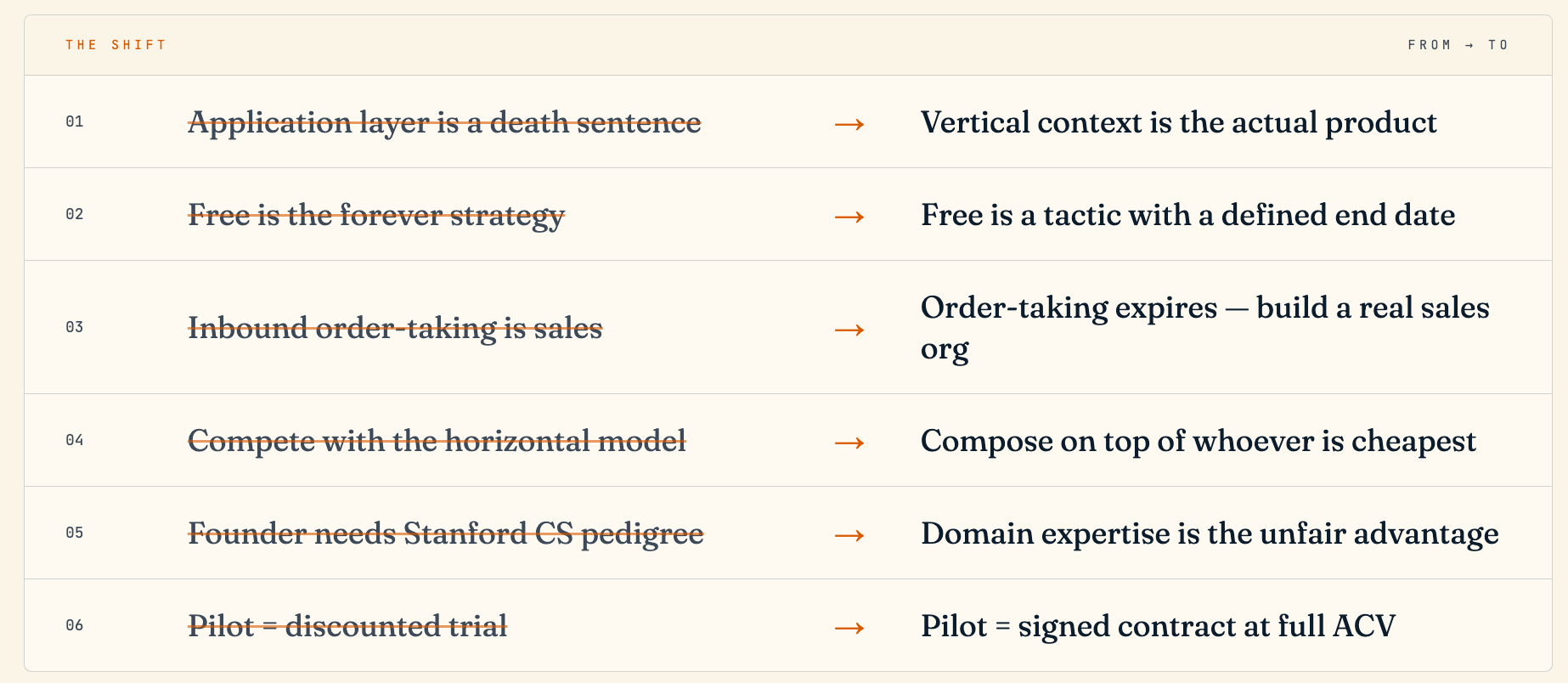
The fashionable take in 2023 was that application-layer AI was a death sentence — platforms would obfuscate every wrapper as the models got smarter. Adeel bet the opposite, on a very specific population: K-12 teachers spend one or two hours a day at a screen, in front of kids the rest of the time. They are not going to maintain ten Claude projects, three MCP connectors and a custom skill library. They want one button that already knows their kids, their roster, yesterday’s quiz data, and their district’s writing rubric.
Three years in, his read has only sharpened: to get bleeding-edge value out of horizontal models today you need context, connectors, skills, prompts and discipline. That’s a hobby, not a job. Vertical AI’s job is to package the entire stack into a single click for someone who would never assemble it themselves. The wrapper isn’t the liability — the wrapper is the whole thing.
Action item: Map the entire chain of context your power-user version of yourself would assemble to do your user’s job. Then ship the one button that hides all of it.
#03. Free is a feature until it isn’t, and you have to be honest about when
Magic School was free from launch in May 2023 to January 2024. Adeel’s heuristic was naive on paper and brilliant in retrospect: the biggest companies he had ever loved as a consumer were free. So get teachers in the product, figure out the rest later. In five months it went 0 to 1M users, all organic — number one Google result for “AI for teachers” — and roughly one of every three U.S. teachers had logged in.
The hard part was knowing when to turn the meter on. They flipped to paid in January 2024 at the moment the PLG halo was loudest, not the moment it had faded. The lesson isn’t “go free” — it’s that free is a deliberately temporary strategy with an end date, and the end date is determined by the customer’s willingness to pay, not by your runway anxiety.
Action item: Write down today the metric or moment that triggers your free-to-paid flip. If you can’t define it, you’re not running a PLG motion — you’re running a free product that’s going to stay free.
#04. Sign the contract for $1,000 — price the renewal at full ticket
Adeel’s most original move during the order-taking year: he offered districts spring-semester pilots at $1,000 per school site or $2,000 for a whole district — Miami-Dade with 350,000 students, same price as a single school. The trick was the contract. Pilots locked in the standard renewal ticket price for July, the moment K-12 buying cycles actually close. The pilot was cheap; the contract was a real signed agreement.
Internally the renewal rate was a wide-ranging bet — the CRO modeled 50%, Adeel modeled close to 100%. Bain Capital Ventures wrote the Series A in the middle of that uncertainty. Everyone renewed at full price. The structural insight: in long-cycle enterprise sales, the asset that matters is a signed paper agreement, not the revenue under it. Price the entry low enough that no one says no, then make the renewal economics non-negotiable.
Action item: Re-write your pilot contract this week so the entry price is whatever your buyer can sign without procurement, and the renewal is locked at your real ACV. Make it impossible to say no on the way in, and impossible to lowball on the way out.
#05. Order-taking buys you the right to build a real sales org. Don’t confuse the two
Year one, anyone on the Magic School team who wasn’t an engineer was a salesperson. Calendars were packed with inbound. People wanted to do this, what does it cost, let’s go. That worked because the market was pulling so hard. But Adeel is explicit: that wasn’t sales. That was order-taking dressed up as sales, and order-taking has a half-life.
The fall after monetization, he brought on a CRO with three previous K-12 sales orgs under his belt. That hire brought a team, a strategic-AE playbook, prospecting discipline, and the muscle to operate after the halo faded. Year two of selling looks nothing like year one — and any vertical AI company that mistakes order-taking for a sales motion will hit a brick wall the quarter the model stops generating inbound for them.
Action item: Identify the quarter your inbound stops being free. Hire the second-time CRO at least two quarters before that — and let them rebuild the whole motion, not retrofit yours.
#06. Hire technical-enough sellers — but domain-deep ones
Adeel’s hiring filter for go-to-market: domain expertise is the rare ingredient, AI literacy is the trainable one. The buyers he sells to — district CIOs and chiefs of academics — are geeking out on the new Claude release on X. So sellers have to be technical enough to answer a hard question about how the model works. But that’s the trainable half. The other half — having stood at the front of a classroom, having sat through a school-board meeting, having lived a district implementation — is what closes the deal.
Magic School’s solutions architects skew toward people who used to run district technology rollouts themselves. When they walk into a CIO’s office and tell the story of a deployment they actually owned, the conversation stops being about features and starts being about partnership. Customers buy the partnership; the product is the receipt.
Action item: Pull your last five lost deals. Was the gap a feature, or was it that nobody on your side could speak your buyer’s professional language? If it’s the second, change who you’re hiring before you change what you’re building.

A quick word from our incredible partner,
Parafin - the leading embedded capital partner.
4.8 star rating on Trustpilot, with over 500 reviews [source]
71% CSAT rating across all partners
84 NPS
Serving top Fortune 500 companies, including Amazon, Walmart, and DoorDash
#07. Defensibility is the context you assemble that horizontal models can’t
The pessimistic 2023 thesis was that horizontal models would absorb every workflow as their reasoning got better. That bet hasn’t paid out. Adeel’s frame three years in: the gap between a stock Claude answer and a Magic School answer is everything Magic School knows that Claude can’t — the teacher’s grade, the district’s curriculum, the writing rubric, yesterday’s quiz results, the kid’s IEP. The vertical platform doesn’t compete with the model. It composes context on top of the model.
That’s also the answer to the wave of copycats. PowerSchool, curriculum companies and every legacy K-12 vendor has launched a Magic-School-shaped product — same UI, same labels on the toolbar. They almost never show up in Magic School’s deals. Distribution is owned, brand is owned, context is owned. The model is rented from whoever’s cheapest this quarter.
Action item: List every piece of context your product packages that the underlying model doesn’t have. If the list is short, you’re a wrapper. If it’s long and growing, you’re a vertical platform — defend it like it.
#08. Treat the legacy SoR as a partner, not a rival — until they prove otherwise
Every district has a system of record — PowerSchool and friends. They’ve all shipped copycat AI features. Adeel’s playbook isn’t war; it’s optionality. Some incumbents are going headless on purpose, telling Magic School they’d rather integrate than reinvent — the Salesforce-of-K12 frame. Others are defensive and want to win it themselves. Treat both as legitimate. The defensive ones are answering the same board question every CEO is getting: where is our generative AI revenue?
What earns the option to partner later is winning now. Brand halo, district trust, a product teachers refuse to give up — that’s the moat that eventually forces a serious integration conversation, or makes the incumbent irrelevant in the discussion. The mistake is picking a fight before you’ve earned the leverage.
Action item: Pick the top three systems-of-record in your vertical. Reach out to one this week with an integration proposal. Use the other two as the BATNA in your own product roadmap.
#09. PLG inflection isn’t forever — survive the shape change
Adeel had to do real personal work to accept that not adding 150,000 users a week wasn’t failure — it was math. There are only 3.5 million U.S. teachers. The Slack and Notion arcs are the same shape, just slower: explosive top-of-funnel, then a deliberate transition into enterprise sales, then a new chapter built on a much harder kind of growth. Compress that into AI-era timelines and the founder has to grow up faster than any normal SaaS playbook prepares you for.
The Anthropic vs OpenAI moment played the same theme on a bigger stage. When you hit an inflection, the world tells you everything is possible. The discipline is choosing the one thing — knowledge-work tools, not Disney contracts — and giving up the other ten for now. The companies that don’t make that choice spend their inflection instead of compounding it.
Action item: Write down the one growth metric that defines your next 12 months — and the three exciting things you are explicitly not chasing while you compound it.
#10. Education is hard for VCs and easy for impact — pick your reason and own it
Adeel raised the seed in the worst possible quarter for application-layer AI, in a vertical that has historically produced very few venture-scale outcomes, with a teacher-founder profile no investor had pattern-matched on. Most of the 100 people he met said no. The pattern eventually broke — but only because the company started speaking for itself in the rounds that came after.
His closing frame: literacy and math scores are at their lowest point in decades. If your North Star is impact, there is no better mission to pick. You will not be the VC darling, but the impact at scale is unlike anything else software can do. Vertical AI founders who pick a hard, unfashionable, deeply-mattering vertical are not making a worse career bet — they’re making a different one, and the people they serve will know.
Action item: Write the version of your founder bio that leads with the customer’s outcome, not your fund’s logo. If it reads compelling without a single investor name, you’re underwriting the right thing.
Most of the doomer takes on application-layer AI in 2023 were directionally wrong, and they were wrong in the same direction that the 2024 copycats are still wrong.
The founders actually winning verticals like K-12 didn’t out-engineer the platforms — they out-empathized them.
Live the user’s job.
Then build the easy button only you could build.
If you’re building vertical AI in 2026 — and especially if you’re sitting on a so-called thin wrapper that quietly works — four moves separate the founders who compound from the ones who get eaten:
1. Recruit domain depth onto the cap table. If you haven’t done the user’s job, hire someone who has and give them real equity. Magic School’s go-to-market is 85–90% former educators by design — the product is what falls out, not what gets bolted on.
2. Package every piece of context the horizontal model doesn’t have. Roster, rubric, last week’s data, the workflow your user actually runs. The wrapper isn’t the liability — the wrapper is the durable margin.
3. Use free as a deliberately temporary strategy with an end date. Adeel ran it for eight months and flipped to paid at the peak of the halo. The window is wider in AI than in old SaaS, but it still closes.
4. Price the entry impossible to refuse — and the renewal impossible to lowball. $1,000 pilots that locked districts into full-ticket July renewals underwrote a Series A. Re-write your pilot contract this week.
The vertical AI founders who win this decade will not be the ones who out-engineered the platforms. They will be the ones who out-empathized them — who lived the user’s job before the model existed, and who quietly built the relationship, the brand and the context the model can never own. Be that founder, and the wrapper outlasts the wave.
Thanks for reading LINEAR. I reply to every email…
Have any questions, feedback, comments? Let us know, we work for you!