


MaintainX Acquired By AutoDesk for $3.6B (!!) Let’s dig into the company…
Most people will look at MaintainX and say: “It’s just maintenance software.”
That is technically correct. And strategically useless. Because the real story is not “maintenance software.”
The real story is:
MaintainX built a mobile-first system of record and action for the people who keep the physical world running — then layered data, AI, and enterprise rollout on top of it.
That is a much more interesting company.
And it helps explain why Autodesk agreed to acquire it for approximately $3.6B in an all-cash deal. Autodesk said MaintainX is expected to exceed $135M of ARR in calendar 2026 while growing more than 50%. They paid 26x EOY ARR. Holy sh*t…

The founding story
MaintainX started in 2018 with a very simple observation:
The software given to frontline and industrial workers was stuck in the past.
MaintainX’s own framing is that the tools keeping the world moving were outdated, and that maintenance teams were still relying on antiquated systems for critical workflows. Chris Turlica and his cofounders had already built and sold a company together, and Turlica later said the team wanted to build something as easy to understand as Slack or Asana, but designed specifically for frontline maintenance, safety, and operations.
BCV tells the founding story even better.
Their version is that Turlica’s earlier consumer chat app was being used by factory workers to photograph clipboards and discuss work orders. That is one of those great startup moments where the market tells you what the actual product should be. Not a generic workflow app. Not another dashboard. A purpose-built operating layer for physical operations.
That wedge mattered.
Because if you start with the technician, the supervisor, the plant manager, and the actual job to be done, you don’t build “software for maintenance.” You build software that becomes embedded in the daily motion of keeping equipment online.

The early journey and fundraising history
The company moved quickly.
In March 2019, MaintainX announced a $3.8M seed round led by August Capital and Amity Ventures. At that point the pitch was straightforward: digitize procedures, inspections, audits, checklists, and work orders for deskless teams who were still operating on paper, radios, spreadsheets, and email. The company said more than 1,600 businesses had joined the platform and were ready to start using it daily.
In June 2021, MaintainX announced a $39M Series B, and disclosed a previously unannounced $11M Series A from 2019. That brought total funding at the time to $54M. The company said revenue had grown 12x from early 2020, retention was 98%, and customers across 20+ countries were using the platform to manage hundreds of thousands of physical assets.
By December 2023, MaintainX had raised a $50M Series C at a $1B valuation. Turlica wrote that the company had grown to 6,500+ customers, processed 15M work orders, and managed 2.5M assets.
Then in July 2025, MaintainX raised a $150M Series D at a $2.5B valuation, bringing total funding to $254M. The company said it served 11,000+ companies, managed 11M+ assets, and was using the new capital to expand AI, machine health monitoring, predictive maintenance, and broader enterprise asset management capabilities.
Then came the Autodesk deal.
From seed in 2019 to a $3.6B exit agreement in 2026.
That is a serious run.
What the product actually became
This is the part I think people miss. MaintainX did not stay a simple CMMS.
It kept widening the surface area.
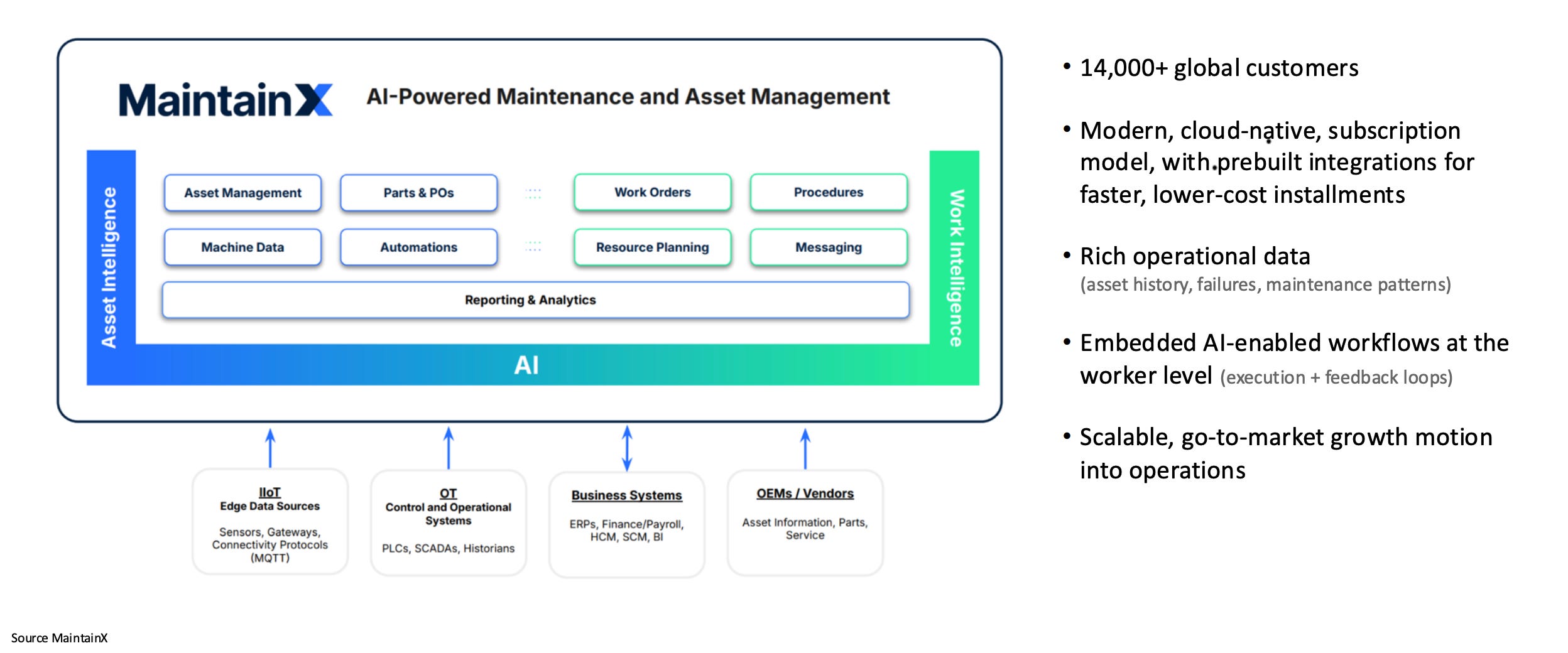
Today the core stack includes:
work order creation, assignment, and tracking
preventive maintenance scheduling
condition-based work triggers
asset health and reliability insights
parts and inventory management
inspections, safety procedures, and compliance workflows
analytics and reporting
AI copilots and natural-language querying for maintenance teams
That is how vertical software gets more valuable.
You start with the obvious pain and you solve it with a STUPIDLY simple capability.
Then you absorb adjacent workflow.
Then you absorb data.
Then you absorb decisioning.
At some point, you stop being a tool.
You become the operating layer.
MaintainX’s own homepage now frames the company around work intelligence, asset intelligence, AI-powered reporting, predictive parts needs, and compliance digitization. That is no longer “just maintenance.” That is workflow ownership around uptime.
The GTM motion was sneakily powerful
This may be my favorite part of the story.
BCV describes MaintainX as a rare industrial software company that behaved almost like a PLG wedge inside a traditionally top-down market.
Frontline workers liked the app.
Factories adopted it because it was easy to use.
Regional managers noticed that certain sites were outperforming.
COOs saw the pattern and standardized around it.
That is an elite motion.
You get bottoms-up love and top-down expansion.
You get usability as the wedge.
You get operational data as the moat.
You get enterprise standardization as the scale unlock.
Autodesk explicitly called out MaintainX’s pre-built integrations and scalable go-to-market growth motion in operations as part of the rationale for the acquisition.
That line is doing a lot of work.
Because it tells you Autodesk was not just buying a product.
It was buying a repeatable distribution engine into operations.
The post-sales motion mattered too
A lot of software companies win the deal and then lose the deployment.
MaintainX seems to have taken implementation seriously.
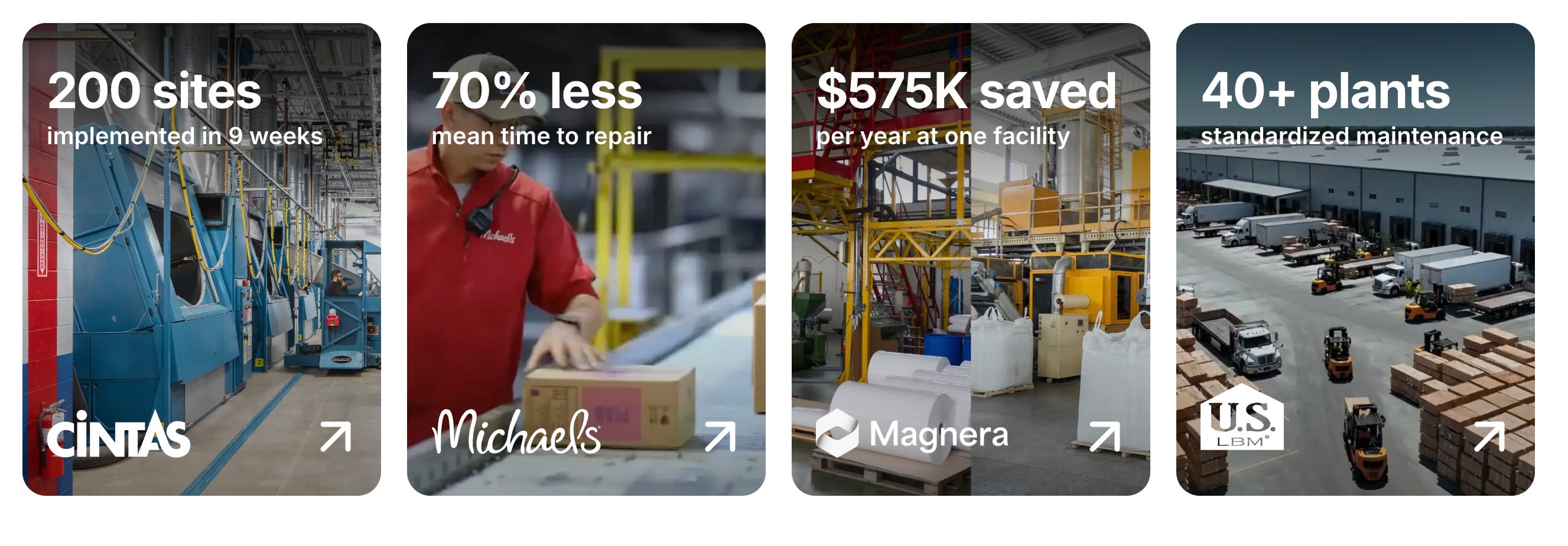
Its implementation page says the company has completed 3,000+ implementations with a stated 98% adoption rate, and offers tailored onboarding led by specialists with engineering and operational backgrounds. The messaging is very clear: get sites live in weeks, not years; standardize, optimize, and build a center of excellence.
For enterprise customers, MaintainX highlights a structured three-week onboarding process, a dedicated implementation specialist, support for multi-site rollouts, ERP/IoT/BI integrations, SSO, MFA, custom permissions, unlimited custom dashboards, and dedicated account management.
And the case studies back it up.
At US LBM, the rollout happened in waves of 3-5 sites at a time, with early focus on the 20% of the tool that would drive 80% of the impact. The company standardized asset naming and reporting, but still allowed sites enough flexibility to adapt local procedures. That is smart implementation. Not rigid. Not chaotic. Structured enough to scale, loose enough to spread best practices.
The customer success motion also looks mature.
MaintainX’s enterprise CSM role includes onboarding, product demos, training sessions, webinars, quarterly business reviews, adoption monitoring, churn mitigation at lagging facilities, and upsell/cross-sell identification with the sales team. That tells you a lot about how the company expanded inside large accounts.
This is what good vertical software looks like.
Not just software people love.
Software that gets implemented, adopted, expanded, and embedded.
Why Autodesk paid up
This is where the story gets really interesting.
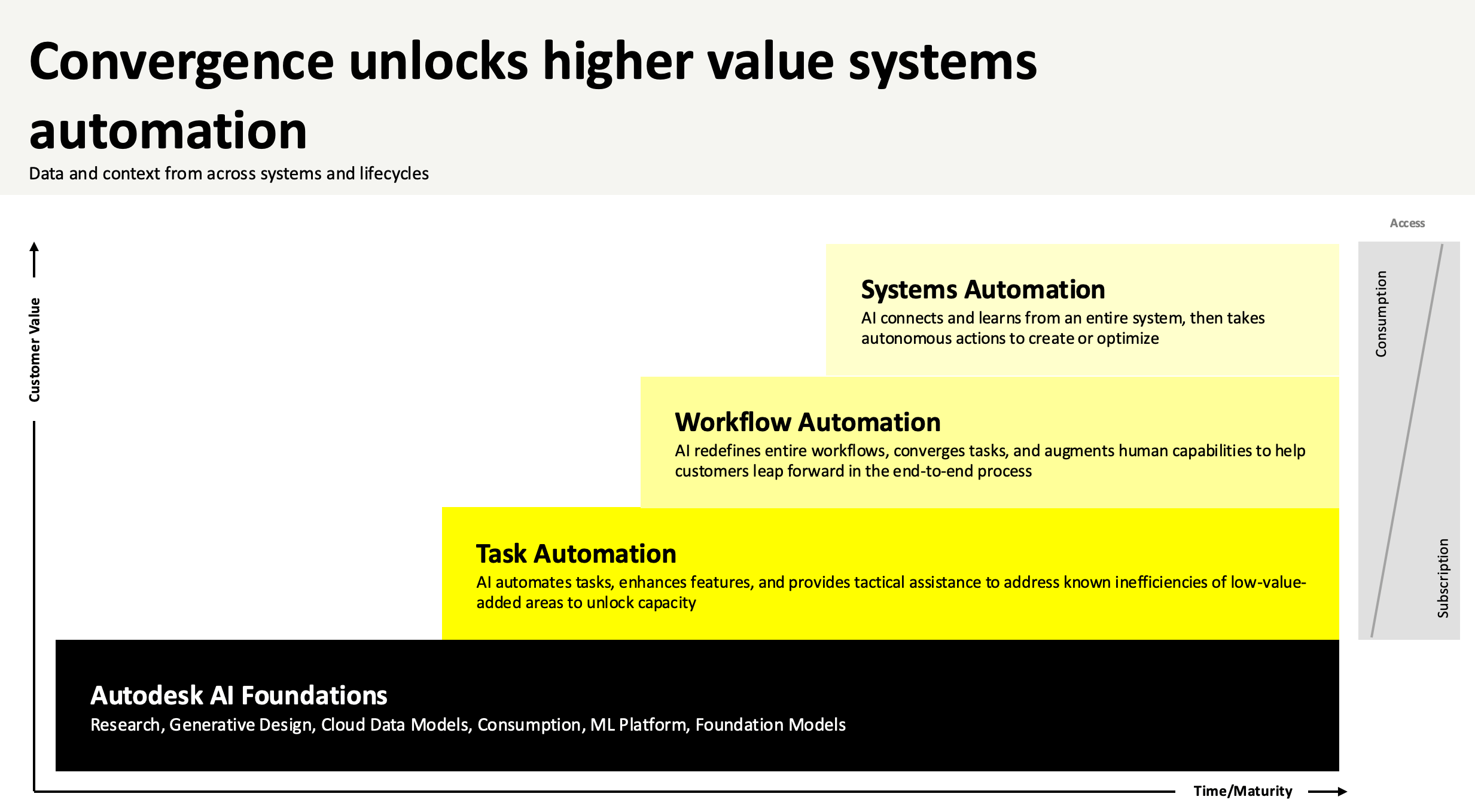
Autodesk is trying to connect design, make, and operate.
MaintainX gives them a much stronger position in the last part.
Autodesk said the acquisition strengthens its ability to connect operations workflows with the broader lifecycle, brings richer data on asset history and maintenance patterns, and helps extend Autodesk’s relationship with assets from years to decades.
The investor presentation sharpens that further.
Autodesk frames the deal as a way to add roughly $40B of Operations TAM to its existing $78B Design & Make TAM, while extending its duration with assets and systems from a few years to 50–60+ years.
The idea is simple: design software knows how an asset was supposed to work; MaintainX knows how it actually performs in the field. Put those together, and you get a much more valuable loop.
BCV put it well too.
For decades, design tools captured how an asset should work, while operations platforms captured how it actually worked, and those datasets rarely talked to each other. Autodesk + MaintainX closes that loop.
That is what Autodesk is buying:
Not just CMMS revenue.
A frontline data asset.
A workflow foothold in operations.
A long-duration relationship with the physical world.
And eventually, a better foundation for system-level AI.
Big kudos to the team
This is a huge win.
Chris Turlica deserves a lot of credit for seeing a very unsexy problem clearly and then building with unusual intensity around it.
Same goes for Hugo Dozois-Caouette and the broader team.
They picked a market where the pain was real, the buyer need was persistent, the workflow was mission-critical, and the software incumbents were ancient.
Then they did the hard part:
They actually executed.
They built something workers used.
They made the data useful.
They made implementation real.
They expanded into enterprise.
And they gave a strategic buyer a very clean reason to pay a premium.
That’s the playbook.
Find a workflow the world cannot live without.
Build the system of action around it.
Turn usage into data.
Turn data into intelligence.
Turn intelligence into strategic value.
MaintainX did that.
And a $3.6B outcome is what that can look like when you do it really, really well.
The Hidden Ceiling in Embedded Payments
A lot of vertical SaaS founders think embedded payments is about choosing the “right” model. Referral, hybrid, or PayFac. But I’m starting to think that framing misses the bigger issue entirely.
Because the real mistake usually isn’t choosing the wrong model. It’s locking into one too early.
Early-stage SaaS companies naturally optimize for speed. They want the fastest path to launch, the simplest onboarding experience, and the least operational friction possible. Totally reasonable. Nobody wants payments turning into a six-month operational project while they’re still trying to grow the core platform.
The problem is that what works early often becomes limiting later, because SaaS businesses don’t stay static for very long.
As companies scale:
Customer segments become more diverse
Enterprise deals introduce new requirements
Sales teams need more flexibility
Payments revenue becomes materially important to company economics
That’s where rigid payments strategies start creating problems. Not obvious failures, but hidden ceilings.
At first, everything still looks healthy on the surface. Merchants onboard. Transactions process. Revenue grows. But underneath, the same payments structure is getting applied across completely different customer types. SMBs get treated like enterprise accounts. Enterprise accounts get forced into SMB workflows. Sales teams lose flexibility, and adoption slows because the process no longer fits every segment equally well.
Most founders don’t notice this immediately because nothing technically “breaks.” Growth just becomes harder than it should be.
That’s why the strongest SaaS platforms don’t treat payments like a fixed infrastructure decision. They treat it like an evolving revenue strategy that matures alongside the business itself.
The priorities change over time:
Early on, the goal is speed and adoption
Later, the focus shifts toward improving revenue per customer
Eventually, the focus becomes margin optimization and enterprise monetization
Those are completely different operational priorities, and they rarely fit neatly into one permanent model.
The best operators understand this intuitively. What works at 100 customers usually breaks at 1,000. What works for SMBs often doesn’t work for enterprise. What feels operationally simple early on can quietly suppress long-term revenue later.
That’s why more sophisticated SaaS platforms are starting to structure payments differently based on the customer segment itself. SMBs might prioritize simplicity and fast onboarding. Mid-market customers may require a more balanced approach. Enterprise accounts can often support higher-control, higher-margin structures.
Not because complexity is the goal, but because maximizing long-term revenue usually requires flexibility.
Honestly, I think this is where the embedded payments conversation is heading. The future probably isn’t about choosing between referral, hybrid, or PayFac. It’s about building the ability to move between them as the business evolves.
That’s part of why I’ve been paying attention to what Xplor Pay is doing lately. They seem to think about embedded payments more as an evolving growth system than a static infrastructure decision, which honestly feels much closer to how SaaS businesses actually operate.
Because at a certain stage, payments stops being just infrastructure. It becomes part of the growth strategy itself.

Your strongest AI Users are probably worth 10x your other employees
One strong AI-native Employee can now do the work that used to require a researcher, a designer, a coordinator, a writer, and a developer.
That changes everything, and we’re really not talking about it enough.
The right question is:
Who in our org has rebuilt their entire workflow around AI?
That’s who matters.
Because once someone figures this out, they stop behaving like a normal employee inside a normal function.
They become a throughput machine.
They learn faster.
They iterate faster.
They ship faster.
They document better.
They unblock other people.
They make management look smarter.
They make average teams feel more coordinated than they really are.
And most importantly:
They create leverage that compounds.
A strong AI user does not just produce more output. They create prompts, templates, automations, operating procedures, and internal playbooks that other people can reuse.
So their value is not just their own output.
It’s the new system of work they drag into the company. That is why I think these people are worth way more than most org charts suggest.
If you have an IC who is implementing AI into every part of their workflow, you should think about them differently.
Not as a normal employee. As infrastructure. As a force multiplier.
I think a lot of companies are massively underestimating this.
Not 10% better.
Not “a bit more productive.”
10x more valuable.
What I would do
1. Identify your top 5 AI-native operators immediately.
Not the people talking about AI the most.
The people quietly using it to get absurd amounts done.
You probably already know who they are.
They are the ones sending better memos faster.
The ones with cleaner thinking.
The ones who come to meetings with the first draft already done.
The ones who somehow keep eliminating steps.
2. Turn them into internal teachers.
Ask them to document exactly how they work.
What tools they use.
What prompts they rely on.
What gets automated.
What still requires human judgment.
What a “good” AI workflow looks like inside your company.
If you do this well, one great AI operator can upgrade ten others.
3. Give them harder problems, not more busywork.
Do not turn your best AI users into cleanup crews.
Use them on strategy, customer insight, GTM experiments, internal systems, and cross-functional bottlenecks.
Point them at the highest-friction parts of the business.
Let them redesign the work.
4. Promote for leverage creation.
In a normal org, we reward ownership.
In an AI-native org, we should reward scalable ownership.
Who is building repeatable systems?
Who is making other people faster?
Who is changing the slope of execution?
That is the game now.
5. Weed out the Non AI People
Can you imagine if your entire organization was made up of these people? I’m seeing it first hand. I’m truly living it. I’m involved in companies with a few AI native IC’s (across every type of role BTW) and companies where Claude is the legit operating system of EVERY employee.
There is a serious difference between the two. And I don’t want to be in organizations that are the former. So If your a little hardcore like me, you may want to start thinking about weeding out the people that are still criticizing the use of AI. If they haven’t got it now, will they ever? Do you want to pay for them to catch up? If they ever do?
In an AI-native org, we should reward scalable ownership.
That is the game now.
The takeaway
The companies that win over the next few years will not just “adopt AI.”
They will identify the people who are best at using it, then reorganize around them.
That’s the opportunity.
And that’s also the warning.
If you have a few of these people in your company, treat them like gold.
If you don’t, go find them.
Fast.
If you made it thus far! You’ve found the easter egg.
Snag a free ticket to the Vertical Software Summit. Just use code FREE4FOUNDERS!
Vertical Software/AI Founders, Operators, Investors only please.
If you’re not your submission won’t be accepted.
Do me a solid and forward to a friend :-)