

Today’s newsletter is sponsored by Xplor Pay. Most AI conversations focus on features, but long-term advantage comes from infrastructure. Clean payments data, system control, and flexible architecture determine how intelligently your platform can scale over time.

Shaped by lessons from growing and scaling 20+ vertical SaaS platforms, this guide explores what AI readiness actually means for software providers. Read the guide.
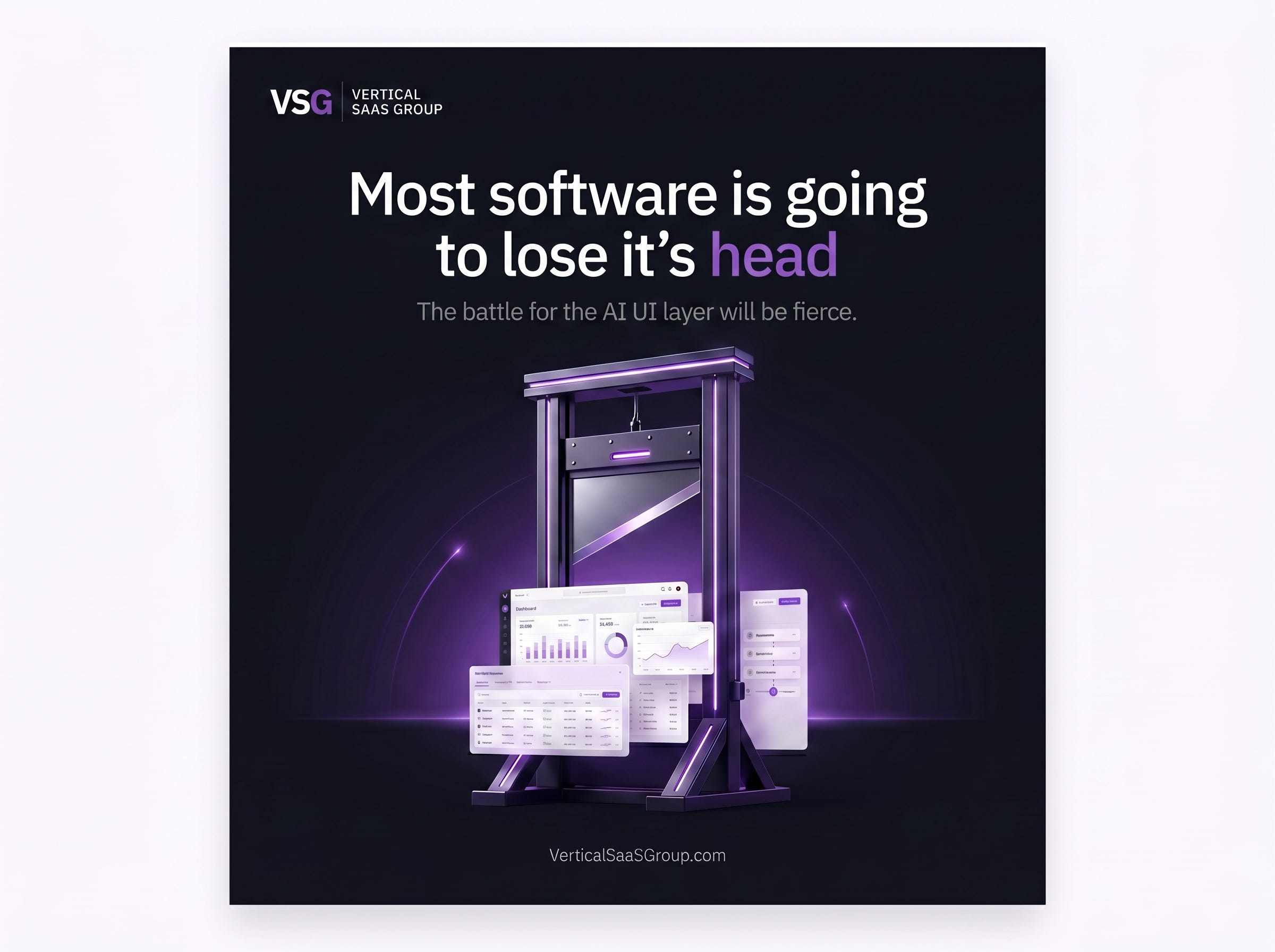
Most software is going headless
For the last 20 years, most software value was packaged inside the UI.
That was the bundle.
You sold the workflow.
You sold the dashboard.
You sold the reporting layer.
You sold the place where the user logged in and did the work.
The product was the screen.
And that worked because humans were the operators.
Humans had to know where things lived. They had to click through tabs, navigate record pages, update fields, run reports, approve tasks, move work from one system to another, and string together a process using the interface as the coordination layer. That made the UI incredibly important, because it wasn’t just presentation — it was behavior-shaping infrastructure.
But agentic software changes that.
If an agent can understand intent, retrieve context, call the right tools, reason across multiple systems, and execute a workflow on the user’s behalf, then the software no longer needs to be primarily optimized for a human operator sitting inside the product. It increasingly needs to be optimized for machine access, orchestration, permissions, and reliability. OpenAI’s ChatGPT agent is explicitly built to move across connectors, websites, browsers, APIs, and terminals to complete tasks. Anthropic’s computer use capability similarly shows models operating software by looking at the screen, clicking, typing, and navigating interfaces designed for people.
That’s the core headless thesis.
A lot of software won’t necessarily die.
It will just lose its head.
Meaning: the software still exists, but the human-facing interface is no longer the primary source of leverage.
Instead, the software gets reduced — or elevated, depending on how you look at it — into its underlying components:
structured data
workflow logic
permissions
audit trails
compliance controls
APIs, MCP tools, and commands agents can call
That’s not a small shift. That is a fundamental reordering of where value sits in the software stack.
The other problem is if the AI UI layer wants to do what your headless software does, they will do it, and you will die….
That’s why becoming the AI UI layer in verticals is where i’m spending my time.
The cleanest example of this showing up in the market is Salesforce’s Headless 360 announcement.
Salesforce said the quiet part out loud: instead of burying capabilities behind a UI, expose them so the platform is programmable and accessible from anywhere. They describe Headless 360 as the capabilities agents need most, exposed as an API, MCP tool, or CLI command, across the breadth of Salesforce workflows. They also say plainly that if your platform requires humans to click through UIs to make progress, it is not ready for the agentic enterprise.
That is a massive statement.
Because Salesforce is one of the most important systems-of-record companies in enterprise software. For decades, “using Salesforce” meant working inside Salesforce. Open the app. Navigate the object. Update the record. Run the workflow. Now they are telling the market that the future is not just humans working inside the application — it is agents acting on the system directly. Trailhead makes the same point even more clearly: in the agentic enterprise, agents don’t click through pages, buttons, and tabs; they call APIs, invoke MCP tools, and run CLI commands directly.
This is why I think so many point solutions and horizontal SaaS tools are about to get pushed down the stack.
If your product’s main value proposition is that a human logs in and manually performs a repeatable workflow, that position is getting weaker. If the steps can be abstracted, coordinated, and executed by an agent, then the UI becomes less of a moat. The value migrates below the interface into the quality of the data model, the richness of the workflow graph, the trust and permissioning layers, and the ability to safely support machine execution. a16z’s framing is useful here: in the agentic era, defensibility shifts downward into data models, permissions, workflow logic, and compliance, and upward into networks, proprietary data generation, and real-world execution.
That doesn’t mean every software category gets commoditized overnight.
Some products will remain highly human-centric for a long time. Some workflows will stay collaborative, exception-heavy, or emotionally nuanced enough that the interface still matters a lot. And many companies will live in a hybrid world where humans and agents work side by side for years. Showpad’s response to Salesforce is instructive here: they explicitly say the future is both humans and agents, and they’re building dual-track — strong UX for people while enabling agent access in parallel.
That’s probably the pragmatic transition path for most of the market.
But even in that hybrid state, the power structure changes.
Because once users stop starting in the native app, the real battle is no longer just over the system of record.
It’s over the AI UI layer.
Who owns the place where the user expresses intent?
Who owns the conversational surface?
Who owns the orchestration layer?
Who decides which tools get called, in what sequence, with what context, and with what permissions?
That is the new choke point.
And everyone serious in software can see it.
OpenAI is pushing toward a world where ChatGPT becomes a layer that can act across apps and workflows. Microsoft is explicitly combining agents and workflows so AI can reason where processes are ambiguous and workflows can execute where consistency matters. Salesforce is trying to make its system programmable for agents while also shipping an Experience Layer that lets rich interactive components render across Slack, mobile, ChatGPT, Claude, Gemini, Teams, and other clients.
That Experience Layer point is especially important.
Salesforce describes it as a UI service that separates what an agent does from how it appears, so interactive components can render natively across multiple surfaces. In plain English: build the logic once, but let the interface show up wherever the user already works. That matters because it means the fight is no longer “which app do users log into?” It becomes “which layer owns the interaction, even if execution is happening elsewhere?”
That’s why “headless software” is not just an architecture idea.
It’s a market power idea.
In the old model, the best product often won by becoming the place where work happened.
In the new model, the winners may be the ones that:
own the deepest context
control the critical workflow
enforce the trust layer
and sit closest to the point where intent becomes action
That is a very different game.
And it is bad news for thin point solutions that are mostly UI wrappers around relatively generic functionality.
If your wedge is “we have a slightly better dashboard,” you should be nervous.
If your moat is proprietary context, embedded workflow ownership, regulated execution, payments, domain-specific data, or a mission-critical system of record, you are in a much better position. Because in a headless world, the closer you are to the trusted execution layer, the more durable you become.
So my take is pretty simple:
Nearly all software is moving toward some degree of headlessness.
Not because interfaces vanish completely.
Not because apps stop mattering.
Not because every workflow becomes fully autonomous.
But because the center of gravity is shifting.
From screens to systems.
From navigation to orchestration.
From UI to execution.
From software you use… to software agents use for you.
And the fiercest battle in software over the next few years may be the battle to own that new AI UI layer.

The Story of AIDoc & Their Massive Series E Round
How a radiology wedge became a clinical AI operating system
Aidoc is one of the clearest examples of what a real vertical AI winner looks like.
Not a generic copilot. Not a horizontal wrapper. Not “AI for healthcare” in the abstract.
It started in one painful, high-stakes workflow, earned trust where mistakes actually matter, and then expanded into platform, workflow, and enterprise infrastructure. That’s the playbook.

1) Founding story: start where the pain is brutal
Aidoc was established in 2016. The company says its founding team came out of deep AI and defense-tech backgrounds, with Talpiot-trained founders bringing algorithmic, computational, medical, and research expertise into one company. CEO and co-founder Elad Walach says he began in the elite Israeli Defense Force technology program Talpiot and later led AI research in the Israeli Air Force; co-founder and CTO Michael Braginsky brought a medical-image-processing background and helped define a roadmap covering more than 75% of common acute CT pathologies. In other words: this was not “let’s bolt AI onto healthcare.” This was a technical founding team choosing a vertical where accuracy, speed, and workflow integration actually change outcomes.
The original wedge was smart too. Aidoc first focused on helping radiologists reduce turnaround time and improve quality by flagging acute anomalies in real time. That’s important. They did not start by promising to reinvent all of medicine. They started with one clear buyer pain: overloaded imaging workflows, rising scan volume, and costly delays in diagnosis. That’s classic vertical software strategy—begin with a sharp wedge inside a mission-critical workflow, then expand once trust is earned.
2) Product: from point solution to operating layer
Aidoc’s first chapter was essentially workflow-aware clinical AI for radiology. But the current product story is much bigger.
Today the company is built around two core assets:
CARE — its clinical foundation model
aiOS — its enterprise AI operating system for health systems
That product evolution is the whole story.
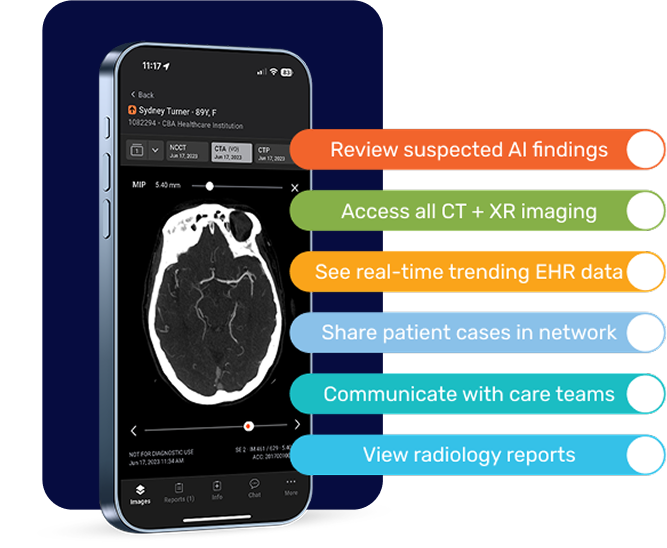
A lot of AI companies get stuck selling a single model for a single use case. Aidoc appears to have used the initial radiology wedge to climb into infrastructure. aiOS is described as the layer that runs, orchestrates, and governs clinical AI across the health system. It integrates with PACS, EHR, mobile, worklists, and care tools; supports urgency-based triage; provides validation, drift detection, override tracking, and analytics; and is positioned as the way hospitals move from pilot projects to enterprise-scale deployment without “sprawl.” That’s a huge jump up the value chain.
The most important recent product milestone is FDA clearance for what Aidoc calls healthcare’s first comprehensive foundation-model AI triage solution. The company says CARE now supports a workflow combining 11 newly cleared indications with 3 previously cleared ones, with mean sensitivity of 97% and mean specificity of 98% in the FDA-reviewed pivotal study. More strategically, Aidoc says this is the first FDA clearance of a comprehensive set of double-digit acute indications powered by a single foundation model. That matters because it suggests the company is no longer just shipping separate narrow models. It’s building a scalable clinical intelligence layer.
This is what I like most about the product.
They are not selling “AI magic.” They are selling:
earlier detection
faster triage
cleaner workflow routing
better care-team coordination
governance
enterprise deployment
That is how vertical AI becomes durable.
3) GTM: enterprise, multi-stakeholder, and trust-heavy
Aidoc’s go-to-market motion is exactly what you’d expect in a serious healthcare vertical AI company: slow at first, then powerful if you get it right.
This is not bottoms-up PLG. This is not swipe-a-card SaaS. This is enterprise clinical workflow software with regulatory weight.
The company’s public materials point to health-system sales centered on measurable operational outcomes: improved efficiency, shorter length of stay, faster diagnosis, reduced silos, and ROI. It also appears to sell into multiple service lines—radiology, neurology, vascular, cardiology, emergency care—which is important because it expands ACV after the initial wedge. Once you are trusted in one workflow, you can use the same platform and integration layer to expand across adjacent clinical domains.
The integration strategy is a big GTM advantage. Aidoc says aiOS is vendor-agnostic and connects with PACS, VNA, worklists, EHR, scheduling, and communication interfaces. It also says it is available within Epic’s App Orchard and can integrate with Radiant to provide acuity-based feedback in radiologists’ workflows. In healthcare, integration is distribution. If your product lives inside the clinical systems teams already use, adoption friction drops and your ROI story gets easier to prove.
I also like the partner strategy. Aidoc has both reselling partners and AI application partners. That means it is not just selling a closed suite; it is positioning aiOS as the orchestration and governance layer through which other clinical AI applications can be deployed. That is a much more ambitious GTM posture than “buy our algorithm.” It says: make us the control plane for AI inside the health system.
4) Customer success: this is where the company seems to separate itself
Most AI companies talk model performance.
Aidoc talks rollout, workflow, governance, and speed to value.
That’s a tell.
On the aiOS page, Aidoc highlights several scaled deployments:
Advocate Health: 69 hospitals, 8M+ annual imaging studies, 22-site rollout, nearly 63K patients/year projected to benefit
Hartford HealthCare: 500+ care locations, first sites live in 3 weeks, 17 FDA-cleared algorithms deployed plus care coordination and patient management tools
Mercy: 1,000+ facilities, 12 use cases deployed system-wide in 3 months, urgent and incidental findings triaged in under 5 minutes, down from 20
Those are not vanity metrics. Those are customer-success metrics.
They show that Aidoc understands a truth most AI founders miss:
In the enterprise, the model is not the product. The implementation is the product. The workflow change is the product. The internal buy-in is the product.
The Hoag case study reinforces this. Aidoc highlights how radiology leaders built internal buy-in by starting with pulmonary embolism and vascular workflows, demonstrating shorter stays, improved outcomes, and cost savings, then expanding once the ROI case was clear. That is textbook vertical expansion: prove value in one high-pain workflow, create champions, then widen the footprint.
If I were underwriting this business, that’s what I’d focus on.
Not just “does the model work?” But:
how fast can they go live?
how many use cases can they layer in?
how sticky is the workflow once deployed?
how much internal political capital does the champion need?
Aidoc’s public stories suggest they’ve gotten very good at that layer.
5) Revenue: likely large ACVs, land-and-expand economics
Aidoc does not publicly disclose revenue in its own materials, so any revenue discussion has to be intellectually honest.
What we do know is this:
the company says it is deployed across nearly 2,000 hospitals
supports decision-making for roughly 70 million patients each year
analyzes more than 110 million patient cases
and is clearly selling enterprise software into major health systems
A third-party database, Prospeo, estimates annual revenue at roughly $95M, but I would treat that as directional rather than verified fact. Still, even if you haircut that estimate, the public customer scale suggests this is no tiny experiment. This is a real enterprise vertical AI business with meaningful commercial traction.
My read on the revenue architecture is that Aidoc likely benefits from a classic vertical AI compounding motion:
initial wedge into one service line
expansion into adjacent use cases
platform value from aiOS
additional monetization through broader orchestration/governance footprint across the health system
That tends to create larger ACVs, better net revenue retention, and more strategic importance over time. That last part matters most. Once the product becomes the layer managing multiple clinical AI tools and workflows, ripping it out gets much harder. That’s when revenue quality improves.
6) Fundraising: massive round, but the more important signal is why it got done
Aidoc announced a $150M Series E in April 2026 led by Growth Equity at Goldman Sachs Alternatives, with participation from General Catalyst, SoftBank Vision Fund 2, and NVentures. The round brought total funding to over $500M.
That’s obviously a big round.
But the deeper signal is the narrative behind it.
Aidoc is not pitching “we have one impressive model.” It is pitching:
a clinical foundation model
an enterprise operating layer
regulatory rigor
scaled deployment
measurable customer ROI
and a path toward end-to-end workflow automation, including draft reporting
Elad Walach framed the round as “the end of the beginning” for clinical AI and said the capital will go heavily into R&D: expanding CARE to cover hundreds of diseases, upgrading aiOS to support scale, and investing in AI-generated draft reporting. That is exactly the kind of post-wedge capital allocation you want to see. Use the first phase to prove trust and workflow fit. Use the next phase to widen disease coverage, deepen infrastructure, and automate more of the value chain.
Also worth noting: Goldman’s quote emphasizes efficiency, shorter length of stay, and measurable financial returns. That’s investor-speak meeting buyer-speak. The company isn’t being funded on vibes. It’s being funded on the idea that clinical AI is moving from pilot project to operating necessity.
7) Why Aidoc matters
Aidoc matters because it shows what the best vertical AI companies are becoming.
They don’t stay point solutions.
They start as a wedge. Then they become workflow. Then they become system layer. Then they become control plane.
That’s the climb.
Aidoc started with radiology anomaly detection. Now it is trying to become the enterprise operating system for clinical AI across the health system. That is a much bigger business than “AI for scan reading.”
And there’s another reason this is important.
In vertical AI, the real moat is not just the model. It’s the combination of:
workflow ownership
trust
deployment muscle
integrations
regulatory credibility
and customer success at scale
Aidoc seems to understand that better than most.

Be intellectually honest about job security in an agentic world
Now let’s talk about an uncomfortable truth.
Too many companies are still speaking about AI as if it’s only a productivity enhancement.
That framing is becoming less credible by the month.
Agents are not just helping people write faster or summarize documents.
They are increasingly capable of doing real operational work:
gathering information
navigating systems
coordinating tools
executing repeatable workflows
updating systems of record
producing standard outputs
handing work from one step to the next
And if that’s true, then companies need to be much more intellectually honest about labor.

Not every role goes away.
Not every function gets automated.
Not every org can move at the same speed.
But a lot of companies are keeping roles in place that they no longer really need in the same form.
They know it.
They just aren’t pulling the trigger.
I’ve seen so many companies with staff that they really don’t need anymore.
Why? Because saying “we can eliminate this role” is much harder than saying “we’re experimenting with AI productivity tools.” One sounds innovative. The other forces a real org redesign conversation. But sooner or later, that conversation is coming.
If a role is heavily concentrated in:
repetitive information gathering
system-to-system coordination
standard process execution
routine output generation
structured follow-up and admin work
Then leadership should be asking whether that work should still live on the org chart, or whether it should now live inside an agent-enabled workflow.
That’s not fear-mongering.
That’s just operational honesty.
The companies that move first will redesign teams around agents and reallocate human talent toward judgment, escalation, relationship-building, and high-leverage decision-making. The companies that move slowly will keep carrying labor costs for work that the market increasingly expects software to handle.
So what should people do?
Don’t be the person defending the old workflow.
Be the person redesigning the new one.
Map where work is repetitive.
Identify where agents can already perform.
Figure out where humans still add real value.
Learn how to orchestrate tools, prompts, data, permissions, and workflows.
Show your org what AI-native execution actually looks like.
In short:
become the AI whisperer of your organization.
Because in an agentic world, job security won’t come from pretending disruption is exaggerated.
It will come from being the person most capable of helping the company turn that disruption into leverage.
Do me a solid and forward to a friend :-)