

The Vertical AI Investor Playbook
This week’s episode was a fun one. We flipped the format and put Nic Poulos in the hot seat, with Sierra Ventures stepping in to run the interview. And honestly, it made for one of the sharper conversations we’ve had yet — less founder storytelling, more raw investing frameworks, category formation, and what actually matters when you’re underwriting vertical AI at day zero.
Nic is a GP at Euclid, but the arc here matters: banking, startup/operator reps, AOL Ventures, co-founding Bowery Capital, then spending the last decade developing real pattern recognition around vertical software before leaning hard into what he sees as the next chapter: vertical AI. His core belief is simple: AI is not killing software — it’s creating a new generation of software winners.
And that’s what makes this episode so good. It’s not fluffy “AI is changing everything” content. It’s a practical conversation about where the wedges are, what actually creates defensibility, how the best founders validate demand before the product is done, and why fund size is quietly reshaping founder outcomes.
This Weeks Vertical Titan: Nic Poulos (Co-Founder & GP @ Euclid Ventures)
Nic has spent 10+ years backing early-stage vertical software companies, with prior stops including Bowery Capital and now Euclid, which is explicitly built to invest pre-product, pre-traction, pre-everything with a focus on founder-market fit and inception-stage conviction. That background matters because his lens isn’t coming from theory — it’s coming from a decade of seeing how category leaders in vertical software actually get built.
What I liked most is that Nic is not chasing AI because it’s hot. He is chasing it because he thinks LLMs unlock new product wedges that vertical SaaS simply couldn’t access before: voice intake, document abstraction, automated drafting, workflow launch points, and products that can finally go after the much larger services budget sitting next to software spend.

That’s also why the Sierra setup worked so well. Sierra Ventures has been around for four decades, manages more than $2B in AUM, and has a long history in early-stage enterprise investing. So instead of a typical founder interview, you get a real investor-to-investor conversation on how vertical AI is being underwritten right now.
The core thesis: the next big vertical AI companies won’t just be “AI wrappers.” They’ll sit at the point where work actually begins, own a critical workflow, expand from wedge to system, and capture dollars that historically went to labor, BPOs, or fragmented back-office services.
Below — lessons from Nic:
1) Underwrite the team and market, not fake pre-seed precision
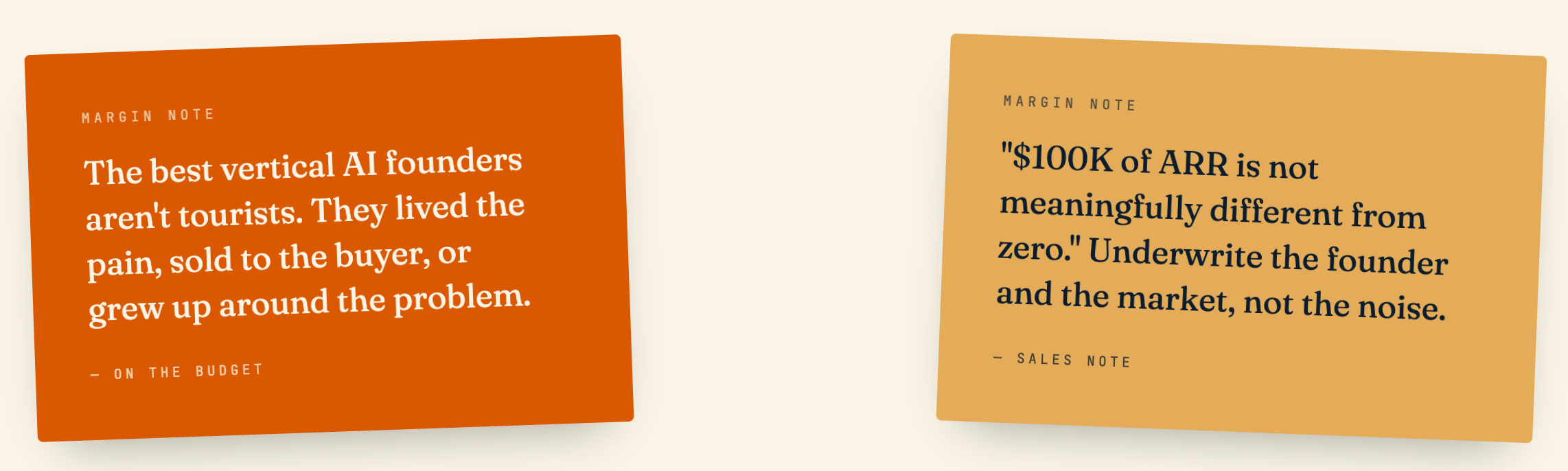
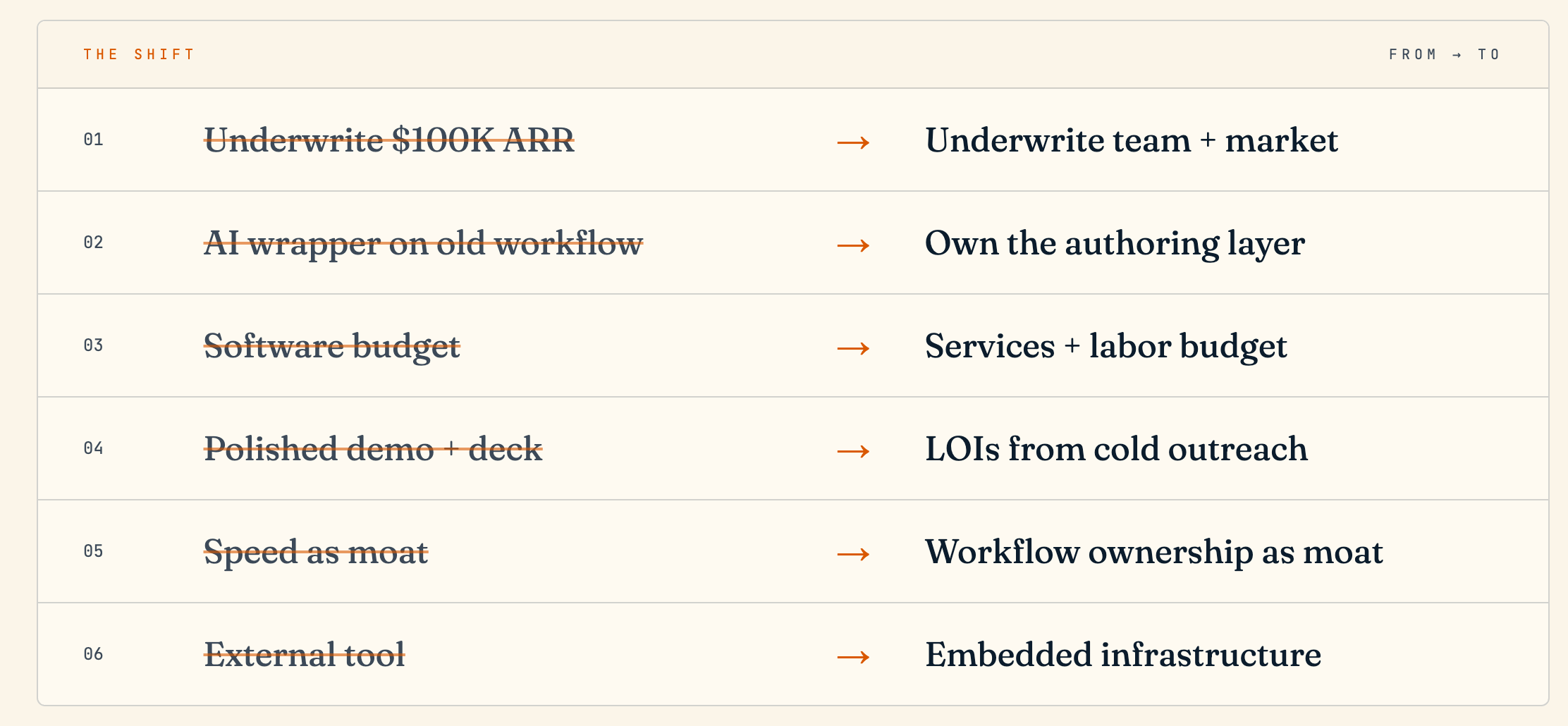
At inception, Nic’s point is brutal and correct: $100K ARR is not meaningfully different from zero if you’re trying to build a category-defining company. The real underwriting variables are the founder, the market, and whether the team has the right to win.
Action item: Stop optimizing your deck for revenue. Make the case for why this team, in this market, at this moment, is uniquely positioned to win.
2) “Earned insight” is still the cheat code
The best founders are not tourists. They’ve lived the pain, sold into the buyer, built adjacent tools, or grew up around the problem. That earned insight is what lets them spot a wedge that outsiders miss.
Action item: Audit your unfair advantage in plain language. If you can’t explain why you specifically should build this, neither can your customer.
3) Start at the authoring layer
This was probably the cleanest framework in the whole episode. The best vertical AI products often start where a record is first created: a phone call, an intake form, a contract hitting the inbox, a claim entering the system. Own that moment, and you can control everything downstream.
Action item: Map your industry’s workflow back to the very first keystroke. Build there, not where the dashboards live.

A quick word from our incredible partner,
Parafin - the leading embedded capital partner.
4.8 star rating on Trustpilot, with over 500 reviews [source]
71% CSAT rating across all partners
84 NPS
Serving top Fortune 500 companies, including Amazon, Walmart, and DoorDash
4) Don’t build “the agentic command center for X”
That’s the solution-first trap. If your product mostly vacuums data out of systems and summarizes it, you are building directly into the teeth of OpenAI, Anthropic, and every horizontal platform. That’s not great territory.
Action item: Pressure-test your wedge against ‘Claude 14.’ If a better base model flattens you, your moat is positioning, not product.

5) Sell before the product is ready
One of my favorite parts: Nic loves founders who can create commercial pull before the product is fully built. If customers will become design partners, sign LOIs, or start paying early, you’ve proven urgency — and urgency is gold.
Action item: Run a paid pilot or signed LOI before you write the second sprint of code. If the market won’t pull, the product won’t push.
6) Use cold discovery as a market stress test
Talking to 50–100 potential users is not a “nice to have.” It’s the work. And if a founder can convert cold outreach into active design partners quickly, that is often a stronger signal than polished demos or fancy decks.
Action item: Add up the labor and services dollars sitting next to the software line in your customer’s P&L. That’s your real TAM.
7) Go after services budgets, not just software budgets
This is one of the biggest insights in vertical AI. In many industries, services spend is multiples larger than software spend. If AI can replace headcount, manual coordination, outsourced processing, or consultants, the TAM expands dramatically.
Action item: Be ruthless about your wedge. Cut every adjacent feature until the one that earns the next conversation is undeniable.
8) Wedge first, then expand across workflow
The first product does not need to be the whole platform. It needs to be the right entry point. Once the wedge works, you expand into adjacent workflow, pull more actions into the system, and earn the right to become the operating layer.
Action item: Inventory the things that are obvious to you and unknowable to a horizontal team. Build the product around those.
9) Speed is a tool, not a moat
This is the nuance most people miss. Yes, speed matters. But no, speed alone is not defensibility. Speed is how you get to insight faster, ship the second product faster, and lock in workflow ownership before others catch up.
Action item: Before you sign, model the outcome your lead investor needs to be happy. If it isn’t the same as yours, walk.
10) Vertical nuance beats horizontal breadth
Nic’s implicit test is great: imagine a future where frontier models get much better. If your entire company gets flattened by “Claude 14,” you never had enough differentiation. Real moats live in vertical nuance, messy workflow logic, domain-specific edge cases, and system-level integration.
11) Become internal, not external
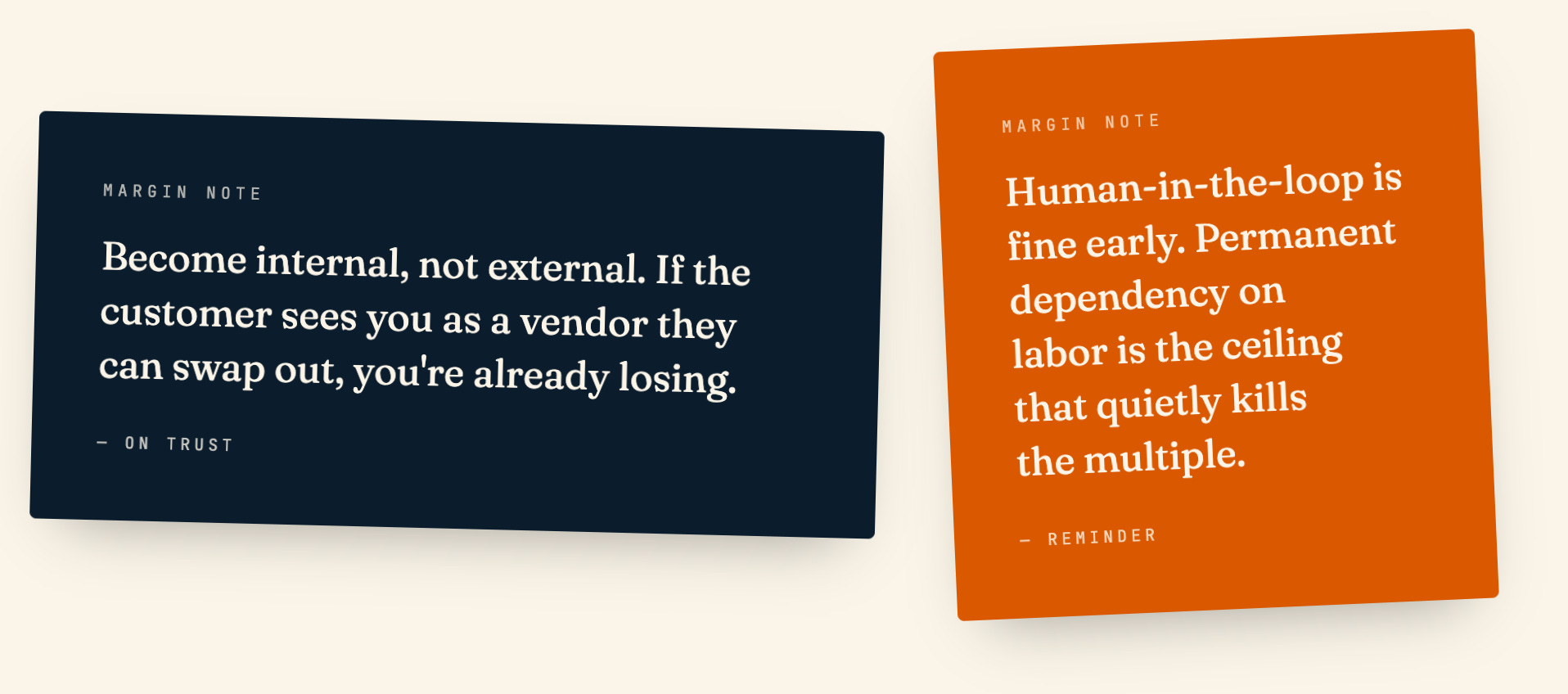
If the customer sees you as an outside service they can swap out, you’re vulnerable. If you become embedded in first-party workflow, connected to operational data, and tied to daily execution, you start to look like infrastructure.

12) Avoid the permanent services trap
Human-in-the-loop is fine early. Permanent dependency is not. Founders can absolutely use services to bridge the gap while models improve, but if the long-term model never escapes labor-heavy delivery, the ceiling gets lower fast.
13) The first technical hires matter disproportionately
The early engineering team doesn’t just write code — they set the culture, quality bar, and velocity norms for everything that follows. One great early hire compounds. One weak one lingers.
14) Don’t raise just because you can
This one should be printed and taped to every founder’s wall. More capital is not always better capital. Too much money too early can hide problems, delay hard decisions, and reduce the discipline that actually creates product-market fit.
15) Fund size is strategy
Nic’s critique here is sharp: if your investor only wins when you become a $5B+ company, that may not be aligned with what a great founder outcome actually looks like. Bigger funds don’t just change check size — they change incentives, exit math, and boardroom behavior.
The Anti-Playbook
A few traps from the episode that are worth calling out directly:
Thinking “AI-native” means slapping a chatbot on old SaaS. That’s not reimagining workflow — that’s feature dressing.
Believing speed alone will save you. It won’t. Speed only matters if it helps you discover and lock in something durable.
Starting too far downstream in a workflow. If another system owns the first touch, you’re always negotiating from behind.
Building for consensus instead of alpha. The biggest winners rarely look obvious when they start.
Assuming a giant fund is automatically the best cap table addition. Sometimes it is. Sometimes it quietly destroys alignment.
We’re not watching the death of SaaS.
We’re watching category creation reopen.
If you’re underwriting — or building — vertical AI today, Nic’s playbook comes down to three commitments:
1. Understand the market deeply. Earned insight beats AI-native positioning every time. Tourists get filtered out by month three.
2. Wedge at the authoring layer. Own the moment the record is created. Everything downstream becomes negotiation from a position of strength.
3. Go after the services budget. The biggest outcomes will eat labor and BPO spend — not fight for another seat license next to the incumbent.
The founders who win here won’t be the ones with the fanciest AI positioning. They’ll be the ones who understand a market deeply, wedge into the workflow at the exact right point, create ROI fast, and then expand with ruthless focus.
Thanks for reading LINEAR. I reply to every email…
Have any questions, feedback, comments? Let us know, we work for you!