

Stop pricing AI like a tool.
Start pricing it like labor.
If AI can actually do the work, why are we still valuing it like a tool? A conversation with David Haber on what happens when software stops helping humans do the work — and starts doing the work itself.
Most founders and investors are still looking at AI through a SaaS lens — copilots, productivity gains, better UX. But the real shift is this: software is starting to do the work itself. That isn’t a feature upgrade. That’s a business-model shift.
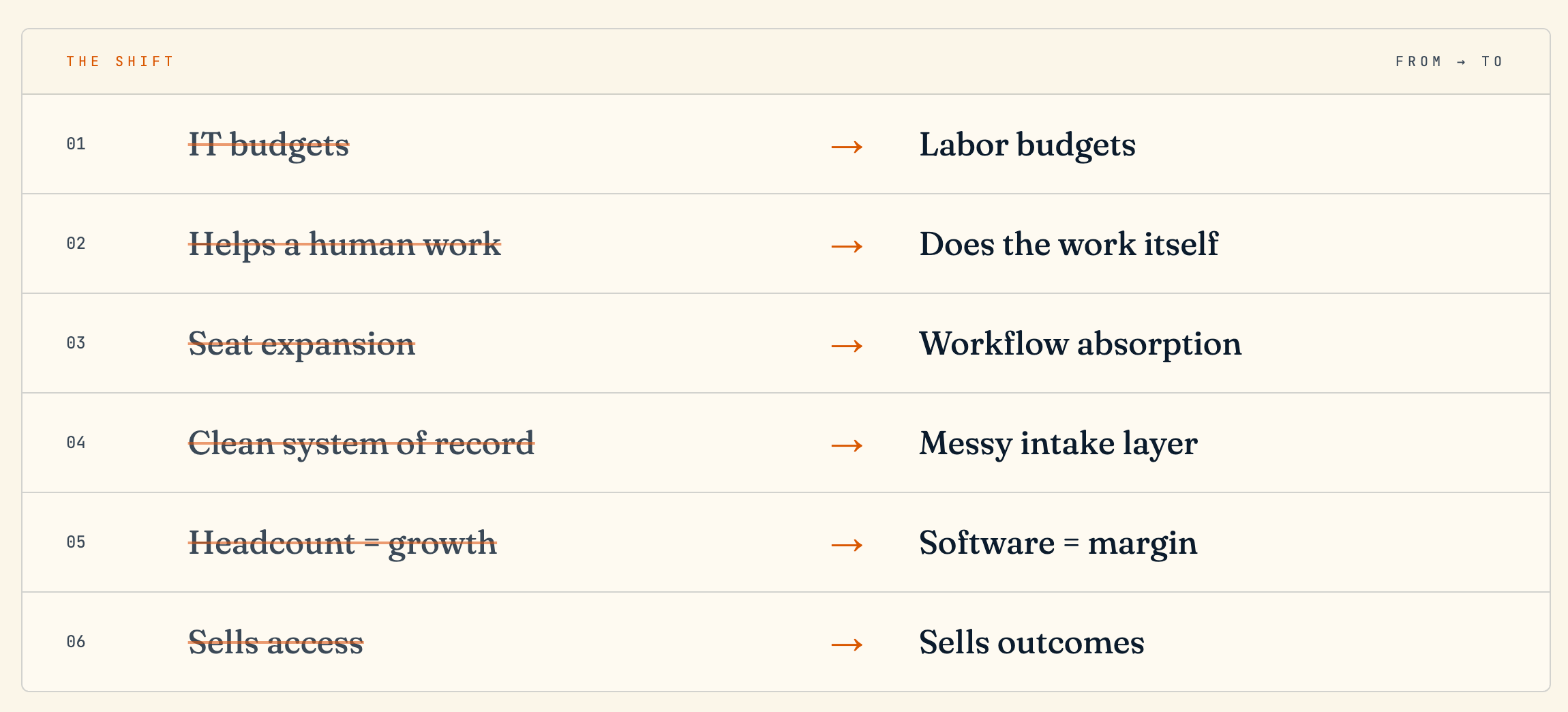
In vertical markets especially, that shift is going to create some very, very large companies. The economic prize moves from IT budgets to labor budgets — and once you see that, vertical AI starts to look completely different.
This Weeks Vertical Titan: David Haber (GP at a16z)
This week on Verticals, we brought on David Haber.
David is a General Partner at a16z, where he spends a lot of time around AI applications, software, and the broader shift happening across vertical markets. Before that, he was an investor at Spark Capital, then went and built Bond Street, a small business lending company, sold it to Goldman Sachs, and later joined a16z to help build out the firm’s New York office.
So he has seen this world from a few different angles: investor, founder, operator, strategist.
That matters, because the most interesting part of David’s perspective is that it is not some generic “AI is transformative” take. Everyone says that now. His actual argument is much sharper.
He believes vertical AI is not simply another software wave. It is a shift in what software is able to capture.
In the old world, software sold into IT budgets. It made a person more productive. It gave a team better visibility. It organized the work. But at the end of the day, the human still did the job.
In the new world, AI-native software increasingly performs the job itself. It reads the intake, structures the mess, makes the decision, routes the case, drafts the document, handles the workflow, and improves over time. Which means the economic prize starts to move away from software budgets and toward labor budgets.
That is a very big deal.
For years, most software founders have been trained to think in terms of seat expansion, ACV expansion, and software category TAM. David’s point is that the more interesting market may not be the software budget at all. It may be the payroll attached to the workflow.
And once you see that, a lot of vertical AI starts to look different.
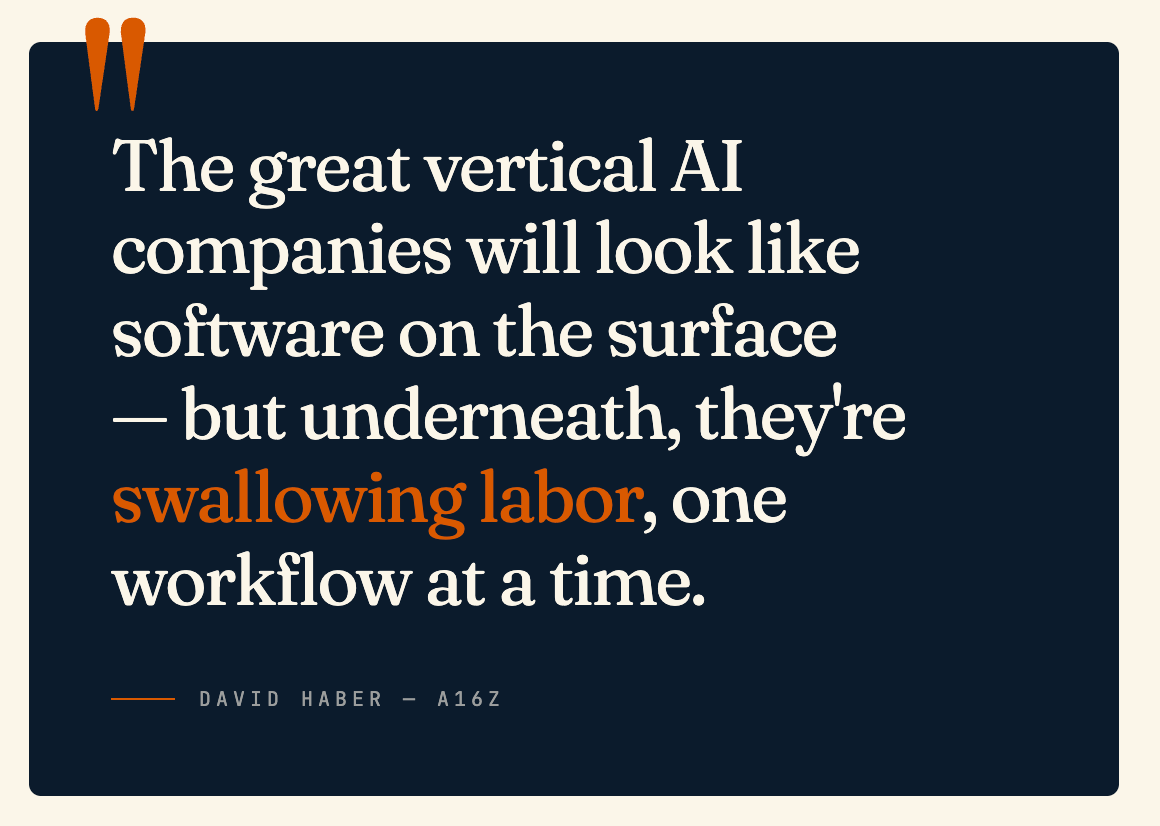
The great vertical AI companies may not look like traditional SaaS companies. They may look like software on the surface, but underneath, what they are really doing is swallowing labor, one workflow at a time.
That is why David is so focused on vertical markets in particular. These industries are full of messy handoffs, fragmented systems, tribal knowledge, ugly operational workarounds, and expensive human labor hiding between the lines of the official workflow. In other words: exactly the kind of environment where AI-native companies can wedge in and become incredibly valuable.
David dropped a bunch of frameworks that every founder and investor in vertical AI should internalize…
1) Stop thinking about IT budgets. Start thinking about labor budgets.
This is the first and biggest shift.
If your product is just helping someone work faster, you are still in software-land.
If your product is actually doing the work, you are now competing for labor dollars.
That changes the TAM math dramatically.
The right founder question is no longer:
How much does this industry spend on software?
It is:
How much labor spend exists around this workflow, and what percent of that can AI absorb?
That is a much more interesting question.
A lot of founders are still pitching “better software for X.”
The stronger version is usually: we remove headcount, compress cycle time, improve throughput, and own the output.
That is where the really large companies get built.
2) The best wedges are often the messiest inboxes
One of my favorite ideas from the conversation was David’s point that email, fax, and voice are not just annoying legacy surfaces.
They are wedges.
That is such a useful heuristic.
Why?
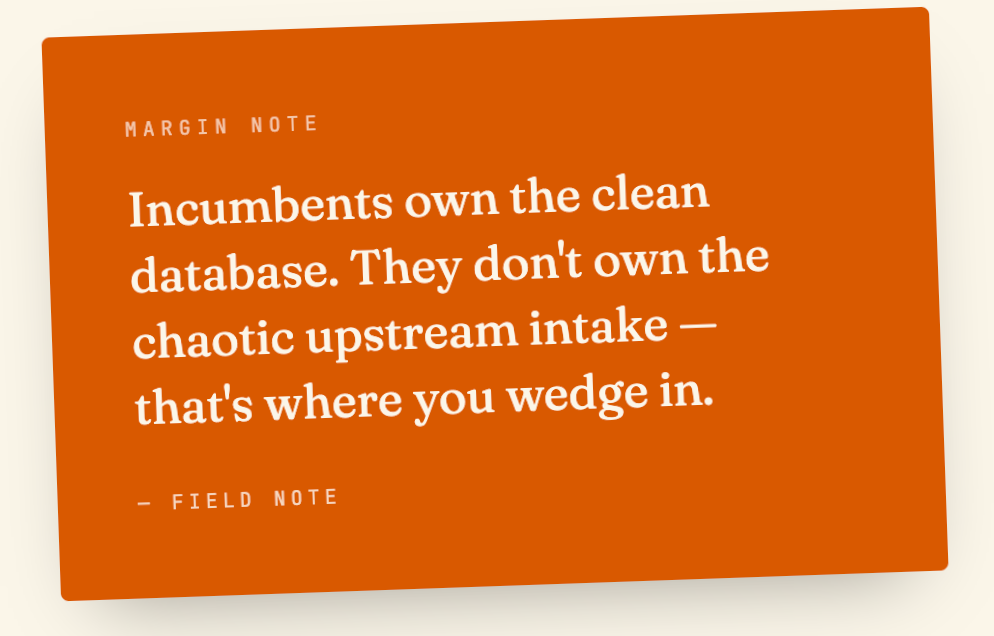
Because incumbents usually own the clean database. They usually do not own the ugly, chaotic, upstream intake layer where the work actually starts.
In healthcare, legal, construction, financial services, and other traditional verticals, the highest-value workflows often begin in some gross mix of:
fax
voicemail
email
PDFs
attachments
half-complete forms
conversations that never make it into the system of record
That mess is exactly where AI can shine.
If you can ingest the chaos, structure it, and trigger downstream action, you can own the workflow before the incumbent even knows the work exists.
That is an incredibly powerful place to start.
A good founder question here is:
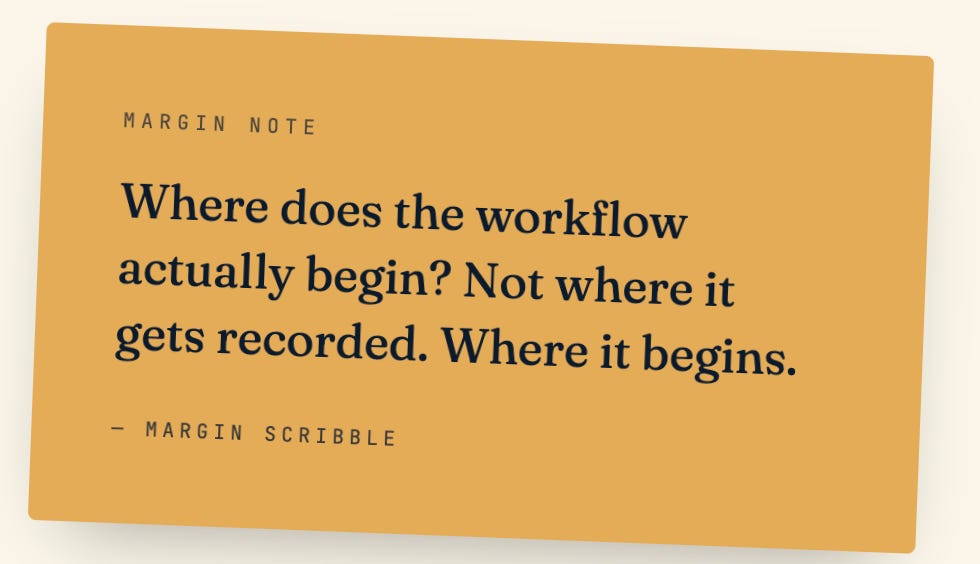
Where does the workflow actually begin?
Not where it gets recorded.
Where it begins.
Those are often two very different places.
3) There are 3 credible ways to attack incumbents
David laid out three broad strategies for how AI-native companies can win.
A. Replace the system of record
This is the hardest path, but often the biggest upside.
You build the new core platform from the ground up and try to become the new default operating system for the vertical.
Hard to do. Great if you can pull it off.
Usually works best when the customer is still on primitive tools, spreadsheets, or lightweight software and is ready to graduate.
B. Wrap the incumbent and own the work around it
This is the “wrapper” strategy.
Instead of ripping out the incumbent immediately, you integrate with it and automate the ugly workflows around it.
This is often a much better entry point because customers do not need to take replacement risk on day one.
You get adoption first.
Then maybe you earn the right to become the system of record later.
C. Turn a services business into a software machine
This is the killer one.
Take a low-margin, labor-heavy services category.
Insert AI aggressively.
Use software to operationalize the service.
Let margin accrue to you as automation improves.
That is not just a good software business.
That can become an insane business.
Especially in verticals where customers are already used to paying for outcomes, not licenses.

A quick word from our incredible partner,
Parafin - the leading embedded capital partner.
4.8 star rating on Trustpilot, with over 500 reviews [source]
71% CSAT rating across all partners
84 NPS
Serving top Fortune 500 companies, including Amazon, Walmart, and DoorDash
4) Market structure matters more than market size
This is a subtle point, but an important one.
David basically argued that market structure matters more than market size.
I agree.
A huge market with a deeply entrenched incumbent, painful switching costs, and locked-up distribution can be far less attractive than a smaller market with fragmented systems, bad UX, and lots of workflow leakage.
Founders love headline TAM.
But smart founders spend more time on:
fragmentation
incumbent weakness
workflow gaps
distribution access
speed to embed
switching friction
whether they can wedge in upstream
That is what actually matters.
The best vertical markets are not always the biggest.
They are the ones where the structure gives you a path in.
5) Moats still matter. Maybe more than ever.
There is a lazy take floating around that AI kills moats.
I do not buy it.
David does not either.
The interface layer may get easier to copy.
The workflow layer does not.
The real defensibility still comes from the stuff that has always mattered:
workflow embedding
proprietary data
distribution
trust
customer intimacy
operational excellence
unique outcomes data
But AI introduces a new layer too:
Latent context
This was one of the most important ideas in the whole episode.
Most businesses generate valuable context that never gets captured:
meetings
calls
edge-case discussions
negotiation language
verbal decisions
judgment calls
exceptions
customer nuance
Historically, that context just disappeared.
Now it can be recorded, structured, and used.
That is a very big deal.
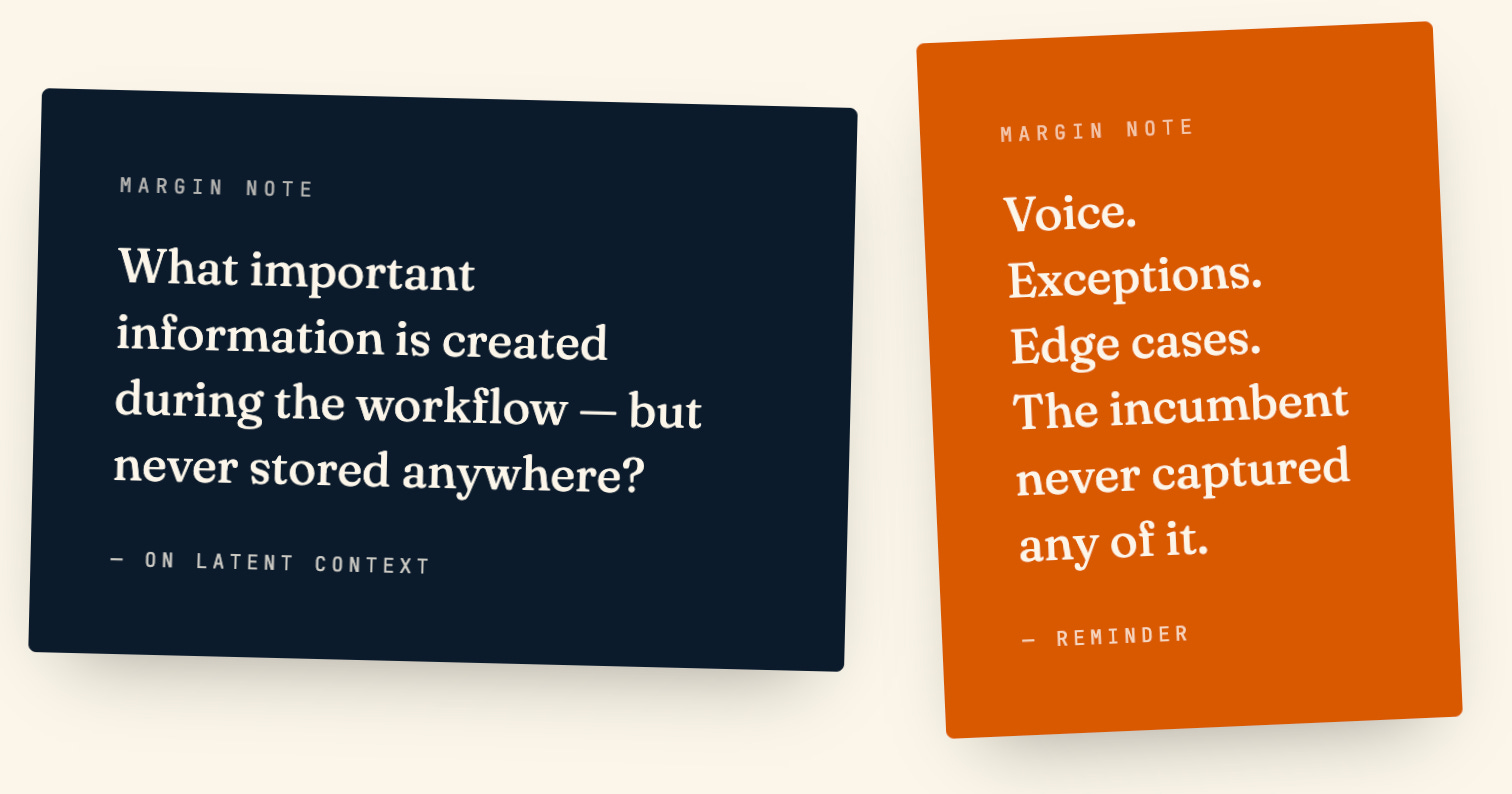
If you are the company capturing voice, intake interactions, workflow exceptions, and downstream outcomes, you can build a context layer the incumbent never had.
That can absolutely become a moat.
A really good founder question is:
What important information is created during the workflow but never stored anywhere?
That may be your future data advantage.
6) The system of record might become free
This was the most contrarian part of the conversation.
And maybe the most interesting.
If AI owns the workflow, owns the data, and owns the outcome… do you even need to make money on the system of record?
Wild question.
But a real one.
In classic SaaS, the system of record was the castle.
In vertical AI, the system of record may just be the front gate.
If the real money is in the automated work, claims flow, revenue collection, underwriting, financing layer, or some other high-value outcome, then the database itself may just become a distribution asset.
That is a very different world than vertical SaaS 1.0.
A lot of founders are still trying to monetize the software seat.
The more interesting opportunity may be monetizing the work performed through the software.
That changes pricing, bundling, and business model design in a big way.
7) The best AI services businesses get better margins as the model gets better
This is where things get really fun.
Traditional services firms add people to grow.
AI-native services businesses add software.
That means every automation gain can drop to margin.
That is the dream.
You start with a workflow customers already pay humans for.
You operationalize it as a service.
You automate aggressively.
You capture the spread.
You turn a human-heavy operation into something with software-like economics.
This is why so many great vertical AI companies will look weird in the early days.
They may not look like clean SaaS companies.
They may look operationally heavy, messy, or services-inflected.
That is okay.
The real question is not whether it starts as a service.
The real question is whether the workflow is softwareable.
If it is, that can become an incredible business.
The Takeaway
A lot of people are still trying to build better software when they should be trying to build better businesses.
Those are not the same thing.
The best vertical AI founders are not just asking how to add intelligence to an existing workflow. They are asking where the labor sits, where the workflow begins, where context gets lost, and where margin can be captured if the machine starts doing more of the job.
That is a much better set of questions.
If I were building in vertical AI right now, I would spend far less time obsessing over whether the category is “big enough” in the traditional software sense and far more time looking for three things.
First, I would want a workflow with real labor intensity. Not something nice-to-have. Not something cosmetic. I would want a workflow where expensive humans are spending real time on repetitive, rules-heavy, process-heavy work every single day.
Second, I would want messy intake. I would want the part of the workflow that still lives in email, voice, fax, PDFs, attachments, half-complete forms, and ugly communication patterns. Because that is often where the incumbents are weakest and where the wedge is most available.
Third, I would want closed-loop outcomes. I would want to be able to see not just that the work happened, but whether it worked. Did the claim get paid? Did the case settle? Did the loan perform? Did the patient convert? Did the workflow complete successfully? That feedback loop matters enormously, because that is how the system gets smarter and how the business gets stronger.
That combination is deadly. Labor-heavy work, messy intake, and visible outcomes.
If you find all three, you may have the foundation for a very large company.
Because once you own the workflow and the feedback loop, you are not just selling software anymore. You are selling speed. You are selling accuracy. You are selling throughput. You are selling outcomes. And ultimately, you are capturing value that used to belong to labor.
That is the real punchline here.
Vertical AI is not interesting because it makes software cooler.
Vertical AI is interesting because it may let software companies go after a much larger prize than software ever could on its own.
And if that is right, then some of the biggest companies of this cycle are going to look a lot less like traditional SaaS businesses and a lot more like AI-native operating companies hiding inside software wrappers.
Thanks for reading LINEAR. I reply to every email…
Have any questions, feedback, comments? Let us know, we work for you!