

Software isn’t dying.
But it is being re-rated.
A weird thing is happening…
Public software has been absolutely smoked. Multiples have compressed. The market is acting like the old SaaS playbook is 100% broken. And yet — enterprise buyers still need software. They still don’t want to build everything in-house. And AI isn’t killing software; it’s changing what good software looks like.
That’s why this conversation with Morgan Livermore matters. He’s spent ~15 years investing across enterprise and infrastructure software at Accel, Geodesic, and Quiet Capital. Now he’s building SuperCruise — a fund focused on a very specific wedge: profitable, bootstrapped enterprise and infrastructure companies with a few million in revenue, very high growth, and founders who want aligned capital — not high risk rocket fuel that could blow the engine up.
This Weeks Vertical Titan: Morgan Livermore (Founder & GP Supercruise Capital)
Morgan is one of those investors who has seen a few software cycles up close.
He started in growth at Accel, where he looked at the kinds of businesses most people now view as canonical software outcomes — profitable, compounding, infrastructure-heavy companies like Atlassian-style businesses that didn’t need to light money on fire to matter. He then sharpened that lens at Geodesic and Quiet Capital.
What he’s building now with SuperCruise is a reaction to the last decade of venture excess.

His core belief is simple: there’s a large and undercapitalized class of software businesses doing $2M–$7M in ARR, growing fast, already showing signs of efficiency, and being pushed toward venture models that don’t actually fit them. Too much capital, taken too early, can create what he calls internal combustion — the company grows headcount faster than it grows product-market fit, and the whole thing becomes structurally misaligned.
So SuperCruise is designed around a different promise: be the first real institutional capital for founders who have already proven viability, help them reach escape velocity, and do it without forcing them into a growth-at-all-costs script that no longer maps to reality.
That worldview also explains why Morgan is so interesting right now.
He’s not just underwriting software companies. He’s underwriting the transition from classic SaaS to AI-shaped software economics — where margins, pricing, distribution, and defensibility all get re-written.
Sixteen ideas for building
the next era of software.
Not just for investors — for founders building the next generation of vertical software and vertical AI businesses.
Below are the biggest playbooks Morgan surfaced — not just for investors, but for founders building the next generation of vertical software and vertical AI businesses.
1) Don’t confuse capital with product-market fit
A lot of founders still operate as if fundraising is validation.
Morgan’s view is the opposite: prove the business can stand on its own first. Capital should supercharge a working engine, not become the engine.
When money gets used to paper over weak product fit or sloppy execution, it creates internal combustion.
Action item: Ask a brutal question: if you couldn’t raise for 24 months, would your current product and GTM still survive?
2) Optimize for escape velocity, not vanity growth
Morgan isn’t looking for companies growing “fast” in the abstract.
He’s looking for businesses growing fast enough to become undeniable — fast enough to become IPO-able, strategically valuable, or structurally durable.
That’s a much better lens than generic growth worship.
Action item: Replace “how do we grow faster?” with “what growth rate gets us to inevitability?”
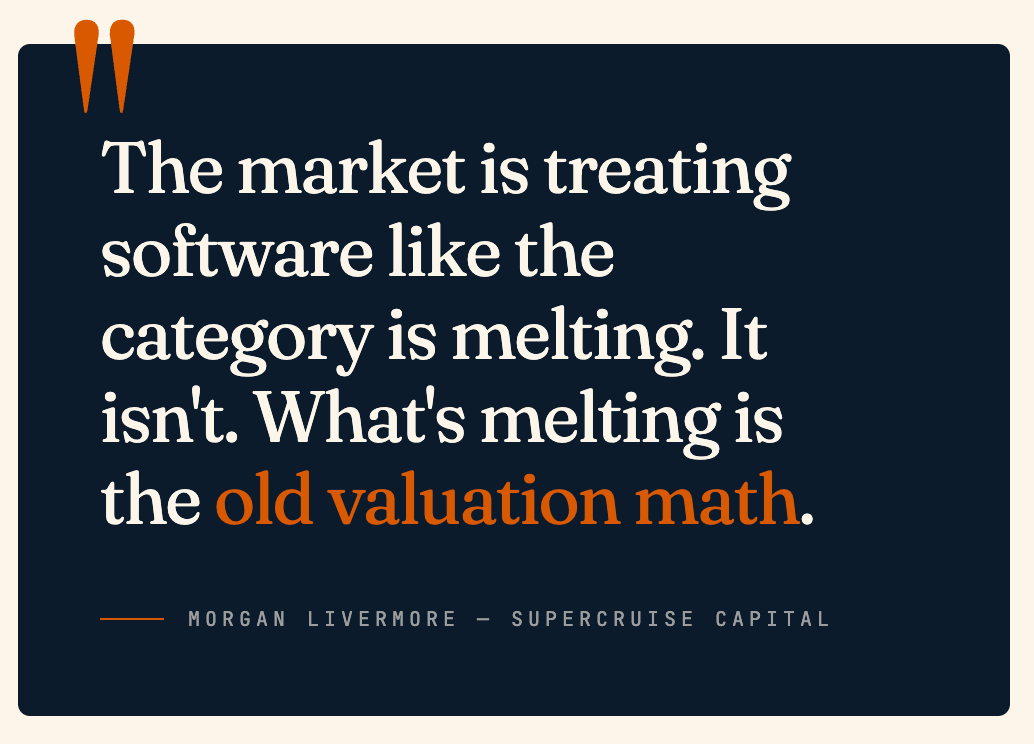
3) SaaS isn’t dead — but old valuation math is
One of Morgan’s most important points: software may be oversold, even if it deserved a repricing.
The market is treating many software names as if the whole category is melting.
But enterprises still rely on these tools, and ripping them out is far harder than Twitter makes it sound.
Action item: Separate multiple compression from category collapse. They are not the same thing.
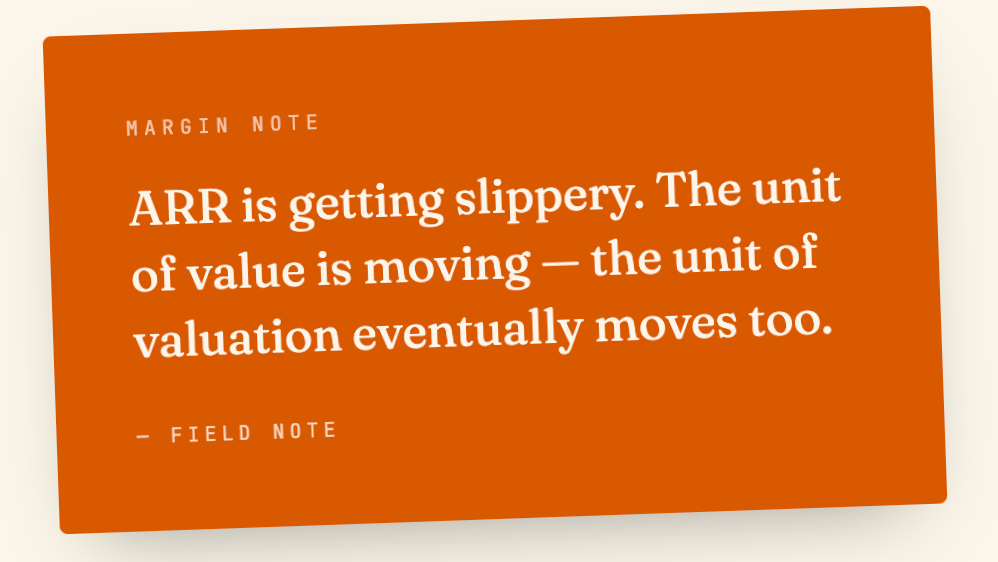
4) ARR is getting more slippery
For years, investors had a clean north star: ARR.
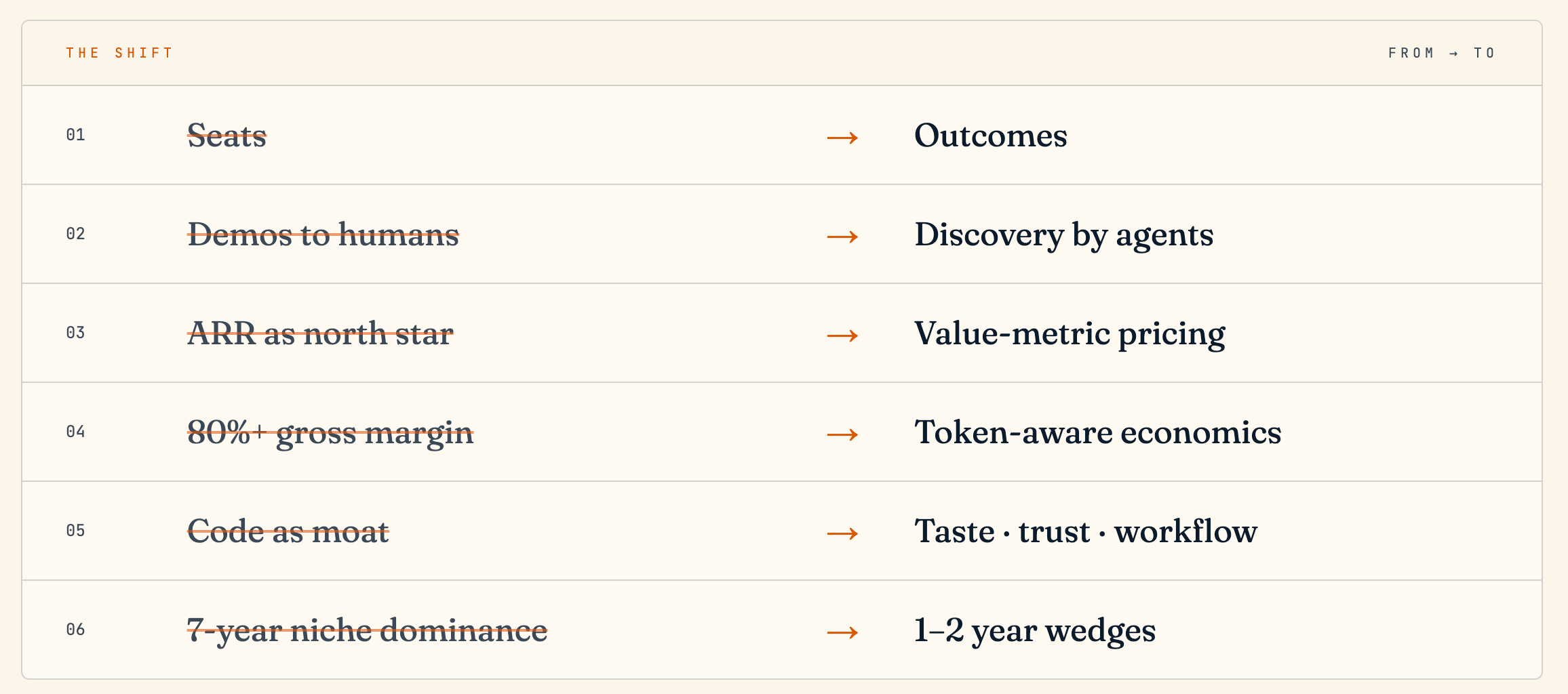
But ARR gets much fuzzier when pricing shifts from seats to usage, billing frequency changes, and revenue becomes tied to outcomes.
In AI, the unit of value is moving.
That means the unit of valuation eventually moves too.
Action item: If you’re an operator, define your real value metric now — before the market defines it for you.
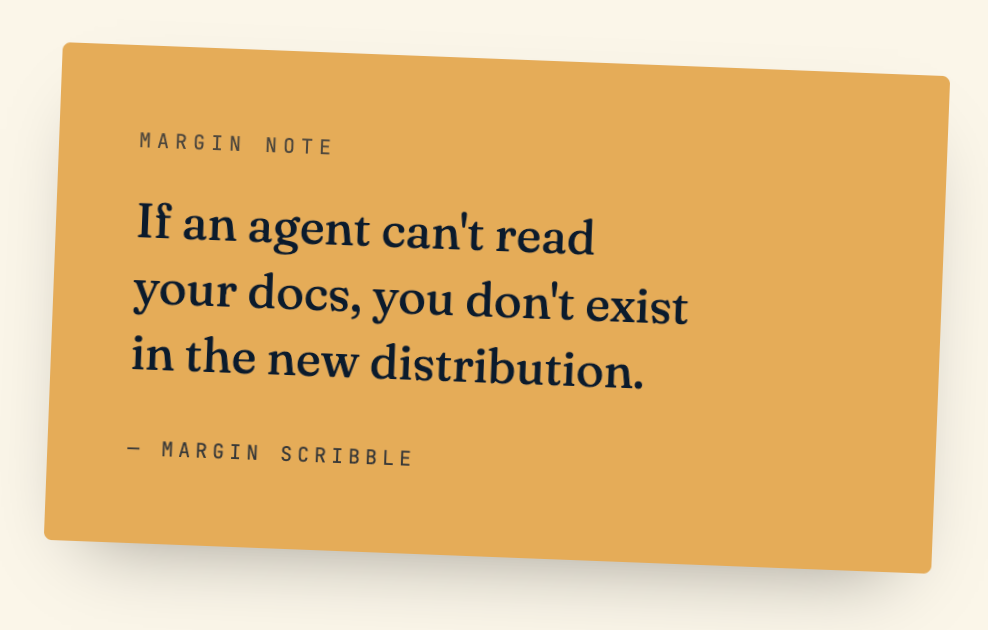
5) The next moat might be… documentation
This was one of my favorite parts of the whole conversation.
Morgan shared an example of a company winning because its documentation is easily accessible to AI agents.
Not because it had the flashiest brand.
Not because it had the biggest sales team.
Because agents could actually find it, understand it, and implement it.
In a world where software gets discovered and evaluated by machines, documentation becomes distribution.
Action item: Treat docs like a GTM surface, not a support artifact.

A quick word from our incredible partner,
Parafin - the leading embedded capital partner.
4.8 star rating on Trustpilot, with over 500 reviews [source]
71% CSAT rating across all partners
84 NPS
Serving top Fortune 500 companies, including Amazon, Walmart, and DoorDash
6) AI agents change who the buyer is
Historically, software was sold to a human buyer through demos, decks, and relationships.
Increasingly, software will be selected, tested, or recommended by agents upstream of the human decision-maker.
That shifts the game toward accessibility, interoperability, and clarity.
Action item: Ask: can an agent understand what we do, how to use it, and why we’re differentiated?
7) The incumbent tax is real
Legacy software companies aren’t just fighting technical debt.
They’re fighting incentive debt.
If you run a large seat-based software business, moving to an AI-native or outcome-based model means attacking your own cash cow.
It might mean lower prices, fewer seats, and layoffs.
Founder-led challengers can make that leap far more easily than professionally managed incumbents.
Action item: If you’re a startup, go where incumbents are least willing to cannibalize themselves.
8) Outcome-based pricing is coming — slowly, then all at once
Seat-based pricing made perfect sense when software was basically licensed access to workflow.
But AI changes the customer question from “how many users?” to “what work got done?”
Morgan believes software increasingly gets paid on units of labor or business outcomes — tickets resolved, meetings booked, tasks completed.
Action item: Start testing pricing around completed work, not just access.
9) Deep domain insight matters more as code gets cheaper
If everyone can build faster, the bar for “we built software” drops dramatically.
That means defensibility shifts away from raw code and toward earned insight — the kind that comes from understanding the strange, specific, ugly details of a workflow better than anyone else.
Action item: Write down the 10 non-obvious workflow truths your team knows that a generic AI team does not. How can you build around that?
10) Vertical beachheads will compress
The old playbook was to dominate a niche for 7–8 years and then expand.
In AI, that window may shrink to 1–2 years.
Products can be built faster. Competitors arrive faster. Expansion matters sooner.
Action item: Plan adjacency earlier. Your wedge still matters — but your expansion clock starts sooner.
11) The compound startup is becoming the norm
Win a foothold, then sell more and more functions into the same customer.
That matters even more now because distribution is precious and context is compounding.
Once you own trust, workflow, and data exhaust, adjacent products get much easier to layer in.
Action item: Map your second and third products before your first one fully matures.
12) The long tail gets more interesting in AI
Historically, many software companies couldn’t profitably serve small customers because implementation and service costs were too high.
AI changes that.
Lower build costs and lower service costs mean more of the SMB and long-tail market becomes economically viable.
Action item: Re-open segments you previously ignored because ACV looked too small.
13) Free wedges still work
In AI and infrastructure, giving people a “taste” of the product still works extremely well.
Let users adopt something cheap or free, then monetize enterprise security, governance, scale, and support.
That playbook isn’t dead.
It may actually get stronger.
Action item: Identify what complement you can commoditize to pull adoption forward.
14) Gross margins may go down — and that’s okay
One of the most under-discussed AI realities: some of the best new software businesses may not look like classic 80%+ gross margin SaaS.
Tokens cost money. Inference costs money.
But if the market gets dramatically larger and the product does more labor, a slightly lower-margin business can still be much bigger and much better.
Action item: Don’t benchmark an AI-native business only against legacy SaaS margin expectations.
15) Taste becomes a moat when intelligence gets commoditized
If intelligence becomes cheap, then knowing what to build, how to package it, and how to make it feel trustworthy becomes more valuable.
In a world full of generic AI output, taste starts to matter more, not less.
Action item: Invest in product sharpness and user judgment, not just model capability.
16) Human trust still matters
This might be the most important counterweight in the whole conversation.
Yes, AI automates.
Yes, agents will mediate decisions.
But in vertical markets especially, buyers still want trusted partners.
They want someone who understands the workflow, the risk, the weird edge cases, and the consequences of getting it wrong.
In a world flooded with AI-generated slop, trust becomes easier to lose and more valuable to own.
Action item: Build your company so customers experience you as a partner, not just a vendor.
The old software era was built on seats.
The next one isn’t.
It will be built by founders who stay lean longer.
By companies that understand a domain better than generalist competitors.
By products that are legible not just to humans, but to agents.
By pricing models that track outcomes more closely than access.
And by teams that understand that trust, taste, and workflow insight may outlast almost every other moat.
So no — software isn’t dead. Bad software, bloated software, and mispriced software are getting re-rated. The next iconic vertical software companies will be born from this exact moment — when everyone else is busy confusing chaos for collapse.
Thanks for reading LINEAR. I reply to every email…
Have any questions, feedback, comments? Let us know, we work for you!