

There’s a certain kind of vertical SaaS company that looks small from the outside and massive once you get inside the workflow. This weeks focus company is one of those.
If you looked at it lazily, you’d probably call it booking software for racquet clubs.
That’s technically true, but it completely misses the point. It’s built is much closer to operational infrastructure for an entire category than simple scheduling software.
Let’s dive in…
This Weeks Titan: Andres Robelo (Founder & CEO at PlayByPoint)
What makes this story interesting to me is not just the market. It’s the shape of the problem.
When Andres started the business, a huge chunk of the racquet sports world was still running on pen and paper, disconnected systems, and generic tools that didn’t really understand how clubs worked. And that’s usually where great vertical SaaS companies are born. They start in markets that outsiders assume are “simple,” but operators know are full of ugly, painful, edge-case-heavy workflows.
That’s exactly what happened here.
A court booking sounds simple until you actually follow the workflow. One player books. Two more get added. Somebody pays later. Somebody else cancels. Refund logic changes based on club policy. Booking windows vary by location. Residential clubs operate differently than country clubs. Municipal facilities have different rule sets than private operators. What sounds like a clean little scheduling problem turns into a pretty deep operating system once you zoom in.
That’s the wedge.
Not “we built booking software.”
More like: we built around a messy, nuanced, rules-heavy operational layer that generic software never cared enough to get right.
And that’s why I think Playbypoint is such a good example of how real vertical titans get built. They don’t win by telling the prettiest story. They win by getting absurdly close to the actual workflow and solving the stuff that looks too annoying for everyone else.
The other thing I really like here is the customer alignment.
Andres is very clear that the company is built around the club, not the end consumer. Yes, there’s a B2B2C dynamic. Yes, there are millions of player touchpoints. But the strategic center of gravity is still the operator. And that matters. Because in vertical SaaS, the operator is the one trusting you with revenue, scheduling, customer data, payments, and the day-to-day functioning of the business.
That trust is what earns you the right to become the system of record.
And once you become the system of record, a whole lot opens up. Payments. Messaging. Retention. Analytics. Marketing automation. AI agents. The expansion paths get a lot more interesting when you own the workflow that actually matters.
One thing that really stood out to me was Andres saying that the business today is still primarily SaaS, not just payments. I expected the mix to skew much more heavily toward payments, but it hasn’t. That tells me there’s real discipline in the model. A lot of founders would be tempted to over-rotate into payments because it looks like the easiest monetization lever. But building a business where your whole moat is take rate compression is dangerous. If somebody better capitalized comes in and buys down the economics, what’s left?
That’s why this company feels thoughtful to me.
It’s not just monetization plumbing.
It’s software depth, operator trust, and category knowledge.
And then there’s the AI angle, which I think is where this story gets even more relevant.
Andres said something that I think a lot of vertical SaaS founders know deep down but don’t always want to say out loud: the old “it took us five years to build this” moat just doesn’t hit the same anymore. That doesn’t mean product knowledge doesn’t matter. It matters a lot. But when building software gets easier, the durable advantage shifts away from code volume and toward workflow understanding, trust, speed, and judgment.
In other words, the question is no longer just “can someone build this?”
The question is “will they know what to build, in what order, with what customer trust, and with what distribution?”
That’s a much better question.
And honestly, it’s why I’m still very bullish on vertical SaaS.
Not lazy vertical SaaS.
Not surface-level vertical SaaS.
But the kind that lives so close to the customer that it understands the business better than anyone else in software possibly could.
Playbypoint feels like that kind of company to me.
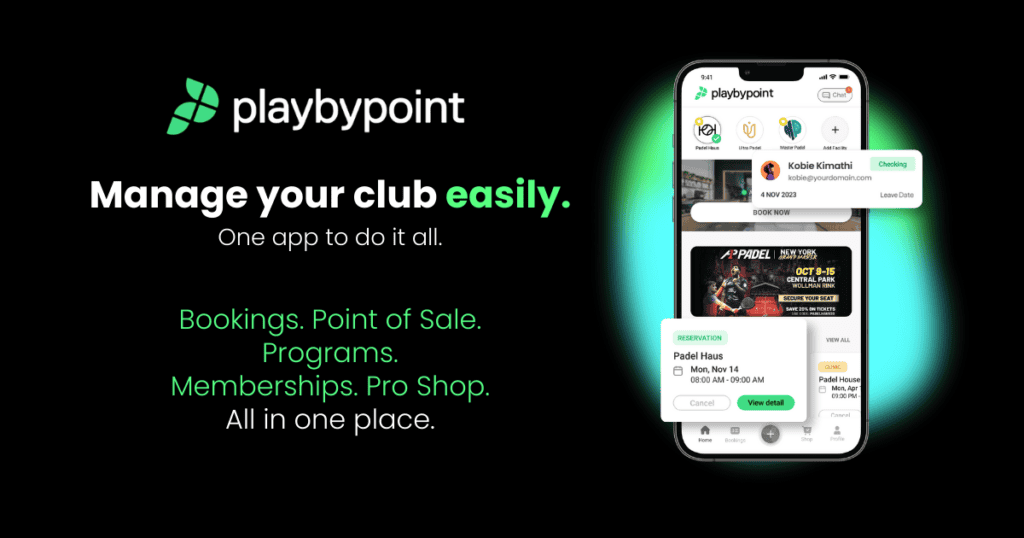
It also fits a pattern I’ve seen over and over again in vertical software: the market always looks too small until it doesn’t. Racquet sports, padel, club software — all of that sounds niche until you realize you’re sitting inside a growing category with passionate users, complex operations, embedded payments, physical infrastructure, and plenty of room to layer new products on top.
That’s usually where the best opportunities are.
Not in the categories everyone already agrees are huge.
But in the ones that feel narrow until the workflow and expansion vectors reveal themselves.
That’s what this one feels like.
And I think there are a lot more like it.

If I were pulling lessons from this story and applying them to vertical SaaS more broadly, the first one would be simple: go where the workflow is ugly.
Too many founders still want markets where the product demo looks clean. That’s usually the wrong instinct. The best vertical opportunities often live inside businesses where the workflow is full of exceptions, weird rules, messy handoffs, and operator pain that doesn’t show up on a clean website screenshot. The uglier the workflow, the more likely it is that generic software has failed.
That’s where you want to be.
The second playbook is to stay obsessively clear about who the customer actually is.
This sounds obvious, but a lot of B2B2C companies lose the plot here. They start by serving the operator, then get distracted by the prettier consumer narrative, and eventually end up building a product strategy that doesn’t serve either side particularly well. The sharper move is to decide who writes the check, who feels the pain, and who decides if you stay or go. In most vertical SaaS markets, the answer is still the operator.
If you get that right, everything gets cleaner. Product. Positioning. Sales. Expansion. Even AI roadmap.
The third playbook is that AI is not killing vertical SaaS. It’s raising the bar.
That’s a very different thing.
If your only moat was that software used to be hard to build, then yes, you should be nervous. But if your moat is real customer intimacy, trust, workflow understanding, and speed of execution, AI can actually widen the gap between strong companies and weak ones. It exposes who really knows the market and who was just benefitting from slower product cycles.
That’s why I think the winners in this next era won’t just be the companies with AI features slapped onto their nav bar. They’ll be the companies that use AI to rethink the actual operation of the customer they serve.
And that leads to the next playbook: build your agent roadmap from the customer’s org chart.
This is one of the cleanest ways to think about AI in vertical SaaS. Don’t start by asking what flashy AI feature you can launch next quarter. Start by asking who works inside the business, what they do all day, what tasks are repetitive, what breaks all the time, and where labor is being wasted on work that should be automated or augmented.
That’s where the real product roadmap lives.

A quick word from our incredible partner,
Parafin - the leading embedded capital partner.
4.8 star rating on Trustpilot, with over 500 reviews [source]
71% CSAT rating across all partners
84 NPS
Serving top Fortune 500 companies, including Amazon, Walmart, and DoorDash
In a business like a racquet club, you can already see it. Failed payment recovery. Retention campaigns. Match recommendations. Reactivation flows. Member outreach. Operator alerts. Staffing coordination. There are dozens of little workflows that used to feel too expensive or too custom to build. Now they don’t.
That changes the game.
Another playbook here is self-cannibalization.
I think this is one of the hardest muscles for software companies to build. When the market shifts, the natural instinct is to protect the old pricing model, the old packaging, the old way value gets sold. But the companies that survive platform transitions are usually the ones willing to break their own model before the market forces them to.
That mindset really matters right now.
If you know your customers are going to care more about outcomes, automation, and proactive workflows than they care about seats and dashboards, then you need to move there before someone else does. You can’t cling to a shrinking definition of value just because it was once the right one.
Only the paranoid survive.
And finally, maybe the most timeless playbook of all: stay embarrassingly close to the customer.
Andres talked about keeping direct WhatsApp groups with customers, and I loved that. It may not be infinitely scalable, but that’s not the point. The point is proximity. Founders lose touch long before they realize they’ve lost touch. The moment you stop hearing the rough edges in real time, you start building for internal narratives instead of real customer pain.
I’ve seen this happen up close.
It’s subtle at first. You still think you know the customer. You still reference old conversations. You still talk like you’re close to the workflow. But little by little, the sharpness disappears. The intuition dulls. And eventually you’re making roadmap decisions from a conference room instead of from the front lines.
That’s when the rot starts.
The best vertical SaaS founders I know all have some version of unreasonable customer proximity. They stay in the pain longer. They keep the feedback loop tighter. They learn faster because they’re still willing to be uncomfortable.
That never goes out of style.
So if I had to boil this week’s playbook down into one line, it would be this:
Find a category outsiders underestimate, earn deep trust with the operator, and move fast enough that your product evolves before the market gets a vote.
That’s the job.
And in this environment, that’s the whole job.
You’ve got this.
Thanks for reading LINEAR. I reply to every email…
Have any questions, feedback, comments? Let us know, we work for you!