

Today’s newsletter is sponsored by Xplor Pay. In their latest case study, they show how a POS provider embedded payments using PayFac as a Service without taking on the burden of compliance, risk, or merchant onboarding.

Learn how white-labeled payments, streamlined setup, and flat-rate pricing helped the platform improve the experience while unlocking new recurring revenue. Read the full case study.
Alright, let’s get to it…

InKind: The Most Creative Business Model I’ve Seen In A While…
InKind Is Rewriting The Restaurant Funding Playbook
(And It’s Absolutely Wild)
You know what makes me absolutely giddy about vertical SaaS? When someone takes the most beaten-down, capital-starved, traditionally un-investable industry... and figures out a financial model so creative that it makes VCs who previously ran screaming suddenly start writing checks.
Meet inKind. And buckle up, because this model is chef’s kiss brilliant.

The Founders & The “Why Now” Moment
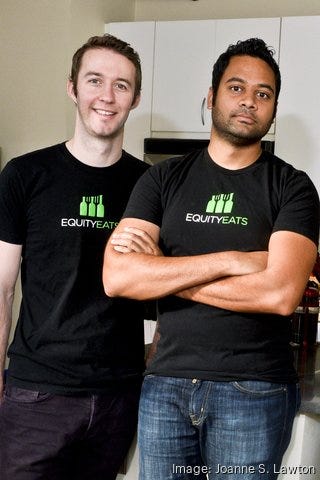
Johann Moonesinghe and Andrew Harris launched inKind in 2016 in Austin, alongside Johann’s late brother Rajan Moonesinghe and product designer Marcus Triest. But here’s the thing—Johann wasn’t some tech bro trying to “disrupt” restaurants from the outside. The dude owns FOUR restaurants between Austin, Scottsdale, and Las Vegas. He’s lived the pain.
And that pain? It’s restaurant financing. Or more accurately, the complete absence of reasonable restaurant financing.
Think about it: restaurants have historically thin margins, high failure rates, and unpredictable cash flow. Banks don’t want to lend to them. VCs won’t touch them (too asset-heavy, no venture-scale outcome). And traditional equity investors want ownership stakes that most operators aren’t willing to give up.
So what did Johann and Andrew do? They literally cashed out their home and retirement accounts to bootstrap this thing in the early days. Say whaaaaaaaat. That’s conviction, folks.
What It Is & How It Works
Here’s where it gets interesting. InKind isn’t a lender. They’re not taking equity. They’re not even touching your credit card processor.
They’re buying your future food.
Let me break it down: Let’s say you’re a restaurant that needs $100,000 for a kitchen renovation or to smooth out operations. InKind will give you that $100K in cash TODAY—but in exchange, you’re giving them $200,000 worth of food and beverage credit that they can sell to diners through their app.
Then inKind turns around and sells that $200K in credit to consumers through their mobile app—often around $150K, pocketing the spread as their margin. Diners get access to these credits PLUS a 20% cashback reward to use at any other inKind restaurant. So consumers are getting 20 cents back on every dollar spent. Pretty compelling value prop.
For the restaurant, the math works because food cost is typically only 20-30% of menu price. So even selling credits at 50 cents on the dollar, the restaurant can still be profitable—assuming they manage their other costs well and drive enough non-inKind traffic.
The Product Suite: Way More Than Just Financing
But wait, there’s more. (I promise this isn’t an infomercial, though it kinda feels like one.)
InKind has evolved into a full restaurant commerce platform:
Sherlock AI - This is their secret sauce. Named perfectly, this system analyzes a restaurant’s menu, local spending behavior, and customer trends to determine EXACTLY how much credit a restaurant can absorb without tanking their cash flow. In Johann’s words from year one: “I lost 50% of the money I funded because I bought $100,000 in donut credits from some donut place in Michigan. It was impossible to sell.” Ouch. But they learned, and now Sherlock prevents that.
Labor Management Software - Johann built this internally for his own restaurants and saw a 10% margin improvement. Now they’re rolling it out across their 6,000+ restaurant network.
Margin Monitoring Tools - Helping operators actually understand their unit economics in real-time.
POS Integrations - They’ve partnered with Toast and other major players so payment processing is seamless.
InKind Pass - A monthly subscription for power diners that unlocks premium perks.
The Numbers: Holy Schnikes
Here’s where I had to do a double-take:
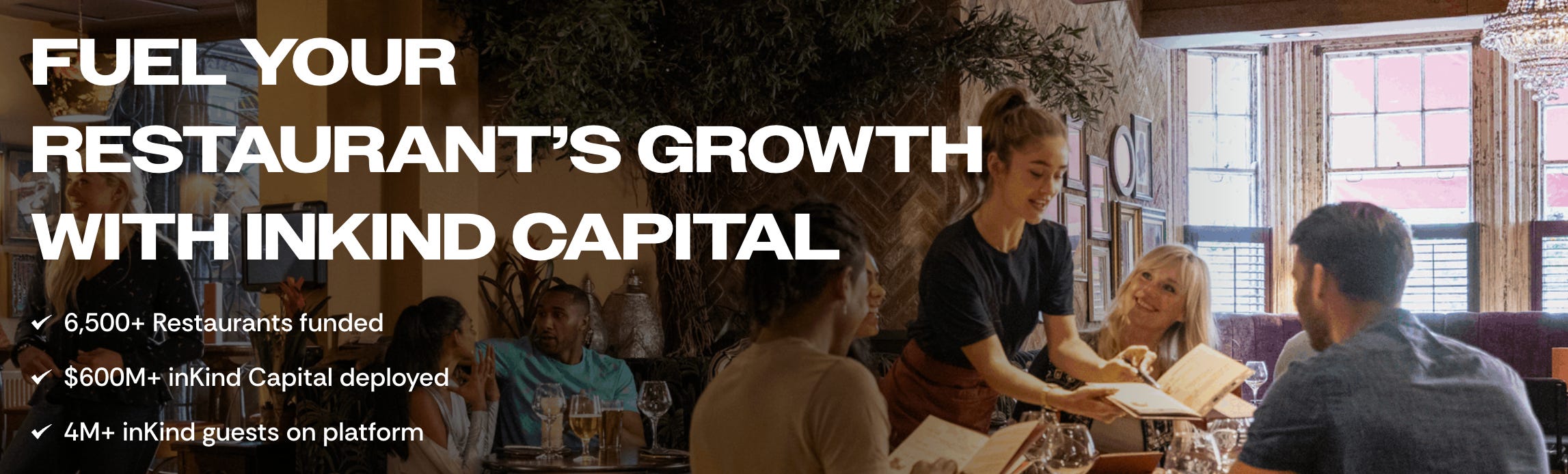
$600M+ deployed to 6,000+ restaurants nationwide
$450M just raised in February 2026 (Series B led by Magnetar Capital)
Investors include: Jay-Z’s MarcyPen Capital, ex-Yahoo CEO Jerry Yang, all four members of Metallica (!), and dozens of restaurant owners
2% failure rate among funded restaurants (compared to industry average of 60% in first 3 years)
4 million+ app users who’ve received $175M in dining rewards
Partners include José Andrés Group, MINA Group, 20 Michelin-starred restaurants, 50 James Beard nominees
Estimated revenue: ~$350M (2025 estimates from CB Insights)
Founders still own 75%+ of the company despite the massive funding
That last stat is WILD. Most founders are diluted to single digits by Series B. But because Johann and Andrew took a relationship-driven funding approach and didn’t need to spray-and-pray with VCs, they maintained control.
Business Model: The Spread Is The Whole Game
InKind makes money on the spread between:
What they pay restaurants for credit (say, $100K for $200K in credit = 50 cents per dollar)
What they sell that credit to consumers for (say, $150K = 75 cents per dollar)
Their gross margin = 25 cents on every dollar of credit purchased
The risk? If restaurants close before the credits are redeemed, inKind eats the loss. That’s why Sherlock AI is so critical—it’s essentially their underwriting engine.
But with a 2% failure rate vs. the industry’s 60%, they’ve clearly figured something out. Part of it is selection (they only fund restaurants with solid fundamentals). Part of it is the inKind effect itself—by driving more customers through the door with that 20% cashback, they’re actually improving the restaurant’s odds of survival.
Capital Raised vs. Capital Deployed
This is fascinating. They’ve raised roughly $600M+ in total funding, and they’ve deployed... $600M to restaurants. They’re essentially a capital-as-a-service business. The funding they raise from investors goes almost directly into restaurant financing, and they recoup it by selling dining credits over time.
Early on, Johann said: “Venture investors hated our business because we’re so balance sheet heavy, we require so much money to give the restaurants. And the debt partners didn’t want to lend us, because they’re like, restaurants are the most risky.”
But now? With a decade of proof, a 2% default rate, and Jay-Z writing checks? The fundraising is relationship-driven, and Johann’s turning investors away.
Outlook For The Future
With that fresh $450M, they’re planning to fund 10,000 additional restaurants in the next year. That would bring them to 16,000+ restaurants.
They’re also expanding the tech platform—more AI-driven tools for labor optimization, margin management, and operational efficiency. Johann’s not just financing restaurants; he’s building the operating system for independent restaurant success.
And here’s the vision: inKind Day. They’re doing a year-long celebration of their 10th birthday with exclusive events in NYC, LA, Chicago, SF, Austin, Miami, and Vegas. They’re building not just a financing platform, but a community and lifestyle brand for restaurant operators and food lovers.
Other Industries That Could Benefit From This Model
Okay, this is where my brain goes into overdrive. Because this model—buying future inventory at a discount, selling it to consumers at a markup, everyone wins—could work in SO MANY verticals:
Fitness Studios / Boutique Gyms - ClassPass already does something adjacent, but imagine providing capital to SoulCycle-style studios in exchange for class credits. Sell them to consumers at a discount. Studios get cash flow, consumers get deals, you take the spread.
Salons & Spas - Same deal. Buy $200K in haircut/massage credits for $100K cash, sell them for $150K. Built-in customer acquisition for the salon.
Auto Repair Shops - This is HUGE. Buy $50K in future service credits, sell them to local car owners. Shops get working capital, car owners lock in discounted maintenance.
Veterinary Clinics - Pet owners would LOVE to pre-buy discounted vet visits. Clinics get capital for equipment.
Home Services (HVAC, Plumbing, Electrical) - Seasonal businesses with lumpy cash flow. Imagine buying $100K in HVAC credits during winter (slow season), selling them to homeowners before summer (peak season).
Dental Practices - Dentists need capital for equipment. Patients want cheaper cleanings and procedures. Match made in heaven.
Child Care Centers - Always strapped for cash, parents always looking for deals. Buy tuition credits at a discount, resell them.
The pattern? High-frequency, repeat-purchase businesses with predictable inventory costs in traditionally underfinanced industries. That’s the sweet spot.
The key constraints are:
Margin structure needs to support the discount (ideally <30% COGS)
Customer frequency needs to be high enough to sell the credits
The service/product needs to be appealing enough that consumers will prepay
The Bottom Line
InKind is proof that the best vSaaS businesses don’t just sell software—they solve the existential problems of an industry. For restaurants, that problem isn’t marketing or POS systems (plenty of those). It’s access to non-predatory capital.
By reimagining the entire financing model and building a consumer app to support it, Johann and team created something genuinely new. And with 75% founder ownership at $450M+ raised? They’re playing the long game.
This is what I mean when I say vertical SaaS is about depth, not breadth. InKind went ALL IN on restaurants. They learned the unit economics, built underwriting AI, created a consumer marketplace, integrated with POS systems, and became an indispensable partner to 6,000+ operators.
Could this model work in other industries? Absolutely. But it won’t be easy. You need domain expertise, patient capital, a two-sided marketplace, and a willingness to be balance-sheet heavy.
But if you pull it off? You’re not just building a SaaS company. You’re building the financial backbone of an entire industry.
You’ve got this.

We’re hosting a workshop on
AI-Powered GTM.
This won’t be a theory session. This won’t be a ppt deck full of generic AI takes.
Our guest is going to get into the actual tools and build everything out from scratch in 60 minutes.
Our guest, Ryan Vanshur, VP GTM Intelligence & AI at Handle.com,
and he is one of the most advanced AI pilled folks I’ve met…

If you’re thinking about how AI can actually improve execution across your sales org,
this session will be worth your time.
April 9th, 2026 at 2:30 PM EST
Limited to the first 25 founders/operators.
Or access our last workshop, Building AI Agents That Actually Work here.
The Best Moat for Legacy Vertical SaaS Systems in the AI Age (And I’ve Seen NO ONE do it yet)
The best moat for legacy vertical SaaS in the AI era might be an agent app store...
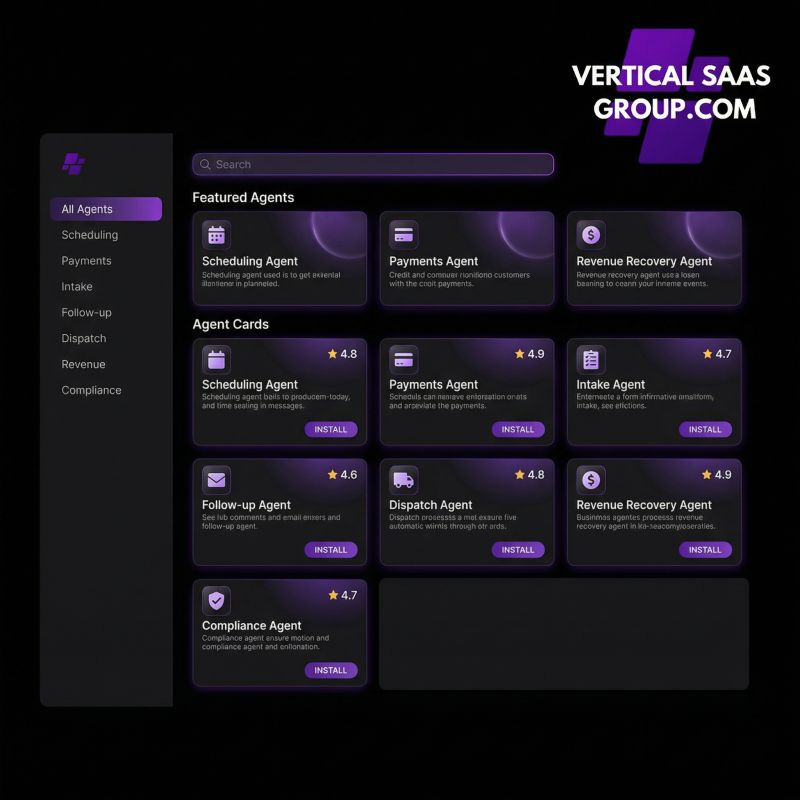
If you’re the system of record in a vertical, you already have the thing every AI agent startup wants:
The data, the workflow, the permissions, and the distribution. So why are so few legacy vertical SaaS companies leaning all the way in here? The obvious move isn’t to try to build every AI feature yourself.
It’s to let the market build on top of you.
Give developers and startups governed access to your data + workflow layer
as long as they launch inside your agent app store.
That’s a monster moat.
Why?
Because it means:
— You don’t have to compete with every AI agent upstart
— You don’t have to build an agent for every use case
— You get more innovation than your internal roadmap could ever ship
— You become the distribution layer for the whole category
— You keep the customer relationship and system-of-record status
— You can monetize via rev share, payments, and platform fees
That’s the part I think people are underestimating. In AI, the product moat is getting thinner. But workflow control + proprietary context + embedded distribution? That still compounds.
If I’m a legacy vertical SaaS company, especially a big one,
I’m not only asking:
“Which agents should we build?”
I’m asking:
“How do we become the place where all the best agents get built, discovered, bought, and used?”
That changes the game.
Now every startup building in your vertical is no longer just a threat.
They can become supply.
You don’t need to out-innovate the entire market.
You need to orchestrate it.
And if you do this right, you get the upside of AI innovation without carrying all the product risk yourself. That’s a way better business.
The incumbents already have the ingredients:
-customer trust
-workflow ownership
-historical data
-embedded payments potential
-implementation footprint
-distribution into the exact end user
So again, the question is:
Why haven’t more legacy vertical SaaS brands built AI agent app stores yet?
Feels like one of the clearest moats of this era.
I'm asking you Veeva Systems, Procore Technologies, Yardi, Toast, nCino, etc. (!)