

What if the most profitable AI businesses aren’t built by chasing moonshots—but by solving the unsexy, painful problems that bleed money every single day?
Christophe Rimann and Camber didn’t build a general-purpose AI platform. They built a vertical machine so specific, so disciplined, and so ruthlessly focused on one problem that it became nearly impossible to compete with….
This Weeks Titan: Christophe Rimann (Founder & CEO at Camber)
Christophe’s path into healthcare wasn’t linear, which is usually a good sign.
He got into crypto back in the 2012–2013 era, when Bitcoin still looked like fake internet money to most people. He went on to build a crypto broker-dealer that hit about a $1 million run rate and operated with a FinCEN license at a time when almost nobody knew what the rules even were. In other words: he got his reps in early building inside a chaotic, infrastructure-heavy market where trust, compliance, and edge cases mattered.
Then he went deeper technically.
After crypto, he went to grad school to do blockchain-related research, then joined McKinsey, where he spent nearly two years doing healthcare consulting, much of it in revenue cycle management for large hospital systems. That matters. Because once you’ve spent enough time in rev cycle, you realize this isn’t some back-office annoyance. It is the bloodstream of the business. You can have great clinicians, strong demand, and solid patient outcomes — but if claims don’t get paid, none of it works.
💡But the real driver here wasn’t just market logic. It was personal.
Christophe talked about being diagnosed with ADHD in college and how access to behavioral healthcare changed his life. He explicitly said he doesn’t think he’d be in a position to run a company today if he hadn’t gotten that care. That’s not branding fluff. That’s founder-market fit with actual emotional depth behind it.
He didn’t back into healthcare because it was a big TAM slide. He got there because he saw firsthand how important access to care is — and then later saw how broken the financial plumbing behind that care really was.
At big hospital systems, a human can chase the last 5–10% of a claim because it might be worth thousands. But in outpatient and behavioral health, the economics fall apart.
If a clinic gets paid 90% of a $150 claim, are they really going to pay a person to chase the last $15? Maybe. But probably not at scale. And when you multiply that across hundreds of thousands of claims, clinics end up leaving tens of thousands — even millions of dollars — on the table.
🎯 Camber was built on the idea that the long tail of healthcare claims is too operationally painful for humans and too economically important to ignore.
SAY WHAAAAAAAAT.
That’s a very good vertical SaaS wedge. It’s painful, frequent, workflow-native, tied directly to revenue, and hard enough that most software companies never want to touch it.
#1. Pick a wedge where the market already exists — then ask if you can actually build the product
One of the smartest things Christophe said was that Camber didn’t really have a product-market-fit problem. Revenue cycle has existed for decades. Everyone knows the pain. Buyers already spend money on it.
The real question wasn’t “will someone buy this?” It was “can we actually build software that performs at or above the level of resilient human labor?”
There are markets where distribution is the hard part. And there are markets where the pain is so obvious that distribution is not the primary constraint. In those markets, the real bottleneck is capability. Can the product actually do the job? Can it survive edge cases? Can it outperform the incumbent process in live production, not just in a sandbox?
#2. Stealth is not cowardice — it can be sheer discipline
Camber raised pre-seed, seed, Series A, and Series B without announcing a single round. No press releases. No chest pounding. Just building.
Because GTM wasn’t the bottleneck early on. The bottleneck was proving they could build a system that actually worked. That’s a contrarian move in a market where founders are often rewarded for narrative before substance.
Some of the best vertical businesses won’t look “hot” on Twitter during the build phase. They’ll look quiet. Weird. Unfashionable. Maybe even too operational.
Then one day they emerge with real customers, real margins, real data, and a much stronger moat than the loud company that spent three years farming engagement.

A quick word from our incredible partner,
Parafin - the leading embedded capital partner.
4.8 star rating on Trustpilot, with over 500 reviews [source]
71% CSAT rating across all partners
84 NPS
Serving top Fortune 500 companies, including Amazon, Walmart, and DoorDash
#3. Don’t fake automation with labor
Christophe said they made an explicit decision not to offshore the work. Why? Because once you use cheap labor as the release valve, you stop feeling the pain strongly enough to automate it properly. The incentive to fix the root problem disappears.
A lot of founders will tell you they’ve built automation when what they’ve really built is a labor buffer wrapped in software. If labor becomes the permanent crutch, your gross margin story is fake and your product never compounds.
No offshoring. No hiding from the pain. Build the machine. And according to Christophe, that decision led them to gross margins that look like standard SaaS — even upper-quartile SaaS — despite operating in a category most people would assume has to look like a services business.
That’s how real moats get built.
#4. Humans in the loop are not a bug — they’re the training data advantage
There’s a lazy narrative in AI right now that the best system has zero humans involved. Christophe described their insurance operations team almost like expert labelers for a foundation model. When a claim fails or a strange edge case appears, humans don’t just patch the issue. They feed the learning back upstream so the system improves.
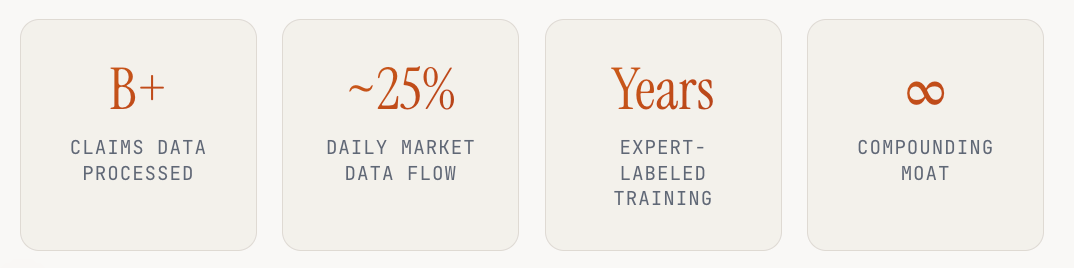
Your goal is not to eliminate human expertise on day one. Your goal is to convert human expertise into proprietary system intelligence faster than anyone else.
#5. Sell EBITDA uplift, not just cost savings
Most AI companies sell some version of labor reduction: fewer heads, lower costs, faster workflows. Camber goes after yield. They care about collections. They care about getting claims paid at a higher rate. They care about increasing EBITDA, not just reducing payroll.
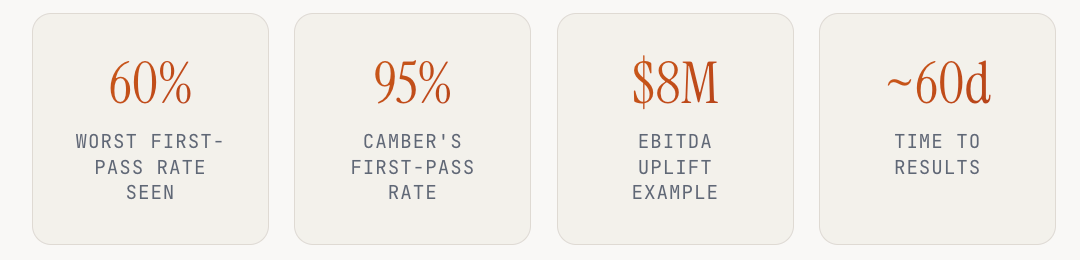
If you help a provider collect an extra 100 to 300 basis points, that’s not some nice-to-have dashboard improvement. That can be a deeply material financial change in a tight-margin business.
They don’t charge a classic SaaS fee. They charge a base fee tied to collections — usually lower than what the customer is already paying — and then participate in the upside they generate. The customer wins first. Then Camber wins with them.
#6. Don’t become the system of record if the better business is the payments layer
Do you need to own the system of record to matter? Camber’s answer is basically: not necessarily. Christophe’s view is that they’re building something much closer to Stripe for healthcare — a payments network that sits on top of systems of record rather than replacing them.
In a lot of vertical markets, the system of record gets all the attention, but the economic value ends up accruing in the payments layer, financing layer, or workflow infrastructure wrapped around it.
Are you really supposed to own the whole stack? Or is there a narrower layer where you can become indispensable to the entire ecosystem?
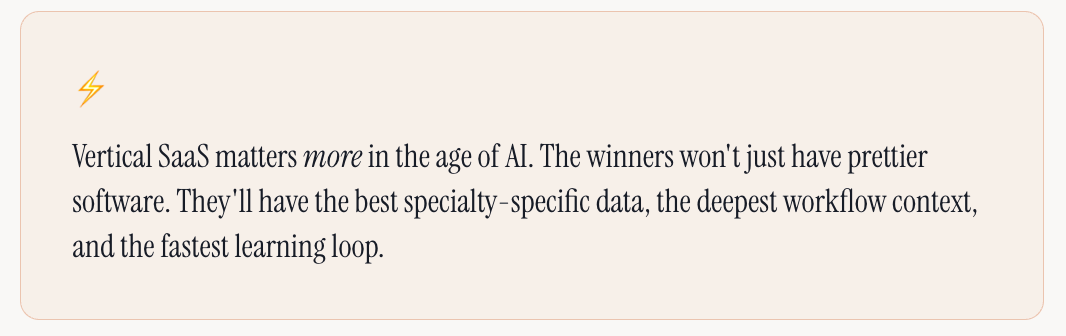
#7. Going vertical is what makes AI actually work
Camber started in behavioral health, then expanded into areas like physical therapy, neuropsychology, ENT, and cardio. That expansion didn’t happen by accident. It happened because the model is learned specialty by specialty.
People assume broader is better because general models are broad. But in regulated, workflow-heavy industries, breadth is often a weakness.
#8. Distribution can come from private equity before it comes from the market
Christophe said one of Camber’s most common GTM motions is to talk to private equity firms first. In some cases, PE groups bring them into diligence before buying an asset so Camber can help identify revenue and EBITDA upside.
If your product can materially improve margins, reduce leakage, or tighten operations inside fragmented service businesses, you may not need to start with the operator. You may be able to start with the capital allocator.
A software vendor that can plug directly into diligence, quantify upside, and then help realize it post-close is not just a tool vendor. That starts to look like strategic infrastructure.
#9. In enterprise vertical AI, change management is part of the product
This is such an important reminder for vertical AI founders who think better models alone will win the enterprise. If you are selling outcomes, then you are selling workflow change. And workflow change means training, implementation, trust-building, process redesign, ownership alignment, and a lot of on-the-ground work.
That doesn’t make your business less software-like. It makes it more real. The companies that embrace this will outperform the ones that pretend implementation is someone else’s problem.
Why This Matters for the Rest of Us
The big idea here isn’t just that Camber is automating claims. It’s that they found a painful, fragmented, high-frequency workflow sitting directly next to revenue… and then they built a data engine around it before the rest of the market woke up.
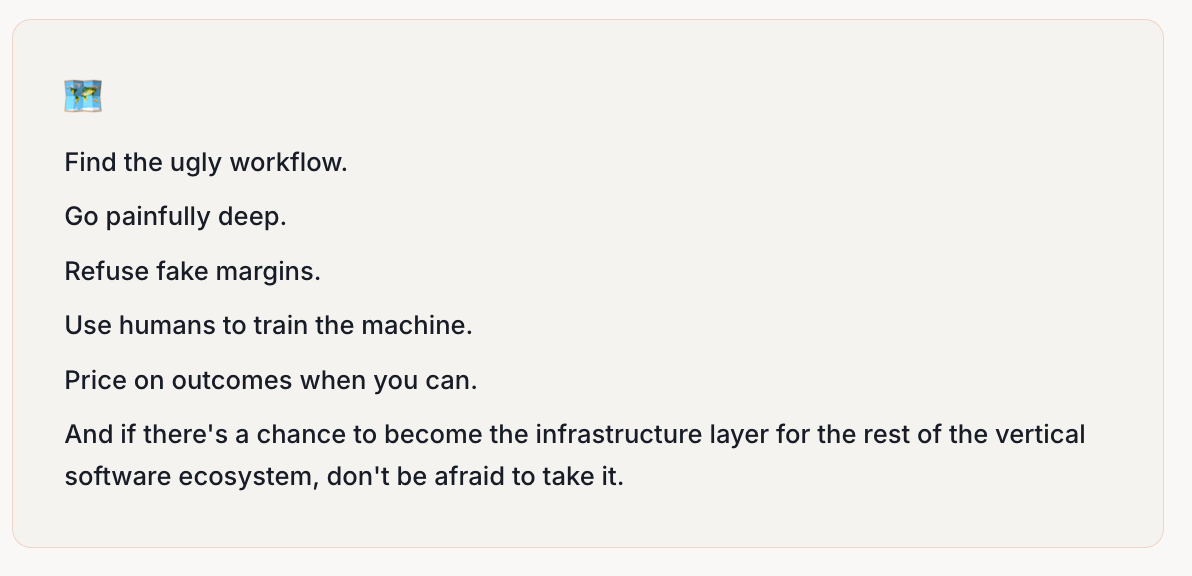
The next generation of great vertical SaaS companies may not look like traditional SaaS at all.
They may look like services on the surface, software underneath, and financial infrastructure at the core. That’s a very interesting place to build — and a very interesting place to invest.
You’ve got this.
Thanks for reading LINEAR. I reply to every email…
Have any questions, feedback, comments? Let us know, we work for you!