

Today’s newsletter is sponsored by Xplor Pay. In their latest case study, they show how a POS provider embedded payments using PayFac as a Service without taking on the burden of compliance, risk, or merchant onboarding.

Learn how white-labeled payments, streamlined setup, and flat-rate pricing helped the platform improve the experience while unlocking new recurring revenue. Read the full case study.
Alright, let’s get to it…
Why OpenClaw Might Be a Bigger Vertical SaaS Opportunity Than Most People Realize
Most people look at OpenClaw and see a personal AI assistant.
I think that framing is too small.
When a new AI product breaks out, most people try to put it into one of two buckets. Either it’s a toy, or it’s a wrapper. That’s usually the whole conversation. “Cool demo, but who cares?” Or, “Interesting product, but what’s the moat?” And honestly, that’s often the right instinct. We’ve all seen enough thin AI products to know how this usually goes.
But OpenClaw feels a bit different.
Not because it magically solves trust, workflow design, distribution, or any of the hard stuff that actually makes software valuable. It doesn’t. But because if you look at what it actually does, it doesn’t really feel like a normal chatbot. It feels more like an execution layer.
And once you see that, the vertical SaaS angle gets a lot more interesting.
The wrong way to think about OpenClaw
If you describe OpenClaw as “a personal AI assistant,” you’re not wrong.
You’re just leaving out the most important part.
That description makes it sound like another chatbot with memory. Something that sits in a chat window, answers questions, drafts a few things, maybe remembers some context, and helps you feel a little more productive. That’s fine, but it undersells what makes it potentially valuable.
The interesting thing about OpenClaw is not that it can respond.
It’s that it can operate.
It can sit across tools, channels, and workflows and actually do things. It can move work forward. It can exist closer to where business processes actually start, which is usually not inside some beautifully organized dashboard.
That matters a lot more than people think.
Because businesses do not really pay for “AI that talks nicely.” They pay for outcomes. They pay for fewer dropped balls, faster response times, more booked appointments, cleaner handoffs, lower labor costs, and more revenue collected. If an AI product cannot move one of those numbers, it may still be cool, but it’s probably not a business.
OpenClaw at least points toward that world.
So what is OpenClaw, really?
The simplest way to think about OpenClaw is as an open-source AI assistant that runs on your own devices and works across the tools and channels you already use. That alone is interesting. But the more useful framing is this: OpenClaw behaves less like “a bot you talk to” and more like “a system that can sit inside your operational environment.”
That’s a big distinction.
Most people imagine work happening inside the app. But if you’ve spent time in real businesses, especially messy vertical ones, you know that’s not how it works. The app is often where the record ends up. The actual work starts before that, around that, and between that.
It starts in:
text threads
missed calls
support inboxes
Slack messages
WhatsApp conversations
scheduling requests
random follow-ups nobody owns
That messy layer is where a lot of the pain lives. It’s also where a lot of software still does a terrible job.
That’s why OpenClaw matters.
It’s not just another AI UI. It looks more like a programmable layer that can live inside the chaos and help convert communication into action.
Why that matters for vertical SaaS
If you’ve built in vertical SaaS, or even just studied the good companies long enough, you start to notice the same pattern over and over again.
The best businesses usually do not start with some giant category-defining vision.
They start with one painfully specific workflow.
One workflow that is:
frequent
expensive
repetitive
full of manual steps
tied to money or labor
annoying enough that customers will gladly pay to make it go away
That’s the whole wedge.
Not “software for dentists.”
Not “AI for real estate.”
Not “digital transformation for SMBs.”
One ugly workflow.
That’s where vertical winners are born.
And OpenClaw gets interesting because it seems well-suited for exactly that kind of wedge. It maps well to environments with fragmented systems, lots of communication, too much manual follow-up, weird handoffs between people and tools, and revenue leaking out because no one owns the operational middle.
That’s basically vertical SaaS in a nutshell.
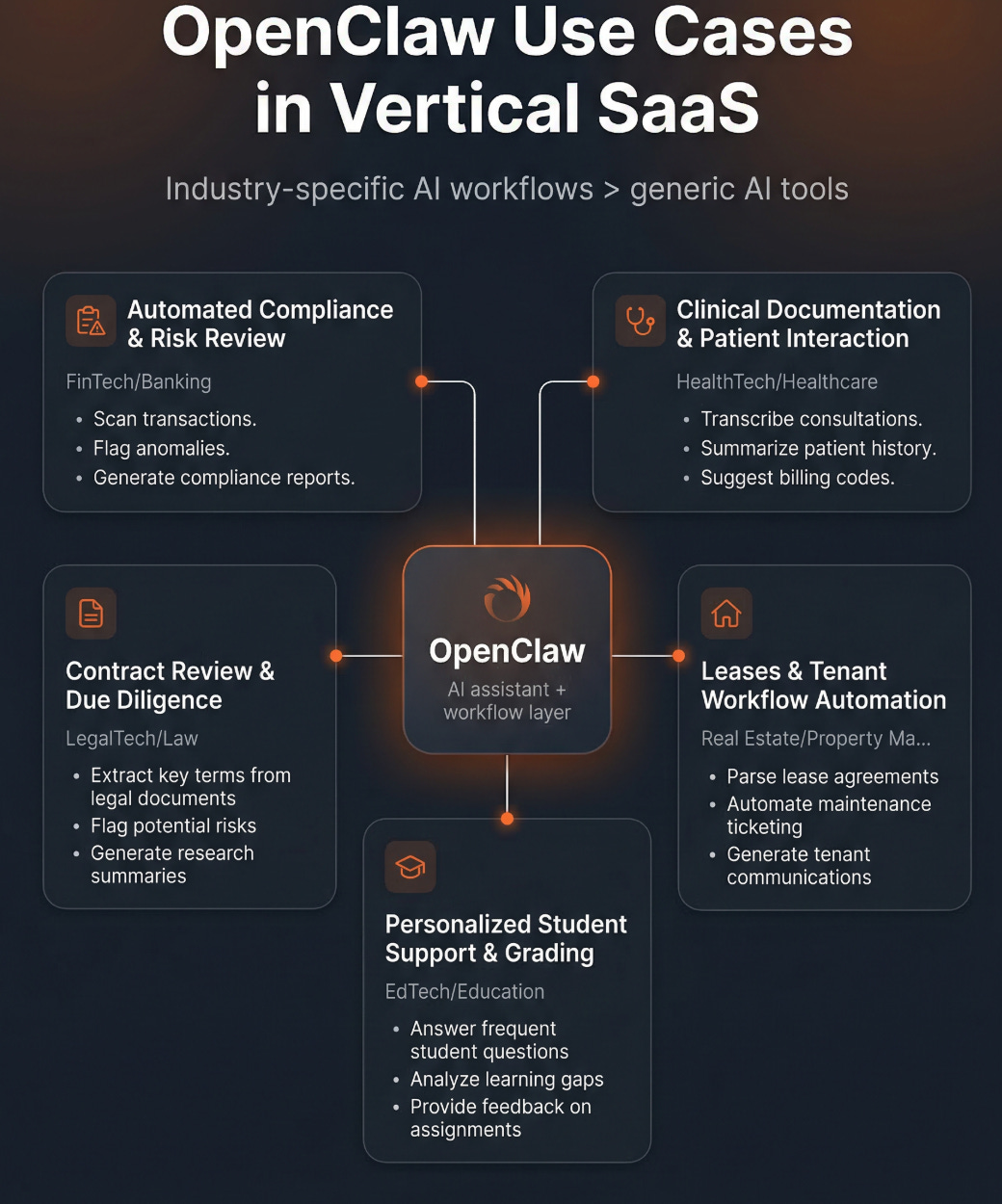
The key idea: OpenClaw as a workflow layer
The most useful way to frame OpenClaw is this:
It becomes valuable when it acts as the communication and execution layer around a painful workflow.
Not the whole stack.
Not a magical AI employee for everyone.
A focused layer that:
receives input from the channels people already use
interprets what needs to happen
triggers the next step
routes context into the right system
keeps the workflow moving until it’s done
That’s a much stronger product concept than “assistant in your messaging app.”
It also fits how a lot of great vertical SaaS products actually get built. They don’t replace everything on day one. They wedge themselves into a high-value workflow, own that workflow, then expand from there.
That’s the opportunity here.
What OpenClaw is not
This is where people get themselves into trouble.
OpenClaw is not automatically a company.
It is not automatically a moat.
And it is definitely not a finished vertical product.
Say whaaaaaaaat.
This is the part people in AI land constantly want to skip. They find a cool runtime or framework and act like the hard part is over. It’s not. The hard part has barely started.
You still have to do the real work:
pick the right market
understand the workflow deeply
build trust
integrate with incumbent systems
handle ugly edge cases
package the UX
prove ROI
own distribution
That’s the business.
OpenClaw is the ingredient, not the meal.
Where the use cases get interesting
This is where things start to click.
If you stop thinking of OpenClaw as a generic assistant and start thinking of it as infrastructure for workflow software, some really compelling vertical use cases show up.
1. Missed-call recovery for local-service businesses
There are still a lot of verticals where the phone is the front door to revenue. Dental practices, med spas, HVAC companies, plumbers, lawyers, pest control operators, specialty clinics — these businesses do not treat calls like casual communication. Calls are often purchase intent.
So when they miss a call, they are not just missing a message. They are missing money.
That’s a great wedge.
An OpenClaw-powered vertical product here could answer after-hours inquiries, qualify leads, collect the right details, book appointments, send the follow-up text, and push the context into the CRM or scheduling system. That is a very clean example of where an execution layer creates value.
The buyer does not need to believe in AI.
They just need to believe that missed calls are costing them business.
2. Property management operations
Property management is another obvious one. The workflow volume is constant and the communication burden is enormous. Leasing inquiries, tour scheduling, maintenance triage, resident follow-up, reminders, collections nudges, internal coordination — it never stops.
That makes it a great environment for a conversational execution layer.
The opportunity here is probably not to replace the property management system. That’s usually too ambitious and too expensive at the start. The better opportunity is to own the workflow layer around it.
That means being the system that:
answers first
routes correctly
follows up automatically
keeps the lead warm
reduces admin workload
improves response speed
helps reduce bad debt
That’s a real product wedge. And if you get it right, you can expand from communication into deeper operational ownership over time.
3. Back-office coordination in ugly industries
Some of the best software businesses are built in the ugliest workflows.
Construction ops. Logistics. Insurance admin. Healthcare back office. Specialty trades. These environments still depend on shared inboxes, spreadsheets, voicemails, status checks, document chasing, and too many humans manually bridging systems that do not talk to each other well.
The problem there is usually not lack of intelligence.
It’s lack of execution.
Someone has to keep the workflow moving. Someone has to follow up, escalate, remind, route, and confirm. And too often, that “someone” is a tired ops person drowning in tabs and email threads.
That’s exactly where an OpenClaw-like layer could shine.
You could imagine products built around:
document collection
status chasing
vendor coordination
claims follow-up
dispatch confirmations
internal escalation workflows
These aren’t sexy demos. They’re better than sexy demos. They’re useful.
4. Payments and collections
This one is sneaky big.
The best vertical SaaS products do not just help customers work. They help customers get paid. And once software gets closer to money movement, the ROI gets way easier to understand.
That’s why payments and collections workflows are such an interesting area for something like OpenClaw. A focused product could handle invoice reminders, failed payment recovery, financing nudges, payment-link follow-up, and escalation flows for overdue accounts.
That is a much easier sale than “AI transformation.”
If the customer sees:
more recovered revenue
better cash flow
less time spent chasing payments
fewer delinquent accounts
…then the product story becomes very simple.
And simple product stories usually sell better.
5. Field-team copilots
A lot of workers in vertical industries do not want more software. They want less friction.
They want to talk, text, upload a photo, get the next action, and move on.
That’s why field-team copilots are interesting. Think technicians, inspectors, dispatchers, estimators, site managers, care coordinators. In those jobs, the ideal interface is often not “another dashboard.” It’s something much lighter.
An OpenClaw-like layer could help turn informal inputs into structured action. The worker sends a note, a photo, or a message. The system translates that into the next step, routes the context, updates the right system, and keeps things moving.
Less clicking. More doing.
That’s a very strong value proposition in a lot of vertical markets.
What founders should be careful about
This all sounds promising, and I think it is promising. But there are a few places founders can get themselves into trouble.
First, it’s easy to confuse a flexible runtime with a finished product. Customers do not buy “flexibility.” They buy solutions to painful problems. So if you build on OpenClaw, your job is not to show how many things it can do. Your job is to make one important workflow feel inevitable.
Second, trust matters a lot. The second your product touches payments, healthcare, legal workflows, scheduling, or customer communication, “pretty good” is not good enough. Reliability, control, guardrails, and error handling matter. A lot.
Third, the moat is never the wrapper. The moat is the workflow. More specifically, it’s the domain expertise, the system integrations, the edge-case knowledge, the customer trust, the data exhaust, and the distribution. That’s how vertical SaaS companies win. Not by having a clever AI layer, but by becoming deeply embedded in how one industry actually operates.
The bigger opportunity…
The real opportunity here is not to build a horizontal “AI assistant for businesses.”
That market gets crowded fast, and it usually gets commoditized even faster.
The real opportunity is to take OpenClaw-like capabilities and wrap them around a painful, recurring, industry-specific workflow with immediate ROI.
That’s the playbook.
If I were looking at markets through that lens, I’d want workflows that are:
communication-heavy
repetitive
operationally messy
easy to measure
tied to revenue, collections, response speed, or labor savings
That’s where this gets really interesting.
Because that’s where software stops being cool and starts being valuable.
To wrap it up…
OpenClaw is easy to underestimate because “personal AI assistant” sounds small. It sounds like a category we already understand.
I don’t think that’s the right way to look at it.
Underneath that label is something more interesting: a system that can sit across communication surfaces, tools, and workflows and help convert messy inputs into action.
On its own, that’s not a company.
But in the hands of a founder who deeply understands one vertical, one painful workflow, and one sharp wedge, it could absolutely become the foundation for a very real business.
Not because it’s magic.
Because it fits the way real industries still work.
And in vertical SaaS, that’s usually where the best opportunities hide.

The Story of Gloss Genius:
The OS For Beauty Businesses
You know what’s wild? There are over 444,000 licensed salons, spas, and barbershops in the US alone. That’s a $247 billion global market. And until recently, most of these businesses were running on... pen and paper.
I’m talking about talented hair stylists, aestheticians, nail techs, and massage therapists who could charge $100+ per hour for their craft, but were stuck managing their entire business with a physical appointment book and Square Reader. Maybe Mindbody if they wanted to drop serious cash on clunky software built for yoga studios.
Enter GlossGenius.

Founded in 2016 by Danielle Cohen-Shohet and (who did makeup artistry as a side hustle at Princeton), GlossGenius is now serving over 70,000 beauty and wellness businesses, reportedly hit close to $100M in revenue (as reported by Axios in 2024), and sits at a $510M valuation. And they did it by going vertical in one of the most fragmented industries in America.
The Wedge: Scheduling + Payments
Here’s what Danielle got right from day one: she understood that time is the unit of currency for beauty professionals. If you’re a hairstylist, your business scales based on how many hours you can book. Every minute spent managing appointment books, chasing down payments, or manually sending reminders is money left on the table.
So GlossGenius started simple — scheduling, payments, light CRM, and basic reporting. All in one elegant mobile-responsive web app. At a time when it wasn’t conventional to integrate payments with the rest of the stack (everyone told Danielle this was a mistake), she bundled it anyway because it was the same damn customer.
The wedge worked. Beta users started emailing support asking if their colleagues could use it too. Word of mouth took off. Beauty pros who normally hated “business stuff” were posting about GlossGenius on Instagram.
The Full Stack Play
But here’s where it gets interesting. GlossGenius didn’t stop at booking and payments.
They kept going deeper:
Client management with detailed profiles, service history, and notes
Automated SMS/email for confirmations, reminders, rebooking
Forms and waivers that auto-populate client files before appointments
Marketing automation with segmentation by visit history and spend
Inventory management with barcode scanning
Payroll that auto-pulls hours, tips, and commissions in three clicks
Buy Now Pay Later at checkout (6% fee vs. 2.6% standard)
Genius Loans — pre-qualified capital from $1K to $250K via Stripe Capital
That last one? That’s the vertical SaaS dream. You sit on billions of dollars in transaction data. You know exactly which businesses are healthy. So you can underwrite capital better than any bank.
The Business Model: Subscriptions + Payments
GlossGenius charges $24 to $148/month depending on team size, plus 2.6% on every card transaction. That dual revenue model is beautiful — recurring SaaS revenue plus a growing take rate as customers process more volume.
Sound familiar? It’s the Toast playbook. And just like Toast, about half of GlossGenius’s value comes from the payments side.
The Market Opportunity
Here’s what gets me excited about this space:
Massive fragmentation: 29% of beauty professionals are self-employed. Salon suites (where stylists rent private spaces) are exploding. More talented pros are going independent thanks to Instagram and TikTok.
Underserved customer: 40% of beauty businesses aren’t using any technology. The ones that are? They’re cobbling together Square + Google Calendar + Mailchimp. Their systems don’t talk to each other.
Payments unlock: The industry is finally moving toward upfront payments and hourly billing (vs. per-service). Why should a talented stylist eat the cost of no-shows when you pre-pay for flights and concert tickets?
TAM expansion: GlossGenius started with hair but is already expanding into massage ($21.6B), aesthetics, wellness, personal training, yoga. The global wellness economy is projected to hit $9 trillion by 2028.
The Capital Efficiency Story
What I respect most? Danielle kept funding rounds small and stayed capital efficient.
2016: Raised a seed from angels with just a few hundred customers and zero revenue
2017: Launched paid product, grew 10% month-over-month organically
2021: $16.4M Series A from Bessemer
2022: $25M Series B (tripled valuation)
2023: $28M Series C at $510M valuation
Total raised: ~$70M to get to an estimated $100M in revenue (as reported by Axios in 2024)
That’s roughly a 1.4x revenue-to-funding ratio if the estimates hold. In a world where vertical SaaS companies are raising $100M+ to get to scale, GlossGenius did it with a fraction of the capital.
How? Product-led growth. Word of mouth. Maniacal focus on customer value. Danielle spent years personally answering support tickets because it gave her direct insight into what customers needed.
The Competitive Moat
GlossGenius competes with:
Horizontal players (Square, Mindbody) — too generic, missing industry-specific workflows
Vertical freemium (Fresha) — free software, monetizes via 20% booking fees
Vertical marketplaces (Vagaro, Booksy) — consumer discovery platforms
GlossGenius differentiated by:
Simplicity: Beauty pros love how easy it is vs. clunky Mindbody
Pricing: $24/mo beats Boulevard’s $158-$369/mo enterprise pricing
Payments integration: Capturing transaction volume competitors miss
Trust: They don’t compete with their customers via a marketplace (yet)
What’s Next?
The fintech expansion is obvious. With Genius Loans live, they could add business bank accounts, credit cards, and insurance. They’re sitting on the data to underwrite risk better than anyone.
The marketplace question is interesting. Fresha, Vagaro, and Booksy all drive incremental bookings through consumer discovery. GlossGenius has 70,000+ locations — enough liquidity to launch a marketplace that actually works. But do they want to risk the relationship with customers who might see them as competition?
My bet? They’ll build it eventually. But they’ll be careful about positioning it as a tool for their customers, not a replacement.
The Bottom Line
GlossGenius is a textbook vertical SaaS success story:
✅ Picked a massive, fragmented, underserved market
✅ Wedged in with a simple, must-have product
✅ Went full stack with payments, fintech, and operational tools
✅ Built a product customers love enough to recommend
✅ Stayed capital efficient while scaling to estimated $100M ARR (as reported by Axios in 2024)
And they’re just getting started.
You Can MONOPOLIZE In Vertical SaaS
You CAN monopolize in Vertical Software.
We’ve seen it time and time again: your target should be 100% market share.

Not because you’ll literally get every customer in the market.
But because aiming for anything less usually leads to building a nice tool… instead of a category-defining company. That’s the big misunderstanding in vertical SaaS.
People think,
“this is a niche market”
or
“if we get 5-10% share, we’ve done great.”
Maybe.
But the best vertical software businesses don’t think that way.
They ask:
How do we become the default operating system for this industry?
That means more than just solving a few pain points.
Owning the data.
Owning the payments.
Owning the daily habit.
Using AI to actually SELL the work to be done.
That’s how vertical software compounds.
You start with a wedge: scheduling, CRM, estimating, compliance, charting, dispatch, inventory, whatever the market is begging for.
Then you expand.
More workflows.
More users.
More products.
More revenue per customer.
Higher switching costs.
Deeper moats.
Eventually, you’re not selling software.
You’re running critical infrastructure for that industry.
That’s why the great vertical companies feel so dominant.
Not because the market is massive at the start.
But because they go deep enough to make themselves unavoidable.
The question isn’t:
“Is this TAM too small?”
The better question is:
“If we win this vertical completely, how big does this get?”
That’s usually where things get interesting...
This piece tied bunch of ideas together for me about openclaw and vertical saas, with interesting points about industries and use cases where manual, disparate disconnected tools is still the default
Your ending how to monopolize (and that that is the true right goal in vertical saas) reminded me also of the 7 enduring powers / defensible moats
Network effects
Scale economies.
Switching costs.
Counter positioning.
Cornered resource. (Incl data)
Branding.
Process Power. (Extension of workflows as wedges, then owing adjacent drivers of value and pain points for the same customer like glossgenius)