

When Deepak Chhugani started Nuvocargo in 2019, the startup HATED tech-enabled services. Then came the SaaS-only correction. Then the agent gold rush. Through every hype cycle, Deepak kept building toward one thesis: customers pay for outcomes, not tooling.
In this deep-dive conversation on the Verticals podcast with host Nic Poulos, Deepak breaks down exactly how Nuvocargo went from a scrappy YC startup moving tequila across the Mexican border to an AI-native logistics platform with $85 million in funding, multiple acquisitions, and a product that’s making traditional freight brokers rethink everything.
Along the way, he delivers a masterclass in why most AI agent startups are failing to retain their customers — and what to do instead.
Vertical Titan: Deepak Chhugani
Deepak Chhugani is the founder and CEO of Nuvocargo, an AI-native logistics platform powering North American freight. Born to Indian parents and raised in Ecuador, his multicultural upbringing gave him a rare edge in a market defined by cross-border complexity. He attended school in Latin America before coming to the US in 2010, where he launched his career on Wall Street at Bank of America Merrill Lynch.
In 2015, a twist of fate reshaped his trajectory. Deepak was one of thousands of immigrants who lost the H-1B visa lottery — “a third of folks in these high-paying jobs had to leave the country,” he recalls. Rather than let him go, BofA relocated him to their Mexico City office, where he spent years helping large family businesses and industrial companies raise capital, think about IPOs, and structure deals. That exposure to the Mexican industrial economy, combined with his family’s logistics business back in Ecuador, planted the seed for what would come next.
When he left banking, Deepak entered the startup world through a winding path — a mix of early-stage ventures and private equity, “1 to 2 years figuring out what the hell I’m doing,” as he puts it. He got into Y Combinator, went through pivots and idea changes, and landed on the concept that became Nuvocargo: a technology-driven logistics company focused on the massive, underserved US-Mexico trade corridor.
He was 26 when he founded the company in 2019. Seven years later, Nuvocargo has raised over $85 million from Tiger Global, QED, NFX, YC, and angels including the founders of Ramp, Nubank, and Deel. The company has made multiple acquisitions — in software, AI, freight brokerage, and customs — and expanded from US-Mexico cross-border to all of North America. Revenue is in the mid-tens of millions, and the company was recently named one of Fast Company’s most innovative startups.
What makes Deepak unusual among logistics founders is the combination: a bicultural, bilingual background that gives him authentic credibility on both sides of the border; a finance pedigree that taught him capital structure and deal-making; and a first-time founder’s willingness to challenge conventional wisdom about how freight should be built and sold. “A lot of companies that were doing tech-enabled services in freight had a lot of challenges post-2022,” he says. “I think that we weathered this crazy freight recession really, really well, and we reinvented our business for the age of AI.”
From Wall Street to the Border
The US-Mexico trade corridor is a trillion-dollar market — $50 billion spent annually on freight alone — but unlike most international freight, it all moves over the road. Not air. Not ocean. Trucks. Deepak saw a unique niche where his bilingual, bicultural background gave him an edge no one else had.
“It was a unique niche,” Deepak says. “I thought it would be a great place to start.” He went through Y Combinator, pivoted a few times, and landed on what would become Nuvocargo — a company that would grow from a handful of cross-border tequila shipments into a platform managing freight across all of North America.
“Every little thing around you has parts or was moved in trucks and goes through the global supply chain. Trade is what moves the world. Trade is what connected populations.”
— Deepak Chhugani
The First Shipment: A Tequila Brand and a Stack of Immigration Papers
Nuvocargo’s origin story has the kind of serendipity that can’t be manufactured. Deepak’s very first customer was Carlos Soto, the founder of Nosotros Tequila — a small (at the time) tequila brand importing from Mexico into the US.
How did he win the account? Not through a pitch deck or a demo. Months earlier, when Deepak had no business relationship with Carlos, he’d gifted him a stack of immigration paperwork that had cost him over $10,000 — documents he no longer needed, but that would save Carlos enormous time and money navigating the same immigration process. “I gave him all this paperwork just to be nice because I knew the immigration process was very annoying,” Deepak explains.
When Nuvocargo launched and Deepak reached out about handling some cross-border shipments, Carlos remembered. He was “extremely helpful” and gave Deepak a shot with a few early loads. From there, it was network effects and “good old-fashioned hustle” — customers in plastics, packaging, manufacturing. Names most people wouldn’t recognize, but shipments that taught the team how freight actually works at the ground level.
“They started trusting us with a few shipments here and there,” Deepak says. “And then we started learning the process and really building software and tools to make that whole experience better and better.” The lesson embedded in this origin: in B2B services, generosity and trust compound over time in ways that cold outreach never can.
The Bilingual, Bicultural DNA
The US-Mexico freight market has a peculiar structure that shapes everything about how Nuvocargo operates. Unlike a typical domestic freight play, decision-makers sit on both sides of the border. A Mexican manufacturer exporting to the US might be responsible for delivering to an American warehouse. An LA-based brand importing tequila needs someone to handle transportation from Mexico. You’re selling to both types of customers simultaneously.
“That’s why the company’s DNA was very bilingual, bicultural from day one,” Deepak explains. “And that was really one of our unique advantages before things around our software or our regulatory compliance and licenses became more of our powerful differentiators.”
When asked what advice he’d give founders building a cross-border business from day one, Deepak is candid about the difficulties. He was 26 and a first-time founder. COVID hit in their second year, shattering any plans for in-person culture building. “Despite that, we were pretty good about keeping two main hubs, New York and Mexico City. I would say it’s hard.”
But the cross-border structure was also a survival mechanism. Companies that built all their operations in expensive US cities like San Francisco, Seattle, or New York ended up with “incredibly bloated cost structures.” Nuvocargo’s distributed model — born out of necessity — turned out to be a structural advantage. “If you had to ask me, like, my wave a magic wand, how would I have done it? I would have liked to have had the first 40 or 50 people in the same office with me every single day. But COVID kind of broke that for everyone in our vintage.”
“I just had a really good network with people that owned businesses in Mexico. And then also just good old-fashioned hustle.”
— Deepak Chhugani
Three Products, One Platform
Today, Nuvocargo is far from a Mexico-only play. Roughly 80-90% of what they do is within the US, with cross-border and Canadian freight rounding out the picture. They’ve expanded from full truckload to less-than-truckload and multiple equipment types. But the real strategic insight is in their product architecture — three offerings that mirror what the biggest winners in freight have built at scale, because “customers kind of demand of you to be a true partner for their supply chain.”
01 — Freight Brokerage
The most intuitive part of the business — and what many people assume is all Nuvocargo does. In reality, it’s about 40% of gross profit. They connect shippers with their network of 300,000+ carriers, using AI-powered procurement and negotiation to find competitive rates. The brokerage handles both domestic US freight and cross-border shipments.
For smaller customers spending under $5 million on freight annually, the relationship often starts here — “what’s your price?” — but quickly evolves. “If you can be consistently and structurally cheaper, at least for SMB customers, we have found that they just want to do everything with you,” Deepak notes. What begins as a transactional vendor relationship becomes an outsourced supply chain department.
02 — Customs Brokerage
A licensed, regulated service — think of it as being a specialized lawyer who prepares all the paperwork required to import or export goods through any US port. Nuvocargo is a US customs broker with CTPAT certification (a significant credential in the freight world that signals deep compliance capability). This product handles the regulatory complexity that makes cross-border logistics so daunting for most companies.
03 — Managed Transportation
This is the product Deepak is most excited about — and the one most aligned with where AI is taking the industry. The pitch to an enterprise customer spending $5-50 million annually on trucking: “Let me run all of that for you. I will obviate the need for you to hire 10 or 20 SaaS tools to coordinate everything. Your teams don’t have to learn how to use them. And we just charge you a small fee based on outcomes.”
The key distinction from brokerage: managed transportation isn’t about quoting a shipment from Dallas to New York. It’s about asking, “Do you even need to ship that? Could we combine it with 3 other shipments and reduce your spend overall?” Nuvocargo becomes the orchestration layer between the customer’s ERP and all their freight vendors — consuming purchase orders, optimizing routes, managing carriers. “That used to be with software and humans,” Deepak says. “Now it’s increasingly software, AI agents, and some humans overseeing what’s going on.”
The Hype Cycle Carousel
Deepak has a wry view of how the startup world has oscillated on business models over the past six years. “It’s been amusing to me to see how the startup world and the tech Twittersphere changes its mind,” he says, before cataloging the whiplash:
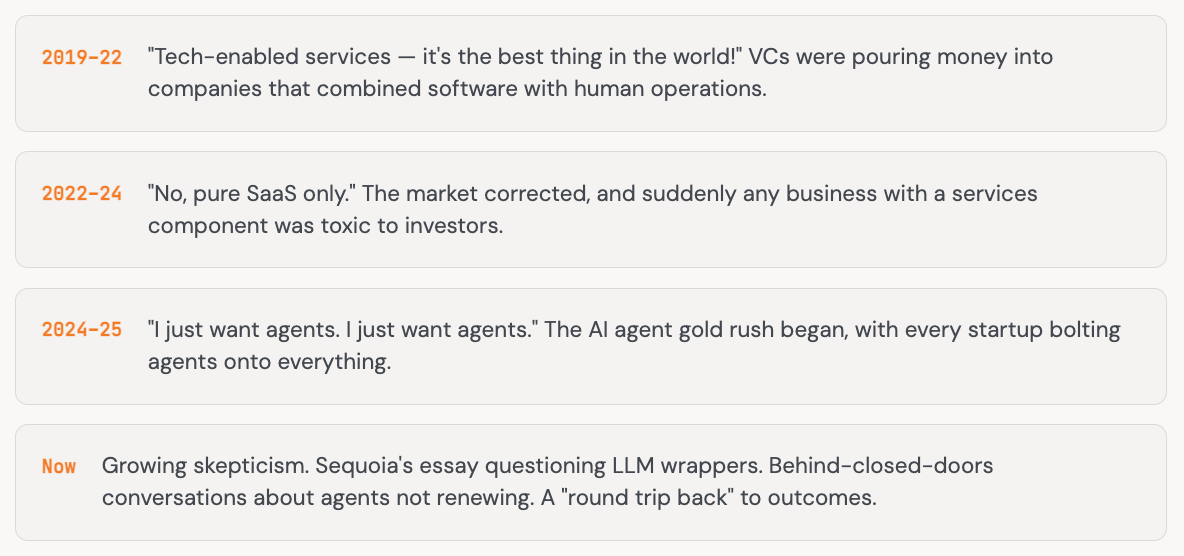
Through all of it, Nuvocargo kept building the same core thesis: charge customers to deliver outcomes. “We’ve done this like round trip back to the best model for customers and for value is what we’ve been doing all along,” Deepak says. “AI has just gotten so much better. We can actually offer so many agents, so many integrations right out of the box.”
“We lived 2019 to 2022, tech-enabled services, it’s the best thing in the world. Then 2022 to 2025, no, pure SaaS. And then it was like, I just want agents. I just want agents.”
— Deepak Chhugani
Why Most AI Agent Startups Aren’t Renewing
The AI agent renaissance in freight started with voice AI — automating carrier negotiations that industry veterans had sworn could never be automated. The use case was electrifying: AI systems that could call trucking companies, negotiate rates with drivers, and handle the messy, relationship-driven work of freight procurement. “This was one of those things that you would hear industry veterans saying, this cannot be automated with software. These Silicon Valley people are insane.”
And then it started working. Demos were phenomenal. Conference booths were packed. VCs got excited about freight again for the first time since the Convoy and Flexport era.
But Deepak has a different view from behind the curtain. “You really have to talk to people behind closed doors that are rolling this out. And they’ll tell you some successes they’re having, like, ‘Oh, now my inbound calls from carriers are run by these agents.’ But actually deploying this at scale where humans don’t need to monitor the agent anymore is incredibly difficult.”
The core problem is variation. Two freight brokers using the exact same TMS — the system of record in logistics — use it in fundamentally different ways. They have different business rules, different commission structures, different negotiation philosophies. Each customer requires intensive forward-deployed engineering and prompt engineering to get agents working. And even then, there’s an error rate that persists.
Worse, the failure mode is socially toxic. When agents break down, someone has to tell the customer that their team — not the AI — is the bottleneck. “It’s much easier to blame the vendor,” Deepak observes. “And that’s why I think a lot of them are not renewing. There’s a lot of controversy around whether this is going to work.”
The deeper strategic concern: if every broker adopts the same three or four agent vendors, where’s the differentiation? “It feels like it’s going to become another way that freight brokers commoditize themselves,” Deepak argues. “We all use the same 5 providers. It’s a little bit different, but not really.”
“If your AI strategy is just to work with a third-party vendor, all your competitors can hire the same thing. I don’t understand how that’s differentiation. It feels like it’s going to become another way that freight brokers commoditize themselves.”
— Deepak Chhugani
Own the Outcome, Own the Agent
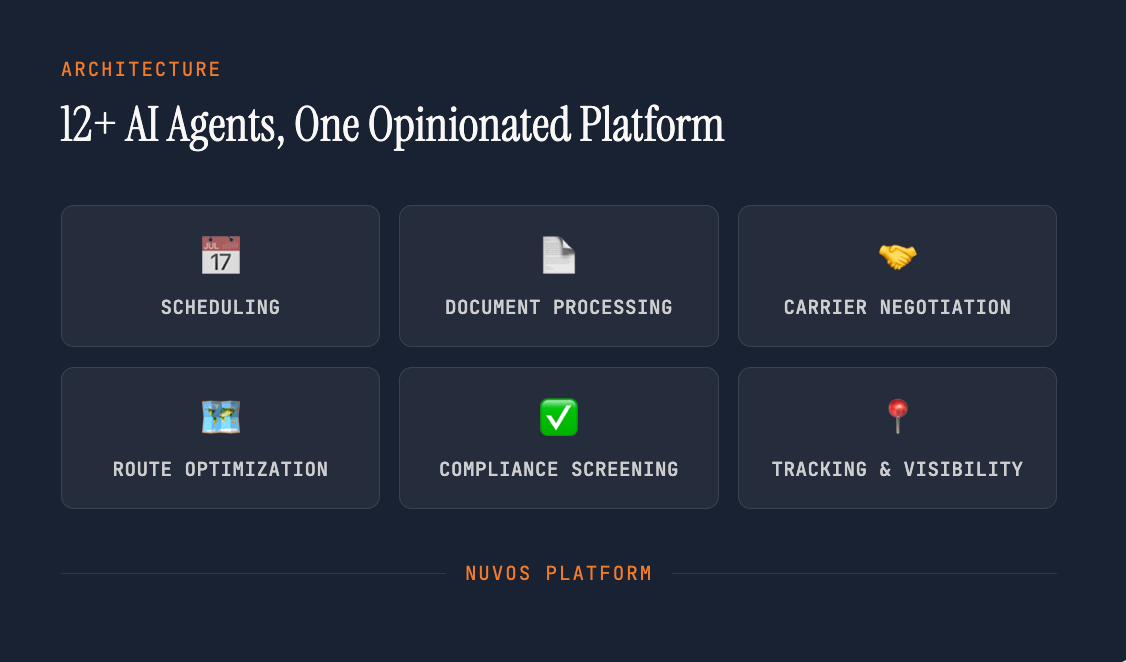
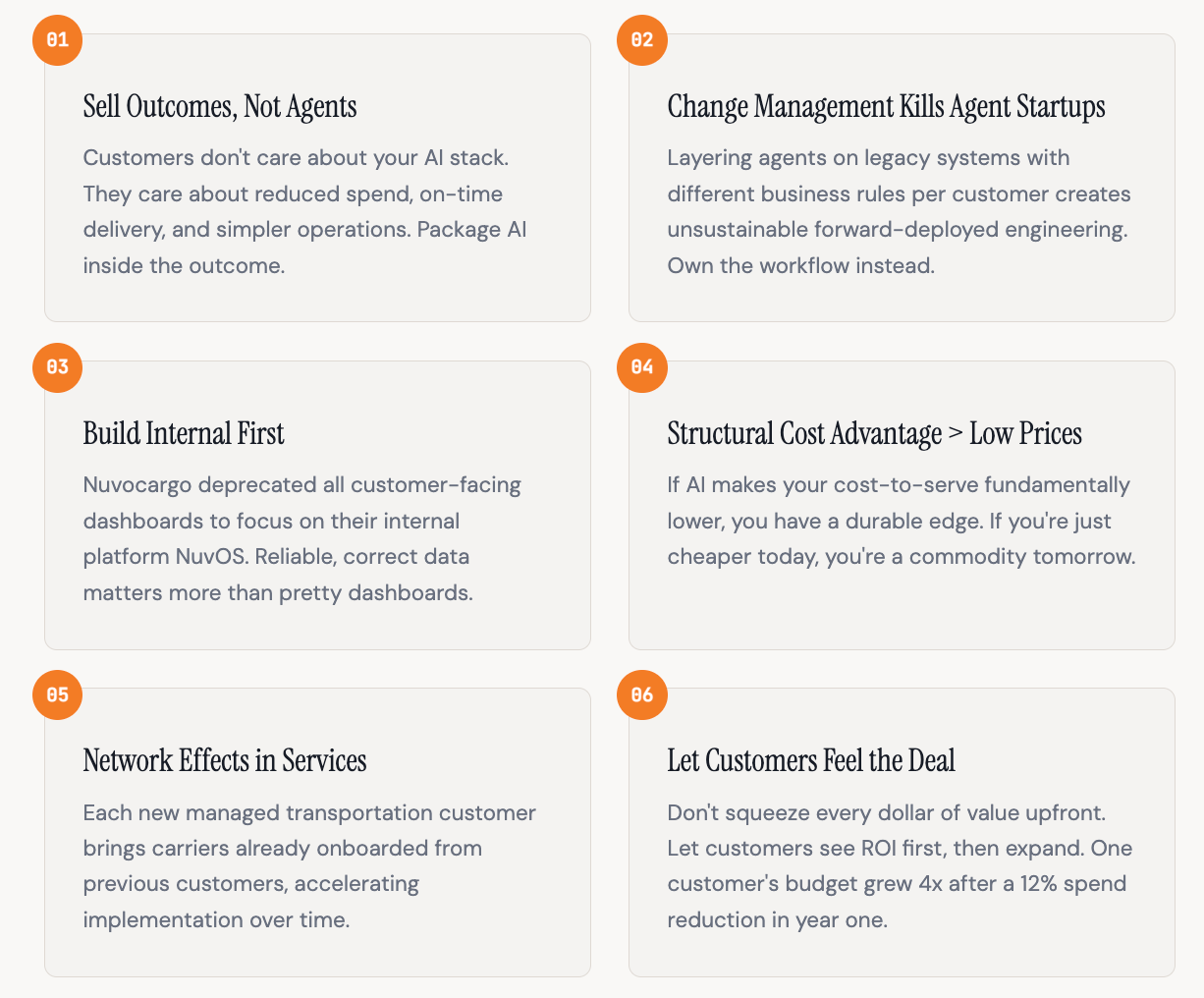
Nuvocargo’s approach inverts the typical agent model entirely. Instead of selling agents to freight brokers and hoping they figure out the integration, change management, and operational redesign — Nuvocargo sells the outcome. The pitch is disarmingly simple: “Just give me 10 shipments and I will show you the power of 12 AI agents and access to 300,000 trucking companies.”
Compare that to the typical agent startup pitch, which Deepak characterizes as: “Try my agent. Let me teach you my agent. Let me spend months on forward-deployed engineering.” Nuvocargo skips all of that because the agents run inside their own platform, NuvOS, where they control the entire workflow.
Each agent handles one narrow, deterministic task: a scheduling agent books pickup and delivery appointments. A document processing agent handles customs paperwork. A compliance screening agent vets carriers. Each step is binary — the agent either completed the task correctly or it didn’t. If it fails, a human steps in and unblocks it. If it succeeds, the next downstream step fires automatically.
“There’s not like one agent that runs all your freight,” Deepak explains. “There’s just too much potential for errors and variability. So we find that different customers might have different ways of doing different steps, and we’ll train our agent to figure that variability out. But they just do this one narrow thing.”
The customer never wrestles with prompt engineering, integration headaches, or agent management. They never have to retrain their teams to “manage agents instead of stale SaaS tools.” They just see results: lower spend, on-time delivery, fewer vendors, less work. And because the agents operate inside Nuvocargo’s platform across all customers, there’s a flywheel effect — each new customer’s carriers are often already onboarded from previous implementations, accelerating the next deployment.
“We Deprecated All External Views”
Between 2019 and 2023, during the tech-enabled services boom, Deepak admits he made a common mistake: spending too much time on the customer-facing dashboard — the one VCs would see in board meetings and customers would see in sales demos. The shiny external layer.
Then came a radical decision. Nuvocargo deprecated every external view of their software and went all-in on building NuvOS, their internal platform. “No one gives a shit about that data if it’s not reliable, correct, and timely,” Deepak says bluntly. “Especially in freight. No one cares.”
The insight is counterintuitive for any VC-backed startup: stop building the thing your investors want to see, and start building the thing that makes your operations bulletproof. When Deepak looks at shipment 4745, the data needs to be correct — tracking information present, documents right, appointments set. Getting that right internally makes exposing it externally trivial.
“A lot more of our roadmap has been internal,” he says. “And I think if you bonded with tech-enabled service founders or AI services founders — which I think is kind of the same thing at this point — they would tell you that the internal thing is much more important and getting it right at a smaller scale is much more important because iteration requires all this change management with the people in the operation.”
“No one gives a shit about that data if it’s not reliable, correct, and timely. Especially in freight. No one cares.”
— Deepak Chhugani
Internal vs. External AI Services
Nic Poulos offers a framework that resonates with Deepak: the distinction between internal and external AI services. An internal service is embedded within a customer’s operations — absorbing workflows, consuming first-party data, becoming part of how the business runs. An external service is just another vendor — maybe cheaper because AI automates costs on the back end, but not truly integrated.
Deepak’s response reveals how Nuvocargo thinks about this: “That’s one of the reasons we decided to move into managed transportation.” Freight brokerage alone can feel external — “what’s your price?” is the entire relationship. But managed transportation changes the dynamic. “When customers see what we’ve built, the first thing they ask is, ‘Can you integrate with my ERP?’”
He draws a parallel to Ramp: “When they started, I can’t tell you how many people were like, ‘It’s just a credit card. More cash back. It’s a commodity.’ Look at where they are today. It started that way, but then you build in more ways to add value to the point where they couldn’t imagine going off to the next guy just because the cashback is 10 bps higher.” The same dynamic is playing out in freight — but only for companies willing to go deep.
Pricing on Outcomes, Not Seats
Managed transportation pricing in freight isn’t something Nuvocargo invented — it’s a known model from multibillion-dollar incumbents. The standard: 2-4% of the customer’s total freight spend to manage their entire transportation operation. Then if the customer also wants access to Nuvocargo’s brokerage — the 300,000-carrier network — that’s a separate, complementary revenue stream.
Nuvocargo’s pitch isn’t “we invented a new pricing model.” It’s “you’re going to pay me the same as the managed transportation provider that started in 1980 or 2005, and you’re just going to get much better outcomes because of our modern technology stack.”
But Deepak’s most interesting insight on pricing is about restraint. He admits to learning the hard way during the ZIRP (zero interest rate policy) era: “No matter how amazing your product is, if you focus on squeezing every dollar of value upfront from the customer, first of all, you’re not going to win the business because they need to feel like it’s a great deal.”
The proof is in his numbers. One customer saw a 12% reduction in their multi-million dollar freight budget in year one. Deepak didn’t capture all that value — but the customer then quadrupled the amount of spend flowing through Nuvocargo and adopted additional products. “You have to believe you’re going to be able to add a lot of value, or your cost of giving them the service is going to keep going down — which we deeply believe and we see in our data.”
“I would not focus on top line. You’re just proving it’s a big market and a lot of people want to find the cheapest option. I don’t think that’s where value gets created.”
— Deepak Chhugani
From “AI Is the Next Crypto” to “You Guys Need to Chill”
The internal transformation at Nuvocargo mirrors what many companies are going through — but Deepak is unusually candid about how it unfolded. Early on, respected people in his R&D org and product operations talked about AI “like the next crypto or VR, like a bubble, like something that doesn’t add value.”
Fast forward to the company’s most recent executive offsite: “I swear I had to tell them, ‘You guys got to chill out. This is too much AI. All we’re talking about is AI.’” For Deepak, that whiplash illustrates how radical the transformation has been.
His approach to driving that change was deliberately grassroots. Step one: be the annoying CEO. “I was that annoying guy spamming people with, ‘Check out this AI startup, check out this VC talking about how AI is going to change everything.’” He knows it was annoying — he draws a parallel to VCs who forward their own content to founders. But he didn’t see another way.
Step two was more tactical. Leveraging his YC network, Deepak opened the doors to any AI startup that wanted to pitch Nuvocargo. “Anyone who wanted to pitch us, you can pitch me. I don’t care if it’s 5 hours of my day. You can pitch me because you’re spending all your time with the new tools and I want to see.” He’d loop in team members from operations and engineering. “60% of the time they would say it was garbage. But the 30 or 40% started being like, ‘Holy shit, I can’t believe that this is possible.’”
The journey wasn’t smooth. They churned through multiple AI vendors — some overpricing, some underdelivering. They tried voice AI providers, email AI systems, carrier negotiation tools. But gradually, the cultural momentum shifted. “It felt like a year of being behind, and then now fast forward, I have people dropping in our inbox telling me, ‘I want to join your company because my company feels 4 years behind what you guys are even publishing.’”
Selling the Story of the Real Economy
How do you recruit top technical talent to a freight logistics company when they could go work at OpenAI? Deepak credits Ryan Peterson (Flexport) and Dan Lewis (Convoy) for showing the industry how to tell the story differently.
“You could tell a story of, ‘Hey guys, come join me, I know I’m not as sexy as OpenAI.’ That’s a defeatist story. We never had that story.” Instead, Nuvocargo’s pitch leans into the tangibility of freight: “Look at all these AI wrappers, 57 competitors building the same thing. You’re doing something in the real economy. I have customers moving stuff into data centers — plastics, toilets, the real world. Every little thing in the room you’re sitting in was moved in trucks.”
It’s working. Deepak says people have left Nuvocargo for “sexy companies” and come back: “They’re like, ‘I don’t even know what I’m doing. I’m working on marketing software — for what?’” Trade as a narrative — the thing that connected civilizations, that moves the real economy — turns out to be more compelling than another SaaS dashboard, at least for the right kind of builder.
“You take something that sounds unsexy and you have a story that’s completely factually true and it gets people much more excited about the significance of what you’re doing.”
— Deepak Chhugani
The Three Metrics That Actually Matter
When asked what metrics AI service founders should obsess over, Deepak offers a clear framework — one born from making the opposite mistakes during the ZIRP era.
First: Can you structurally reduce your cost to serve? Not just be cheaper today, but fundamentally transform the cost structure of delivering your service through technology and AI. “If you can make it from a service business to almost like an API or a consumption-based business, it becomes inherently more valuable. Businesses like that trade at much higher multiples than human-heavy service businesses.”
Second: Does cheaper cost to serve produce better outcomes? This is where AI becomes transformative rather than just cost-cutting. Nuvocargo can interact with 300,000 carriers, negotiate, and screen for compliance in minutes. “Even the best carrier sales rep in our industry cannot do that.” The promise isn’t just “same thing, cheaper” — it’s “things that were literally impossible before.”
Third: Can you price based on outcomes? Not seats, not usage, not tools — outcomes. Did the shipment cost less? Did it arrive on time? Is the customer’s life simpler? “If you measure those two things and then find a way to price based on outcomes — those are the three things I would be thinking about if I was starting from scratch. And they’re all hard. But it’s meant to be hard, so you have real value at the end. Not just raise your Series A and then kind of be fucked.”
Key Takeaways
From the Episode:
“Just give me some shipments and I will show you the power of 12 AI agents.”
Listen to the full conversation between Deepak Chhugani and Nic Poulos on the Verticals Podcast, Episode 21. If you’re moving freight — or know someone who is — visit nuvocargo.com and try it with 10 shipments or less.
This post was written based on Episode 21 of the Verticals podcast, a show about vertical AI and industry-specific technology companies.
Have a product or service that would be great for our audience of vertical SaaS founders/operators/investors? Reply to this email or shoot us a note at ls@lukesophinos.com