

Today’s newsletter is sponsored by Xplor Pay. If you’re attending TRANSACT 2026 in Atlanta, stop by Booth #717 to learn how you can unlock new revenue streams, scale faster, and streamline the payment experience.

They’re hosting an espresso bar in their booth on Thursday, March 19th, starting at 9 a.m. Stop by if you’re at the show and receive a surprise gift! Learn about PayFac as a Service with Xplor Pay.
Alright, let’s get to it…

Prepared acquired for $640M
Prepared was the wedge.
Axon is the system of record.
That’s the story.
I wrote about Prepared back in Linear #137 (“Prepared: VerticalAI For 911 Dispatch”) because they were a perfect example of how you actually win in a vertical where “selling software” is the easy part and “changing behavior” is the hard part.
And now they’ve been acquired by Axon in a $640M acquisition. Here’s the non-obvious point that matters for every vSaaS founder/operator reading this:
This wasn’t “a 911 software company acquired by another 911 software company.”
This was a wedge product getting absorbed by the system of record / platform incumbent. Prepared didn’t become the big dog. They became the thing the big dog couldn’t ignore.

What Prepared actually was: the “first 120 seconds” wedge
Prepared’s wedge is brutally simple and strategically devastating: it lives inside the earliest moments of an incident — the moment when chaos becomes “what we think is happening.”

Axon frames it as “owning the first 120 seconds.” In that window, Prepared is translating, transcribing, summarizing, flagging urgency, and turning raw signals into usable intelligence.
That matters because the first 120 seconds are upstream of everything.
Upstream of dispatch. Upstream of response. Upstream of evidence. Upstream of reporting. Upstream of liability.
And Prepared had real distribution. The acquisition press release calls out 1,000+ agencies across 49 states and nearly 100 million people protected.
So Prepared wasn’t just “a feature.” It was becoming the interface for the highest-stakes workflow in the public safety category.
What Axon is: the system of record (and the big legacy dog with all the other stuff)
Now zoom out.
Axon isn’t a one-product SaaS company. They’re the platform incumbent in public safety tech — the company most people associate with Tasers and body cams, plus the software stack that sits behind those devices.
This is what systems of record do in real life: they don’t just store data. They become the procurement standard, the compliance anchor, the training layer, the vendor your agency can’t rip out without a multi-year migration and a political fire drill.
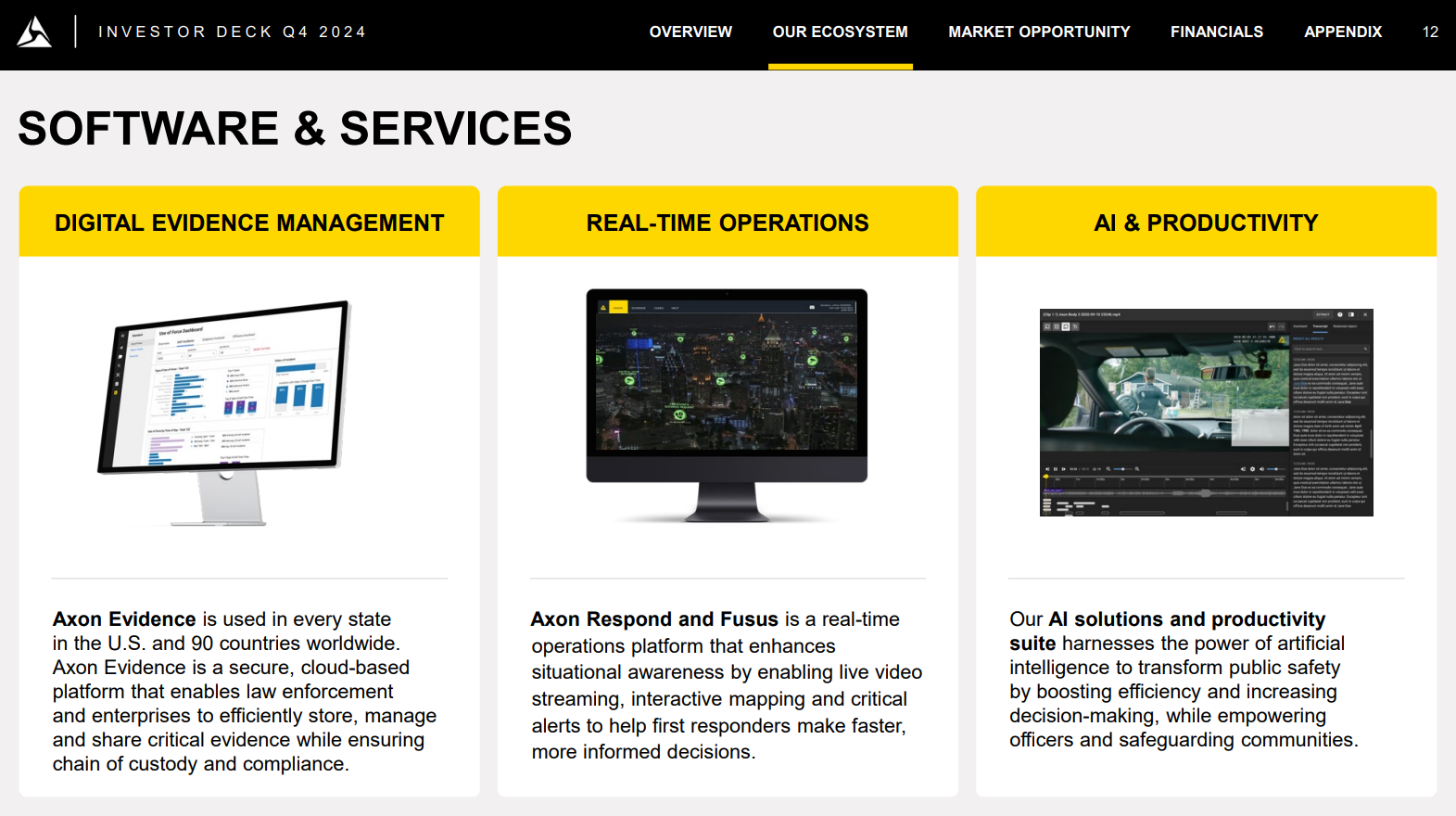
So when a wedge product like Prepared starts to own the front door of incident response, the system of record has a choice:
Let the wedge become the UI (and eventually the control point), or
Buy it and make it part of the platform narrative.
Axon chose option #2. The press release makes it explicit: Prepared strengthens Axon’s strategy to connect public safety “from call to closure.”
That phrase is doing a lot of work.
Because “call to closure” is another way of saying: “we’re the operating system.”
Here’s the deeper trend: every legacy SoR is panic buying the AI agent layer
This is where the Prepared/Axon deal stops being “public safety news” and becomes “software industry inevitability.”
The agent layer is becoming the new UI. And the new UI is where the power lives.
If you’re the system of record, that is terrifying.
So you’re watching systems of record across the enterprise do the same thing Axon just did:
They’re acquiring the wedge / agent companies so they control the front door.
1) Procore (construction SoR) → acquired Datagrid (agentic AI wedge)
This is the most on-the-nose comp to Axon/Prepared.
Procore is the construction management system of record for a massive chunk of the industry. Then they went out and bought Datagrid, explicitly positioning it as a way to eliminate data silos and automate workflows like submittals + RFIs across platforms (i.e., “initiate actions,” not just store data).
Procore even calls out the agentic angle: Datagrid adds “advanced reasoning,” “deep search,” and the ability to unify intelligence across third-party systems like ERP and cloud storage — classic “agent layer sits across your stack” behavior.
2) ServiceTitan (trades SoR) → acquiring Conduit Tech (AI-enabled field/sales wedge)
ServiceTitan is the system of record for home services ops (dispatch, CRM-ish workflows, invoicing, etc.). Conduit is a wedge closer to the field that makes it easier to scan a home (LiDAR), produce designs, and generate proposals fast—which directly impacts conversion and revenue per lead.
ServiceTitan’s framing is telling: they’re integrating Conduit into their suite of “AI automation products,” and they’re buying leverage at the moment value is created (assessment → proposal → close), not just the back office.
3) Guidewire (P&C insurance SoR) → acquiring ProNavigator (AI knowledge agent layer)
Guidewire is a core system of record in P&C insurance (policy, claims, underwriting workflows). They signed a deal to acquire ProNavigator, which is an AI-powered knowledge management platform that delivers “context-aware” best-practice answers inside the workflow.
That’s the wedge: not replacing the SoR, but becoming the thing users ask first while working in the SoR.
This is the same movie over and over:
A wedge product shows up and says: “We’ll take the messy unstructured inputs and do the work.”
Customers love it because it actually reduces labor.
The system of record realizes the wedge is becoming the interface.
The system of record buys the wedge.
Prepared just did that in a vertical where the outcome is measured in minutes and lives, not clicks and conversion rate.
Why the “SaaSpocalypse” narrative makes this intensify (not slow down)
The whole “SaaSpocalypse” thing gets memed to death, but the direction is right: buyers are tired of paying for software that just creates more work.
They want systems of action. They want “less labor.”
And that’s why the agent layer is so dangerous to the system of record. As NEA puts it, we’re shifting from “system of record” toward “system of actions,” where AI agents do more of the remaining labor-heavy workflow.
If that’s true (and it is), then the SoR can’t just integrate the agent layer.
It has to own it.
Otherwise, the SoR becomes a backend database with legacy switching costs… until the day the UI moves, users move, budgets move, and procurement follows.
The punchline for vSaaS builders
If you’re building in Vertical AI right now, the question isn’t “can I build an agent?”
The question is: can I wedge into the workflow early enough that I become strategically unavoidable to the system of record?
Prepared did that by taking the first 120 seconds — the moment when everything downstream gets shaped.
Axon did what big systems of record do: it bought the control point before someone else owned it.
And the rest of the Vertical SaaS market is following…
Vertical Software/AI Summit 2026 is going to be BIG
There are a few other folks out there throwing Vertical SaaS conferences. I think this is great, the more the merrier. It’s about time we had our time.
For those trying to pitch VC’s on Sand Hill Road from 2010-2017, and getting laughed out of the room in a pre-scale Toast, Service Titan world you can relate….
The only thing I’ll say is
A) We are the only conference by Vertical SaaS founders FOR Vertical SaaS founders
and
B) I’m going all out on this years conference and expecting 400-500 vSaaS founders + the entire investment community to be there.
I have ~5 unicorn founders + one billionare already confirmed to speak 🤯
It’s going to be epic. So tap the link below and be ready for an epic few days in Q4…
PS - I will give free tickets to a bunch of folks that opt in above :-))

Charge An Implementation Deposit
This one is stupid simple.
And it massively moved the needle for me at my last company.
Here’s the idea:
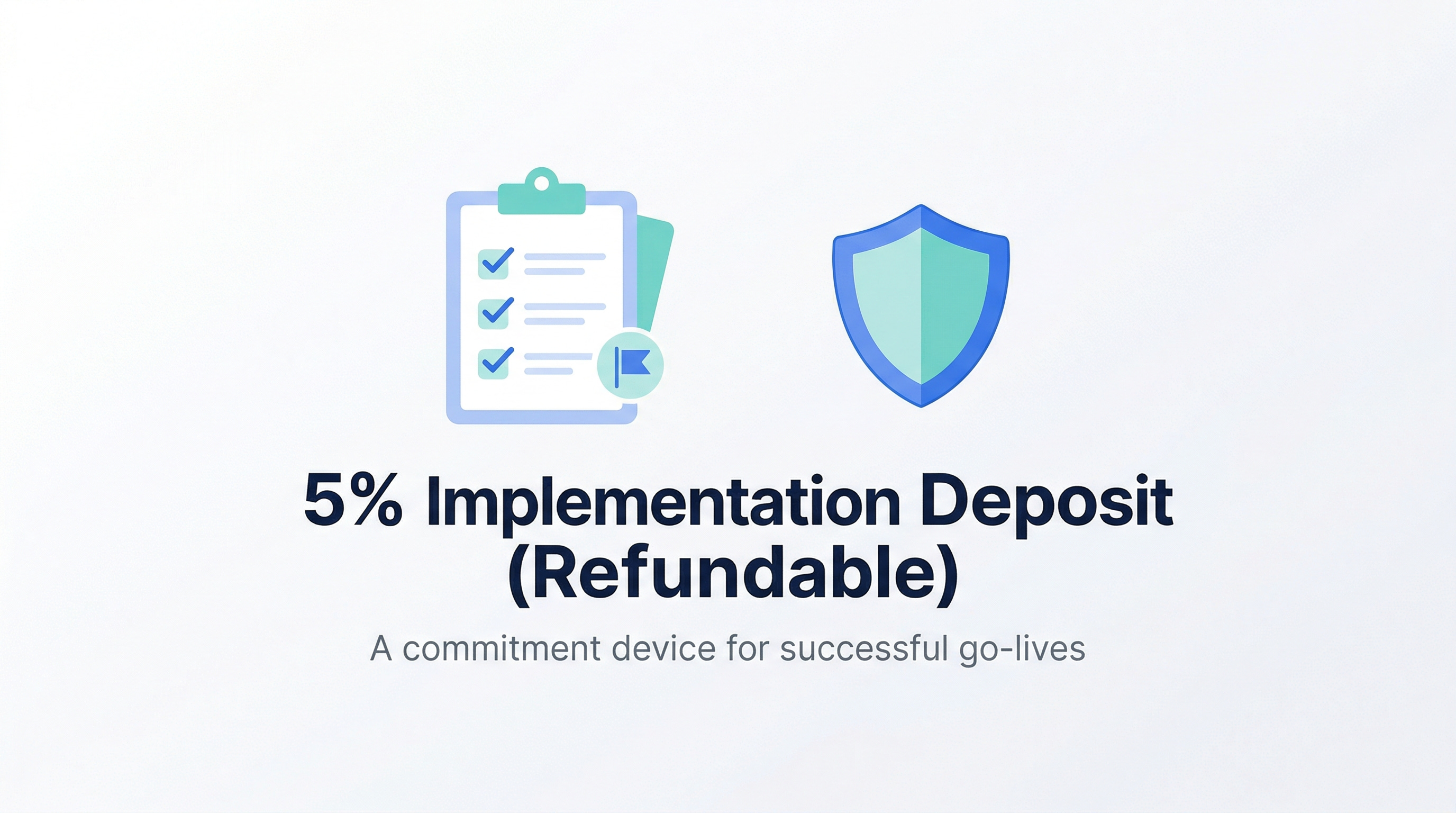
You charge a refundable implementation deposit equal to ~5% of the annual contract value.
You agree on a specific milestone that represents “real adoption.”
If the customer does what they said they’d do (give you data on time, show up to training, assign an internal champion, etc.), they get the deposit back.
And to be crystal clear: you should basically always give it back. This is not a revenue driver. This is a commitment device.
It’s you saying: “We’re going to implement you successfully. You’re going to participate.”
Why it works (and why it’s not just a money grab)
In vertical SaaS, implementations fail A LOT.
Especially with Mid-Market + Enterprise customers.
It’s typically not product, not integrations, not “edge cases.”
It fails because the customer doesn’t do their part.
They don’t get you the roster/export/file.
They don’t schedule training.
They don’t enforce the new software/AI.
They ghost… and then 90 days later you’re staring at a churn risk that was created on Day 7.
The deposit fixes the psychology.
The moment a customer has real money on the line (even a small amount relative to the contract), implementation stops being “that thing we’ll get to” and becomes “a project we need to finish.”
And that changes everything.
The exact structure I like
Deposit amount: 5% of annual contract value.
Collected: upfront, at signature (or before kickoff).
Refund mechanism: refund it when the customer hits the agreed milestone.
Important nuance: the refund can be a literal refund or a credit on the next invoice—depending on how your billing/procurement reality works. But make it clean and explicit.
And again: you are not trying to “catch” customers and keep their money.
You are trying to create a forcing function that makes adoption inevitable.
Pick a milestone that signals “you’re live,” not “we had meetings”
If your milestone is “first kickoff call completed,” congrats, you’ve invented a useless deposit.
You want a milestone that requires customer behavior.
A few examples that work well:
Milestone option A (best for workflow products):
Customer is live with X users and completes Y workflows in production (not sandbox) over a 2-week period.
Milestone option B (best for data-heavy products):
Data import complete + training complete + first “real” report/transaction submitted from the system.
Milestone option C (best for multi-site / enterprise):
First site live with adoption KPI met (then you expand to the rest).
Notice the pattern: the milestone is observable, and ideally quantitative, not vibes.
The customer commitments need to be written down
This is the part people skip.
If you’re going to ask for a deposit tied to a milestone, you need the customer to agree to what they will do.
I’d define “Customer Responsibilities” in plain English, like:
Name an executive sponsor and an internal project owner
Provide required data by a specific date
Ensure attendance at training (with names listed)
Confirm internal rollout date
Respond to implementation questions within X business days
Agree to a real definition of what success looks like!
If they don’t do those things, implementation doesn’t move.
That’s not you being annoying. That’s reality.
What changed for me when we did this
The most surprising impact wasn’t cash flow (again, you give it back).
The impact was operational:
Implementations stopped dragging forever
Customers showed up prepared
“We’re too busy” became “we’ll get it to you by Thursday”
Internal champions suddenly had teeth because they could say, “We already paid the deposit—let’s finish this.”
It also quietly improved retention, because successful implementations are the first domino in long-term customer health.
If you’ve ever watched a customer churn 6 months in and thought, “Yeah… this was doomed from the beginning,” you know exactly what I’m talking about.
How to position it so customers don’t freak out
Call it what it is:
A refundable implementation deposit that ensures both sides are committed to a successful launch.
Here’s the script:
“We charge a 5% implementation deposit upfront. It’s fully refundable once we hit the go-live milestone we agree on together. The reason we do this is simple: implementations only work when both sides prioritize the project. This keeps us aligned, and it keeps your team from losing momentum.”
If you say it calmly, like it’s standard (because it should be), serious buyers respect it.
And if someone loses their mind over it? That’s usually a signal you were about to get a slow, painful, low-adoption customer anyway.
The two common pitfalls
Pitfall #1: treating it like revenue.
Don’t. If your team starts celebrating kept deposits, you’ve turned a customer-success mechanism into a weird punishment system. You’ll lose trust fast.
Pitfall #2: picking the wrong milestone.
If the milestone is too easy, it won’t drive behavior. If it’s too hard or too subjective, procurement will block it and customers will argue.
Make it measurable. Make it fair. Make it tied to adoption.
One tactical detail (that saves headaches): keep the refund process automatic
If the customer earns the refund and then has to chase you for 6 weeks, you just created unnecessary resentment.
Operationalize it:
When milestone is achieved → implementation lead marks complete → finance triggers refund/credit within X days.
Make it boring.
Make it consistent.
Charging an implementation deposit is one of those operator moves that doesn’t show up in product screenshots, but changes the trajectory of accounts.
And if you can make launches predictable, everything downstream gets easier: retention, expansion, referrals, your team’s sanity.
Have a product or service that would be great for our audience of vertical SaaS founders/operators/investors? Reply to this email or shoot us a note at ls@lukesophinos.com