

The New Vertical Software Era → Storage vs. Action
Dave Pandullo and Scott Hoke of AQL Growth join Verticals to unpack why the next wave of vertical software isn’t about storing data — it’s about deciding what happens next and doing it.
Remember folks, the full recording is over on YouTube. Check it out there, and do us a favor if you can and subscribe while you’re there :-) Would mean a ton to us!

Meet The Guests
Dave Pandullo and Scott Hoke have spent the better part of their careers doing one thing: partnering with founders who are building core software systems for niche industries. Both are general partners at Frontier Growth, a growth equity firm that’s been around since 1999 and has been investing in vertical software since 2007 — back when most investors thought vertical markets were too small to matter.
Their first vertical SaaS bet was a company called Vaxco, a club management platform for YMCAs and JCCs. At the time, they thought the market was tiny and got out a little too soon. That business went on to become a dominant platform in broader sports and recreation, growing north of $250–300 million in ARR. It was a lesson in the power of niche dominance — and one that shaped everything that came after.
Now, as part of a planned succession from Frontier’s founders, Dave, Scott, and another partner are launching a new firm: AQL Growth. The name comes from Aquila — Latin for eagle — a nod to the sharp vision and intense focus that defines their investment strategy. AQL is exclusively focused on growth-stage vertical software and vertical AI: companies that have established product-market fit, typically at $2–3M+ ARR, and are ready to accelerate into category leadership.
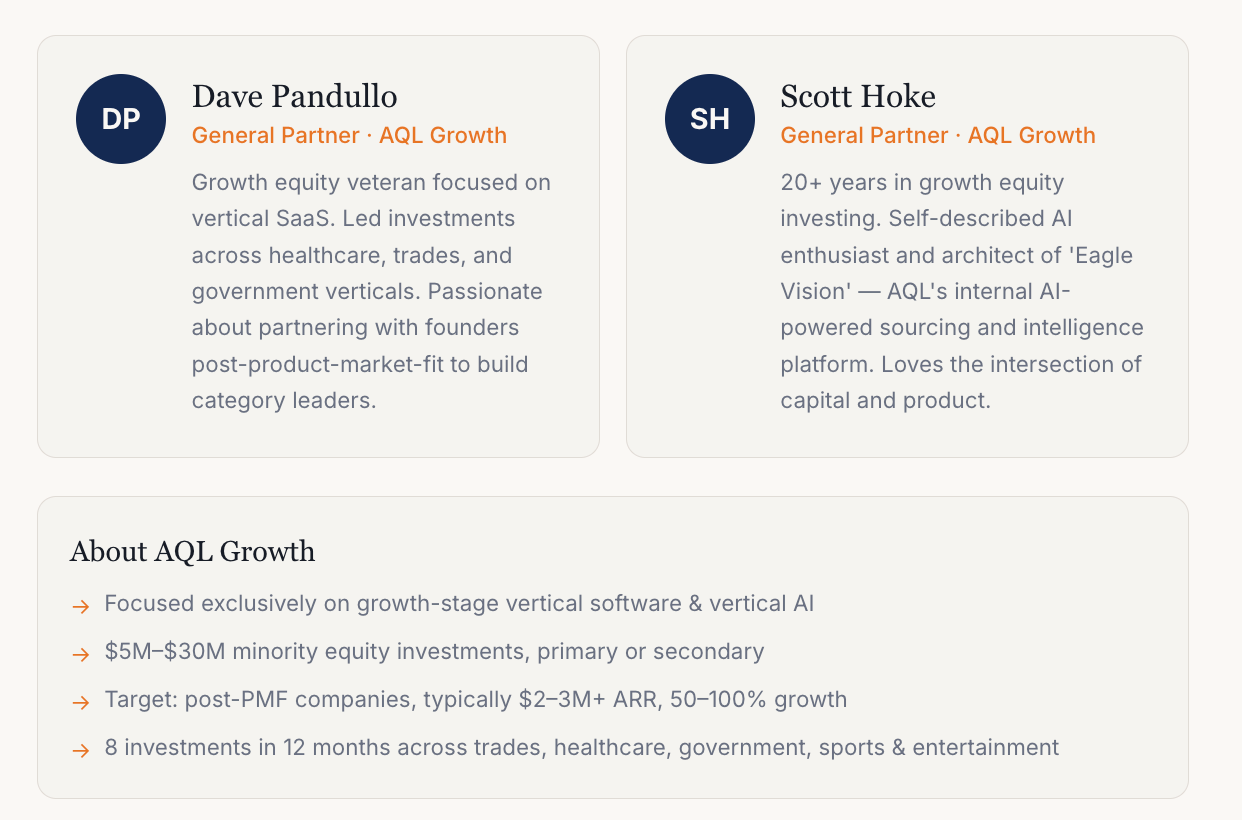
Scott, who’s been a growth equity investor for over 20 years, described the work with characteristic enthusiasm: “We get to sit on the ground floor and help companies with capital and expertise to see whole companies and all the employees just enjoy growing.” His background is in investment banking and finance, but it’s clear his passion lives at the intersection of building and investing.
For founders evaluating AQL as a partner, the key details are straightforward: they write $5M–$30M equity checks, primarily in primary capital but with flexibility for secondary components (cap table cleanup, founder liquidity). They’re minority investors only — they don’t acquire, they partner. Most of their portfolio companies are growing 50–100% at the time of investment, and over the past 12 months they’ve done eight investments spanning the trades, sports and entertainment, state and local government, and outpatient healthcare.

The New Vertical Software Era → Storage vs. Action
The phrase “system of record” has been the north star of vertical SaaS for nearly two decades. The pitch was simple: become the place where a business stores its most critical data, and you become impossible to rip out. Switching costs were your moat. The data was sticky because moving it was painful.
That logic is cracking. As Nic pointed out during the conversation, the transportability of data is now trivial. He shared a personal example: he recently switched an internal system of record by having AI harmonize and migrate all the data for him. Easy. If the switching cost was your primary moat, you’re in trouble.
“A system of record stores what happened.
A system of action decides what happens next — and then does it.”— Scott Hoke, GP, AQL Growth
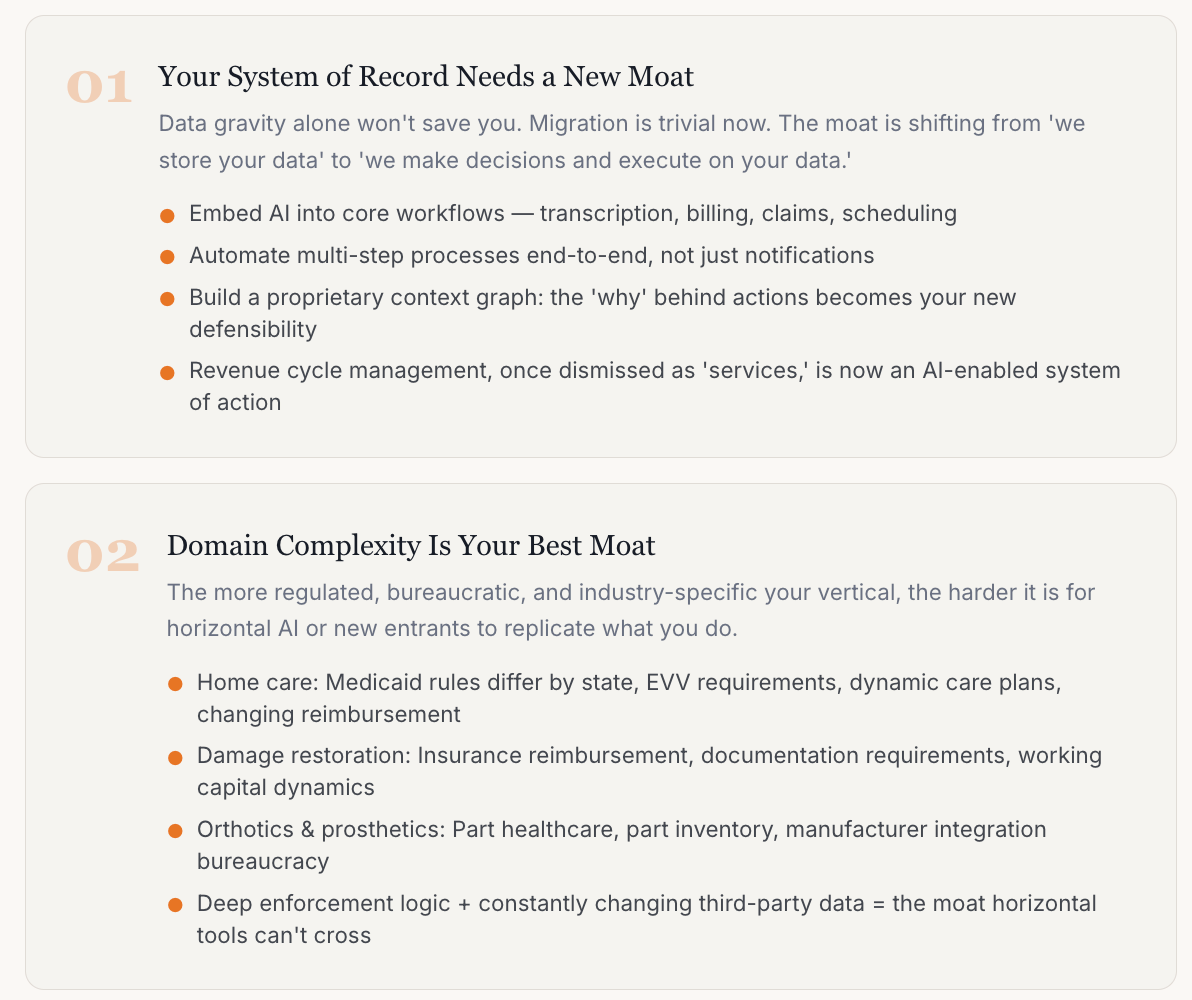
Dave and Scott’s thesis at AQL centers on what comes after the system of record: systems of action. Where a system of record captures data, a system of action governs the workflows where decisions are made and finalized — where work is dispatched, claims are submitted, revenue is recognized, and compliance is enforced. It’s where the actual jobs to be done for a business happen, increasingly with AI enabling those activities autonomously or with a human in the loop.
Luke drew a useful historical parallel. When he was running his company, they built an industry-specific BI tool with a notification engine behind it — sending texts or emails when metrics trended the wrong direction. That was pre-AI systems of action: it could only do one thing. What’s happening now is fundamentally different. AI can execute multi-step processes: create the invoice, send the invoice, run a five-step follow-up cadence to get payment, and reconcile back to the general ledger. That’s not a notification — that’s transformative automation.
The group landed on an important nuance: the system of record isn’t dead, but it needs a new source of defensibility. Nic framed it as a new layer of data that didn’t exist before — what some are calling the “context graph” or “decision layer.” It’s not just what happened, but why it happened. Why did a deal move from one stage to another? Why did you reach out to this contact instead of that one? That proprietary context, accumulated over thousands of decisions within a vertical workflow, becomes the new switching cost.
“CRM data — all my stuff is in there — that was why it was so sticky. But the new modes are closer to the workflow. The actions being taken and the data created as a result — that combination is sticky, and the basis by which you train models to take the next step.”
— Scott Hoke, GP, AQL Growth

Today’s episode is brought to you by Parafin - the leading embedded capital partner.
4.8 star rating on Trustpilot, with over 500 reviews [source]
71% CSAT rating across all partners
84 NPS
Serving top Fortune 500 companies, including Amazon, Walmart, and DoorDash.
Healthcare: A Living Laboratory
Much of AQL’s portfolio sits in outpatient healthcare — the world outside of hospitals and health systems where Epic dominates. They’ve invested in practice management platforms across allied health (chiropractic, acupuncture, mental health), veterinary, durable medical equipment, and home care. Across all of these settings, they’ve seen a proliferation of AI transcription and scribe tools. Their belief is that the practice management system is uniquely positioned to embed those capabilities rather than lose them to standalone point solutions.
But what excited Dave and Scott more than transcription was the opportunity in revenue cycle management — claims processing, billing, denials management. Historically, RCM was a services business that software investors viewed skeptically. You wanted pure SaaS, not services. But in the age of AI, Dave argued, the calculus has changed: “We’re big believers in delivering more value to the customer, automating things that are painful for them, and letting them focus on what they do best — which in healthcare is practicing.”
They pointed to Access Care, their investment in the non-medical home care space, as a case study in domain complexity creating defensibility. Access Care coordinates caregivers who deliver services to elderly or disabled people in the home. Those services are reimbursed by Medicaid, which operates differently in every state. Every visit has to be governed by care plans, authorization caps, licensing requirements, overtime rules, and electronic visit verification to prevent fraud. Reimbursement rules are constantly changing. This isn’t a simple scheduling problem — it’s a deeply complex enforcement equation where new data is constantly flowing from caregivers, coordinators, and third-party sources. That complexity is the moat.
Is the System of Record Actually Safe?
Luke played devil’s advocate with a question that’s been circulating in the ecosystem: there’s a lot of posts going around saying “SaaS is dead, but if you’re the system of record, you’re safe.” Based on the thread the group had just pulled — that agents can extract data, create digital twins, and trivialize migration — is the system of record actually safe?
Dave was direct: “I don’t necessarily agree that under every circumstance, the system of record is safe. Vertical-specific CRMs are definitely at risk.” But he drew a sharp distinction between shallow systems of record (essentially searchable databases) and deep, domain-complex platforms where the system of record is embedded in regulatory workflows, multi-party data flows, and industry-specific compliance.
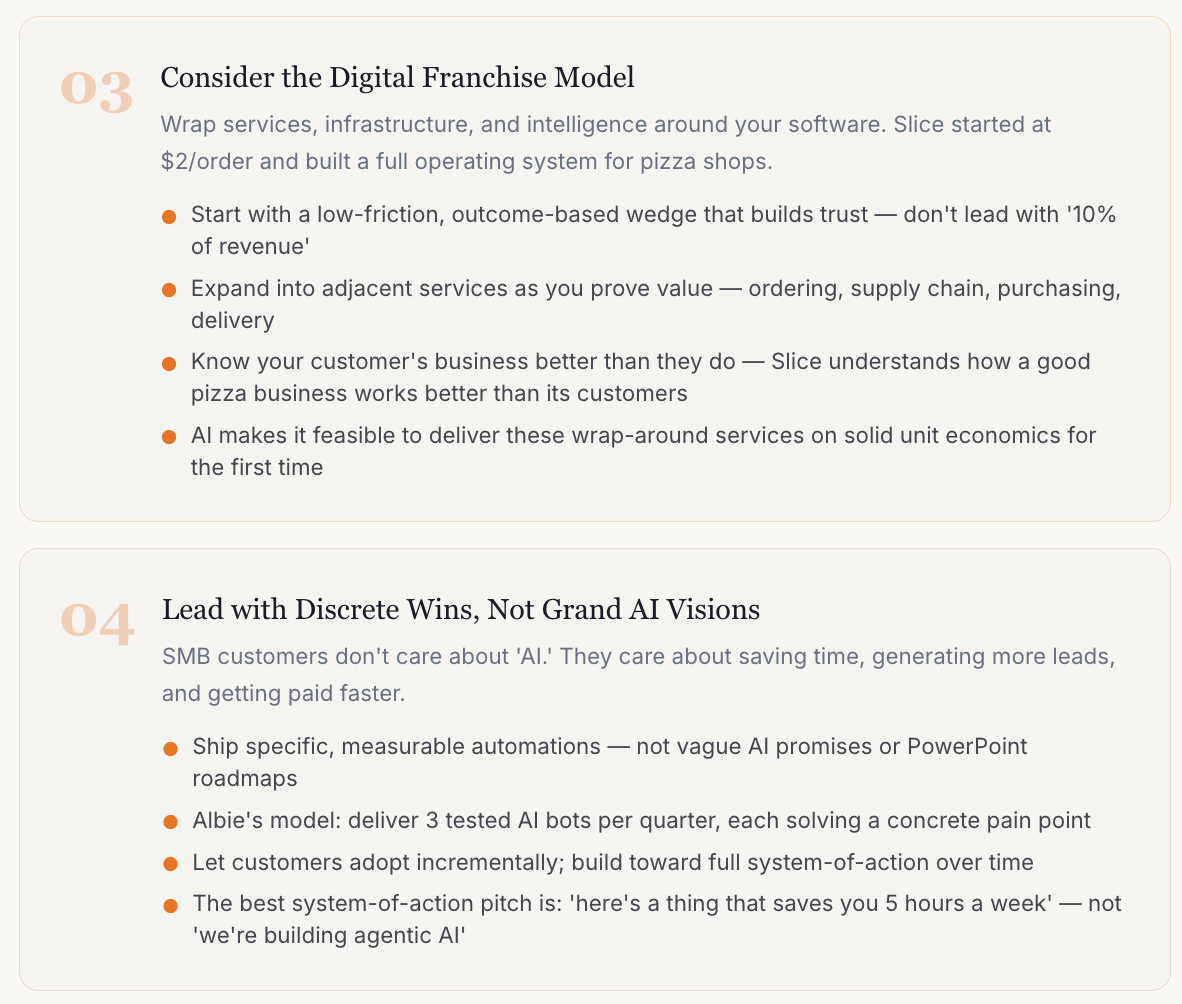
The Slice example resonated deeply with the group. Luke brought up Aleer at Slice — who they featured in their first Verticals episode — as someone who got this right before everyone else. Aleer took what everyone assumed was already commoditized (the POS for pizza shops) and wrapped moat after moat around it: services, ordering, supplies, and now actual delivery infrastructure with vans. He built a “digital franchise” — understanding every aspect of his customer’s business better than the customers themselves.
“Domain knowledge is built into the workflow, into the platform, and that is really hard to replicate.”
— Scott Hoke, GP, AQL Growth
The group debated why more founders aren’t pursuing the “franchise in a box” model. Scott attributed it to maturity — the AI revolution is still too young, and most operators running fragmented SMB verticals are focused on running their businesses, not building software with agentic AI at the forefront. Dave added that prioritization plays a role: even in this new wave of entrants, founders are still focused on delighting customers with their core value prop. He pointed to a portfolio company in orthotics and prosthetics that’s just now launching automated purchasing integration with manufacturers — the bureaucracy and logistics required to deliver that end-to-end are staggering.
Nic offered perhaps the most practical insight: Slice didn’t start as a franchise-in-a-box. It started at $2 per order — a low-friction wedge that built trust. The “10% of your revenue” conversation is intimidating; the “$2 per order” conversation is not. That wedge strategy, especially in SMB industries where customers don’t know or care about AI, might be the most powerful starting point for founders who want to eventually wrap their software around entire businesses.
Eagle Vision: How AQL Built Their Own System of Action
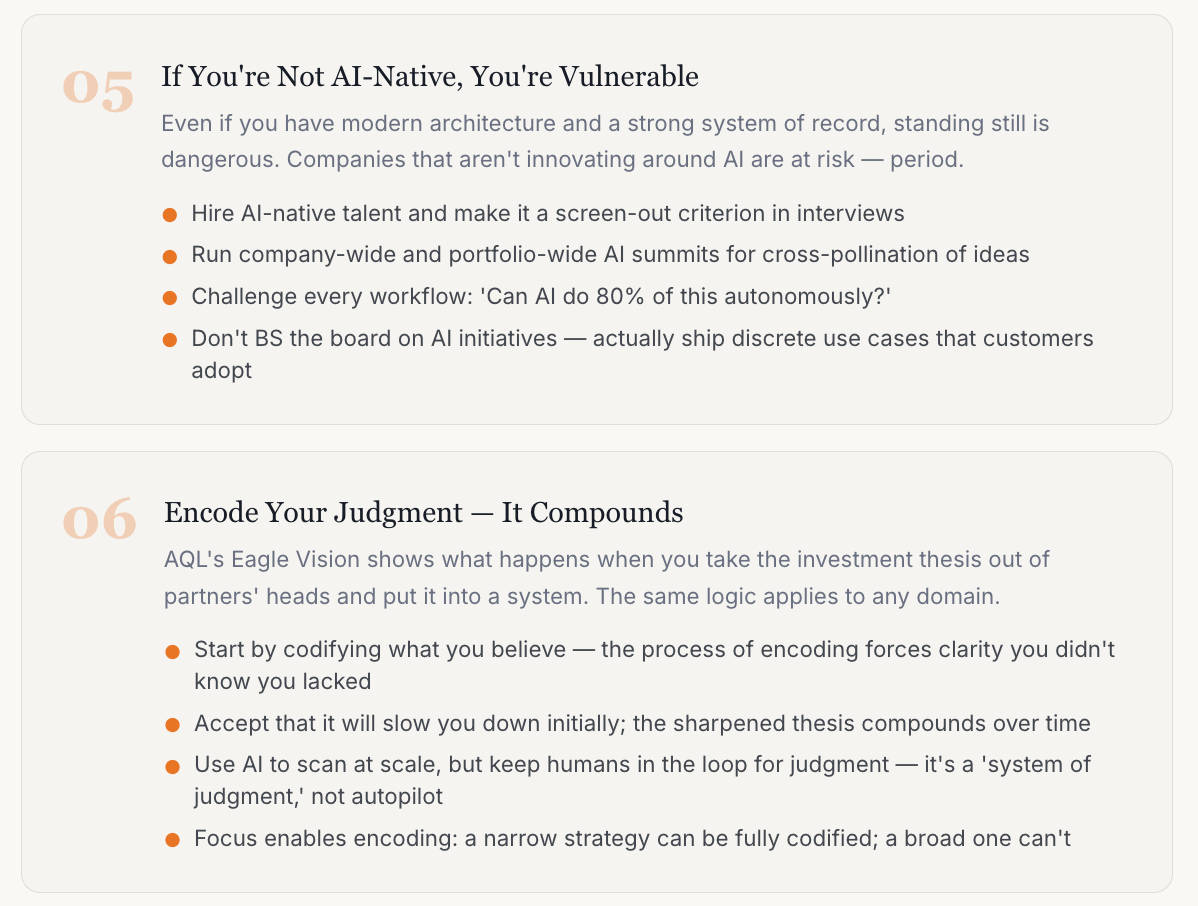
One of the most compelling parts of the conversation was Scott’s candid walkthrough of Eagle Vision — the internal AI platform AQL has built to transform how they source and evaluate investments. It’s a powerful case study of practicing what you preach.
It started, as Scott tells it, with a humbling realization. A couple of years ago, he began experimenting with AI for deal sourcing: “I tried to say, is this company a good target for our investment thesis? And the response was just... it completely whiffed.” The outputs were garbage because they weren’t being specific enough about what they actually believed. That failure sparked something important — it forced AQL to sharpen their thesis to a degree they never had before.
The journey began with a CRM audit. AQL started thinking of themselves as a product company — capital is increasingly commoditized; it’s a product. So who is their ICP? How many targets exist? How should they be ranked? When they dug into their CRM (HubSpot), they found what Scott diplomatically called “a filing cabinet with the wrong information in it.” Companies were mislabeled. Great targets had been passed on because someone in a hallway said “we don’t like marketing automation” or “construction tech is too cyclical” — tribal knowledge misapplied at scale.
“I called Dave and said: I just scanned 25,000 software companies with AI according to our thesis. Our TAM is 6,500 vertical software companies fitting our strategy.”
— Scott Hoke, GP, AQL Growth
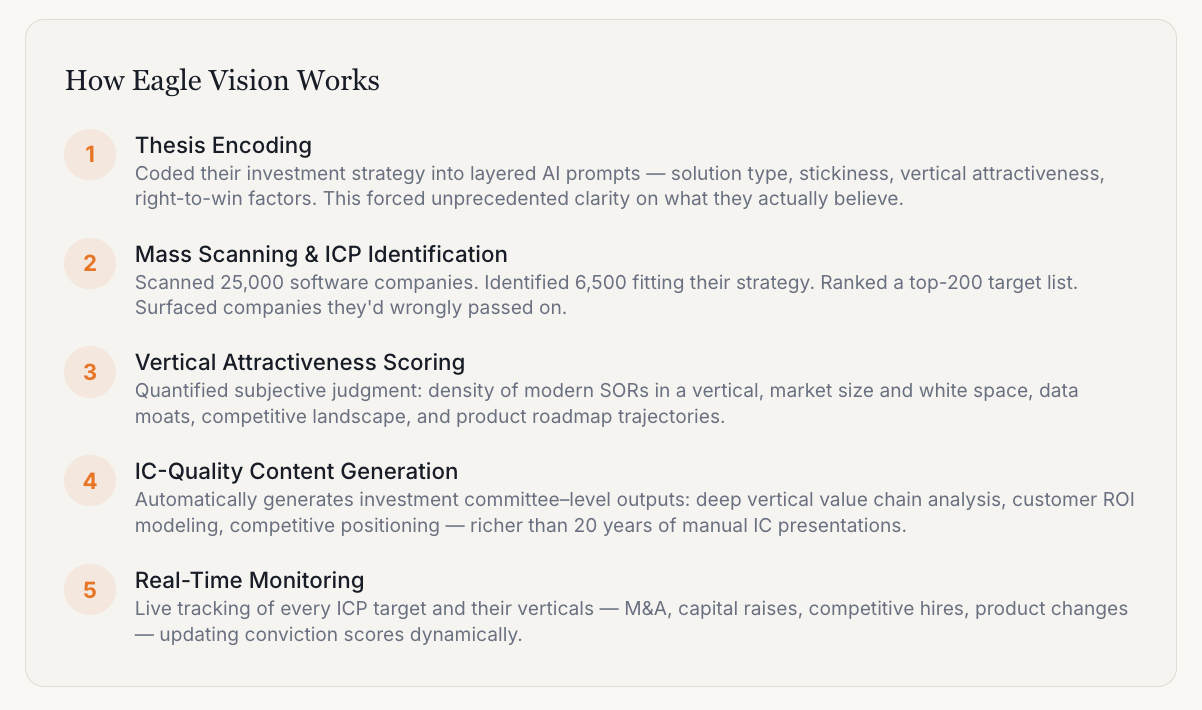
Dave emphasized a crucial point: Eagle Vision wouldn’t have been possible without a laser-focused strategy. If AQL invested across dozens of sectors and stages, the permutations of prompts would have been infinitely more complex. Their narrow focus on vertical software made it feasible to encode their judgment comprehensively. “It flipped the whole model on its head,” Dave said. “Old-school growth equity had analysts screening manually, cold-calling at the top of funnel. Now we’re getting partners on planes before we’ve even had a conversation.”
Scott was refreshingly honest about the process: “This didn’t speed us up initially. It slowed us down. It forced us to get sharper on our thesis, to look at the outputs and analyze how accurate they were.” They used multiple AI models for different purposes — some for web research, others for content creation — and finding the right combination was trial and error. The tech stack includes coding tools like Cursor, platforms like Lovable and Supabase, Clay for data enrichment, and HubSpot as the CRM backbone.
Case Study — Albie
Eagle Vision identified Albie, a business management platform for damage restoration providers (a subset of the trades where ServiceTitan’s ecosystem stops). The company scored highly across AQL’s thesis dimensions despite non-standard retention metrics that other investors flagged. When AQL dug deeper, they found the retention issue was driven by ICP cohort segmentation — the core customer base had incredible retention and customer love. AQL moved fast, shared deep vertical knowledge with founder Alex Duda, and won the deal. Retention has “dramatically changed” in the nine months since investment.
Albie itself is becoming a system of action in restoration. At a recent board meeting, the entire discussion centered on how they’re delivering discrete AI use cases — specific bots, each solving a concrete pain point — rather than talking about AI at a high level. As Dave explained: “Individuals that run businesses in that industry don’t want you to talk high level. They want you to solve a pain point for them.” Albie is shipping three tested AI bots per quarter, with a vision of progressively automating back-office and even field operations so restoration businesses can focus on generating leads and getting paid faster.
Eating Your Own Cooking
One theme that ran through the entire conversation was the importance of walking the walk. Dave referenced Kyle Norton’s talk at the Vertical Software Summit: if you’re not AI-native and you’re not hiring AI-native talent, there’s a big problem. AQL took that to heart, hosting a portfolio CEO summit entirely focused on AI initiatives, which sparked cross-portfolio collaboration and idea pollination.
“AI didn’t make us lazier. People that are truly hungry and curious — it makes you busier. The art of the possible has my mind racing.”
— Scott Hoke, GP, AQL Growth
Scott’s closing advice was personal and energizing: “Take a day or two — a sabbatical — and dive into these tools. Ask questions. You’ll go on a journey. If you’re inquisitive, hungry, and humble, this is the era for you.” It’s advice that clearly comes from someone who has lived it. Dave called Scott “definitely AI-native” — and Scott’s response revealed the quiet joy of someone who’s genuinely excited by what they’re learning: “I’m like going back to school for the first time.”
The conversation closed with a rapid-fire section that revealed some telling details. When asked about his favorite AI wedge product, Dave pointed to Clay — not vertical, but incredibly powerful for ICP data enrichment, and something they’re actively showing to portfolio companies. When asked about the biggest remaining data gap, Scott landed on private company revenue data. The old proxy of employee headcount-to-revenue ratios is “completely bunk now” in the AI era: a company with four employees could theoretically have hundreds of millions in revenue. If someone could create a reliable source of private company revenue data, Scott argued, it would be enormously valuable.
Key Takeaways for Founders
Distilled from the conversation — actionable insights for vertical software builders navigating the AI transition.
Have a product or service that would be great for our audience of vertical SaaS founders/operators/investors? Reply to this email or shoot us a note at ls@lukesophinos.com