

Today’s newsletter is sponsored by Xplor Pay.

More than a traditional processor, Xplor Pay was built by vertical SaaS operators who understand what it takes to launch, support, and scale embedded payments. In their latest guide, What to Look for in a Payments Partner, they share practical lessons SaaS founders should use when evaluating payments, from production-like testing and portfolio visibility to proactive support and go-to-market alignment.
Alright, let’s get to it…
While everyone’s been watching Harvey AI gobble up law firms, a new player just emerged from stealth to attack the $30 billion in-house legal market. Sandstone, a Brooklyn-based AI platform for corporate legal departments, announced a $10M seed round led by Sequoia Capital this week.
And here’s the thing—the founders backgrounds are uniquely positioned to do well here.
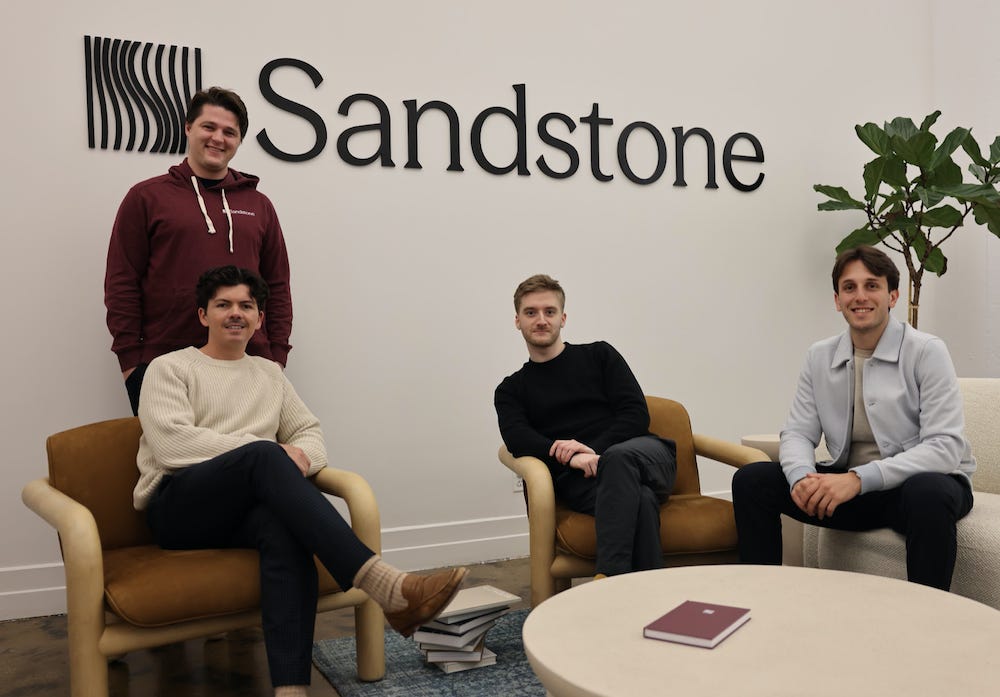
The Founding Story
Nick Fleisher and Jarryd Strydom aren’t your typical vSaaS founders. Fleisher spent years at McKinsey as a legal tech consultant, serving general counsels and mid-market in-house teams. He made engagement manager in just 18 months by “hacking the system”—specializing early in legal tech rather than following the traditional time-based path.
Strydom brings the operator perspective as a former in-house attorney who lived the pain firsthand.
The founding insight? They watched law firms adopt AI tools left and right, but in-house legal teams were still drowning in manual work, fragmented systems, and ad hoc workflows. Every legal request came through a different channel—Slack, email, Salesforce, you name it. No centralized process. No institutional memory. Just chaos.
As Fleisher told the press: “In-house teams don’t really have a way to manage their work.”
That’s the wedge.
The Product: An AI-Native Workflow Engine
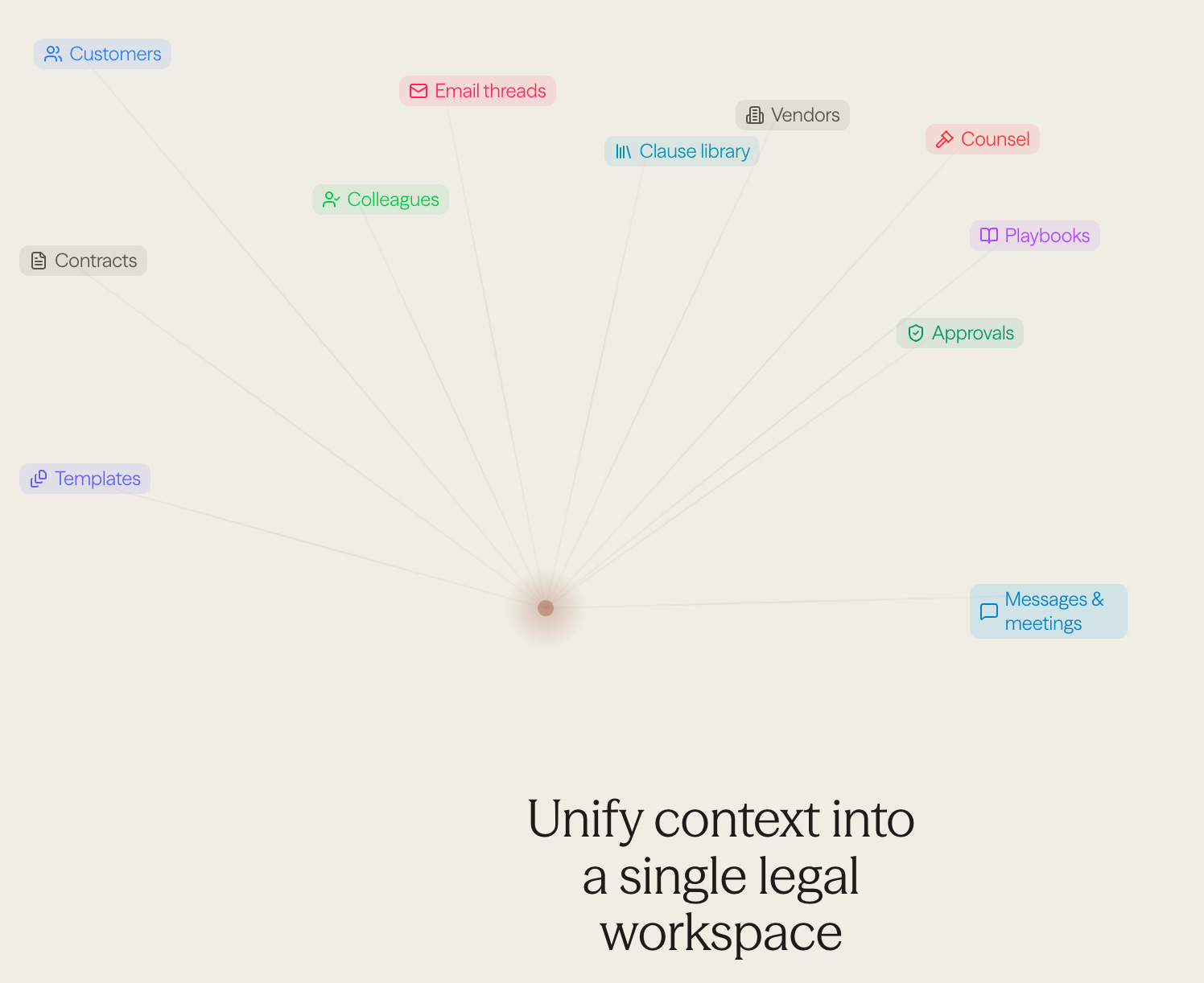
Sandstone isn’t just another chatbot for lawyers. It’s a workflow platform that learns from a company’s institutional legal knowledge to execute work and simplify business operations.
Think of it as the orchestration system for in-house legal.
The platform plugs into 30+ existing systems—Slack, Salesforce, Gmail, Jira, HubSpot, NetDocuments—and meets legal teams where they already work. It centralizes legal requests, automates matter management, handles contract redlining, and builds playbooks based on historical decisions.
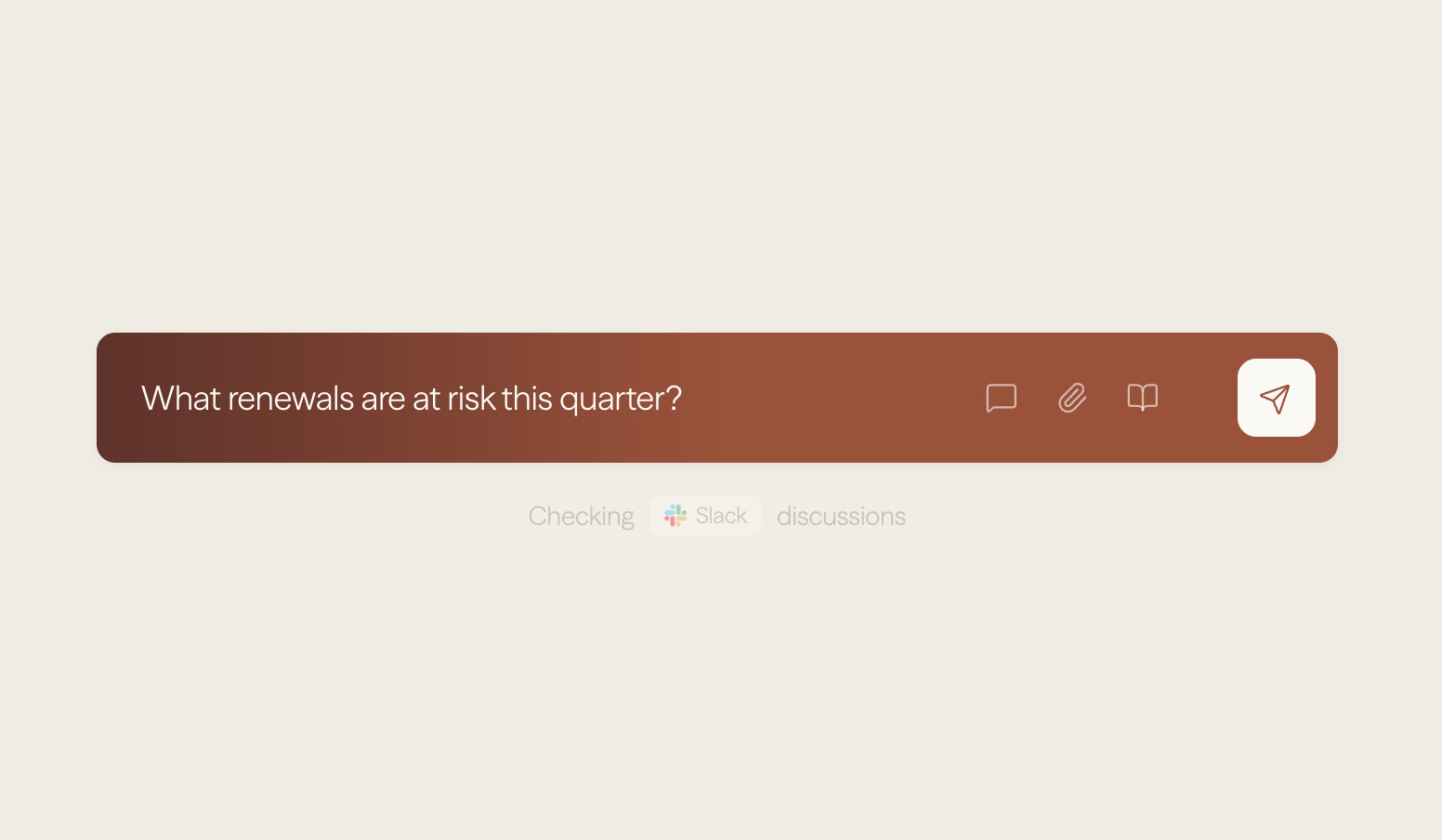
The AI doesn’t just suggest edits. It learns how your legal team has handled similar contracts in the past and operationalizes that knowledge into repeatable workflows.
How It’s Different Than GC AI
Now, some of you are thinking: “Wait, doesn’t GC AI do this?”
GC AI—which raised $60M at a $550M valuation last year—is crushing it as an AI copilot for in-house lawyers. It helps with research, document review, contract drafting, and analysis. It’s fantastic at giving lawyers superpowers for individual legal tasks.
But Sandstone is attacking a different problem: workflow orchestration.
GC AI is your AI associate. Sandstone is your legal operations platform. GC AI helps you draft better contracts faster. Sandstone ensures your entire legal department operates like a well-oiled machine—capturing every request, standardizing processes, and building organizational memory.
They’re complementary plays in the same massive market. And there’s room for both, well, at least for now. I’m sure they will start to compete but looks like they are attacking slightly different problems currently.
Why In-House Legal Is Heating Up Right Now
The in-house legal market is a $30B global opportunity that’s growing faster than law firms. Here’s why:
1. Cost Pressures: Companies are bringing more legal work in-house to save money. Outside counsel is expensive.
2. Complexity Explosion: Every company is now multi-jurisdictional, dealing with data privacy, IP, compliance, contracts, employment law—the list goes on.
3. Staffing Constraints: In-house teams are chronically understaffed. The average legal department is 4-5 people managing hundreds of legal matters.
4. AI Timing: LLMs finally make it possible to capture institutional knowledge and automate legal workflows at scale.
When I was building CourseKey, our tiny in-house legal team (really just one person wearing multiple hats) was constantly underwater with contract negotiations, vendor agreements, compliance reviews, and customer requests. We would have killed for something like Sandstone. Sales folks would get stuck waiting. Deals would slip, we’d miss some quarters because of this…
The Question That Matters
Can Sandstone move upmarket from mid-market legal teams to enterprise departments at Fortune 500 companies? Or will they stay focused on the underserved mid-market where they can own the category?
The mid-market play might actually be the smarter bet. Less competition from incumbents, faster sales cycles, and a massive TAM of companies desperate for legal workflow automation.
What do you think? Is in-house legal the next massive vSaaS category? I think it is a much better play than than serving law firms directly.

How to Throw Your First Customer Conference (And Why You Should Do It This Year)
Let me tell you something I got completely wrong when I was building CourseKey.
I thought customer conferences were not worth the investment.
I thought: “Why would we spend two days in a hotel ballroom and spend six figures talking about our product? Would folks actually get on a plane and come out for it?”
I couldn’t have been more wrong.
Customer conferences are one of the highest-ROI investments you can make in vSaaS business. Not because of training or best practices (though that’s nice). But because they build attitudinal loyalty, not just behavioral loyalty. And when you are multi-product they drive MASSIVE cross-sell / up-sell. I experienced it, and EVERY vSaaS founder I’ve ever talked to that has done one has said the EXACT same thing.
Every. Single. One.
Here’s your playbook…
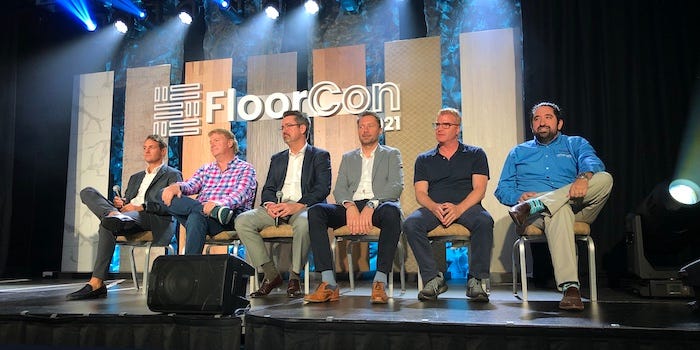
When to Host Your First Customer Conference
The answer is earlier than you think: as soon as you hit 50 customers.
I know that sounds crazy. But hear me out.
You don’t need a Dreamforce-scale production. You can start with 50-100 people, a single day event, and a modest budget. The point isn’t to impress with scale—it’s to create community.
The 4 Real Reasons to Host a Customer Conference
1. Build Community (This Is The Big One)
When your customers meet each other, magic happens. They realize they’re not alone in betting their careers on your product. They share war stories, swap tips, and form genuine relationships.
You’re no longer just a vendor. You’re the platform that connects them to their peers.
This is attitudinal loyalty—they stay with you not just because switching is hard, but because they genuinely believe in what you’re building.
2. Let Your Customers Sell Your Prospects
Invite 20-30 qualified prospects to your conference. Let them sit in sessions where your customers present case studies. Let them have dinner with your superfans.
Your customers will do the selling for you—and they’re 10x more credible than your sales team.
When a procurement director from a competitor company hears your customer explain how they cut invoice processing time by 70%, that’s worth more than a hundred cold emails.
3. Face-to-Face Meetings Build 100x the Relationship
Yes, you can close six-figure deals on Zoom. But you can’t build deep relationships remotely.
One dinner, one hallway conversation, one coffee break—these create bonds that last years. Bonds that protect you when a competitor comes sniffing around with a lower price.
4. Say Thank You (And Have Fun Together)
Your customers made a bet on you. They put their reputation on the line to bring your product into their organization.
The conference is your chance to say thank you. Put them on stage. Make them heroes in front of their peers. Show them they made the right choice.
Your First Conference Playbook: The Practical Steps
Step 1: Set a Clear Goal
Don’t try to do everything. Pick two-three primary objectives:
Build community among existing customers?
Generate pipeline from prospects?
Launch a new product?
Celebrate milestones?
For your first conference, I’d go with: build community and generate top-of-funnel.
Step 2: Start Small and Focused
Size: 50-100 attendees (mix of customers and prospects)
Duration: 1 day (or even a half-day with dinner)
Location: Major city where you have customer concentration
Budget: $50K for your first one
You’re not trying to compete with Dreamforce. You’re creating an intimate gathering.
Step 3: Build the Right Agenda
Here’s a sample one-day structure:
Morning (9am-12pm):
Welcome & Company Update (30 min) - Your CEO sharing vision
Customer Panel (60 min) - 3-4 customers sharing their success stories
Product Roadmap Session (45 min) - What’s coming next (and take feedback)
Lunch (12pm-1:30pm):
Catered lunch with assigned seating that mixes customers, prospects, and your team
Afternoon (1:30pm-5pm):
Breakout Sessions (90 min) - 3-4 parallel tracks on specific use cases
Industry Roundtables (60 min) - Peer discussion groups by vertical or company size
Closing Keynote (30 min) - Inspirational speaker or customer award
Evening (6pm-9pm):
Cocktail reception and dinner - This is where the real magic happens
The key: Make customers the stars. They should be speaking in 60% of the sessions.
Step 4: Nail the Invitations and Marketing
Start inviting customers 8-10 weeks out. Here’s the approach:
Have invitations come from their CSM personally, not a marketing blast
Offer to cover travel for your top 10 customers
Create a simple, beautiful landing page with the agenda
Send 3-4 reminder emails with speaker announcements and sneak peeks
For prospects: Position it as an exclusive industry gathering, not a sales pitch
Find a bad-ass key note presenter. Give value to your customers beyond just your company. Todd at Broadlume crushed this, he made his event the only FUN conference in his entire industry. It was their superbowl…
Aim for 30-40% attendance rate from invited customers.
Step 5: Execute Flawlessly (Even on a Budget)
You don’t need a huge production, but you need to nail the basics:
Venue: Hotel or conference center with good AV and comfortable seating
Catering: Don’t cheap out on food. Good meals = good conversations
Swag: One high-quality item > five cheap items. Think: nice backpack, premium hoodie, or leather notebook
Tech: Reliable wifi, working mics, and someone to troubleshoot AV issues
Team presence: Every executive and most of your team should attend
Step 6: Create Content That Lives On
Record all sessions (with permission)
Take tons of photos
Create highlight reels for social media
Write up customer quotes and case studies
Send a post-event survey within 48 hours
This content will fuel your marketing for the next year.
The Mistakes I Made (So You Don’t Have To)
When we finally did our first customer event at CourseKey, we made these mistakes:
Mistake #1: Waiting Too Long We waited until we had 300+ customers. We should have done it at 50. The early adopters wanted to connect years before we gave them the chance.
Mistake #2: Making It Too Product-Focused We spent too much time talking about features and not enough time facilitating customer connections. People don’t remember your product demo. They remember the conversations they had.
Mistake #3: Not Inviting Prospects We treated it as a “customers only” event. Huge missed opportunity. Mixing prospects with happy customers is pure pipeline magic.
Why This Year Is THE Year
If you’ve been putting off your first customer conference, 2026 is the year to do it. Here’s why:
Competitive Pressure: Your competitors are probably doing this
AI Narrative: Everyone’s trying to understand AI—create the forum to discuss it
Moat Building: This can be a real moat for your business. Take it seriously.
Start planning now for a Q3 or Q4 event. That gives you 6-9 months to get it right.
The Bottom Line
Your first customer conference doesn’t need to be big. It doesn’t need to be fancy. It just needs to happen.
Because when your customers meet each other, share stories, and feel like they’re part of something bigger than a software tool—that’s when you’ve built something defensible.
That’s when you’ve built a movement, not just a product.
You’ve got this !
VerticalSaaSGroup.com is live and it’s 100% free. What’s there?
1. Content Hub - Thousands of pages of vertical SaaS breakdowns, case studies, playbooks, and analysis
2. Community - A network of vSaaS founders, operators, and investors who actually know what they’re talking about
3. Catalyst - Resources and connections to help you build or invest in vertical software
The content hub is the crown jewel. It’s organized by:
Company breakdowns: Deep dives on successful vSaaS companies (Toast, Procore, ServiceTitan, Veeva, etc.)
Industry analysis: TAM sizing, competitive landscape, and opportunity assessment for specific verticals
Strategy playbooks: How to nail embedded payments, build a wedge product, expand TAM, etc.
Operator insights: Real stories from founders who’ve built vertical SaaS businesses
This exactly what I wish I had when I was building my last biz Portico (fka CourseKey):
When you’re about to make a big strategic decision—like whether to build a marketplace, how to price payments, or when to expand vertically—you don’t want to learn from your own expensive mistakes.
You want to learn from the 50 other vSaaS companies and hundreds of vSaaS founders that already figured it out….
Let me know what you think and how we can continue to add value for you all :-)
Have a product or service that would be great for our audience of vertical SaaS founders/operators/investors? Reply to this email or shoot us a note at ls@lukesophinos.com